Where Art Meets History: East Side Gallery

The train from Prague to Berlin was probably one of the worst trips in the whole of my travels through Europe. It sat idly at the station for over half an hour before it finally departed from Prague, and suffered major delays along the way. Parts of the air conditioning weren’t working, and the cabins inside the train were reaching ridiculous temperatures, with everyone on the train dripping in sweat before we were even halfway there. When the train attendants came down the aisle at one point handing out bottles of water to everyone, I knew that the problems were actually pretty serious, and I had no hope of getting to Berlin at my previously anticipated time. But as it is with such unavoidable nuisances, all I could do was sit there in the stinking hot train with a bunch of other travellers around me. Everyone was was so hot and bothered and looking rather fed up with the whole thing that I wasn’t even going to bother trying to strike up a conversation to pass the time. I listened to my music, read my book, and closed my eyes, dozing off and dreaming of my current destination.

The last time I was in Berlin I had stayed with my family friend Donatella and her assortment of wild and zany housemates – Lola’s words about never leaving the city were still nagging at the back of my mind as I found myself drawn back to it. But after meeting and staying with him for the last two nights of my previous stay, Ralf had said that I was welcome back to stay with him any time I was in Berlin. I don’t think he had anticipated my return being quite so soon, but he agreed to let me stay with him when I told him I would be coming back on my way west to Amsterdam. I’d really enjoyed the brief time I had spent with him last time, so I was pretty excited to seem him again. Of course, the train was running late, so some of the logistics in actually finding each other were a little difficult. Yet when I stepped off the train at Berlin Hauptbahnhof there was a slightly different feeling that I hadn’t felt in quiet some time, and that was the feeling of returning to a familiar city. Not since arriving back in Bangkok after the bus ride from Hell had I arrived in a city where I was able to say: Yes, I recognise this place. I know where I am and I know where I have to go. As much as I love the excitement that comes with discovering a brand new place and city, that kind of familiarity with a place is strangely comforting. When I finally met Ralf – and had changed out of my soiled travel clothes, showered and freshened up – we had dinner, and I told him all about the adventures I’d had throughout Europe since I had last seen him. He listened and smiled as I told him my stories, and I was glad I had come back to Berlin – that adorable smile was the cherry on top of all the things that I already loved so much about the city that had drawn me back here.

***

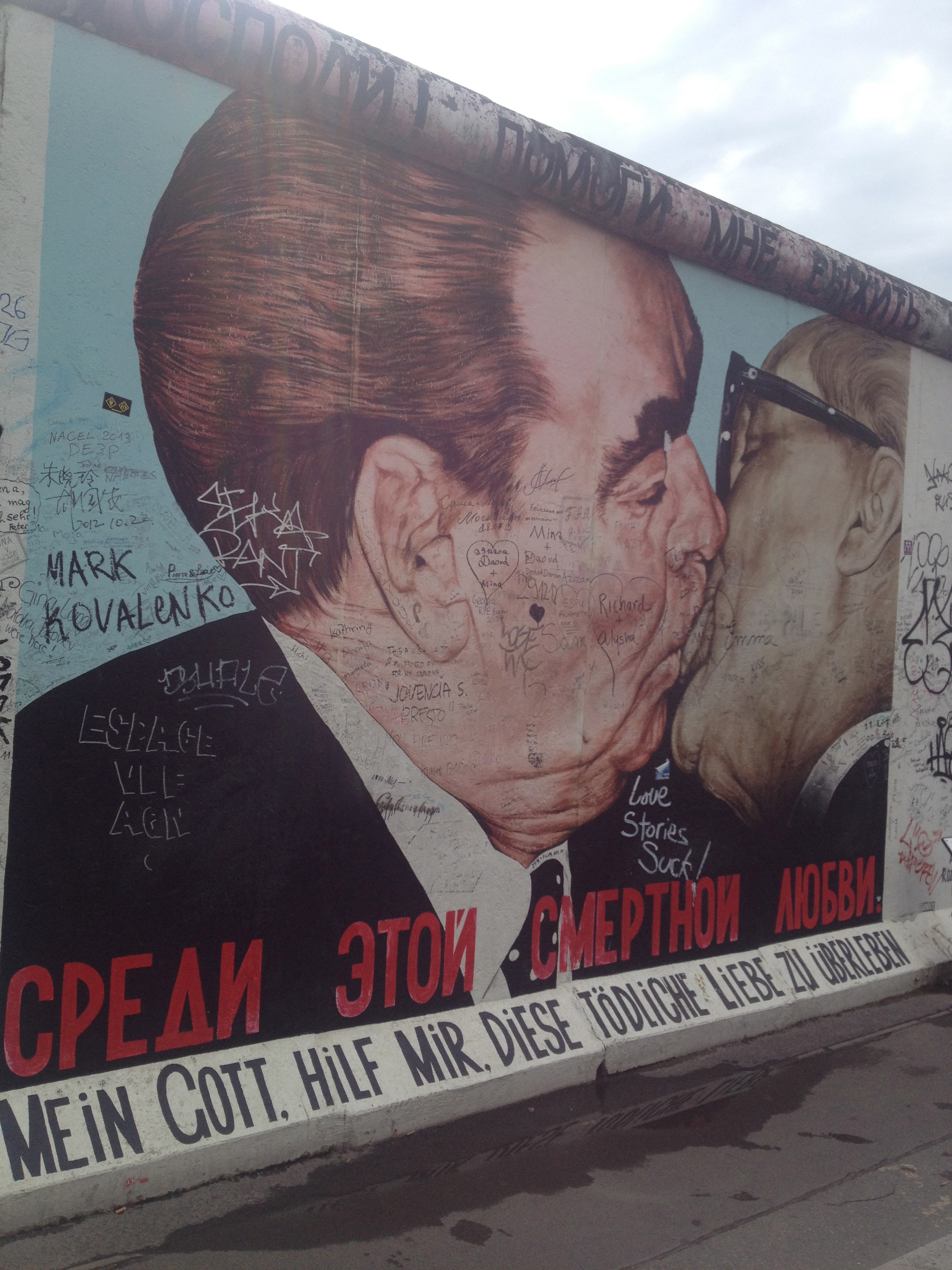
Ralf had to work during most of the week, so I had to find other things to do to amuse myself. I spent a lot of time just resting and hanging out, happy to have a place to myself while Ralf was out, but one of the major things to do in Berlin that I hadn’t gotten around to doing last time I was here was see the East Side Gallery, which is actually the painted and decorated remains of the Berlin Wall. I had only briefly seen it in the dark with Dane on our first attempt to get into Berghain, and I wanted to go back and really take it in. I have to say, I had seen to some pretty amazing art museums on my travels – famous notables include the Hermitage in St Petersburg, the Louvre, and the Vatican Museum – but I have to say that out of all of them it was the East Side Gallery that captivated me the most. The artworks are such a diverse collection, from detailed masterpieces to simple murals that could have been done by children to sections that looked more like elaborate graffiti more than anything else. In fact, despite it obviously not being allowed, many sections of the wall had been vandalised, but in a way I feel like it was almost some kind of artistic extension. The wall is part of a long history for Berlin and Germany, but the periodic graffiti that marks it almost gives the face of the wall itself a traceable history, a reflection of ideas presented in both an official and unofficial capacity.

Whether it was the graffiti or the actual murals, the thing I loved about the East Side Gallery is that there is such a strong and powerful meaning behind each and every word and image. With the wall itself long being a symbol of division and oppression, that’s hardly surprising, but I often found my slow stroll coming to a gradual halt just so I could stand there and look both ways, up and down the wall, and just take it all in. I have no idea what it would have been like here during war time – I couldn’t even begin to imagine – but for me these paintings scratched the surface of the emotions and impacts of the wall that inspired them. It was art and history seamlessly combined into one, and it gave me shivers to behold, something I can’t say for any of the other artworks I’d come across.

At the start of the East Side Gallery walk.

At the start of the East Side Gallery walk.

Beginning my walk down the wall.
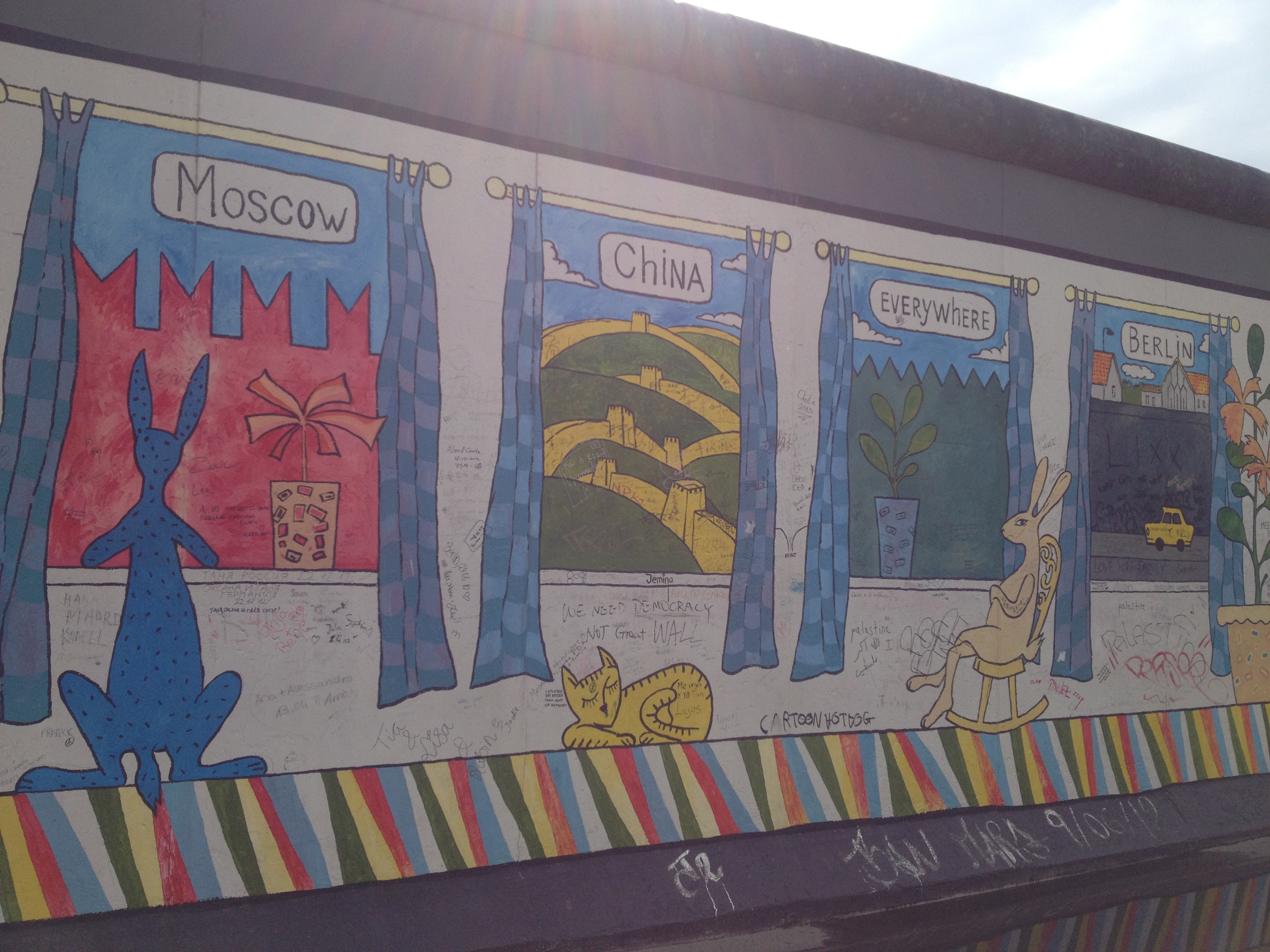
Beginning my walk down the wall.

I got excited because I'd been to all of these places - well, almost everywhere.

I got excited because I’d been to all of these places – well, almost everywhere.
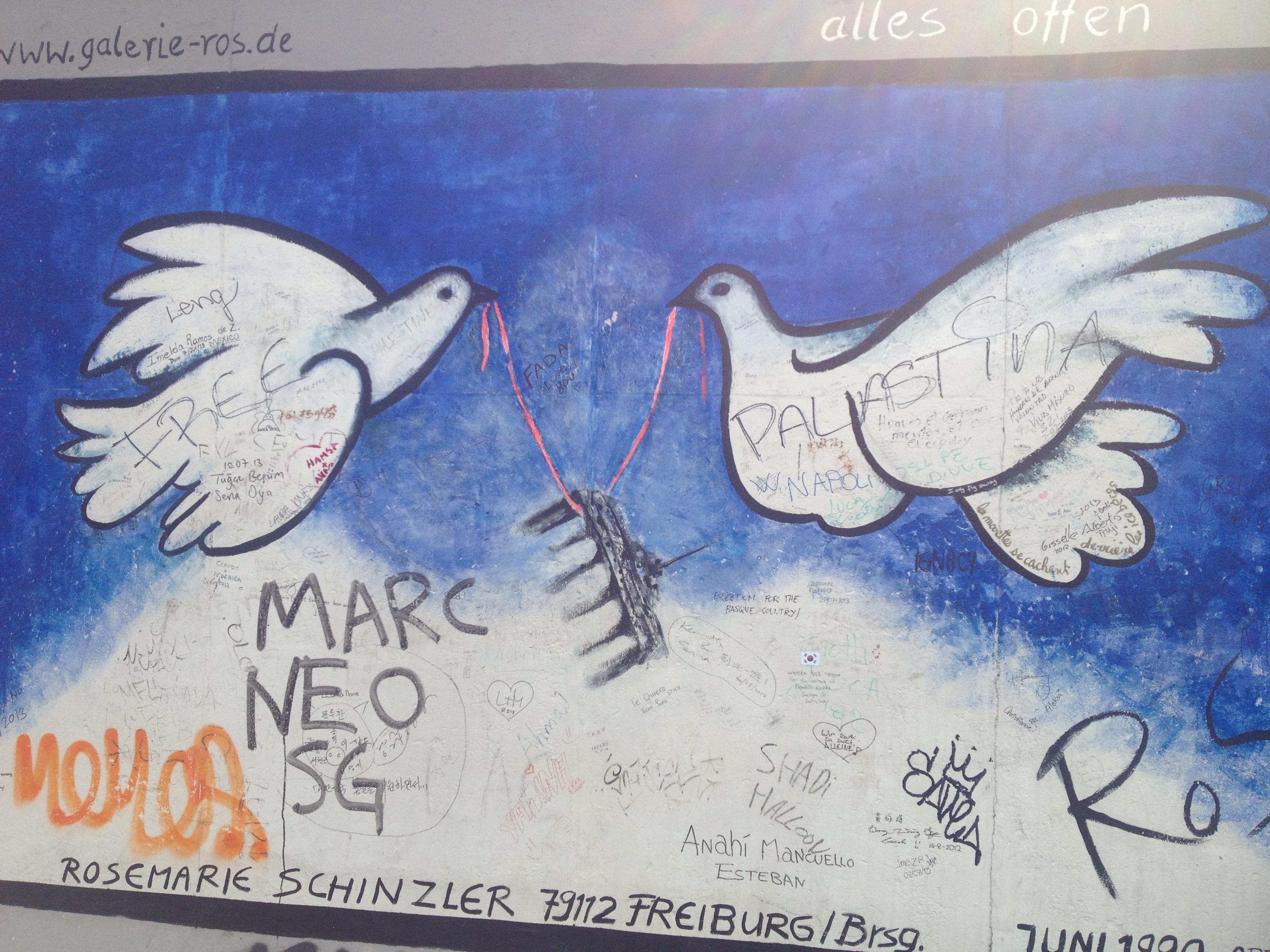
Doves carrying the Brandenburg Gate, an iconic symbol of Berlin.
Doves carrying the Brandenburg Gate, an iconic symbol of Berlin.

An image that doesn't need much explaining.

An image that doesn’t need much explaining.
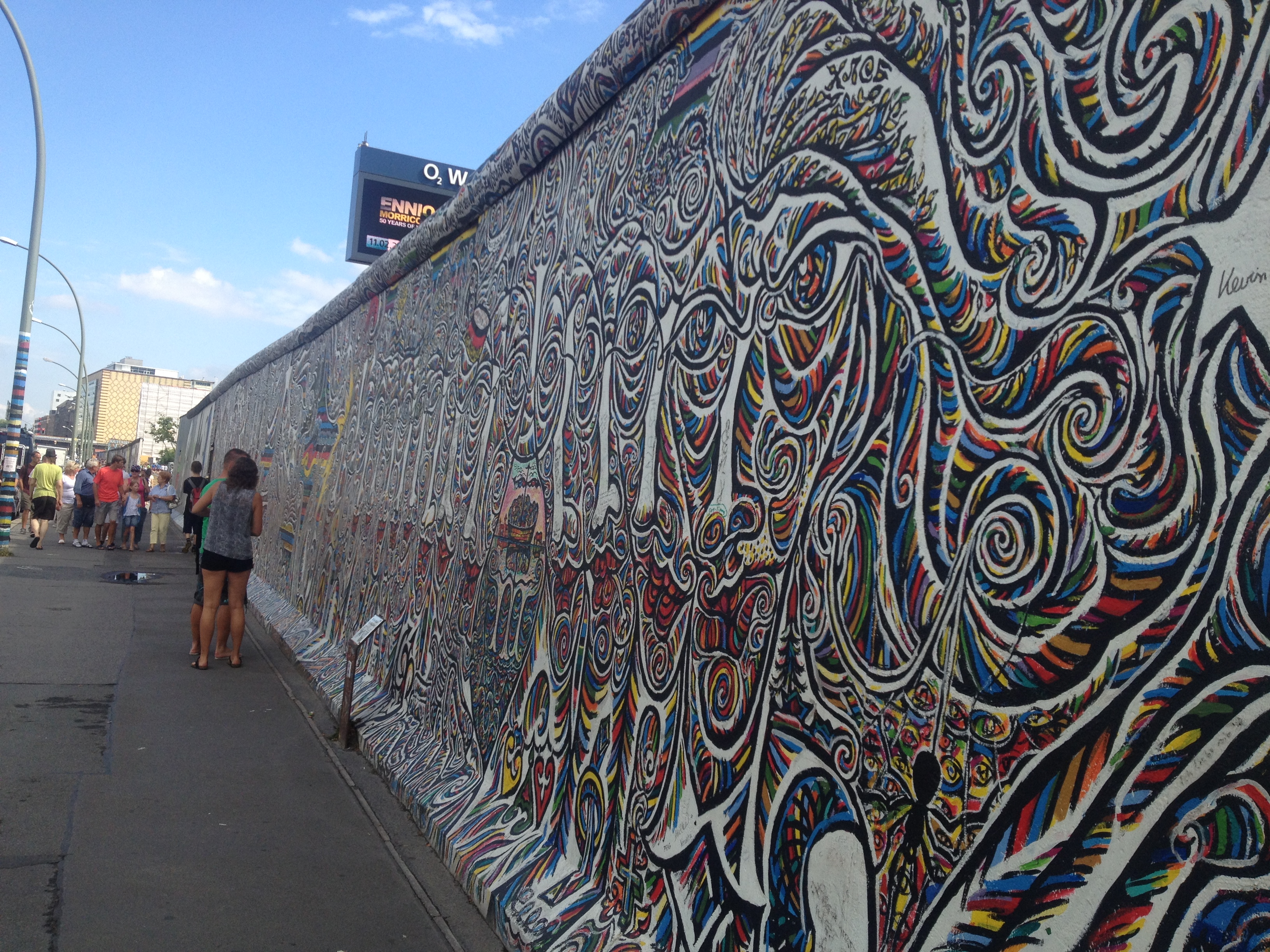
A beautiful and intricate rainbow piece.

A beautiful and intricate rainbow piece.

I loved this painting. So simple yet so powerful and suggestive.

I loved this painting. So simple yet so powerful and suggestive.

A colourful mural tainted by graffiti.

A colourful mural tainted by graffiti.

Even exchanges between graffiti like this I found fascinating, the ever changing face of the wall and the continuing history or perspectives.

Even exchanges between graffiti like this I found fascinating, the ever changing face of the wall and the continuing history or perspectives.

That’s not to say that all those artworks in the previous galleries didn’t have any meaning – there was plenty of beautiful and moving pieces in all of them. But there’s just something kind of sterile about the museum environment, where things are locked away behind glass cabinets, or sectioned off with velvet ropes. There’s a division between the viewer and the art, and it’s kept pristine and preserved in its slice of history. The East Side Gallery at the Berlin Wall had none of that – it was real, it was there in front of you. You could feel it with your hands, and it had moved forward and changed, developing its own history, for better or for worse. It’s not your conventional art gallery, but then I suppose I don’t really like conventional art galleries all that much. There were plenty of other ones I could have visited while I was in Berlin, but I had found such a sense of fulfilment after seeing the East Side Gallery that I really didn’t see the need.

***

It felt great to be back in Berlin, but there’s a danger in getting too familiar and thinking that you really know the city when you still have so much to learn. Previously in Berlin, I had only bought tickets for the U-Bahn about 50% of the time, rationalising it with the fact that you don’t need them to actually enter the trains or platforms, and I had never seen anyone ever checking for them. I had bought them the couple of times I’d travelled places with Ralf, because I wouldn’t be able to play ‘dumb tourist’ if I was hanging out with a local. But for the times I was out on my own, I took a chance and skipped the ticket machine on my way into the subway.

Never really expecting to have it happen, you can imagine my surprise when someone did come around inspecting tickets – of course, on my journey back from the East Side Gallery when I was not in possession of a ticket. I fumbled wildly through my backpack, triple checking my wallet for a ticket that I knew wasn’t there, trying to convince the plain clothed inspector that I had bought one, and I must have lost it somehow. He wasn’t buying any of it. “For not having a valid ticket you will have to purchase an increased fare ticket,” he explained to me, which essentially is a glossed over way of saying you’re going to get a fine. “It’s going to be €40. You can pay for it now, or you have two weeks to pay for it at one of our offices.” I stopped and thought for a second.
“I’ll pay for it later, thanks.” I was only going to be in Berlin for another 4 days, so I figured if I skipped town there was little they could do about it. The guy had already taken my Australian drivers licence to record my name and address, and he told me it would be in the system for two years. He gave me a pice of paper with the payment details and was on his way again. I hadn’t given them my passport, which I feared might have caused migration problems, but he did have my address in Australia. “I’m not going to pay it though. There’s no need, right?” I had said in a discussion with Ralf. “It’s not like they’re going to send me a fine to the other side of the world.”

Fast forward a few months to me sitting on the couch, finally in the United States, with my new friend Mike in Washington, DC. As we were drinking red wine and watching The Walking Dead on Netflix, my phone vibrated. It was an email from my mother with the subject line: “The Germans are after you!”
Yo Bob, got a bunch of what appear to be angry German letters from your letterbox today. Something about not having a ticket. Care to explain?
Well I’ll be damned – I certainly got a schooling in German efficiency. They sold the debt on to debt collectors who had also sent me letters. I have to admire their tenacity, as I had never really expected them to send a single letter, let alone a few. In hindsight, it was a reckless disregard for another countries rules and I do feel a little bad about the whole thing now – though not bad enough to pay the fine, which to this day I still haven’t done. But I did learn a lesson from the whole ordeal – from that day on, no matter what country I was in, I made sure I always bought tickets for the public transport. 
Language Barriers and Being Monolingual in Europe

“So what languages do you speak?” was one thing that a lot of people asked me when I was preparing for my trip. There was also a pretty unanimous expression of shock on the faces of everyone who asked when I replied with, “Other than English, none.” The Asian languages in particular would have been a bit of a challenge that would require a mindful application I just didn’t have, but what of the other languages that use the same Latin symbols and letters? I made a rather naive excuse for it, saying “I’m going to be going to so many countries, there’s no way I could learn the languages of every single one of them!” It sounds lazy, I know, but it was the truth – I was rarely in a country for more than a week, and never exactly knowing where I was going to end up next, so never knowing which language I should prioritise in learning. Because they all had their own languages that were dominant, with no major common lingual factor except – yep, you guessed it – English, in one form or another.

But the honest truth is that I never went into the trek around Europe expecting the world to cater to what was probably my biggest touristic flaw. I was expecting to have a much more difficult time as a monolingual than I did, and the ease with which I actually did around is a surprise for which I am quite grateful. I often found myself playing charades or using broken English in the most obscure or random places, only to be told, “It’s okay sir, I do speak English.” It was slightly humiliating, but it was the one thing I couldn’t escape or distance myself from, or make any immediate move to change that would be directly helpful – by the time I learnt the basics of any language it would be time to move on to the next country! Still, it wasn’t always smooth sailing, and Europe provided me with more than a handful of awkward and memorable linguistic experiences.

***

The Russian and Mongolian languages and their Cyrillic alphabet did inspire a bit of my fascination with other languages, but for the most part, everyone in Russia and Mongolia spoke Russian or Mongolian, and not much else. It was when I got to Finland that the concept of widespread multilingualism really hit me. I watched on, slightly intimidated, as Susanna’s Finnish friends seamlessly moved between Finnish, Swedish – the countries two official languages – and English, which everyone just seems to know anyway despite it not being an official language. Scandinavia and northern Europe were like that, I was told from the beginning – almost everyone learns English in school, so I should have no problems. Yet I was still exposed to what felt like at least three different languages in each country. It actually made me feel a little less intelligent, to see small children yapping away in a foreign language and switch over to what was an impressive command of rudimentary English, especially for a 5 year old, and back again as though it was nothing. In an attempt to make more excuses, I told myself it was the geography and logistics of Europe than lent its residents to learning so many languages. They have many neighbours in close, bordering proximity, with everyday practical uses for the languages they were learning, and a constant need to practice them. How often were my Year 7 French lessons going to come in handy in the middle of Sydney?

Although I shouldn’t speak so soon – the country where I did encounter my first language barrier was, of course, France.
“The French are so arrogant – they’ll understand English, and know you don’t speak French, but they’ll pretend they don’t know what you’re saying because they think it’s beneath them to speak your language in their country.” That was the general idea a lot of people had told me to expect in France, particularly Paris, but I’m so pleased to say that it was not my experience at all. A lot of the guys I was with for Parisian Pride spoke amongst themselves in French, but when they addressed me they always spoke in English, or at least to the best of their abilities. Which was more than I was doing for them, considering I was in their country, so I feeling nothing but gratitude towards the Parisians I encountered. Well, perhaps a little more than gratitude… whatever language they spoke, Parisian men were still Parisian men.

However, during my frantic last morning at the hostel in Paris, packing before my 12pm check-out time, I was accosted by one of the housekeeping staff. She seemed a little flustered when she entered the room and saw me doubled over my backpack, trying to shove everything inside as quickly as I could. I probably looked like a deer in the headlights too, and we both just stared at each other for a few seconds. Then she started speaking to me in French.
“Oh… ah… sorry. I don’t speak French,” I said sheepishly. However, she continued motioning to my bed and speaking to me in the foreign tongue.
“Ahh… Check out is at noon? I still have fifteen minutes?” I said, pointing to the clock. She said something else in French, with some emphatic hand gestures, and stared earnestly at me.
“Ahh… I don’t speak French,” I muttered, before trying again. “I’m about to leave, I’m just packing my things now.” I was mortified to realise I had begun raising my voice, as though the housekeeper might suddenly start to understand English if I said what I was saying loud enough. She just looked and me and said something else in French. We both just stared at each other. It was pointless: neither of us had the slightest clue what the other one was saying, and we weren’t talking to each other anymore – we were talking at each other, and it was achieving nothing except frustrating the hell out of us. In the end she just shrugged her shoulders and left the room, in what I can only assume was a non-verbal cue for “Hurry up and pack your things and get the hell out!”

***

Given that northern Europe was better known for the English skills of its residents, it’s no surprise that Spain was the next country to present me with a language barrier, although this time it was an entirely different situation. I learnt a fair bit of Spanish before a trip I took to Costa Rica a couple of years ago, and even studied it for a semester at university afterwards. Despite all that, the only phrases I had mastered allowed me to tell people I speak Spanish, just not very well, and to order a beer – priorities, right? It wasn’t much, and it really wasn’t enough when I tried to make conversation after locking lips with a guy on the dance floor at a nightclub in Madrid. He spoke about as much English as I did Spanish, or even less, so I basically had to stand there with a blank stare until he finally said something that I even half recognised. Not that he was saying much, other than “guapo“, between our kisses, though. I guess there are some situations where body language really does suffice.

Yet the country does have some other linguistic tensions that are a little bit more important than a Spanish one night stand. When I was in Barcelona I thought my Spanish was just exceptionally poor, but it turns out that in the region of Catalonia, almost everything is written in Catalan, and a lot of the locals get annoyed when you ignorantly launch into speaking to them in Spanish, regardless of your fluency. It meant little and less for me, someone who could hardly speak either, but for a Spanish speaker like Rich it was quite frustrating. But probably not as frustrating as it was to all the local Catalonians who everyone just assumes speak Spanish. I was able to discreetly bow out of that internal national conflict, as my reliance on English wasn’t as likely to offend anyone as much as it would just make them think I was an ignorant tourist.

The way I was able to explore Europe despite only knowing one language does give you an idea of the kind of power that fluency in English can offer you. Some people even find the language rather intimidating. I remember talking about it with Ike when I was staying with him in Ancona. Ike is half Dutch, so he spoke English and Italian as well as a bit of Dutch, but he told me of his own interesting experiences with language in Spain.
“It’s interesting – people are almost afraid of speaking English incorrectly, especially a lot of younger guys”, he mused as I told him my own experiences in Madrid. “I mean, they won’t get better if they don’t practice, but they don’t want to speak it if they can’t speak it perfectly. It doesn’t really make sense. A lot of the guys, they would rather try and speak to me in Italian.” He had a good chuckle remember thing that. “And… I mean, they don’t even know Italian. There’s some small similarities between Spanish and Italian… but, you know, not enough. They’re rather speak to me in terrible Italian than use slightly imperfect English.” It was something that I never came across – most likely because English was the only option they really had when talking to me – and it’s something I still haven’t been able to really explain.

***

Spain and Catalonia aren’t the only regions to have geo-lingusitic tensions. On my first night in Vienna with Kathi, she had explained to me some of the differences between the dialects of German that are spoken in Austria and Germany. “It’s mostly the same, but there are some different words for things that we have that the Germans don’t.” The more she explained it, the more I realised it was much the same as differences between American English and British English and even Australian English. At first it doesn’t seem like much, but you when you think about the different meanings we assign to different words – the use of “thongs” springs to mind – you understand just how much confusion there can be with these slight differences within the language. “It’s also frustrating when we go to Germany,” Kathi continued, “because most of the people in Austria take the time to learn some of the differences in the German they speak in Germany, but not many Germans do they same when they come to Austria.” She sighed and rolled her eyes. “It’s like they think they’re the ones who speak real German.” I couldn’t help but giggle to myself a little. It was interesting to see that such little problems could be, quite literally, the same in any language.

Yet there were other times when the different language posed absolutely no problems at all, and appeared to exist side by side with the greatest ease. When I arrived in Prague and was sitting down in Tomas and Matej’s kitchen eating the dinner they made me, the two often had short, lively exchanges in another language. When I asked Tomas what language they were speaking, Tomas seemed like he had to pause and think about it for a minute. “Well… I am speaking Czech, and Matej is speaking Slovak.” Tomas was originally from the Czech Republic, while Matej was a native of the neighbouring Slovakia.
“So… the languages are the same?” It was confusing, and seemed like literally the opposite of the kind of thing that Kathi had been talking about with the German language – instead of one language that everyone had trouble understanding, this seemed to be two languages operating like one.
“No, not the same,” Tomas said, thinking more. “They’re just… similar. I can speak Czech, and understand Slovak. Matej can speak Slovak, so we can just speak either.” He shrugged, not thinking much of it, but I found the concept rather mind-blowing: that you could speak in one language and listen to someone else speak in another. It was almost more than my poor little monolingual brain could handle. Considering they both used to be part of Czechoslovakia, I can only assume that the languages must be very similar, but even still, I was slightly amazed.

While I was impressed with the way the two languages operated so smoothly in sync, Prague was probably the least English-friendly city that I visited in the whole of Europe. Buying a bus ticket in the corner store proved to be a bit of a mission – Tomas had been having a cigarette outside, but I had to call him in to help me when I realised the woman behind the counter didn’t speak a lick of English. After that, I just had to hang on to my old tickets to show her the one I wanted whenever I went to buy a new one. There was enough English to get by in the main touristic parts of town, but I was lucky I usually had Matej or Tomas around whenever I was in the more obscure parts of town, because something tells me I wouldn’t have fared so well there as I had in the rest of Europe. Even sitting down to chat with their neighbours in their award-winning backyard was a bit of a challenge – out of all the places I’d visited, Prague was the city where learning to speak English hardly seemed like a priority at all. Tomas had only learnt it because he had lived in San Francisco several years ago, but he was definitely in a minority of those who did speak English.

***

I am so lucky that the one language that I do speak afforded me so much opportunity to travel relatively unhindered, but the more I saw of the world, the more my status as a monolingual felt like a handicap. I was insanely jealous as I watched people slip between different tongues so easily – I knew they weren’t saying anything specifically more profound than anything that could have been said in English, but it just felt like there was a wealth of knowledge that I was missing out on. Living in a country like Australia, with no countries with direct borders and no extremely obvious choices of a language to learn that might be useful in your own city, I’d never really considered that learning another language would be such a beneficial skill. Now, after travelling around so many different countries and discovering the complexities of a range and huge variety of languages, it’s become another one of my goals to learn, practice, and eventually become fluent in another language. Which language – for now – is undecided, but I have to thank the many companions and friends I made along the way in Europe for inspiring me, and opening my eyes to the importance of languages, and the highly valuable skill of multilingualism.

Czech It Out

After saying goodbye to Itzel and alighting at Praha-hlavní nádraží, the main train station of Prague, I set out to navigate the public transport system of the capital of the Czech Republic. It was so close to 5 o’clock by the time I arrived in Prague that I didn’t even have to wait around at all – another perk of my detour was that I had done all my waiting either on the train, or in Bratislava. But first I did have to withdraw some crowns, the local currency, and then find somewhere to spend the large value notes in order to get change when I realised none of the metro ticket machines would accept them. There was also the strange requirement that I had to buy an extension for my luggage on top of my regular ticket, presumably because it would take up more room that could potentially fit another passenger. There was also a similar ticket for taking dogs on the metro, but in the end I had to forgo this extension and just buy a regular ticket simply because I didn’t have enough change to get the right one that I needed. “They rarely check for tickets on the metro in Prague,” Itzel had told me. “But they’re not really that expensive either, so you might as well buy it.” I did the best I could with what I had, and hoped that I could bluff my way out of any encountered trouble with excuses of being a tourist.

I followed the directions that my hosts had given me, though it was still very confusing. There were so many buses going on different routes and in different directions that all left from the same stop, and there was an uncomfortably lack of anyone who spoke English to help me out. But I persevered, and in the end I caught the right bus and followed the little blue dot on my iPhone GPS until I finally made it to my new home. Tomas and his boyfriend Matej’s house was right near the bus stop, and thankfully they were home by the time I finally arrived. Tomas had told me that I would be the first guest that the couple had hosted via Couchsurfing. I’m not sure if they were excited or nervous, but they warmly welcomed me into their home, a gorgeous little flat in a beautiful part of town. They had made me some dinner, too – I couldn’t tell you exactly what it was, but it was a homemade meat dish with some vegetables and it was a traditional Czech recipe and it was absolutely delicious – just what I had needed after a long day of travelling. I also noticed the distinct use of dill in the cooking, and I smiled to myself and remembered my time in Russia, and in my head I could still hear Marti saying “Isn’t this dill-icious?” I guess that’s how I knew I was back in Eastern Europe. We sat around their kitchen for a little while, chatting and getting to know each other, and then Tomas asked if I felt like going out and seeing some of the city. After a day of doing nothing but watch the Eastern European countryside pass me by, I was keen to get out and about, so I showered and got changed and the three of us headed back into the city centre.

***

Tomas was probably one of the best hosts I could have asked for during my stay in Prague – he was incredibly knowledgeable of his city, and was always pointing out the smallest and most random things, yet had some interesting story or weird fact about each and every thing. Some things were history lessons, while others were more modern facts, or even urban street smart tips. “Don’t come here at night, it’s a little dangerous,” he had said as we passed a park area on the bus. “There are drugs. Drug dealing, things like that.” Then he shrugged his shoulders with a smile. “Unless you are looking for that kind of thing.” Our first stop that evening was down by the river, where there was some kind of small outdoor performance on, with a band playing live music and a temporary bar set up selling some local Czech beer. Tomas bought us a few beers and we listened to the music and talked more about Prague, and my previous and future travels. Most of my European hosts seemed a lot more interested about Australia though – I’d been gone for so long that even I started to forget that I was actually a foreigner from half a world away. Out on the water, the river was filled with paddle boats, some of them in the shape of swans, slowly gliding along in the warm afternoon sunlight. The further north I travelled, the longer the daylight hours were becoming, and I loved it.

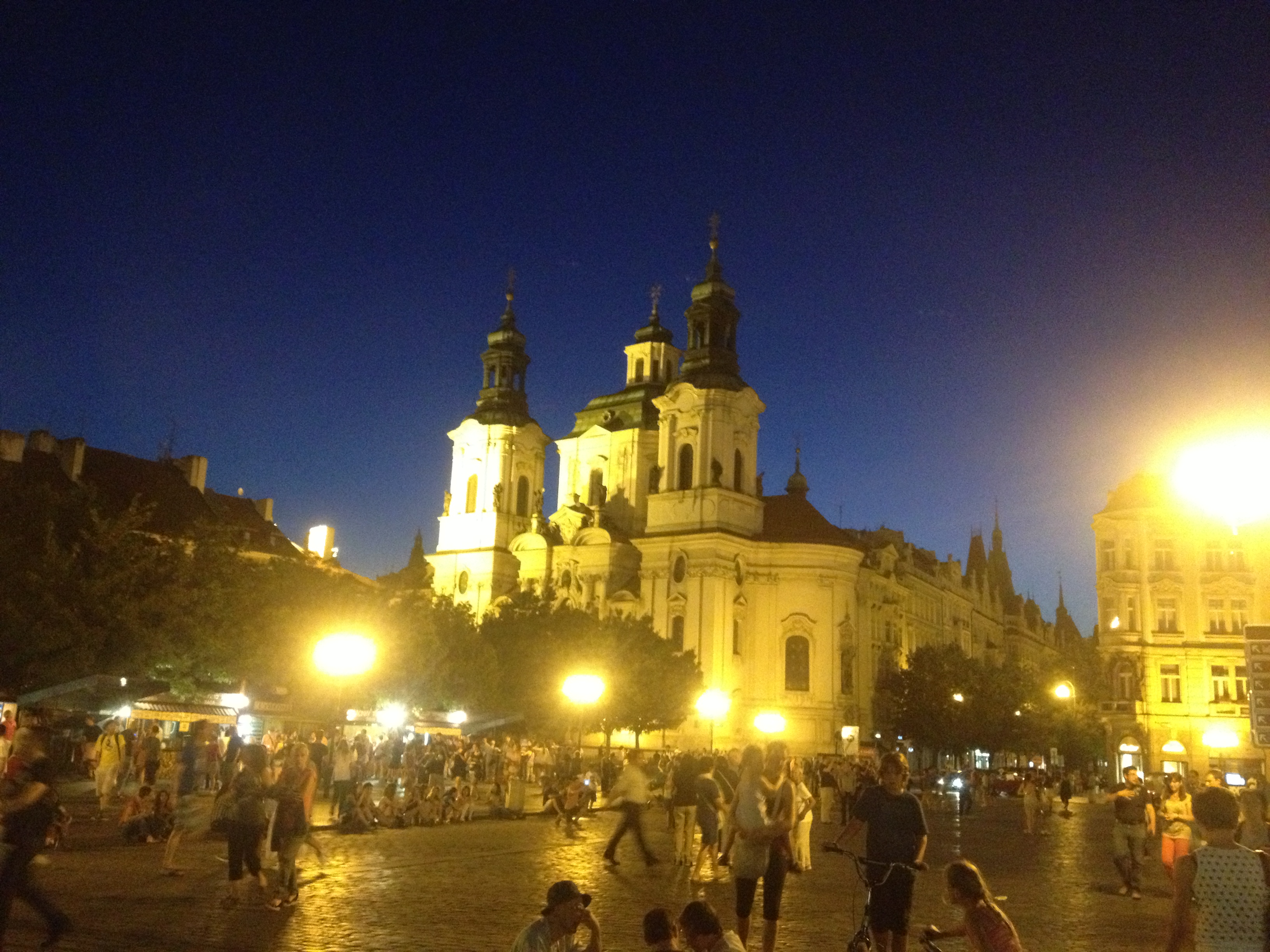
From there we walked back along the river, Tomas pointing out different architectural features of different buildings until we finally wandered up to the Old Town historical centre. Where the riverside pop-up bar had been a more underground affair, I could tell that we had wandered into the prime tourist zone of Prague as soon as we arrive. It was a beautiful area though, with the main square surrounded by small Gothic churches and cathedrals. I say ‘small’ in comparison to some of the larger churches I’d seen in Madrid and Rome, but they did manage to tower above the cobblestone pavements of Staroměstské náměstí, letting the small city hold its own and even stand out as one of the more beautiful places I had visited so far. The other major feature of the Old Town Square was the Old Town Hall, or more specifically, the astronomical clock on the bell tower. “It’s very popular with tourists,” Matej said, indicating the throng of people that was amassing at the base of the tower.
“Yes, every hour there is this… show… display…” At first it just seemed like Tomas couldn’t find the right word in English to explain what he was trying to say, but later I would realise he was just uncomfortable at using any of those words to even try and explain what we were about to witness.

St Nicholas Church, eerily illuminated by the lights of Old Town Square.

St Nicholas Church, eerily illuminated by the lights of Old Town Square.

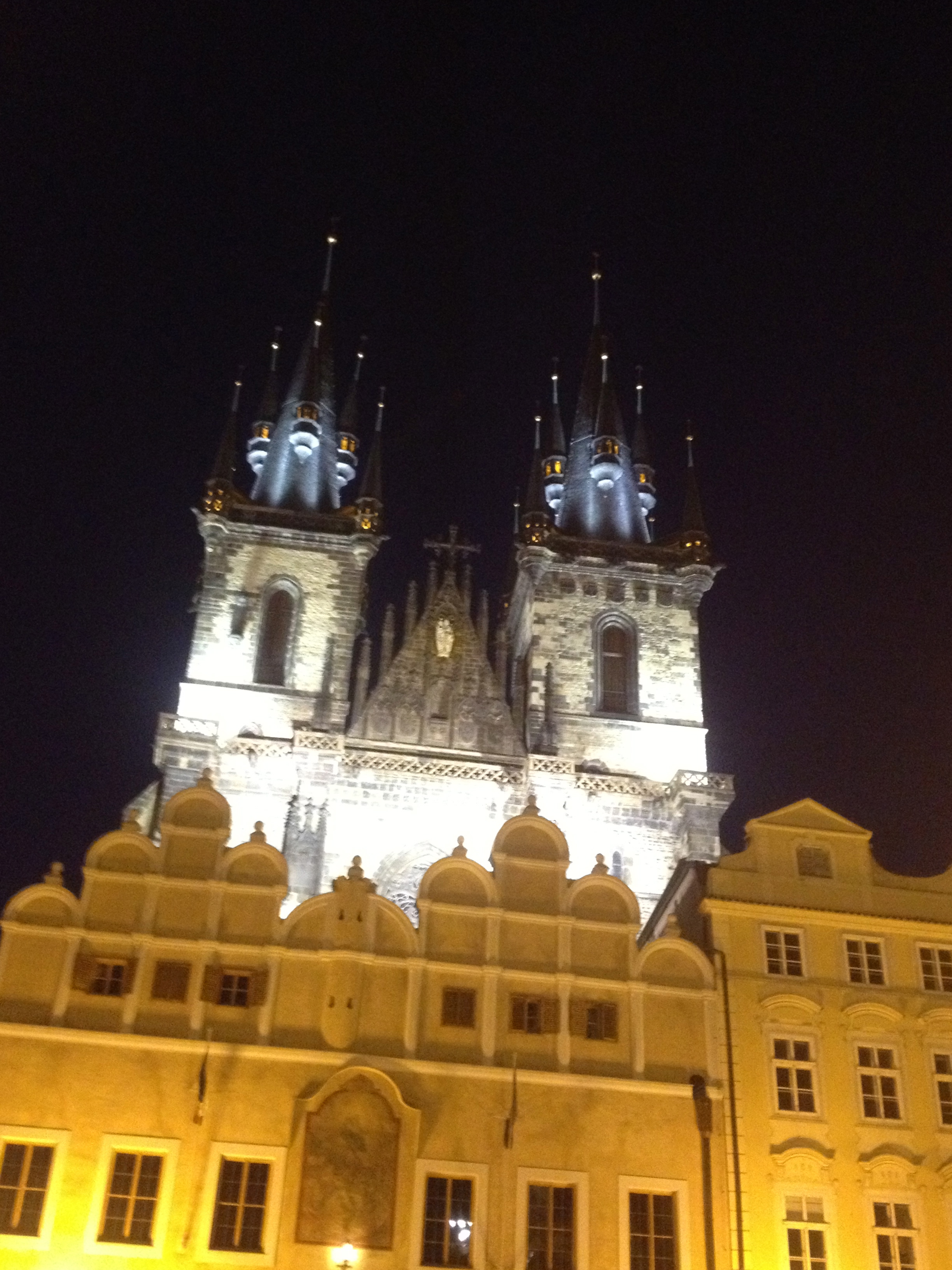
The twin steeples of the Týn Church, built in 1365.

The twin steeples of the Týn Church, built in 1365.

The clock tower of the Old Town Hall as seen at night.

The clock tower of the Old Town Hall as seen at night.

The bell tower performance isn’t technically a tourist trap in that it doesn’t really cost any money. Yet still, I couldn’t help but feel a little ripped off after watching it. It’s an extremely famous and popular sight to witness, and the flocks of people surrounding the bell tower had definitely peaked my curiosity. Matej and Tomas must have been rolling their eyes as I stood on my tip-toes to peer over the crowd, but they knew it was something I would have to witness and judge for myself. When the hour rolled around, the chimes began to echo through the square, and little wooden doors opened up from the clock, and out came a small procession of figurines, which Tomas would later inform me were supposed to be a parade of the apostles. Above them, a skeleton emerged to ring a small bell, which clanged out over the crowd. Flashed from hundreds of cameras went off, and I waited eagerly to see what else would happen… The apostles did their loop and went back inside, and the skeleton eventually finished ringing his bell and retired back into the clock. There was a small cheer from the crowd in front of me.

“That… wait, that was it? Everyone stood around waiting for that?” Don’t get me wrong, it was a cute display, and more than most clocks manage to do to entertain a crowd. But I just couldn’t believe that that was all it took to attract such an audience. Tomas and Matej both chuckled, having clearly anticipated my reaction. “It’s a tourist thing,” they both said. “You had to see it at least once.” As fate would have it, I ended up in the same part of town the following afternoon and purely by chance, I happened to be there on the hour. During the daylight hours it was easier to take some clearer photos, although I can’t say they’re that much more exciting than being there to witness the show first hand… which isn’t saying much.

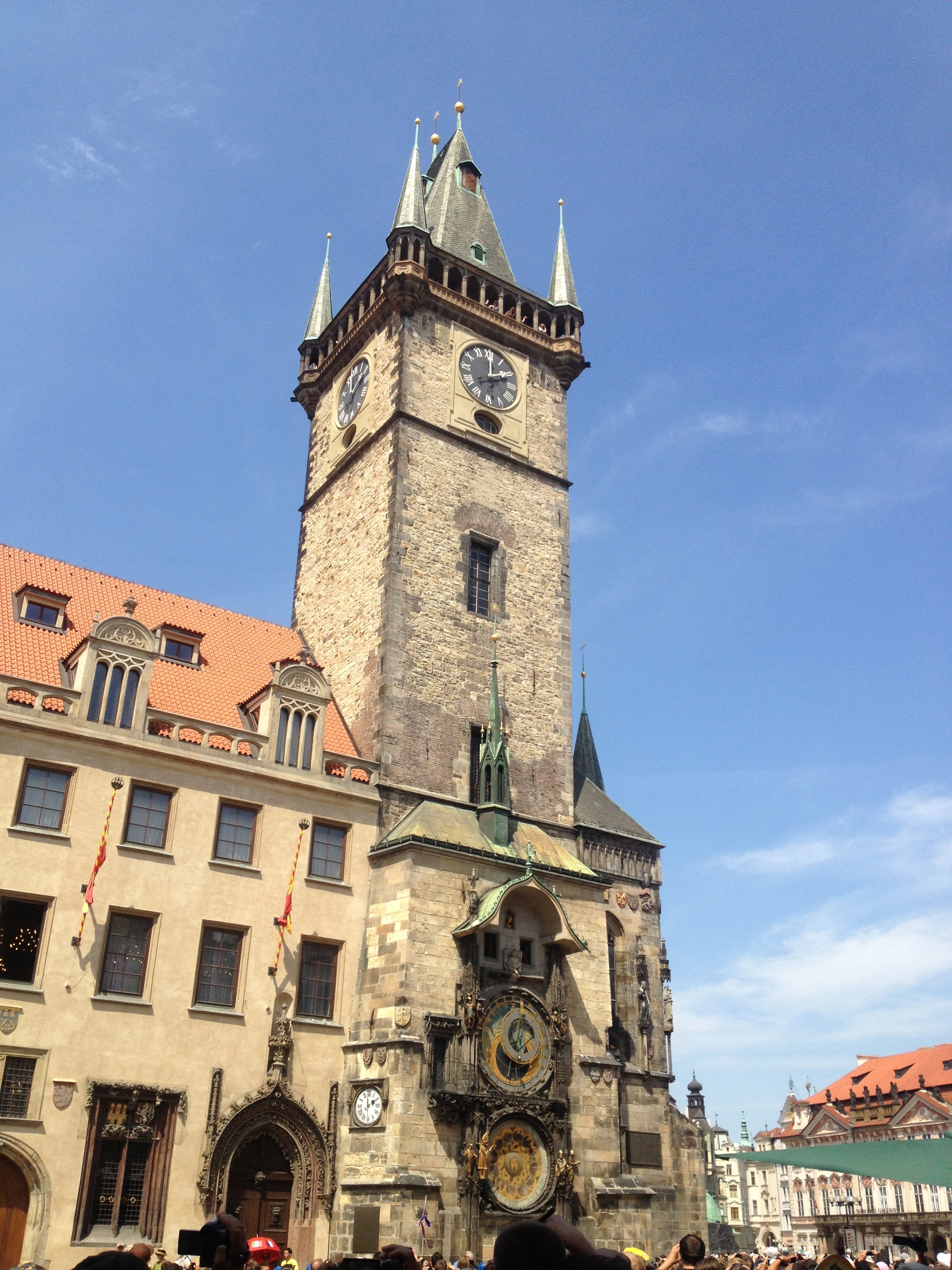
The Old Town Hall tower in the light of day, with the astronomical clock at the bottom.

The Old Town Hall tower in the light of day, with the astronomical clock at the bottom.

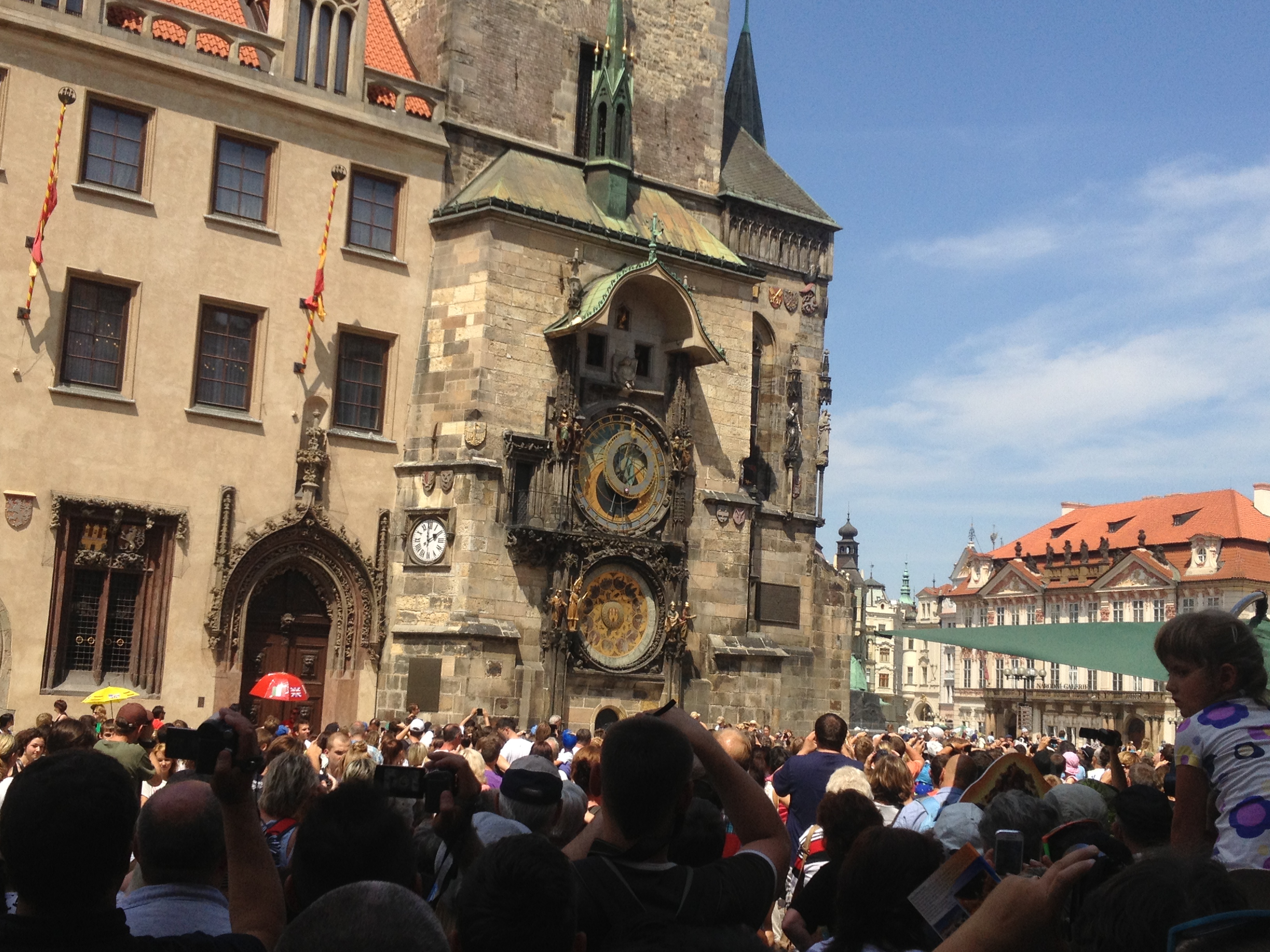
The crowds gathering around the astronomical clock to watch the rather anti-climactic performance.

The crowds gathering around the astronomical clock to watch the rather anti-climactic performance.

After that we wandered through some more of the town, exploring the old streets as I marvelled at the simple, intrinsic beauty of the place. Prague really did feel like a kingdom from a storybook, complete with a castle on the hill across the river, gazing down over the city. The three of us stopped by another one of the couples favourite bars on the way home, where we had a few more beers while Tomas told me more about Prague, while also interrogating me about my own journey and travels. They were both such sweet and lovely guys – I was starting to wonder when my luck at finding such nice hosts was going to run out. The two of them both had to work in the morning though, so we eventually stumbled back down the street to crash, and I would continue my exploring of the fairytale city on the morrow.

Detour: Bratislava

For a trip that should only have taken approximately three hours, I spent a ridiculously long time getting to Prague from Vienna, but there were many factors I had to consider when planning out my day. The first was that Kathi and Anna-Greta would both be leaving before 9 o’clock in the morning, which meant that I would also have to leave at that time, since I would definitely need to be on a train out of Vienna before either of them finished work. Kathi was catching a tram in the same direction as myself – towards the train station – on her way to work, so when my stop finally came we said our warm, slightly emotional goodbyes, and promised that we would definitely see each other at some point in the future. She been a great girl and had been a lovely host, and I knew I had made the right decision in coming to Vienna and staying with her.

I had my next Couchsurfing hosts lined up for that evening in Prague – however, Tomas had informed me that no one would be home before 5 o’clock, so if I arrived in Prague before then I would have to look after myself until that time came. No big deal, I thought to myself. There was always pretty elementary things to take care of when arriving in a new city or country – for example, the Czech Republic’s currency was Czech crowns, or koruna, not the Euro, so I would have to exchange or withdraw some new money. There was also the possibility that trains would run late, so a three hour journey was still only a very approximate guess.

***

The trains were not running late. Neither was I. However, the train station that I was departing from was not that same one that I had arrived in, and the layout of this new one was very confusing. There was English translations for pretty much everything, but it didn’t help me run any fast when I realised I had made a wrong turn and had three flights of stairs to run up with all my baggage to even make it to the entrance of the platform that I was supposed to be on. I made it just in time… to watch the train I had intended to catch slide out of the platform and down the tracks into the distance. Luckily for me, I hadn’t reserved a place on the train, so there was no financial harm done in missing it. It just meant I had to wait a lot longer at the train station for the next train heading to Prague.

Or did I? I pulled out my iPhone and opened the Eurail app I had downloaded, which has listing of all the train stations on the Europeans rail network, as well as all the different times the trains run. It had saved me before when I was stranded in Hamburg, telling me exactly what trains I needed to catch in order to make to Groningen that same evening, and now it was giving me another piece of alternative advice. I could wait for a few hours at this platform, for the next direct train to Prague, or I could take a detour. There is a regular route from Budapest in Hungary to Berlin, and Prague is one of the stops along the way. That train doesn’t pass through Vienna, but if I jumped on a different train I would be in Bratislava – the capital of Slovakia – in just under an hour, and would be able to intercept the train there. That was the beauty of the flexible Eurail pass I was using – I could catch as many of these unreserved trains as I liked in one day, and it would not cost me any extra as it would have to catch the single train to Prague. And, I got to visit another country and city along the way! All aboard for Eastern Europe!

***

On the train ride to Bratislava, I looked up the city on my Lonely Planet book. “Bratislava was pretty fun,” Rachel had told me during the brief period we had hung out in Madrid, “but you only need a couple of hours to see the main centre, really. Talon and my brothers and I were there at like, four in the morning, I think?” She’d laughed, shaking her head at the stories she was reliving. “It was ridiculous, but it was fun. Check it out if you get the chance.”

Despite having an entire day to get from Vienna to Prague, I didn’t have a couple of hours to spend in Bratislava – then entire length of my layover was about 45 minutes. Even so, that didn’t stop me from running out of the train station and down to the nearest main road to take a few photos as evidence that I had made it this far east. I still had all my luggage strapped to me, so it wasn’t as easy as you may think. Unfortunately, the train station isn’t that close to the historical centre, where all the more beautiful architecture can be found. I didn’t want to venture out into an unfamiliar city where I didn’t speak the language and had a deadline to return to – I didn’t want to miss another train – so I settled for taking photos of some street signs, whatever buildings I could see, and the front of the train station.

Welcome to Bratislava!

Welcome to Bratislava!

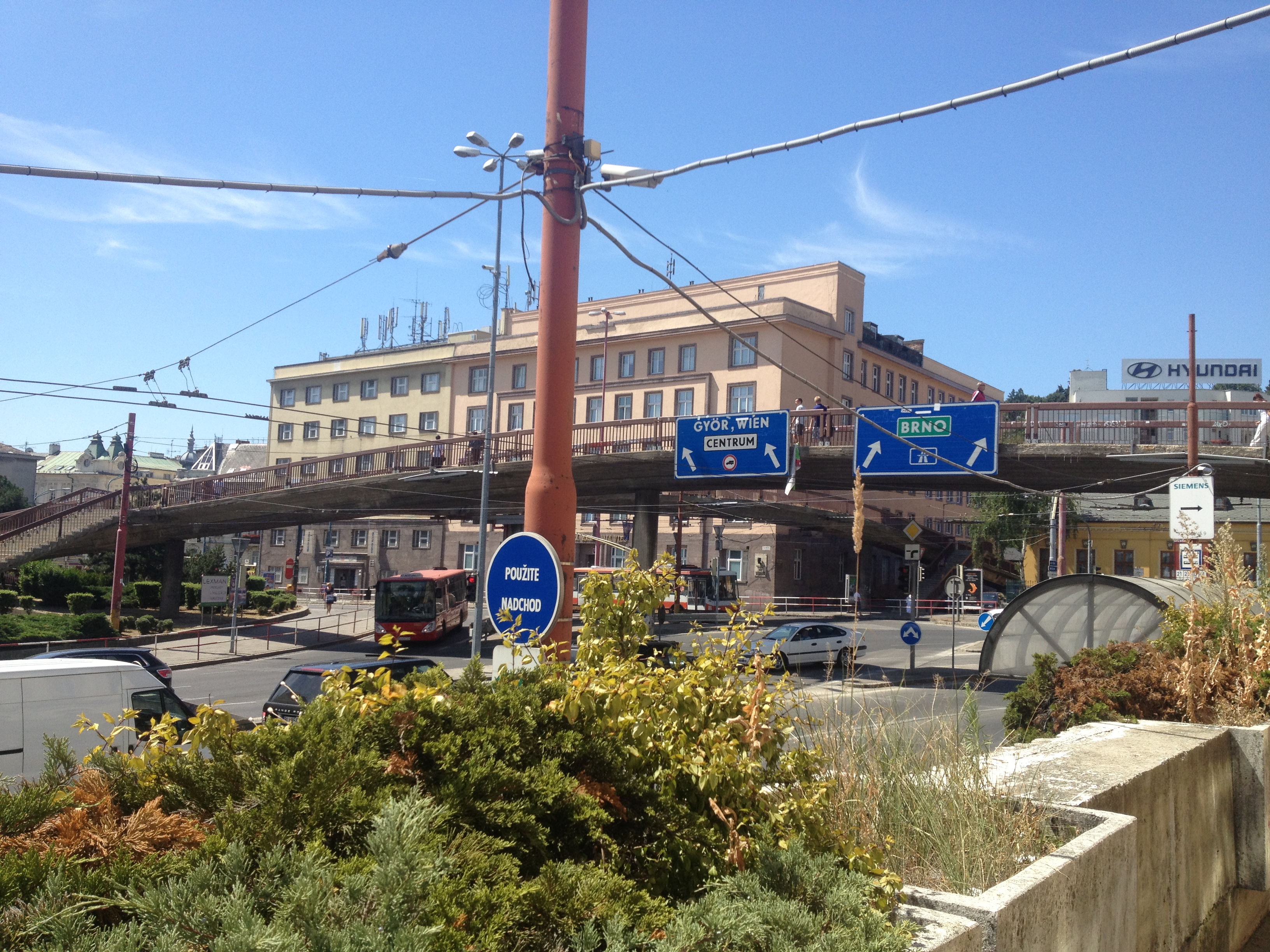
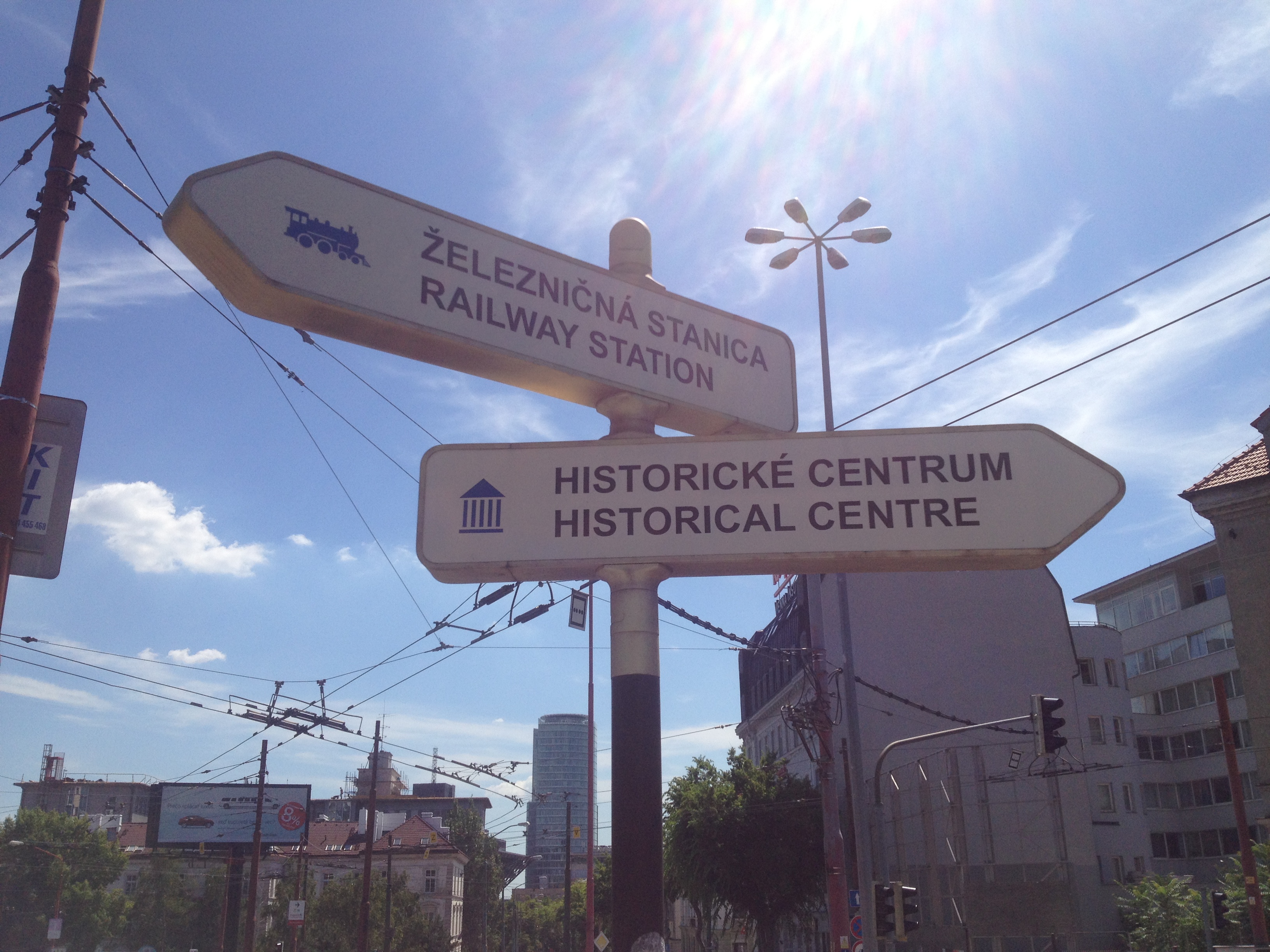
Sign pointing me towards the Historical Centre that I was unable to get to.

Sign pointing me towards the Historical Centre that I was unable to get to.

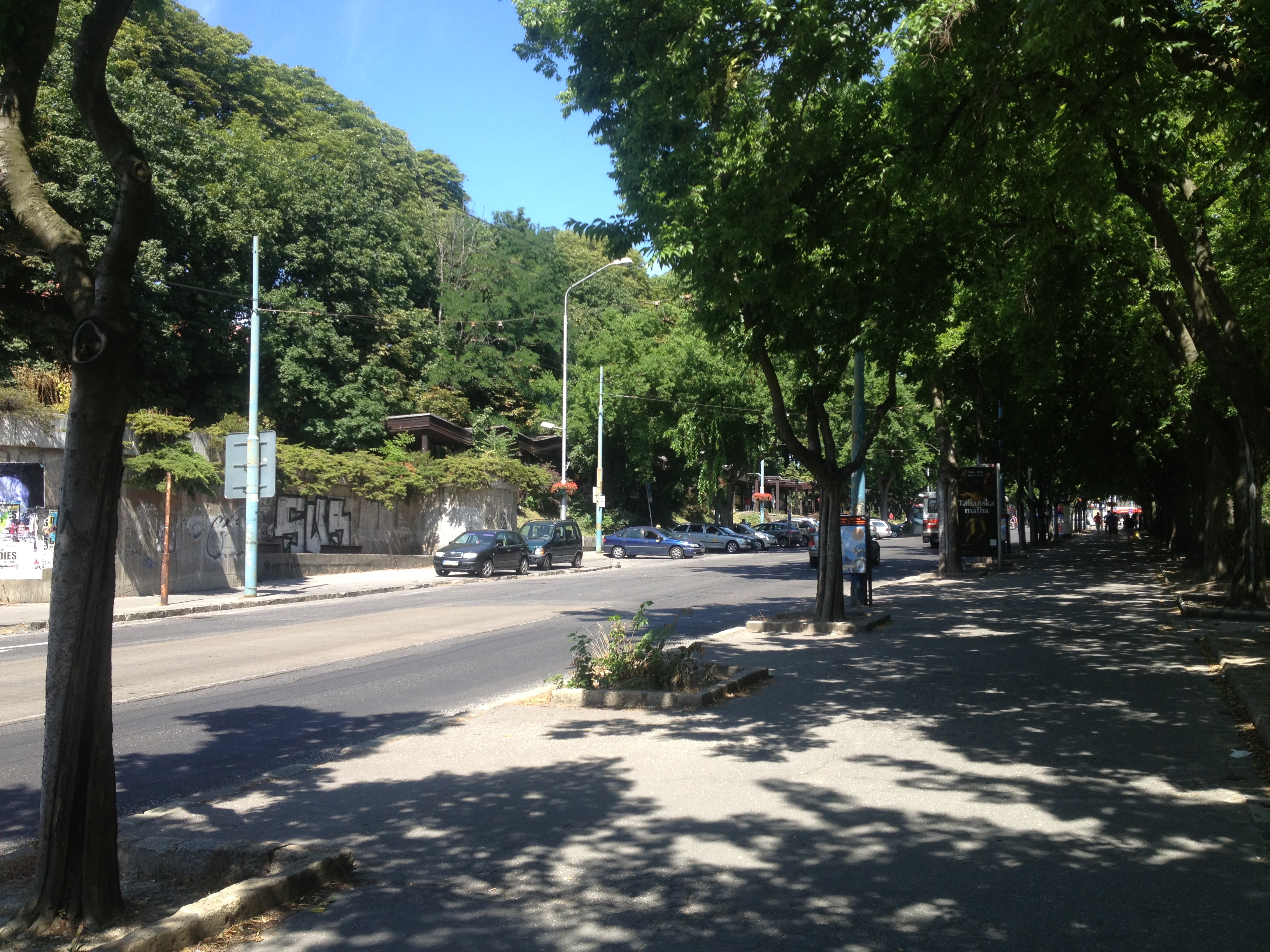
The sole street I walked down from the train station.

The sole street I walked down from the train station.

Slovak billboard - I was limited in the sights I was able to photograph, okay?

Slovak billboard – I was limited in the sights I was able to photograph, okay?

The train station at Bratislava.

The train station at Bratislava.

And a selfie to prove that I didn't just steal these pictures off the Internet.

And a selfie to prove that I didn’t just steal these pictures off the Internet.

***

Then it was back to the station to buy a few snacks before boarding the train to Prague. The train was unlike most of the other ones I’d been on throughout Europe. Rather than being much more open with rows of seats on either side of an aisle, this train was more like the cabins we had on the Trans-Siberian railway. They were closed off compartments with sliding doors, except instead of seats that folded out into beds there were simply six regular seats per compartment. I would later be told by Tomas, one of my hosts in Prague, that that style meant the train was rather old, but it seemed pretty clean and modern to me at the time. I walked down the halls and poked my head into the cabins until I found one that seemed manageable. The curtains were drawn, and there was a young man lying across three of the seats on one side of the cabin, apparently sleeping. On the other side, an young woman who looked about my age sat by herself, looking rather timid. I squeezed in and took the window seat, peeking out the window through a crack in the curtain.

The trip started out quite uneventful. After a while, the sleeping man sat up, rubbed his eyes, and threw open the curtains. He couldn’t have been much older than myself or the other girl who was sitting quietly to my right. He gathered up his things and, without a word to either of us, departed at one of the stops along the way. I can’t say I’m surprised at his silence – in these environments, with the tourists and local travellers thrown in altogether, its pure luck as to whether the people around you even speak your language. He was soon replaced by a family – a mother, father and small child. They would prove to be strange cabin companions, with the little boy being cheeky and misbehaving so much that we witnessed the father lose his temper and repeatedly smack the child. It was a little scary, but I didn’t say anything because I really had no idea if such kind of thing was normal in this part of the world. The child would start crying and wailing, before going back to whatever he had been doing before and earning himself another smack. This exchanged happened periodically throughout the whole journey. However, when they first climbed on board was also the time when someone came around to check our tickets. Mine had already been stamped on the train to Bratislava though, so all I had to do was flash my Eurail pass.

When I pulled out my pass, the eyes of the girl sitting next to me lit up.  I saw her pull out her own Eurail Pass to show the the train attendants, which meant that she had to be a non-European resident. We got chatting after that – Itzel was a traveller from Mexico who was also backpacking around Europe after spending some time studying abroad in France. We got talking about different places we’d been to and where we were going. Itzel had gotten on the train in Budapest, somewhere that was now not on my itinerary but somewhere I had really wanted to see, so she told me all about the city and the things she did there. It sounded like a pretty fun place, and Itzel said she had an awesome time. She was doing the full length of the train route, from Budapest to Berlin, so after that I was my turn to rant and rave about my favourite European city. I told her all about the crazy things I’d done and where she should go, and how to not get turned away from Berghain. She had a hostel booked in advance as well, so I pulled out my Lonely Planet book and showed her the way to get there from the train station.

As it would happen, Itzel had also been to Prague, so she told me as much as she could about the city. “It’s a cute city, pretty small, and it’s easy to get around with the public transport. And of course there’s the castle.” I’d heard a lot of good things about Prague, but I guess I would be finding it all out for myself in a few hours. Itzel and I continued to talk the entire journey – I could hardly believe how much time had passed when my stop crept up on us. I said my goodbyes to Itzel, but we exchanged contact details just in case our paths crossed again in Europe, or if I ever found myself in Mexico on my future travels. I really enjoy the way travel brings people together like that – maybe I won’t see Itzel for months or years. Perhaps I’ll never see her again. But for that shared moment of travel we became the best of friends, and the train trip to Prague would have been quite boring without her.
One Friend, Two Friends: Old Friend, New Friends

When Kathi and I returned from our excursion on the river, we parted ways for our separate plans that afternoon. She had a date, and I actually had another friend who lived in Vienna whose birthday, as it happened, was that very day. It’s not everyday that you accidentally arrive in your friends city on the other side of the world on their birthday weekend, so we had made plans to catch up for a drink to celebrate both his birthday and my being in Austria.

I’d originally contacted Stephen asking if I might be able to crash with him when I was in Vienna, but unfortunately he didn’t have any room for me in the place that he lived in with his girlfriend. Luckily things had worked out through Couchsurfing in the end, and I just met up with him on the afternoon of his birthday instead. I had met Stephen when I was studying at university – he was on an exchange semester at The University of Sydney, and we sat next to each other in one of our philosophy tutorials. Now, almost exactly a year later, we were sitting at a beach-themed bar on the side of the Danube in the middle of the city, catching up and reminiscing and soaking up the sun. I say afternoon, but it was actually closer to 7pm – what I would have typically called “evening”. But this was European summer, and if we measured parts of the day by how much daylight the had, “afternoon” wouldn’t end until approximately 10:30pm. I ordered another Radler and sat down to tell Stephen more about my travels, and what I was planning to do next, both short-term and long-term. “You could always get a working visa and come back to Europe to teach English,” he had suggested. “I know of a lot of places that are always looking for native English speakers to help adult students perfect the language, especially places in Austria and Germany.” Scenarios flashed through my mind of living in Berlin, teaching English to the locals during the week, and spending my weekends on the dance floor or in a dark corner at Berghain. I could definitely think of worse ways to spend my life, but at that stage I was thinking as little as possible about my life after my year of travelling. I’d been on the road for months now, and I wasn’t even halfway through my journey.

Our mugs of beer and Radler in the Viennese sunshine.

Our mugs of beer and Radler in the Viennese sunshine.

Stephen and I.

Stephen and I.

Eventually Stephen had to go, so I wished him a happy birthday one last time as we bid each other farewell. I hadn’t drank too much, and I ended up just heading back to Kathi’s, but that night was still rather significant. After all the travelling I’d done in the past few months, that conversation with Stephen had planted a seed in my mind, an idea in my head – the idea of living abroad. Every following city that I visited, and every time I cast my memory back to the places I’d visited, it wasn’t a question of whether I liked the city or not, but rather, ‘Could I live in this city?’

***

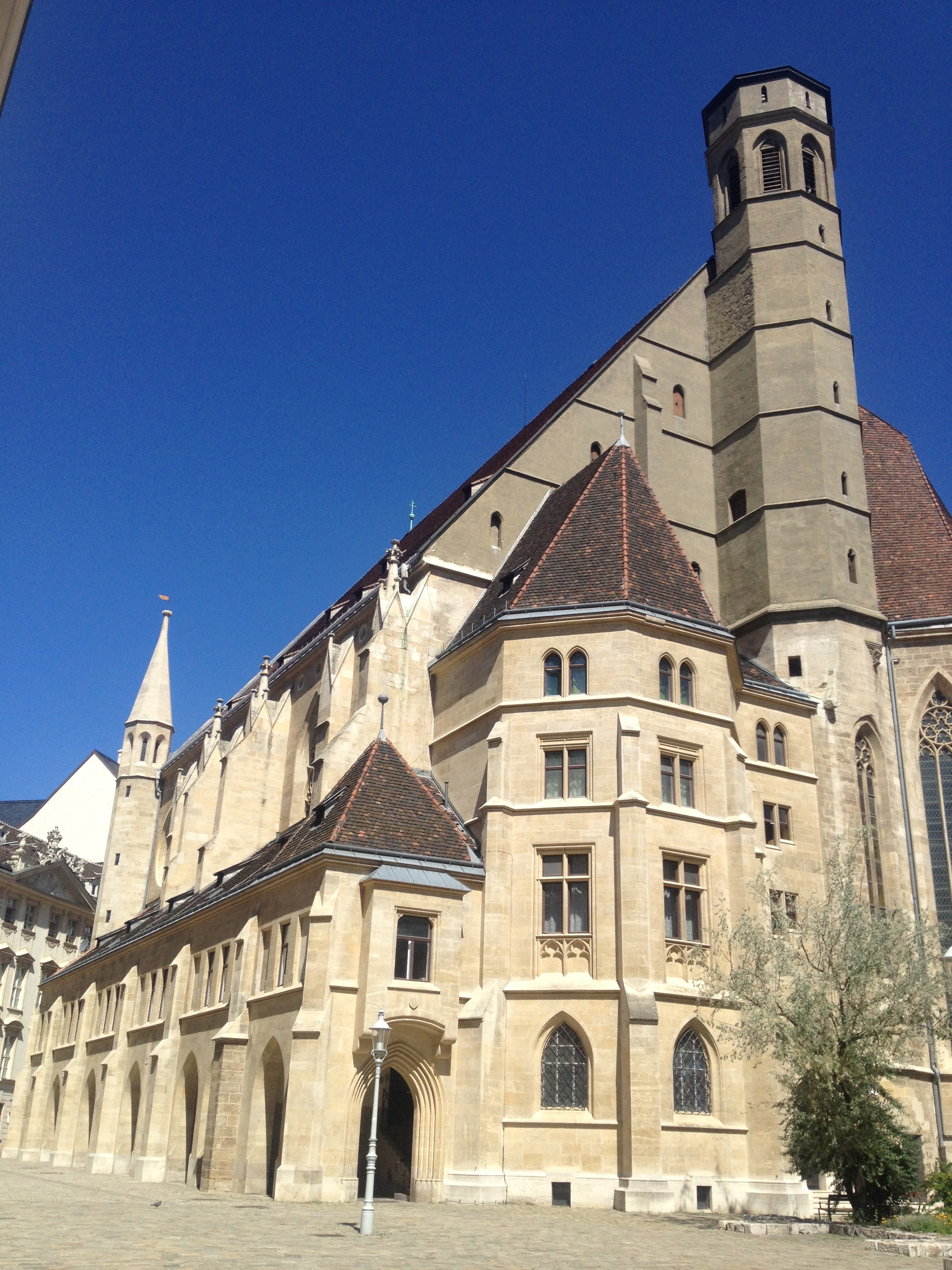
The following day was my final one in Vienna, and since Kathi had to work for most of the day I figured it would be the best opportunity to do my loop around the tourist ring and see some of attractions Vienna had to offer. The inner city, or Innere Stadt, of Vienna is a designated Unesco World Heritage site, and the architecture easily takes you back to centuries past. I wandered the streets and got a little bit lost, just soaking up in the atmosphere as I strolled past the coffeehouses and other eateries and watched the flocks of other tourists come and go.

One of the older buildings on one of the quieter streets in the city centre.

One of the older buildings on one of the quieter streets in the city centre.

Some more classical looking architecture I stumbled upon in my exploring.

Some more classical looking architecture I stumbled upon in my exploring.

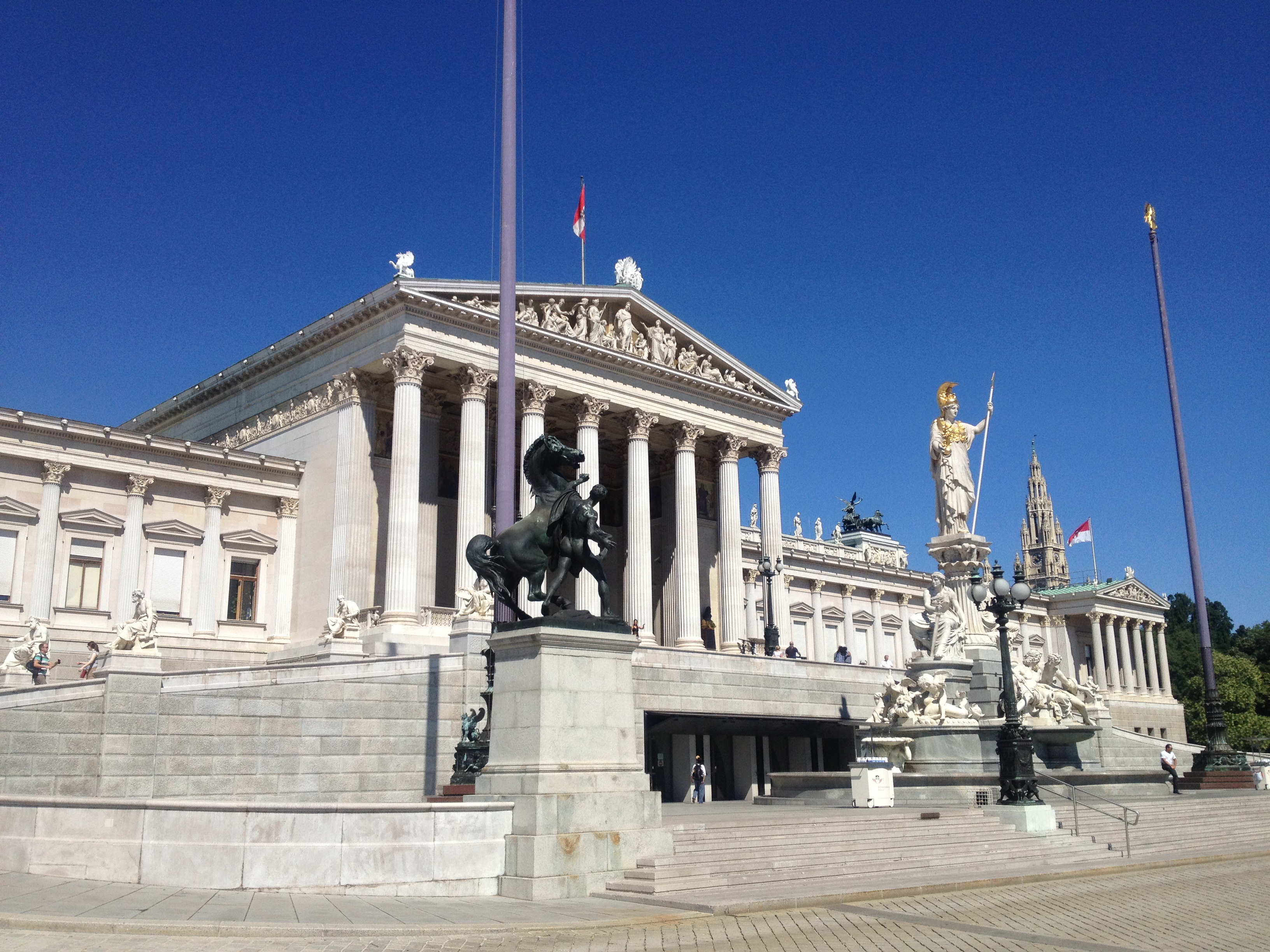
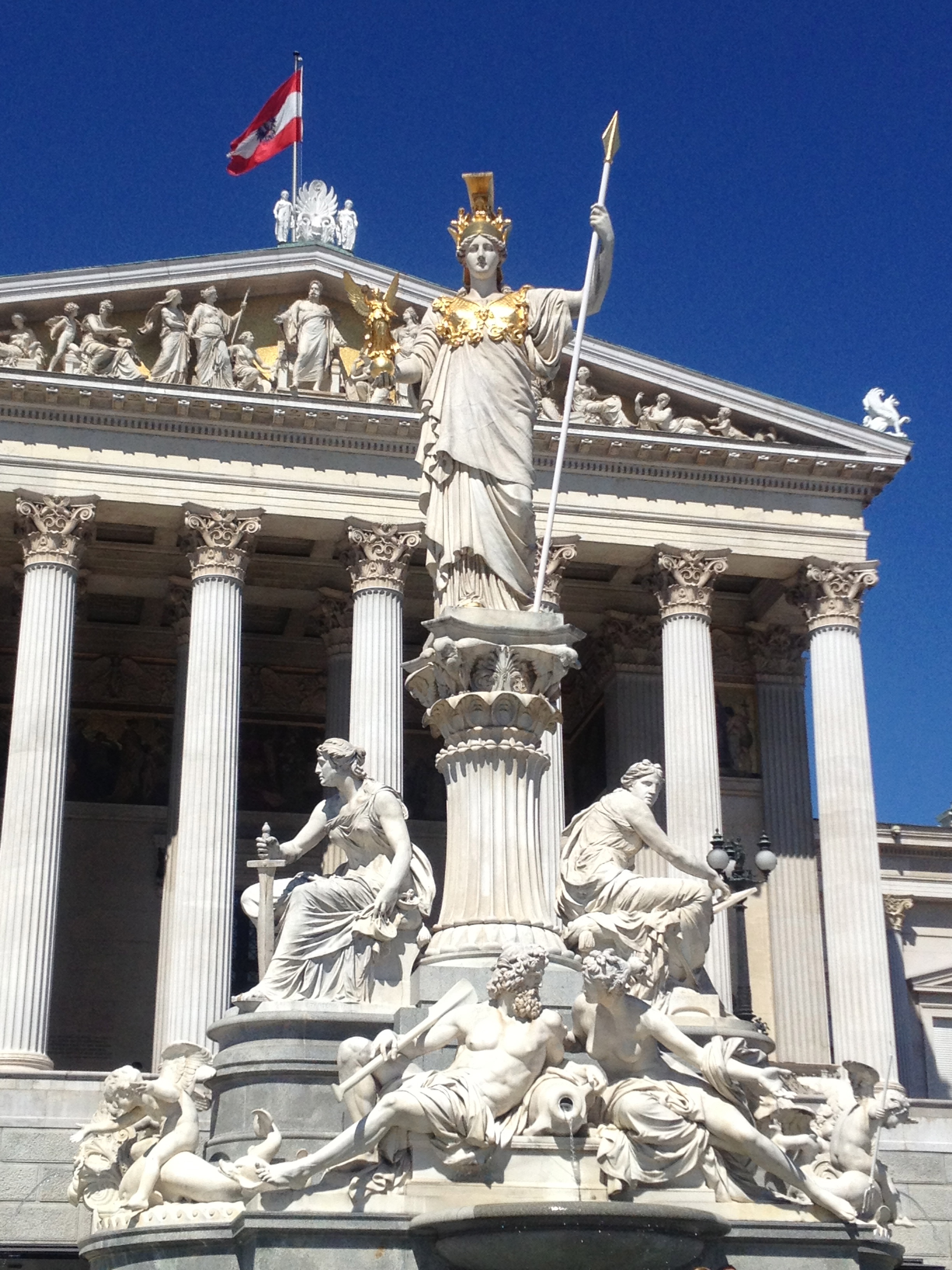
A lot of the major sights are situated along a tram line that does a consistent ring around the city centre, but after I finally made my way out from getting lost in the Old Town streets, I decided that it was such a nice and beautiful sunny day that I would walk around the ring, instead of staying cooped up on the public transport. Some of the highlights of the sightseeing in Vienna were Stephansdom, or St. Stephens Cathedral, a 12th Century Gothic church that towered above the streets, and the impressive neo-Greek architecture of the Austrian Parliament Building, complete with a gold trimmed fountain depicting the goddess Athena, with the four figures around the base of the fountain representing the four most important rivers in the old Austro-Hungarian Empire.
Stephansdom looking overhead.

Stephansdom looking overhead.

The Austrian Parliament Building.

The Austrian Parliament Building.

The statue of Athena in front of the Parliament Building.

The statue of Athena in front of the Parliament Building.

I didn’t take too many photos, but then I didn’t know too much about all the different sights in Vienna. It was kind of better that way, I think. There was no pressure to see all the important things, like their had been to visit the greatest hits of Rome. I was able to just meander around, stopping when I saw something I thought was interesting, taking the odd picture here and there, strolling through the greenery in the various city parks and just enjoying the relaxing atmosphere the city had to offer. I laid down in grass and had a snooze, had a slice of cake at a coffeehouse – it was all just so chilled out that it didn’t even feel like sightseeing. It just felt like living.

***

In the late afternoon I met up with Kathi and one of her housemates who had returned the previous evening, Anna-Greta. Kathi had suggested meeting at Naschmarkt, a popular market that had all kinds of amazing foods and fresh fruit and produce, as well as flea market stalls that were selling all kinds of things. Unfortunately I didn’t have much need for all that food, since I’d be jumping on another train to a new city the following day, but it was interesting to check out. Kathi and Anna-Greta bought a few things, and then we sat down to have some food at one of the restaurants that was set up along the market. We ate Thai food – something I hadn’t seen since Thailand – and I told them how popular it was in Australia, and we discussed other cultural differences between Austria and Australia. My favourite moment, however, was when it took us at least a few minutes to translate the word “bruise” from German to English. I thought something was seriously strange when they were telling me how they sometimes got “blue stains” on their skin – it still makes me chuckle when I think about it.

After we’d finished eating, the three of us just hung out at home for the rest of the evening. Anna-Greta had been partying all weekend at a big festival, and all three of us had to get up relatively early the next day, so we didn’t feel like heading out anywhere. Kathi and I pulled out our ukuleles and Anna-Greta grabbed her guitar, and I gave them a couple of lessons and taught them some chords to be able to play a few new songs. I introduced Kathi to Paramore, whose most recent album has a couple of ukulele tracks that I had learnt how to play. She loved the music, and was pretty stoked when I taught her how to play ‘Interlude: Moving On’, and we also learnt how to play ‘Blowin’ In The Wind’, a challenge that Kathi’s other housemate had set for her. Then we just sat around chatting, and the girls told me about parties that they throw, and the music that they play and all the fun that they have, and it made me a little sad to be leaving the next day. “You’ll just have to come back next time we have a party,” Kathi said with a grin. “And at the end of the night we can run around being crazy while we play the ‘Spanish Flea’.” We all laughed, and I smiled to myself, sincerely hoping that one day that would actually happen. I’d made some great friends during my travels so far, and there wasn’t a doubt in my mind that some of those people such as Kathi – despite the distance – would remain my friends for life.

Down the Danube

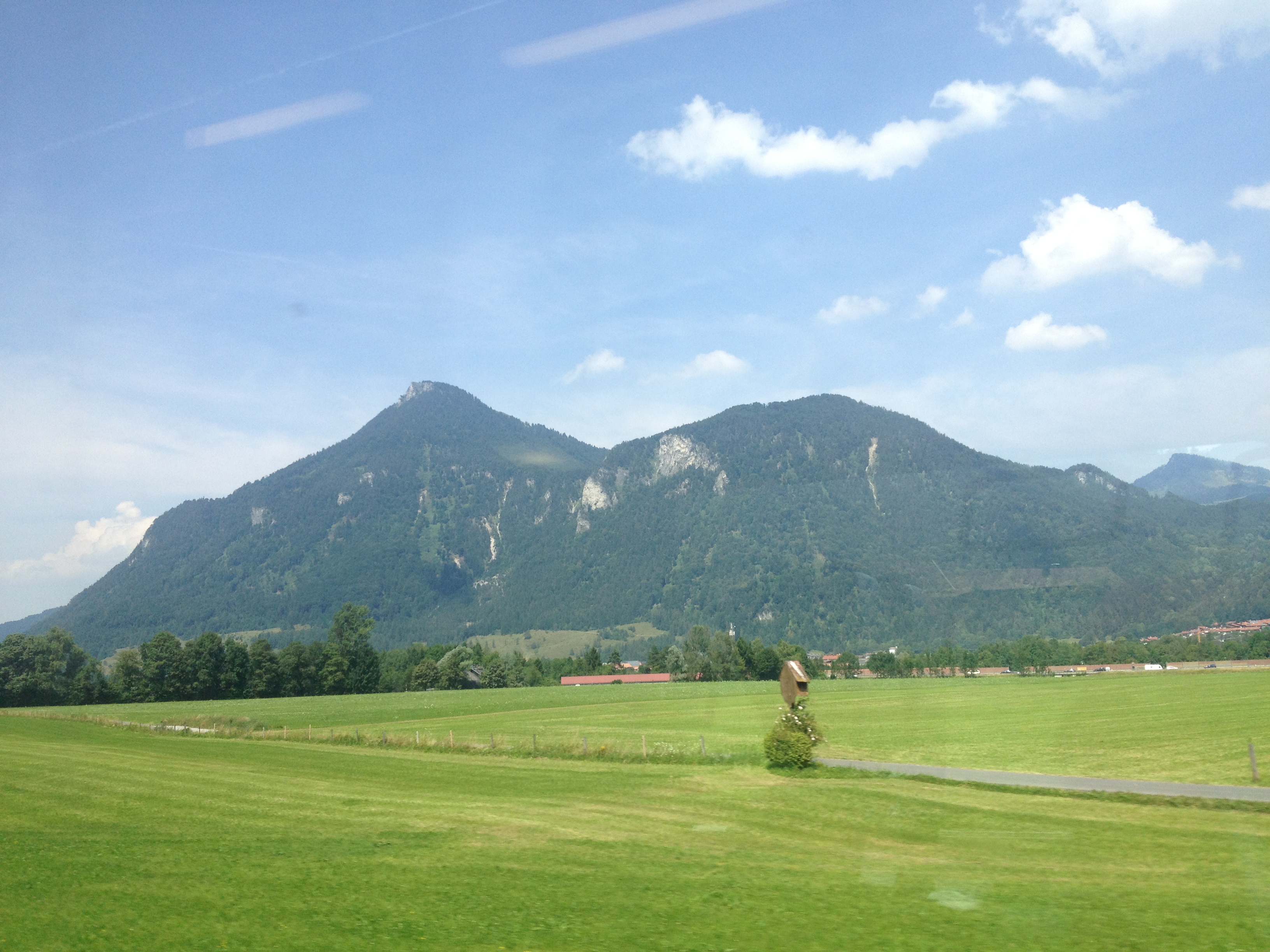
Thankfully, unlike my trek from Ancona to Zürich, I only had to catch one train to get me to Austria. I did have to travel from the western tip to the eastern tip of the country though, but travelling through the mountainous terrain did provide some pretty spectacular, picture perfect views. After the long day of travel I finally arrived in the beautiful city of Vienna and was greeted by my next Couchsurfing host. Kathi was the first female that I was staying with whom I had connected with through Couchsurfing – Susanna in Finland had been a family friend – but I had still found her within my search for hosts in the Queer Couchsurfing group. Robin had showed me how Couchsurfing can be used not just to find places to stay, but also to connect with people who had common interests. I decided that I would probably feel more comfortable staying with gay people while I was travelling, since most of my friends back home are gay, and they would be able to show me some of the queer hotspots – but up until now I had only stayed with other guys. It wasn’t a conscious choice – I think there were just more male hosts available, in general – but when I’d stumbled across Kathi’s profile I’d gotten a really good feeling from it, and she had happily accepted my request to stay with her. I had been tossing up between trying to visit Vienna, or travelling slightly more north to visit Holger – who I met in Barcelona – in Munich, but I had had trouble getting in touch with him, so once again my potential Couchsurfing host had been a real game changer in the direction of my travels.

View of the Austrian countryside as I sped towards Vienna in a train.

View of the Austrian countryside as I sped towards Vienna in a train.

There was a kind and carefree air about Kathi from the moment I met her at the train station. She was also relatively new to Couchsurfing, so she was pretty excited about having me stay with her. I think the fact that I was Australian helped win over a lot of my hosts – to all of them I must have seemed exceptionally foreign and exotic, all the way from that mysterious land down under. She explained some of the culture of Vienna and the basics of the city to me – such as the ringed town layout and the different zones – while we got caught the metro to her apartment, which she shared with two roommates. “The coffeehouse culture is a really big thing in Vienna”, she advised me. “That’s something most people want to check out. The centre Vienna is divided up into rings, in particularly the main ring that encloses the city centre. Most of the things you’ll want to see or do will be there.” I wondered how I would have coped on this trip I hadn’t had hosts like Kathi, Umer, Ike and Valerio to help know these things about their various cities. I imagine I would have done a lot of unintentional aimless wandering around – as opposed to a lot of the intentional aimless wandering around that I still did.

It was a Friday afternoon the day that I arrived in Vienna, and both of of Kathi’s housemates were away for the weekend. One of them wouldn’t bet returning until after I left, so rather than sleep on the couch in her bedroom, Kathi told me that she would sleep in her housemates room, so and that I could sleep in her bed and have the room to myself. It was more than I had been expecting when I had sent the request to Kathi, and it was probably one of the best set ups I’d had through Couchsurfing so far. As soon as we got to Kathi’s, I had a well needed shower – the countryside views through the Austrian mountains had been postcard-worthy beautiful, but the 7 hour trip had left me feeling less than fresh. “Be careful with the water temperature”, Kathi had said as I entered the bathroom. “It tends to just alternate between… Antarctica and Mordor.” I laughed, appreciating the reference. After the shower I joined my new host in the kitchen. “Are you hungry? I was thinking I could show you how to cook some traditional Austrian food, maybe.” I assured her that her national cuisine of schnitzel had made it down to Australia, but all the same it was fun to help out in the kitchen and do some cooking. We cooked the schnitzel and vegetables, and she introduced me to an Austrian drink called Radler. “It’s basically beer mixed with lemonade,” she said, placing a bottle in front of me. “You can mix yourself or buy it like this.” It was a little fizzy from the added soft drink, but the taste was extremely refreshing, the sweetness balancing our the flavour of the beer perfectly, and I enjoyed it much more than the Rivella I had tried in Switzerland. We sat and ate and chatting, getting to know each other as we downed a few bottles of Radler.

Kathi was particularly interested in picking my brains about the gay culture down in Australia. “What’s it like for gay girls in Sydney? Here, it can be really difficult for…” She was choosing her words carefully. “For more… feminine, girls. Like… sometimes I’m never really sure… You know, of where – and who – they are?” I realised she was talking about her gaydar – her ability to identify other queer people on sight alone. I must admit, the more feminine lesbians have always been the least obvious blips on my gaydar, but luckily stopping them had never been quite such a pertinent issue for myself. Kathi went on to tell me that queer girls also had less places to meet people, citing the recent pride festivities in Vienna, where there had been multiple parties aimed at all the gay men, and only one event that specifically targeted same-sex attracted females. I had to regretfully tell her that gender ratio of gay bars and parties in Sydney was of a similar level, though I won’t pretend I know much about the lesbian scene – not for the first time I pondered on the curious fact that the party scenes for gay guys and gay girls were so divided in the first place.

We continued to talk for hours about gay life, travelling and Couchsurfing, and even music. Kathi was learning how to play the ukulele, so as part of the condition of me staying with her I had promised her that I would show her a few tips I had picked up along the way. I was only teaching myself, but as an acoustic guitar player of nearly 10 years I didn’t have too much difficultly figuring it out. But before it we knew it, it had gotten quite late, so I said goodnight to Kathi and hit the hay after the exhausting day of travelling.

***

The next day, at Kathi’s suggestion, we caught the train north of her rather centrally located apartment to the banks of the Danube River. It was a gorgeous sunny day, and we had lunch at a little restaurant next to the river that served some excellent Austrian dishes, and of course, more Radler. That wasn’t the most exciting part about this restaurant though – after we had finished eating, I followed Kathi down to the small jetty that was actually a part of the restaurant. There, we hired a small electric motorboat and went for a cruise down the river. “There’s some nice views of the city from the water. Perhaps we could bring our ukulele’s and have a sing-a-long, or something?” Kathi had suggested the previous evening before we had gone to bed. I had told her that that sounded absolutely marvellous, so once we got out on the river I pulled out my ukulele and started strumming away.

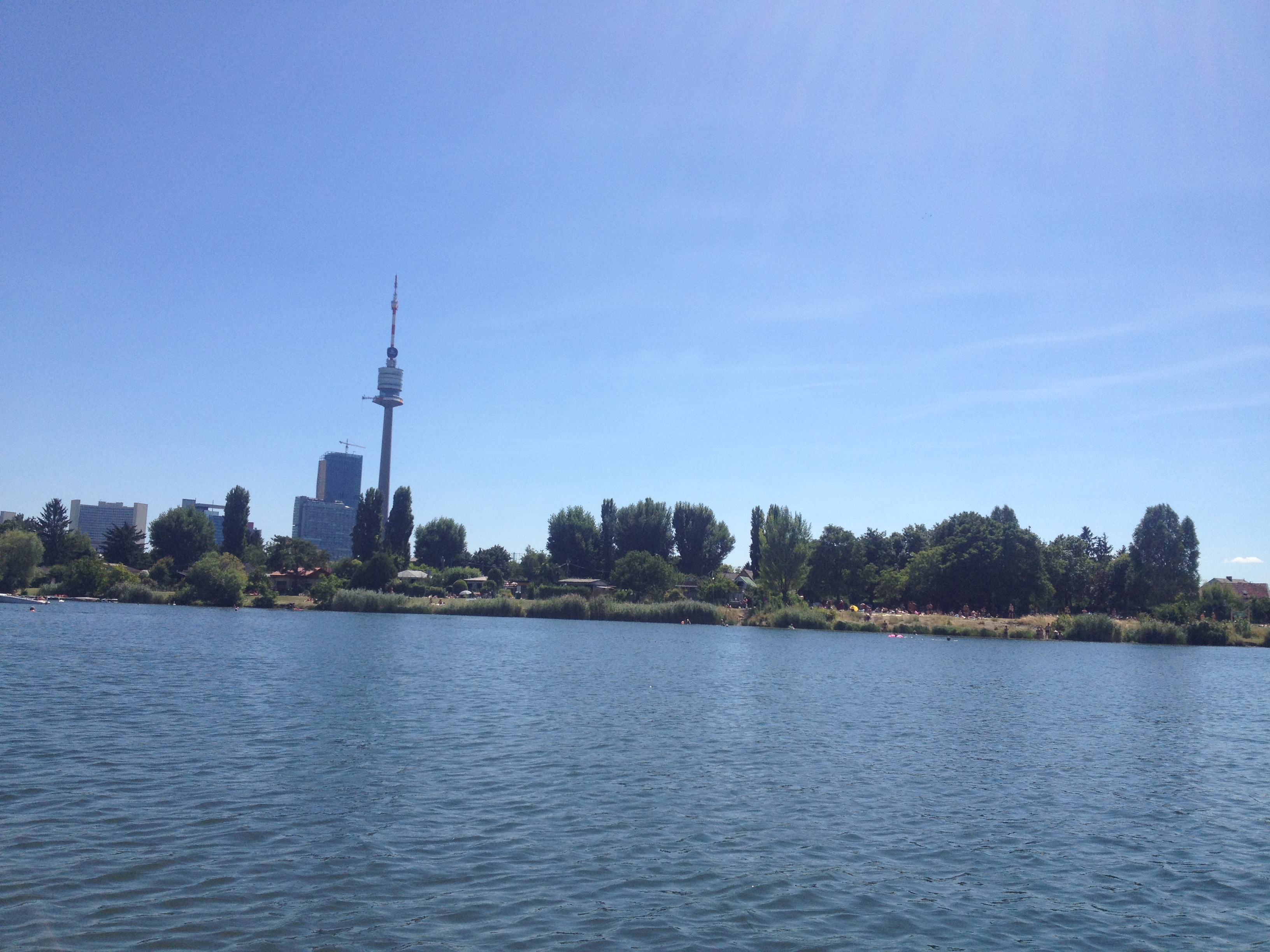
The view of the city from out on the Danube.

The view of the city from out on the Danube.

The sunshine was streaming down on us as I worked my way through the small repertoire of songs that I had managed to teach myself over the last few months, and Kathi steered the boat up the river. We passed a couple areas that were substitute beaches for the Austrians – the idea of living in a landlocked country with no nearby coastal area still seemed so odd to me – but I have to say, they weren’t as nice as the riverside swimming areas in Zürich, probably because the water in the Danube wasn’t quite clean enough to be drinking quality. But it was still beautiful, and Kathi told me how she often comes down here to bathe in the sun and go for a swim. When we reached a wider part of the river, Kathi killed the engine and we just floated for a little while, watching others glide by us on their paddle boats, and soaking it all in while I strummed away on the ukulele. “It’s so nice,” Kathi said between songs, with a huge smile plastered across her face. “It’s just a nice, holiday feeling, to have the ukulele going in the background while we’re out on the water in the sun.” It was no tropical island getaway, she but was right. Kathi didn’t even end up playing her ukulele, and in the end I was just playing random chords to give the scene a nice and cheerful soundtrack. On our way back to the jetty we passed many boats full of other people, both locals and tourists, and they all smiled at us or exclaimed with delight when they saw or heard the ukulele. It really did feel like a scene from a movie, or even a travel brochure, but it was so much fun, and I couldn’t have thought of a better way to spend the afternoon.

Kathi took a sneaky photograph of me while I was playing the ukulele.

Kathi took a sneaky photograph of me while I was playing the ukulele.

The Churches of Old Town Zürich

When I wasn’t exploring the great outdoors with Robin in Zürich, I took time out of the busy, active lifestyle to do a little bit of sightseeing. The city centre of Zürich itself wasn’t exactly huge, or full of iconic landmarks, but simply wandering around the charming little streets and up the cobblestone footpaths was a pleasure in itself, appreciating the quaint and classical beauty that the city maintained.

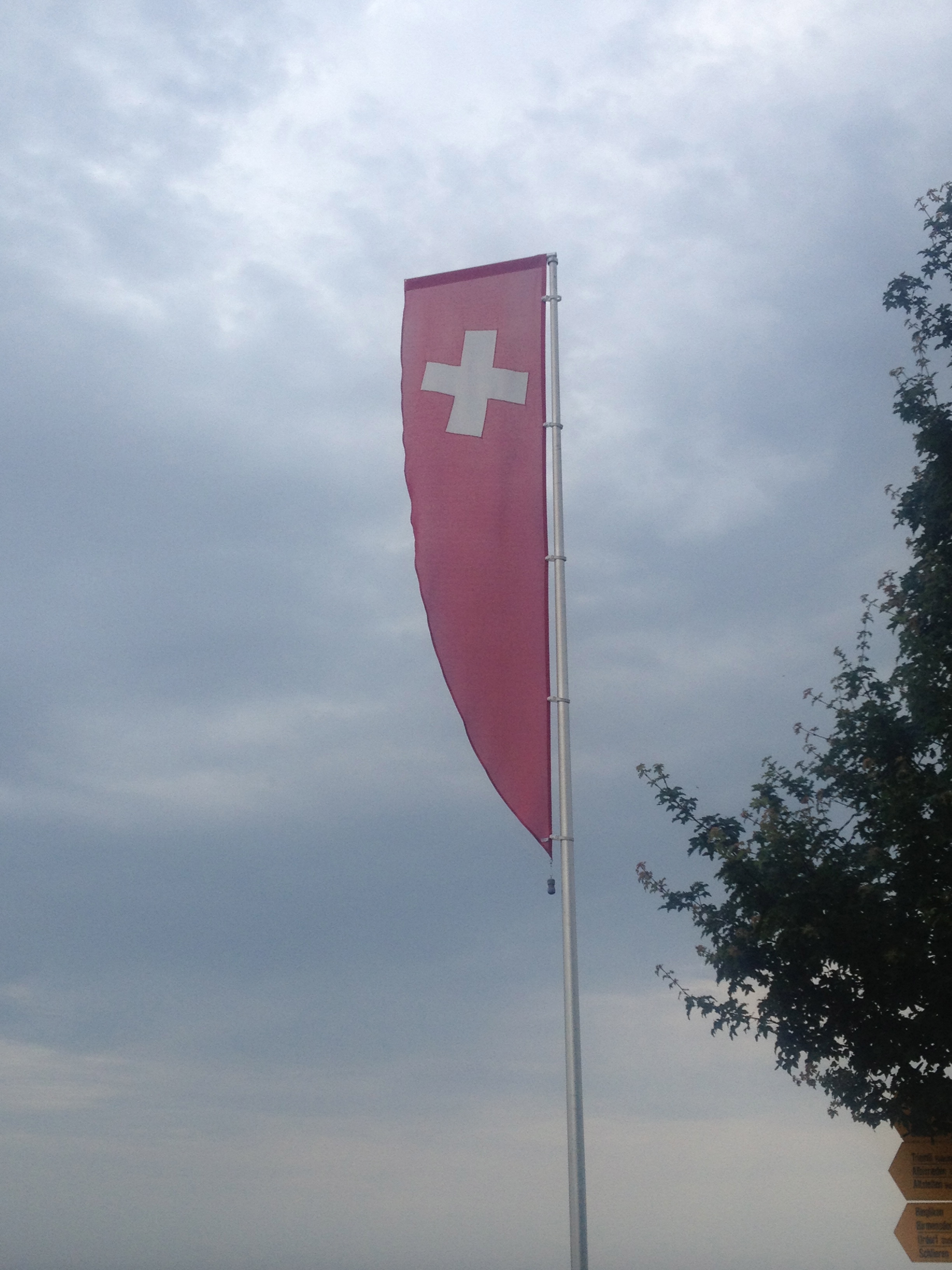
A cute little Swiss street that is obviously very proud to be a Swiss street.

A cute little Swiss street that is obviously very proud to be a Swiss street.

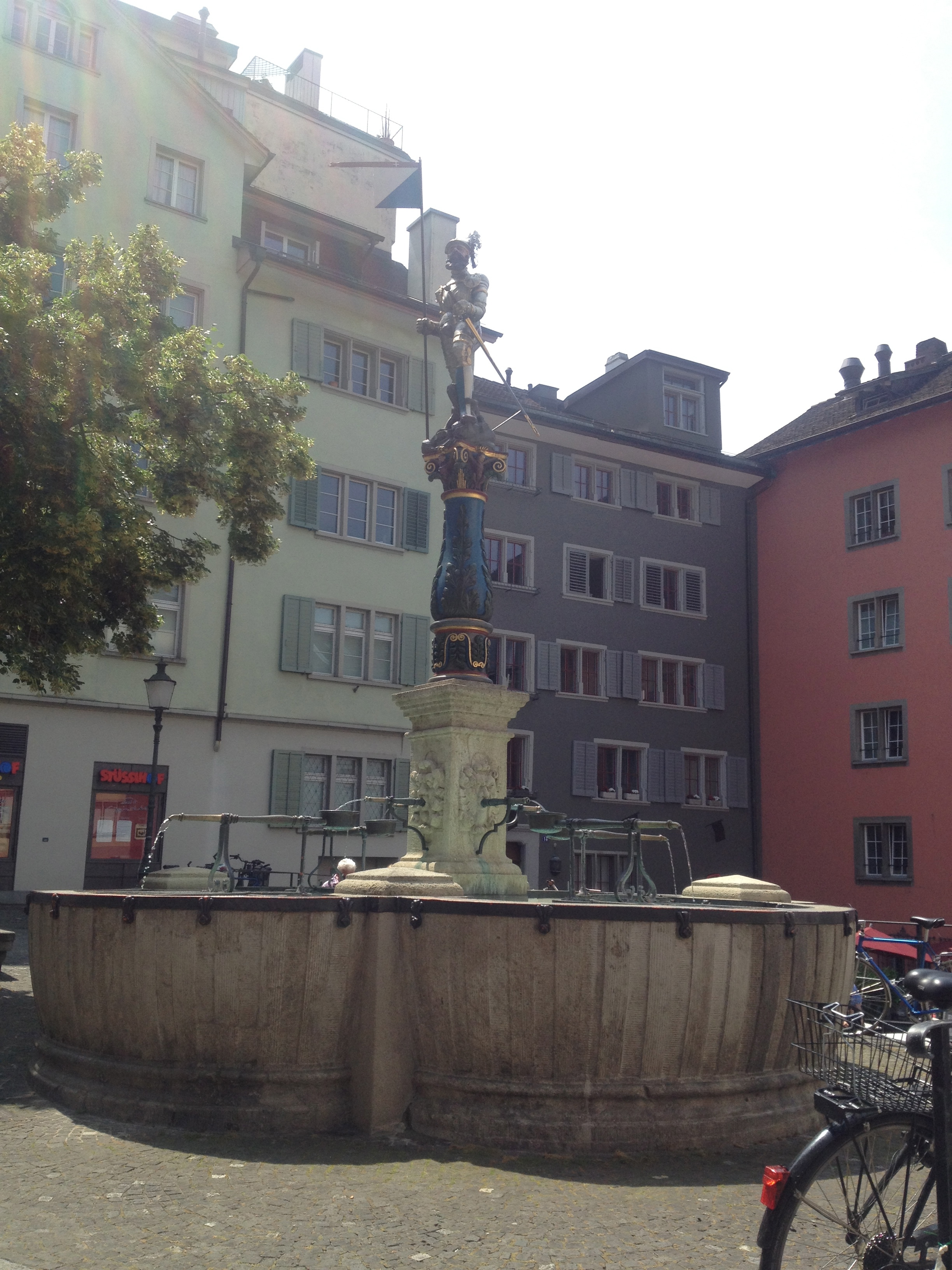
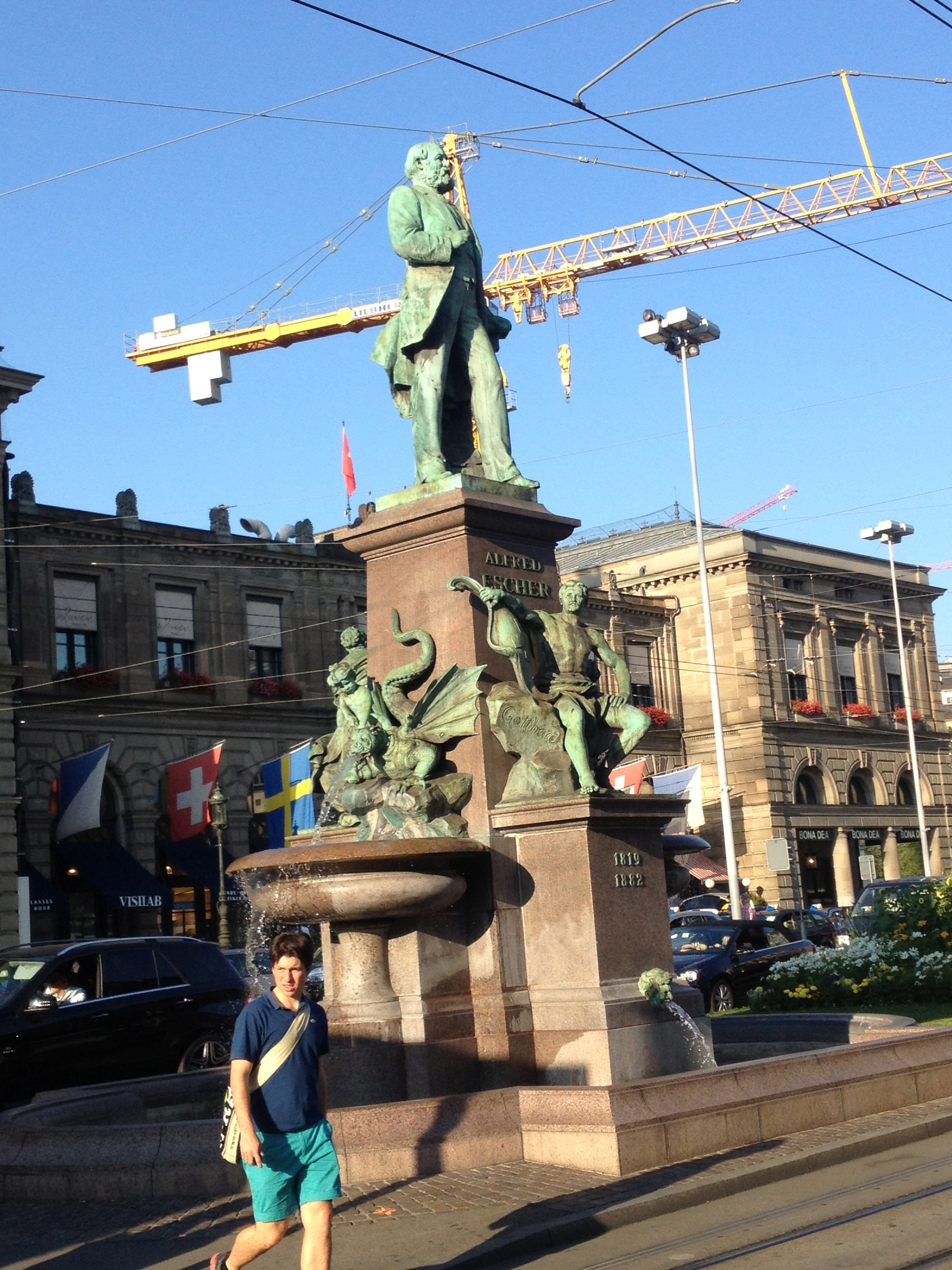
Gedenkbrunnen für Bürgermeister Stüssi, or Stüssi's Fountain, which I accidentally stumbled across in my roaming.

Gedenkbrunnen für Bürgermeister Stüssi, or Stüssi’s Fountain, which I accidentally stumbled across in my roaming.

The most notable sights worth seeing in Zürich were probably the small handful of churches located in the city centre. While I had sworn I was done with churches after my trek through the Vatican City in Rome, these Swiss churches couldn’t be more different from the St Peters Basilica in Italy. They were a fraction of the size, modestly squeezed in between all the surrounding buildings, though the classical design suggested that the holy buildings had been there much longer than their neighbouring structures. The first of the three main churches in Zürich that I passed is called Grossmünster, which translates into “great minister”. It is located along the banks of the River Limmat and served as a monastery church when it was first inaugurated some 800 years ago. The Romanesque architecture was impressive from the outside from where I admired it, but it was a beautiful day outside, and I just wasn’t in the mood for trailing through another church museum.

The grand Grossmünster.

The grand Grossmünster.

So on I moved across the Limmat, where the other two main churches were situated – next was St Peterskirche, or St Peters church. The structure itself was significantly smaller than Grossmünster, and it was in the midst of a sea of buildings to the point where I couldn’t actually find the building itself. However, the main feature of St Peterskirche rose above the sea of buildings so that it could be seen from a great distance – the clock tower. Again, I wasn’t particularly interesting in seeing the inside of yet another church, and the main feature was best viewed from a distance anyway. “The clock on that steeple is the largest clock face in Europe,” Umer had said to to me as we’d breezed through the city on my first afternoon in Zürich. It has a diameter of 8.7 metres, but I hadn’t previously managed to capture any photographs of the impressive clock, so I took a few snapshots before moving on to the third and final church.

The clock tower of St Peters church.

The clock tower of St Peters church.

Fraumünster was the only church in Zürich that I actually went inside, but in retrospect I’m glad that I had made the time to take a quick peek. The English translation is “women’s minister” and the church, which is built directly across the Limmat from Grossmünster, was built on the remains of a former abbey. From the outside, Fraumünster doesn’t seem particularly impressive. However, once you set foot inside the cool and quiet halls, you quickly realise that it’s the inside perspective and the view from within that truly matters in these sacred rooms. I’m talking, of course, about the stained glass windows. From the outside on a bright sunny day they look incredibly unremarkable: black holes leading into the depths of the church. But from the inside, that sun streaming in lights up the coloured panes of glass to produce something beautiful, mystical, and even a little breathtaking. I reiterate that I’m not exactly religious and have no affinity with the Christian faith, especially after the disillusionment that came with my visit to the Vatican, but something about being in Fraumünster recaptured my sense of mysticism.

Fraumünster, looking deceptively plain from the outside.

Fraumünster, looking deceptively plain from the outside.

Back in my days at university I took quite a variety of sociology courses, one of them being a class titled the Sociology of Religion. In the first lecture, our teacher read us a metaphor about religion being like a stained glass window. You can study a religion from the outside – the rituals, the doctrine, the history, the beliefs – but the real meaning of a religion requires an understanding that one can only get from being inside of the fold, and being a part of that religion. Perhaps thats why, whenever I step into any of these beautiful churches far and wide across this continent, I get that superstitious sense that I just can’t quite put my finger on. Until you’re ready to fully accept it and be a part of it, maybe you’ll never be able to truly understand what it means to be part of a religion. I doubt that I ever will fully know what that is like, but for the meantime I was definitely understanding the stained glass window metaphor first hand. I tried to take a couple of photos, but the quality of my camera did absolutely no justice to the images I was seeing in front of me. Not for the first time, I took it as a sign that some things we experience in this world as just so significant to ourselves as individuals, that attempting to share them with others would simply fail to have the same effect on them as it did on us. So I momentarily lost myself there, in the cold stone chambers of Fraumünster, before saying a silent prayer – to who, I’m still not sure – and exited back out into the sunshine.

***

After my church sightseeing and soulful contemplation, I lightened the mood of my day with a stroll through the sunshine by the lake. This was before the afternoon of slacklining with Robin, so I hadn’t been swimming in the lake or river at that point. I found a seat on a bench and read my book for most of the afternoon, but I did come across a huge diving platform from which people were jumping off, and plunging into the depths of the crystal clear water. I considered doing it myself, but at that stage I wasn’t exactly feeling 100% healthy – I was still feeling a little under the weather, and recovering from the effects of prolonged partying in Madrid during Pride. I knew I would  inevitably be getting wet when I went slacklining over the river, but I didn’t want to wait around in wet clothes for the rest of the afternoon, so instead I contented myself with watching others jump off the huge platform and into the water.

The huge structure that had been set up in the lake, from which people were jumping off into the water.

The huge structure that had been set up in the lake, from which people were jumping off into the water.

There is one thing that I found shocking about Switzerland, even though it wasn’t exactly unexpected, and that was the cost of living. I had been warned about it, but it still hit me like a slap in the face. I wasn’t even paying for my accommodation, but my time spent in Zürich was fairly limited simply due to the fact that I didn’t have the budget to do very much. Even eating was a ridiculously pricey affair. I went to get lunch from what seemed to be a relatively cheap sausage stand – they love their wurst in Switzerland – and ended up paying around 6 francs for a simple sausage and a small piece of bread. I felt like that would have almost bought me a meal in any other country, but from what I had seen of the rest of Zürich, I had basically stumbled across a bargain. I considered it a blessing in disguise that I wasn’t feeling too well during my time in Zürich, because it meant that I didn’t have the desire to go out and investigate many of the bars or nightclubs – something that I just didn’t have the funding to do there. Robin and I visited a bar or two and sampled some delicious Swiss beer, made in various microbreweries around the country, but for the most part Switzerland was a continuation of my much needed down time. My pride tour down western Europe had really gotten the better of me.

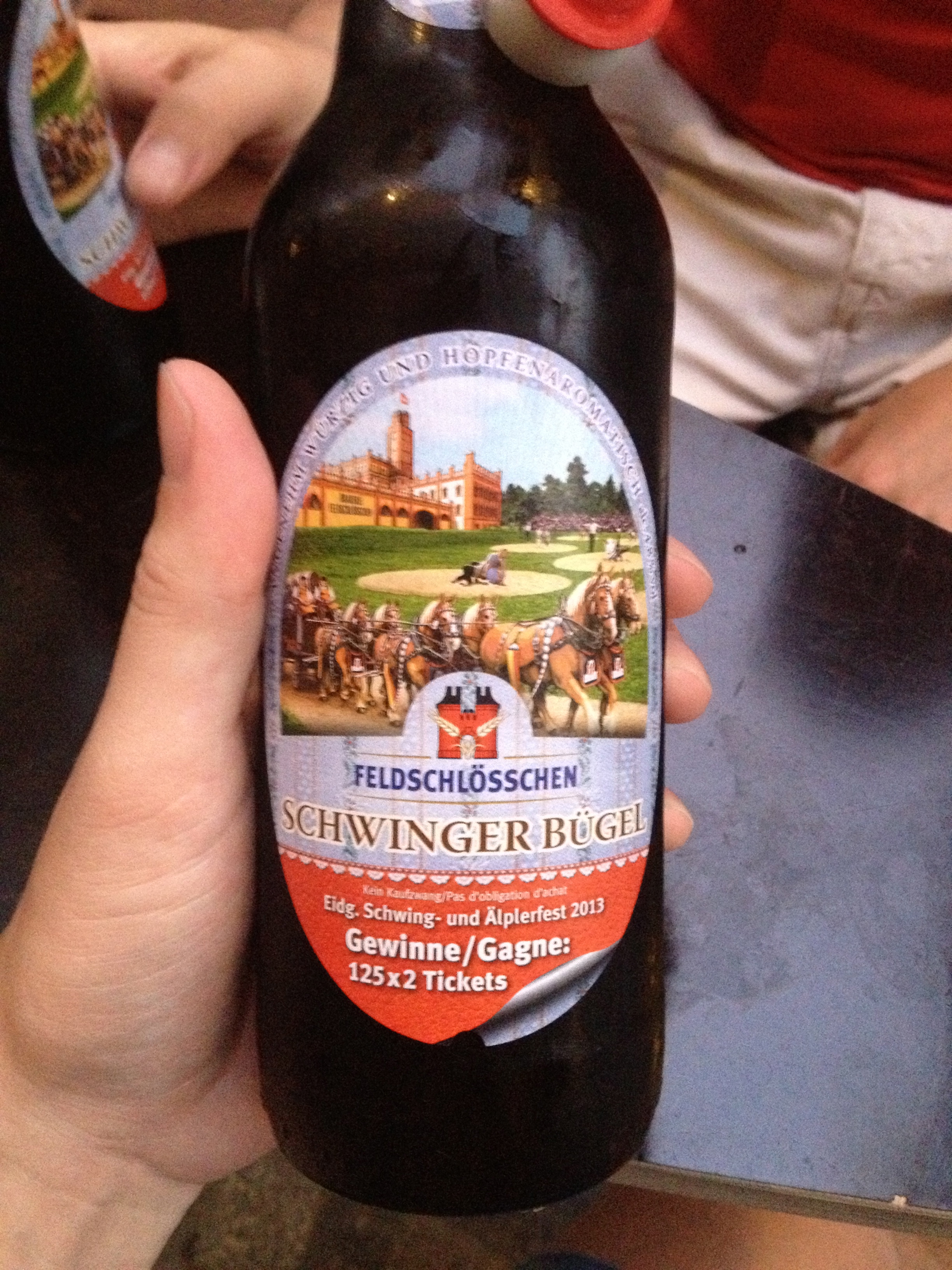
One of the Swiss beers I shared with Robin.

One of the Swiss beers I shared with Robin.

***

Eventually necessity required me to move on from Zürich – there were a handful of other destinations I still had to hit before my Eurail pass expired, and I just couldn’t afford to stay in Switzerland any longer. So on my final morning I packed up my bags, thanked Robin for his hospitality, for introducing me to the world of slacklining, and inspiring me to be that little bit more physically active in my life. Then it was onto the station for another train, another country, and another city on on my ‘greatest hits’ tour of Europe.

River Deep, Mountain High: The Great Outdoors in Zürich

The following morning, I bid farewell to Umer as he set off on his own trip. Before he left, he gave me his dads monthly travel pass again. “My father said he won’t need this today, so you can borrow it for one more day while you’re staying here. It let’s you go a lot further around the city than one of the standard daily tickets, so perhaps you’d like to make use of that while you can.” It was the last of the numerous suggestions and tips that Umer had offered me, and I thanked him for his stellar advice as he headed off to the airport.

***

The first thing I did that morning was head back to the centre of town to the dock at Lake Zürich. The monthly pass that I was using today also covered use of the ferry, which made round trips around the lake to certain points much further down the shore. There were long trips that went to the other end, as well as shorter ones that did rotations to closer docks. Umer had said it was a nice relaxing way to spend the morning, and it was a beautiful day to be out on the water. I took one of the shorter trips, which still took the better part of an hour, and watched the shoreline glide past, admiring all the adorable traditional houses that were situated right by the water. One thing that I would continue to notice during my time in Zürich is that the Swiss love their outdoor activities. It has something to do with the seasons – during the winter there is very little daylight, and the cold doesn’t permit people to be outside for too long, so when summer rolls around and the sun doesn’t set until after 10pm, people seem to take full opportunity of as many daylight hours as possible.

Statue of Ganymed and Zues, represented as an eagle, beside the lake.

Statue of Ganymed and Zues, represented as an eagle, beside the lake.

One of the smaller docks on the edge of Lake Zürich.

One of the smaller docks on the edge of Lake Zürich.

Cute little houses beside the lake.

Cute little houses beside the lake.

There were lots of pools and parks along the edge of the lake, and plenty of people were out sunbathing and swimming and kicking balls and all sorts of recreational activities. I sat in the sheltered shade of my seat in the ferry and just took it all in. I had just come from the small coastal town of Ancona, and I had been expecting to be returning to my tour of major cities when I arrived in Zürich, but I was pleasantly surprised to find that there was a small village feeling very much entrenched into the essence of this place. Even in the major intersections where trams tracks overlapped and cars seemed to be turning in all sorts of random directions, there were no skyscrapers, no obvious central business district, and no particularly large or overwhelming buildings. The feeling was cute and quaint, and it suited the city perfectly.

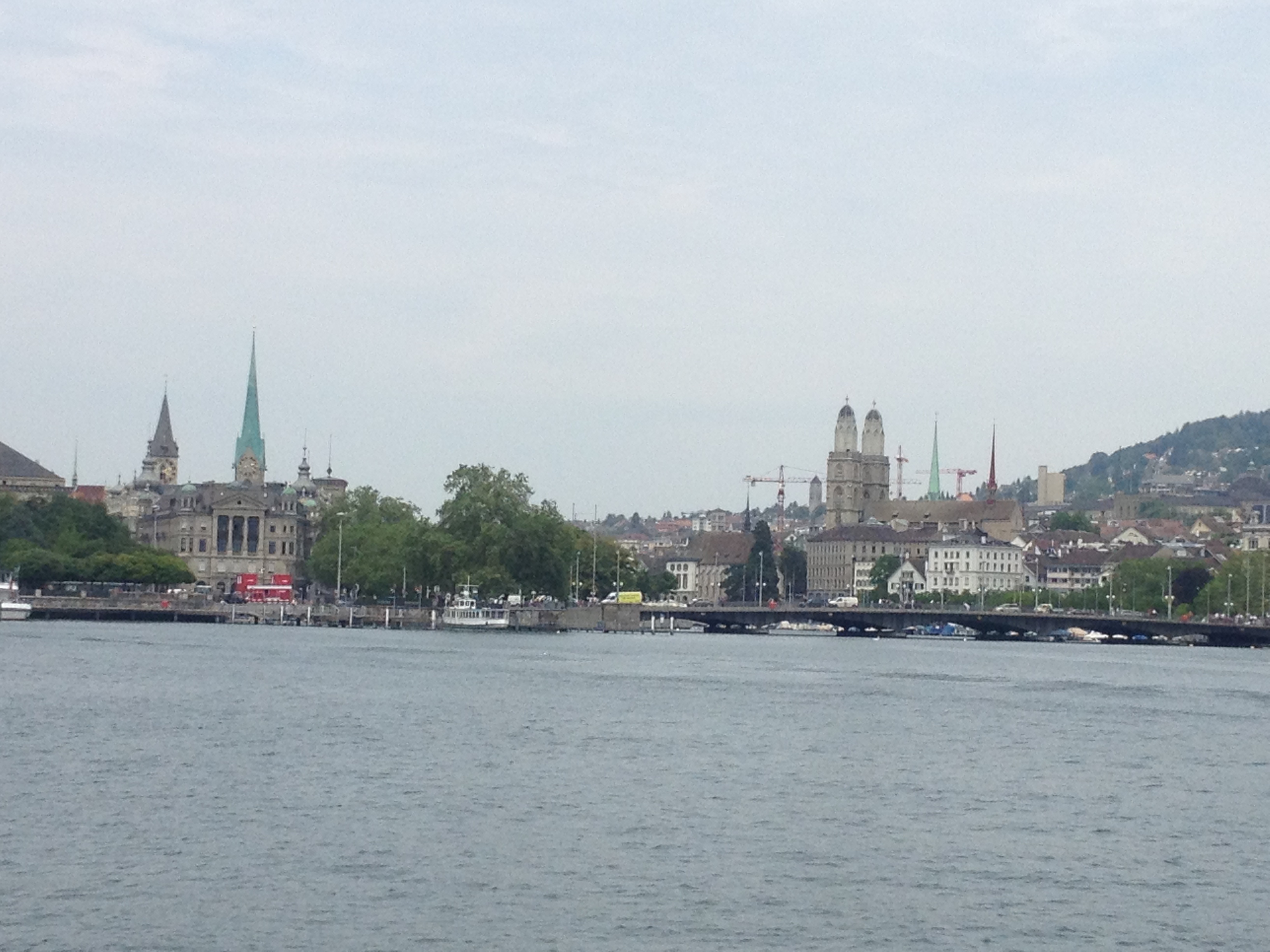
The main centre of Zürich as seen from the ferry on the lake.

The main centre of Zürich as seen from the ferry on the lake.

***

After my tour across the lake, I returned to the shore where I had plans to meeting some. Robin was to be my second Couchsurfing host in Zürich. Originally I had had three lined up: Umer had been the first and Robin the third, but my second host had to cancel at the last minute, which was why I was staying an extra night with Umer’s parents. Robin currently had a friend staying with him, which is why I could not come to stay with him any earlier, but when I told him Umer was going away he said he would be more than happy to meet up to see some more of Zürich with me. When I told him about the pass I was using for the day, he suggested we catch the train south west, just outside of Zürich to the mountain Uetliberg, which was another popular site for recreational activities in the city. Robin’s friend Tammy was busy filling out an application – the two of them were Chilean, with Robin living and studying here and Tammy visiting him, but also applying for courses so that she might be able to come back and live here too – so it was just the two of us as we hopped on the train and set off up the mountain.

As I chatted with Robin, he confirmed what I had observed from the boat – that everyone in Zürich was slightly obsessed with physical activities and outdoor recreation. The bike on the train up the mountain had quite a few people with mountain bikes, which they would ride down steepest parts of the mountain, following the popular trails before turning around and riding back up again. The public transport passes in Zürich ran on 24 hour period, so you could ride as many times as you liked as long as you were in a zone that was covered by your ticket. Robin had to buy an extension on his regular ticket, and off we went along the train towards the mountain. We got chatting along the way up – Robin was a sweet, short and soft-spoken guy who spoke with a pretty heavy accent. He was currently living in Zürich doing research and writing a Masters thesis, about a particular niche in microbiology that I would struggle to reiterate in any further detail, but it was definitely quite interesting.

When we reached the Uetliberg station – it was only about a 20 minute trip – we headed along the short hiking trail that led to a lookout. On the way we saw dozens more people out and about, who were doing a whole manner of exercising such as running, jogging, riding bicycles, and even taking part in what seemed to be some kind of boot camp drill work out. Robin and I casually trekked our way up the hill and dozens of people passed us by – we had all afternoon while Tammy filled in her application, so there was no rush. We eventually reached the lookout at the top peak of Uetliberg and gazed out over the impressive view. There was a metal tower that looked something like a huge lightning rod that we were able to climb, so Robin and I marched up the stairs to the viewing platform at the top. From there you could see the around the whole mountain, the horizons lined with even higher mountains that were cloaked in clouds and a pale pink afternoon sunlight. Up there the air was so fresh, and I breathed in a lungful as I soaked in all my surroundings. Robin pointed out a few of the natural features of the area, and we chatted about each of our home countries, our travelling experiences, and our impressions of Zürich. The nice thing about Couchsurfing is that no matter who you end up meeting or staying with, there’s always at least one thing you usually have in common – a passion for travelling. It’s the reason most people get involved – to be able to go travelling themselves – and in turn allows other people to go travelling and see the world. The more experience I had with the website and organisation, the more amazed and impressed I was at such a simple idea that very could very literally change lives.

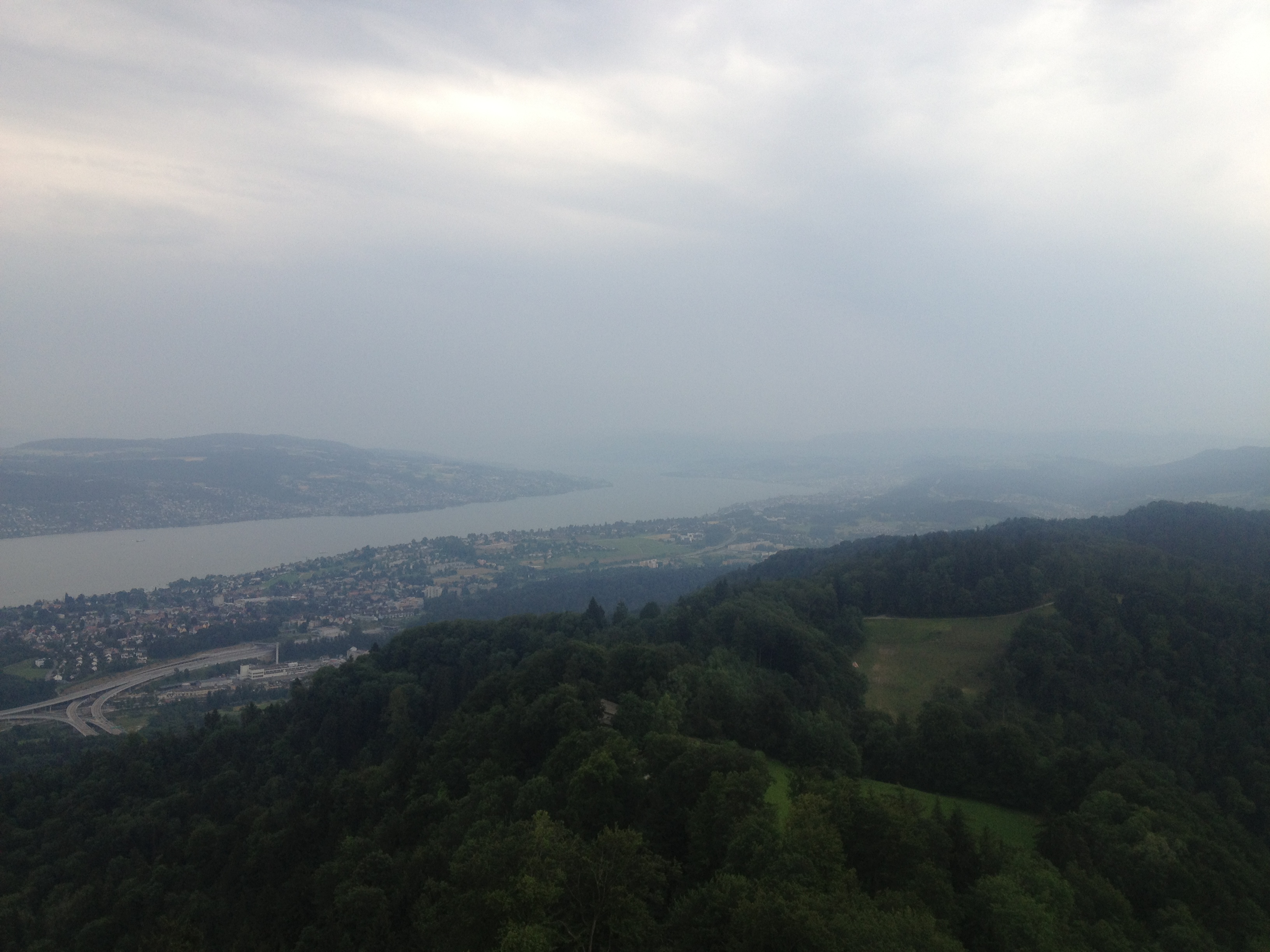
The sun setting behind the clouds, as seen from Uetliberg.

The sun setting behind the clouds, as seen from Uetliberg.

The view from the tower at the top of Uetliberg.

The view from the tower at the top of Uetliberg.

After soaking in the sights from the top of Uetliberg, Robin and I headed back to Zürich to meet up with Tammy, and once we did we headed to the west of the city, where Robin told us there was an outdoor concert happening. He didn’t have too many details, but he thought it might be something cool to check out, so we jumped on a bus across the city. When we arrived, we found what seemed like a huge picnic in a park, with people spread out across the relatively small stretch of grass. In the corner, a large folk band was playing all kinds of music, and there was a crowd who had gathered around them to watch. We bought some snacks from a nearby store and laid out on the grass, listening to the music from across the park and just hanging out, enjoying the cool, pleasant evening air. It was actually getting quite late, but twilight was still lingering over the city, and there didn’t appear to be any signs that the party would be dissipating any time soon. I had to get home though – I hadn’t told Umer’s parents what time I was expecting to be home, so I didn’t want to keep them waiting too late into the evening. I bid farewell to Robin and Tammy for the evening, making plans to see them again when I arrived at Robin’s place the next morning to stay with him for my last two nights in Zürich.

***

The following morning I left Umer’s parents place and made my way to Robin’s. He would be working during most of the day, so that’s when I would do my typical and touristic sightseeing, but in the afternoons when he was free Robin introduced me to some of the activities he did during his spare time and, like any typical resident of Zürich, those were outdoor activities. Enter slacklining: a sport that holds a lot of similarities to tightrope walking – you are required to balance on, and walk across, a piece of nylon or polyester webbing that is tensioned between two anchor points. However, the main difference is that while a tightrope is rigid and taut, a slackline gets its name in having a considerable amount of slack – it is stretchy and bouncy, almost like a long and narrow trampoline. The more extreme variations of slacklining involve doing it unsupported in crazy places such as between skyscrapers or mountain peaks, but Robin was taking me to learn in a much safer but still rather exciting place: over the River Limmat.

We got to one of the bridges that crossed the river, down near the riverside bars where everyone had congregated on the warm, sunny afternoon. We weren’t the only ones setting up a slackline over the river – there were two other guys setting up a much longer one than Robin’s, from the bridge to the rivers edge. “That guy is very, very good. He does it professionally,” Robin said as we set up our slackline. There were a couple of guys walking along the other slackline, but one of them was obviously extremely experienced. He would stop in the middle of the line and do all sorts of acrobatic tricks, bouncing on the line and landing on one foot, or even on his hands, pushing himself back up to keep bouncing and even walking across the line. It was seriously impressive. Robin had only been getting into slacklining recently, he assured me, so he wasn’t that good. I assured him he would be better than me, but nevertheless I was still keen to give it a go.

Once I first stepped onto the line, I realised how sensitive and reactive the slackline was to my body. It wasn’t too windy that afternoon, but as soon as I stepped out onto the line it violently shook from side to side, like a leaf in a hurricane. Robin held my hand to steady me as I took my first step, but he couldn’t take me the whole way. I tried my best to stay balanced, but as soon as I took my first step on my own, I came tumbling down to land in the river. I plunged into the cool and deep blue water, and when I finally resurfaced I realised that I had already floated a couple of metres downstream. The river was flowing exceptionally fast, to the point where if I tried to swim upstream, it was the equivalent to running on a treadmill – going nowhere fast. I quickly swam back to the edge of the river to rejoin the others on the bridge. Robin was definitely a lot better than myself at the slackline – for the first time ever he managed to cross the whole way across the slackline without falling off. That only happened once though – most of the times we both always ended up plunging into the river. I quickly learnt that you can’t be afraid of falling, and when you do fall you have to let it happen and not fight it. The one time I panicked and tried to stay on the line, I fell so awkwardly that I landed on my back in the water, and the impact left a huge red mark on my back that attracted quite a lot of comments from passers by.

Slow and steady across the slackline...

Slow and steady across the slackline…

... keeping his balance...

… keeping his balance…

... and he made it!

… and he made it!

Getting ready for my first attempt on the slackline.

Getting ready for my first attempt on the slackline.

The first, and only, step...

The first, and only, step…

... and down I go.

… and down I go.

Splash!

Splash!

That wasn’t the only reason strangers talked to us, though. The shared love of outdoor activities seems to seamlessly bring all surrounding people from all walks of life together, and make new friends out of complete strangers. Robin and I had plenty of people come up to us and ask us questions about slacklining – most of which I couldn’t answer, though – and asking if they could have a turn. The area was already pretty social with the bars lining the river, as well as a bunch of other cool things – there was a restaurant that also doubled as a DIY garage where people could come and use tools to fix and customise their bikes – so the slacklines on the bridge were just another added element to that friendly social vibe that seemed to be almost everywhere in Zürich. It made for a fun and interesting social experience – all the activities that were happening around the city made me realise something about my life back home: I didn’t have very many hobbies. The closest thing I had to a hobby was playing guitar and writing music – other than that, I just spent a lot of time drinking with my friends and going clubbing. It was a refreshing change, and I think that afternoon was when I made a pledge to myself that when I got home, I was going to find fun new things to do with my time other than drink myself stupid.

It was also an exhausting afternoon though, so afterwards Robin and I headed home for a relatively early night. We sat up for a while just chatting in his room though – there’s just something unnatural about going to bed before the sun does.

***

The following evening we set out after Robin finished work to meet some people in a nearby park. “I haven’t met these people, but there’s a group on Couchsurfing that organises hikes and other outdoor trips and stuff,” Robin told me as we made our way there. “We’re planning something for this weekend, so we’re meeting up to go over the details.” It made me realise that Couchsurfing wasn’t just a place to stay – it was a global, online community. When we arrived at the park, it was a similar sight to my first night in the park with Robin and Tammy, except instead of lazily enjoying the outdoors, everyone was extremely active. There were games of volleyball and soccer, people doing yoga and other aerobic activities, people throwing balls and frisbees, and Robin even brought along his slackline again, and set it up between two trees. It was quite remarkable to see so many people outside until the very limits of daylight. “It really is the summer drawing everyone out,” Robin later said. “The winter was horrible this year – it lasted five months and it was terribly cold, so everyone is very excited now that the warmer weather has finally arrived.” It was a familiar story that I had been hearing for the last month from all over Europe, from Finland and Sweden to Germany and even France. Not so much in Spain and Italy, but I had started heading north again, away from the Mediterranean.

It made me realise just how lucky we are with the weather in Australia, especially the temperate climate in Sydney. It’s never exceptionally cold, and only very occasionally does it get extremely hot. We get a healthy balance of rain and sunshine and we never have days with extreme excess, or lack, of sunlight. Watching these people flock outside to enjoy the weather made me realise just how little I appreciate the weather here, and so in Zürich I made a pact to myself to not only get a few more hobbies when I got home, but also to get out and enjoy the outdoors a little more too.

Swiss Secrets

After a long day of trains and transfers, from Ancona to Bologna, then Bologna to Milan and from Milan to Zürich, I finally arrived in one of the biggest cities in Switzerland, which in reality felt more like a large town than a small city. It was an exhausting day though – one of the most tiresome things about travelling is actually being in transit, and I was usually pretty shocked at how tired I would feel after simply sitting down on a train all day, although by now I was starting to get used to it with all the trains I had been catching around Europe. When I finally stepped off the train at Zürich, I was greeted by my next Couchsurfing host, Umer. Much like Ike had sent me the invitation to visit Ancona, Umer had seen my profile among the people who had listed that they were travelling in Europe, and had messaged me offering a place to stay with him should I ever find myself in his city. Such offers ended up shaping my trip quite a bit, since I had no set or definite plans myself, and I had had no success in finding hosts in any other Italian cities I might have been interested in seeing. I was also acutely aware of the approaching expiry date of my Eurail pass, so I had to make sure I had completed my circuit around Europe before that time arrived.

From the moment we met, Umer displayed a bright and bubbly personality. He helped me find an ATM to withdraw some money, since Switzerland doesn’t use euros like most of its neighbouring countries, but instead has held onto its original currency, the Swiss franc. As we made our way out of the train station, Umer reached into his satchel bag and brought out a bottle of light brown liquid. “Now, you have to try this. This is Rivella. It’s a Swiss soft drink, made right here in Switzerland, and it’s pretty popular. It’s one thing that you just have to try.” It looked like the colour of ginger beer, but it was made from milk whey, but I couldn’t really tell you exactly what it tasted like. It was fizzy, but it wasn’t entirely sweet either, and had a odd aftertaste. I could only manage half the bottle before I handed it back to Umer, but I still hadn’t made up my mind as to whether or not I actually liked Rivella.

Statue of Richard Kissling, a Swiss sculptor, outside the train station.

Statue of Richard Kissling, a Swiss sculptor, outside the train station.

We hopped onto one of the numerous trams that made up Zürich’s impressive public transport system. The system is comprised of trains, overground trams, buses, electric buses, a cable car and regular ferries across Lake Zürich, and the system was so comprehensive that I couldn’t imagine why anyone would bother driving anywhere in the city, when public transport could literally take you everywhere. As we travelled through the city centre, Umer pointed out various attractions that I should come back and visit and photograph later, when I wasn’t carrying my large bag. Umer wouldn’t be able to return with me, though. The following morning Umer had to fly out of Switzerland for a work trip. However, he’d agreed to let me stay at his place for one more night without him, since he lived with his parents who would be home for that time. I had had another host lined up for that next night, but they had cancelled on me last minute. Umer also gave me a very serious warning about tickets on public transport. “If you don’t have a valid ticket, its an on-the-spot 100 franc fine. If you don’t have it on you, police accompany you to an ATM so you can get it, and if  you can’t pay it then they put you in gaol.” He told me a couple of horror stories about previous Couchsurfers of his who had been hit with the whopping fine, and even though I had been happy to risk it several times while travelling on the U-Bahn in Berlin, I decided the risk probably wasn’t worth 100 francs, and definitely not worth spending time in a Swiss gaol. Luckily, Umer had brought along his dad’s monthly public transport pass for me to use, so I didn’t have to buy a ticket that afternoon.

The Swiss flag (although this one isn't in the traditional square shape).

The Swiss flag (although this one isn’t in the traditional square shape).

***

Umer was a fantastic guide, even from the confines of the train, teaching me random bits and pieces about the history of Switzerland, and other interesting facts. After I confessed to him that I originally thought that Zürich was the capital of Switzerland, not Bern, he told me that the city only serves as the capital for international purposes, and that most of the regions within the country are pretty autonomous. “Switzerland really is all about being neutral,” he elaborated. “None of the other cities really have sovereignty over any other – it’s all quite self-sufficient. It’s also one of the few countries that has a square shaped flag, and not a rectangle. The equal sides represent equality in all parts, and that idea of remaining neutral.” Who knew there could be so much history behind a flag? We also got off and had a wander through the downtown area, and passed the Limmat River, which flows out of Lake Zürich. “The water quality in the river is so high that it’s practically drinking quality. It’s mostly freshly melted ice from out of the Alps, so it’s so clean,” Umer said as we strolled by the water that was a bright shade of blue. “We don’t really have beaches around here, but in the summer time you can always find people swimming in the river and hanging out by the bars along the waters edge.” I made a note of it, since my good luck streak with the European summer weather was forecast to continue.

But our stops along the way were all really brief. “I’ll let you take your time with the sightseeing when you come back tomorrow,” Umer said. “For now, I want to show you one of my favourite things in Zürich that you probably wouldn’t see as an ordinary backpacker.” And so we eventually arrived that Thermalbad & Spa Zürich, a thermal bath and spa house whose design still held remnants of the ancient Irish-Roman bathhouse that had once stood in its place. “I love coming here”, Umer told me. “Just wait until you get inside.” We paid, entered, and got changed into our swimwear before entering the complex. The whole place felt like a Buddhist temple in that it was extremely calm and relaxing, but when you looked up the roof was old and arching domes made of ancient bricks and stones. We relaxed in the warm bubbling water, which was apparently drawn straight from natural springs that existed under Zürich, and was full of revitalising and rejuvenating minerals. It was actually the perfect relaxing experience after the long, exhausting day of train travel. There was also a mediation pool, where you could lie face up in a shallow body of water, and when you put your ears in the water you could hear soft, tranquil music playing. The whole place had quite a mystical feel about it.

However, the best was yet to come, Umer assured me. Once we were done on the lower levels, we got into a lift that took us up to the top floor. We stepped out of the lift and straight down into a staircase that led into the bubbling water, and rounded a corner and passed through a plastic curtain… which led us out onto a rooftop spa, with panoramic views of the city. The sun was slowing setting, hanging between the mountains, and the view was absolutely breathtaking. “You should see it in the winter when its snowing, it’s pretty amazing,” Umer said, and I could only imagine that the juxtaposition of temperatures would be rather incredible. So we sat up there on the rooftop spa as twilight sank over Zürich, sharing Couchsurfing stories and telling him all about my travels, much like I would have done with any new host, but in a quite a unique setting. Umer was right – it was a pretty special place, and once again I was grateful that Couchsurfing had been able to introduce me to some experiences that I would had never have had without it. Afterwards we headed back to Umer’s house, where his mother made us some dinner and then I promptly crashed, feeling incredibly relaxed after my time in the spa that had felt like something out of a dream.

I wasn't able to take one, so I stole this photo from the Internet - but I couldn't not include a picture of the amazing rooftop spa and the view that it offered.

I wasn’t able to take one, so I stole this photo from the Internet – but I couldn’t not include a picture of the amazing rooftop spa and the view that it offered. Image courtesy of: http://www.somestepsaway.com

Recovery: From the city to the sea

I watched the Italian countryside whizz past me as the train carried me away from Rome. Eventually the train tracks became parallel with the seaside, and I gazed out into the distance over the Mediterranean. In one short trip I was going from coast to coast in Italy, from the capital city of Rome to the tiny port town of Ancona. “Ancona?” Valerio had asked me with a very confused expression, when I had informed him of my next destination. “Nobody… I mean nobody, goes to Ancona. Pass through maybe, but… well, there’s nothing there!” Ancona was a regular port for ferries that routinly carried passengers from the east coast of Italy to Croatia and Greece. It hadn’t exactly been on my high priority list of places to see, but while I had been searching desperately for a place to stay in Rome via Couchsurfing, I had received a message from Ike.

The interesting thing about Couchsurfing is that you can send requests to potential hosts, but you can also publicly post your travel itinerary so that hosts in areas where you are planning to travel are able to find you and invite you to stay with them. The majority of people who I have spoken to about this assured me that that was way too creepy for them, and that they wouldn’t just accept offers from random people they didn’t know, but my journey so far had showed me that taking a chance on the generosity of strangers can sometimes have the most rewarding results. I had been looking for other places to stay in while travelling Italy, but so far all my other searches had been unsuccessful. Meanwhile, Ike had sent me a message saying he had noticed I was travelling through Europe, and that if I ever made it to Ancona he would be happy to host me. We had stayed in correspondence during my frantic search for hosts in Rome and my breakdown in Madrid, and from what I could gather he seemed to be a nice and rather genuine guy. So when I arrived in Rome and had to make plans for my next upcoming destination, I agreed to visit Ike in his sunny little corner of Italy. Four days later, and I was stepping off the train into the blistering afternoon sun, where he was waiting to pick me up.

Ike was a fun and outgoing guy with a cheeky sense of humour, and just like when I had met Stefan – who had also stayed with Ike – we got on well straight away. I knew I had made the right decision in coming here – better to spend a couple of days in a town you’d never heard of with a fun stranger than wander around a well known city by yourself. I’d done plenty of that in Rome, so during my time in Ancona I was determined to do absolutely no sightseeing. I needed a break from all that. When we got back to his place, Ike showed me a map of the area and a bunch of information pamphlets about things to see and do. “There’s a short historical walk through the main centre,” he said, pointing at the map to a spot in the centre of town – Ike lived a little further up one of the many rolling hills that surrounded the port, about a 10 minute drive from the train station. “Stefan was very into that kind of thing, but I’m not sure what you want to do while you’re here.” I told Ike that I would be happy to find a spot on the beach and just chill out, so he gave me a few options for the nearby beaches that I could try, most of which were pretty easily accessible by bus. “I’d love to come with you if I had the time, but unfortunately I’ve got to work.” Ike even had to go back to work that afternoon, so he left me at his place to do some laundry and get some rest. When he got home, Ike cooked dinner and we had a night of great conversation over a bottle of wine. We talked about travelling, our Couchsurfing experiences, and he even taught me a couple of phrases in Italian. It was a fun and carefree evening, and I was already very pleased with my decision to stop by Ancona and take some time out in this Italian hideaway.

***

The next day Ike had to go to work again, so after a bit of a sleep in and a lazy morning, I caught a bus down the hill to the city centre and then transferred to another bus that would take me to the nearby beach of Portonovo. The bus was crowded with lots children and teenagers, and it was only then that I realised it was the height of summer and that school was probably out, and everyone in town would be heading for the beach. It also took a little longer to get there than I had anticipated – I was on the bus for over half an hour, going up and down the twisting and winding hills of the outskirts of Ancona before we finally arrived at Portonovo. I wandered through some of the shrubbery around the bus stop and down through a small woodland area before emerging onto the beach. The area had a handful of restaurants and other overpriced-looking places where you could hire beach chairs, but I bypassed all that and went straight to the waters edge.

There, I faced a problem that I hadn’t really faced since I’d been in Thailand – I was alone on a beach with a backpack containing valuables such as my phone and wallet, and I had no way of properly securing them. Even if I was to put a lock on my bag, there was nothing stoping someone from simply running away with it. The beach was fairly crowded, but not so much that I wouldn’t be able to see my things if I left them in plain sight from the water, and it was too hot to not go swimming. In the end I just had to take a chance and leave my backpack while I went into the water. I never swam too far from where I’d left it, but I was a little more relaxed than I had been on the beach at Ao Nang. And it was worth it – with the hot sun beating down on the crowds of beach goers, the cool blue water felt absolutely amazing to dive into. When I’d had enough of that, I crawled back onto the beach, lathered myself in sunscreen, and laid down to soak up some rays. I think it was something I’d first noticed lying in the park in Christiana during my time in Copenhagen, but the sun in Europe just doesn’t seem to be as strong as it does down in Australia. Obviously Italy has a lot stronger sunshine than Denmark – Ike told me he regularly uses 50+ SPF sunscreen – but compared to the sun in Australia it felt like a casual warm day. I was very conscious of my sunscreen use though, which allowed me to relax enough to actually doze off into a state of semi-sleep more than a couple of times. It was the perfect temperature, and I stayed there on the beach for as long as I dared before I thought there really was a chance of me getting significantly burnt.

The refreshing blue waters of Portonovo Beach.

The refreshing blue waters of Portonovo Beach.

Lots of people set up camp for a day on the beach in the gorgeous sunshine.

Lots of people set up camp for a day on the beach in the gorgeous sunshine.

I took one final dip in the ocean before heading back to the bus stop, and indulging in some amazing Italian gelato while I waited for the bus. When the bus finally arrived, slowly making its way down the hill from the highway, I hopped on board, thinking it would take me back to the centre of Ancona. I was surprised to find that its final stop was simply at the top of the hill. “Last stop – everyone off,” the bus driver called out to me. It was definitely up there in my travel nightmare scenarios – being forced off the bus but having absolutely no idea where I was or how I was going to get back. However, when I hopped off the bus I was momentarily distracted by the field of sunflowers that spread out in front of me in the paddock beside the road. I took the opportunity to take a few photos, and just sit back and marvel at the Italian countryside and the picture perfect landscape I had laid my eyes on.

The sunflower fields just next to the bus stop by the beach.

The sunflower fields just next to the bus stop by the beach.

But then it was back to panicking. Another bus with the right number came along, so I hopped on. It took me… back down to the beach. What the Hell was going on? I decided to swallow my pride, realising I needed help, and approached the bus driver, crossing my fingers and praying he spoke some English. I explained where I wanted to go, and he knew enough to understand and give me a reply: “Ahh – next bus!” I sighed, knowing it was about as much help as I was going to get, and stepped off the bus. It wasn’t too long before the next bus came trundling down the hill, and when it finally did I was relieved to feel it make the turn onto the main road that led back to Ancona. I had given up trying to understand how public transport timetables – or indeed, any kind of timed service – operated in Italy. I’m not one for generalising stereotypes, but I can honestly say that chronic lateness was something that I experienced in pretty much all public services in Italy. Countries like Italy and Spain are currently suffering from unbelievably high levels of youth unemployment, but I can’t help but wonder if the people who were actually employed were doing any more work than the people who weren’t.

***

That evening was my second and final night staying in Ancona, so when Ike got back from work we decided to go for a little drive to see some of the other parts around the area that I hadn’t been able to see by myself. We headed south down the coast, admiring the countryside in the dying daylight. At the small town of Sirolo, we stopped the car and got out to watch the sunset behind one of the cliffs. It was nice to be outside of the huge cities for a change, and to experience some very natural beauty such as this. I took a few photos before we continued on to the next small town of Numana. There we got out and walked around the town. It was a little more tourist-orientated than the centre port of Ancona had been, and the streets were quite well preserved in an older, historical style, with uneven tiling and cobblestones lining the streets. We walked down to the docks and looked out over the water as twilight settled in. It wasn’t quite as prominent as the white nights in St Petersburg, but even in southern Europe it still took a very long time for nighttime to actually become dark – often there was still a lot of natural light and visibility as late as 10pm. It was a strange phenomenon that I was only now getting used to.

Overlooking the beach at Sirolo at sunset.

Overlooking the beach at Sirolo at sunset.

The ocean view from our vantage point near Sirolo.

The ocean view from our vantage point near Sirolo.

Overlooking the town of Numana.

Overlooking the town of Numana.

Ocean views as dusk settles over the province of Ancona.

Ocean views as dusk settles over the province of Ancona.

After wandering through the old, steep streets, we headed back to the car and went home. I didn’t ask, but in a small town like Ancona I assumed that there wasn’t much of a nightlife scene, gay or otherwise. Even if there was, I don’t think I would have bothered going. My time in Ancona had been all about relaxing and taking the down time that I had been unable to take in the past couple of weeks. I helped Ike make some dinner and we had some more wine before retiring to bed. He was leaving for a work trip the following day, and I had several trains to catch. But I’d had a fun and memorable few days with Ike in Ancona. He’d told me that it was often just a passing through town for so many people, and that people rarely discovered the little gems of beauty it contained. At that moment, I was eternally grateful that I’d decided to travel the way I was travelling: solo, using Couchsurfing, and meeting all kinds of interesting locals along the way. It assured me that not only was I having an amazing once in a lifetime trip, but that I was seeing parts of the world that many other travels might breeze over without a second glance.