Reflections on the Trans-Siberian Railway

The end was drawing near for the the Vodkatrain tour, and our time as a group was almost over. So I have to admit, I felt a little bad about not getting out of bed the following morning to join the others on the boat tour through the canals and rivers of St Petersburg, but I was far too tired from our night out at Blue Oyster. Though the price of the tour sort of deterred me a little bit as well – it wasn’t ridiculously expensive, but I was aware of the money I’d spent last night. Moving into Europe, I had to face the reality that things weren’t going to be as cheap as they had been in previous places. I wasn’t to fussed either way about the boat tour, and I still managed to see a lot of the city by foot. It was a moment of realisation for me, I suppose, that I wouldn’t be able to do everything, so I had to prioritise and do the things I really wanted to do. I had an epic night out at the Blue Oyster, so I stand by my choice.

I had a slow and steady rise late in the morning, and met Kaylah at Nevsky Prospekt at around lunchtime to go and visit the Peter and Paul Cathedral. We didn’t bother looking in any of the museums – neither of us were entirely in the mood – so we just took some pictures of the buildings and sat down in the sun, admiring the architecture while recapping the frivolous events of the previous evening. “It wasn’t my first time at a gay bar,” Kaylah would later tell me, “but it was definitely the most fun I’ve had in one.” It wasn’t the famed party haven of Moscow, a scene I’m still yet to experience, but St Petersburg definitely had our seal of approval.

The Peter and Paul Cathedral inside the main fortress.

The Peter and Paul Cathedral inside the main fortress.

The Peter and Paul Fortress, view from the outside moat.

The Peter and Paul Fortress, view from the outside moat.

We’d walked across the bridges to get to the cathedral, but we took the subway back, so I could practice catching the metro when I would have to do it by myself in a few days to get to the major train station. The peculiar thing about the stations is that they are so far underground due to all the water and rivers in St Petersburg that they need to burrow under. They’re about two, maybe three, times longer than the “long” escalators in the stations back in Sydney, and since the trains are so fast and efficient I made a joke about half the journey time just being the trip down from the street to the platform. Afterwards, we spent a little while just wandering around the streets, browsing along Nevsky Prospekt, and just getting lost amongst the beautiful city. Literally.
“Err… Kaylah, where are we?” Both of us had grown extremely weary, and had decided to head back to the hostel to nap before dinner.
“Umm, we’re… we’re… umm.”
“Yeah, none of this looks familiar.” We looked up Nevsky Prospekt, and back down the way we came, but for all the times we’d traversed it in the last two days, it was still such a foreign world. It was interesting that I’d come so far to Europe, yet English was so much more scarce then pretty much the entirely of South East Asia, which is a reflection of just how prevalent tourism is down there, and now… not prevalent it is in Russia. That’s not to say there were no tourists – the Hermitage was full of guided tours – but Russia as an economy doesn’t seem to be so dependant on holidaymakers, otherwise the visa application process might not be such a gigantic hassle. Anyway, eventually we just backtracked to discover that we had both blindly walked past the street we were meant to turn off – probably in indication of just how badly we needed that nap.

That evening was the last time we would spend together as a group. We had one last final dinner together, and then afterwards we went to a nearby bar for a last round of drinks. We shared our high points and low points of the trip, reflecting on memories and laughing at all the running jokes that had kept us amused for the whole trip. It was crazy to think that we’d only been together for three weeks, yet we’d grown so close and come so far that it felt liken it had been a lot longer. I found myself feeling a little sad that we were all going our separate ways now – I’d grown used to having travel companions, and the sense of security that a familiar group can bring. In the morning everyone took their leave at various times – Dan and Claire being the first at 5am – and I said a few emotional goodbyes to the people I’d grown quite close with. The numbers dwindled, until finally I was on my own again, and the next part of my journey was about to begin.

***

The time I spent travelling the Trans-Siberian Railway with Vodkatrain was nothing short of incredible, because it was more than just a holiday – it was an experience. As I’ve said before, it was particularly challenging at times, to the point where when I’ve told people about it, they’re not so sold on the fact that I even enjoyed the trip. Perhaps I exaggerate a little, but I honestly think the challenging experiences are often the best. I complained about how the train didn’t have any showers, but in the end it’s really a learning curve about some of the luxuries we take for granted, and I proved to myself that I’m not such a princess when it comes to personal hygiene after all – or at the very least, I can cope when my hot showers are taken away from me. But the challenges weren’t just in the train ride – I was so sure I was going to tip over that quad-bike at Lake Baikal, but in the end I feel accomplished in being able to say I’m slowly regaining my confidence behind the wheel of a motor vehicle.

Then there were the real highlights. I’ll never forget the breathtaking views of the Mongolian wilderness, or the beauty of a fresh, crisp morning at Lake Baikal. All the challenges aside, it was really something to travel overland across such a huge distance and observe the changes in scenery, climate and culture. It was a long way, but the fact that we did it reminds me that it really is a small world after all.

Though the thing that I reflect on most about this part of my journey is my companions. I set out travelling by myself because in previous travels, I’d found some clashes in the way people like to organise their holidays. I’m pretty laid back, and usually not the kind of person who is out the door at nine in the morning to cram as much sightseeing into a day as possible. I enjoyed the leisurely pace through which I traversed South East Asia, and though I wasn’t really concerned as to what my fellow travellers would be like this time, I was just curious to see the types of people who would choose to do this kind of trip, and how they would plan their days.

Everyone on the tour was quite a seasoned traveller. I was glad that I at least had the six weeks of South East Asia under my belt by the time I arrived, but after discovering that I was the ‘baby’ – the youngest – in the group, I didn’t feel quite so bad, and I took it as an opportunity to talk to all these people and learn more about travelling. Rach and Marti were great for that. They’d been travelling the world together for almost 5 years, and Marti always had some tips or advice or recommendations, whether it was where to go or where to stay, what to do and things to be wary of. Kaylah and Alyson had been on a trip to Nepal and Tibet the previous year, so they opened my eyes to some destinations I wouldn’t have ever really considered before now, and Tracy knew a lot from her working as a tour guide in both South America and the Middle East. Most of the group probably thought I was really shy – which I suppose I can be when I first meet people – but most of the time I was just too busy listening.

Because whether it was travel, politics, or the difference in our respective countries health care systems, I found myself surrounded by a passionate group of intelligent individuals, with the perfect combinations in sense of humour, food for thought, and thirst for adventure. I could trek it through those seven time zones again and again, drowning in the Beijing smog, marvelling at the Mongolian wilderness, getting lost on the Russian metro lines and even getting cabin fever in the middle of Siberia, but I think I was incredibly lucky to meet the people that I did, because I feel like they all played a major part in making the trip what it was. I know some of them will be reading this, so thanks for being so amazing guys! Hopefully some of you will feature in some future posts on this blog.

Getting Cultured: St Petersburg and the Hermitage

After what had been a surprisingly good sleep, on what was without a doubt the best train we had been on throughout our entire journey, we woke up to a miserable-looking overcast day in St Petersburg. I was still excited though – partly because St Petersburg was supposed to be a beautiful city, but also because our tour was coming to an end. While I had made a handful of new friends who I had absolutely loved travelling with, I was itching to break out on my own again and enjoy the free and spontaneous style of travelling that I had done in South-East Asia. It was a little funny to reflect on the fact that two weeks ago, I had been yearning for the exact opposite – a little bit of structure, and someone to tell me where I was going and what I was doing. I guess it’s all about mixing it up and trying to find a balance, as well as learning the style of travelling that suits me as an individual. I think I’ve already learnt a lot about myself in that regard, though I do have quite a while to keep discovering.

We met Vladimir, our St Petersburg guide, at the train station, and there was a conversation between Maria and Vladimir that seemed slightly awkward but was entertaining to watch, though none of us could understand what they were saying. Within the first half hour, after dropping our bags at the hostel – actual check-in to our rooms wasn’t until 3pm – and meeting at a nearby coffee shop for breakfast, it was already clear that Vladimir was a very orderly and structured person. He knew the facts about his city: the main sights to see, how to get there, and when they were open – a welcome change from the Kremlin fiasco. It would have been interesting to know what Vladimir had made of Maria’s impromptu excursion to St Petersburg, but he wasn’t one for a great deal of chit-chat, so we never really got a chance to ask him. Another thing we weren’t quite expecting was for Maria to tag along with the group – she’d said she had a friend to visit, but we would later find out that that friend was busy on the day we arrived, and Maria ended up booking a night into the hostel with us. Her spontaneous holiday just kept growing and growing, and while some of the others in the group thought it was a little weird that she had come along for the ride, I just found it simultaneously awesome and hilarious.

***

We had arrived in St Petersburg on Sunday, and our Trans-Siberian tour officially finished on Tuesday. A lot of people were scheduled to leave on that morning, but Vladimir had advised us that the the Hermitage, the famous art museum of St Petersburg, was closed on Monday.
“Well then, looks like I know what I’m doing today,” Tim had said in the coffee shop where we’d had our briefing. “I won’t have another chance to do it, and it’s of the things that I really want to see here.” Alyson had shared similar sentiments, and while there were other ideas among the rest of our party, the familiar grouping of Alyson, Tim, Kaylah and myself all decided to hit the Hermitage that afternoon. While I was actually staying in St Petersburg for two extra days after the tour was over, I could see myself getting particularly lax after the others were gone, so I decided to do the typical tourist things while I was still with my companions, and save the city exploring for when I was flying solo again.

But first we set out as a group to have a tour of the main streets of St Petersburg. Vladimir showed us the way through some smaller streets around our hostel, taking us past a cathedral called the Church of the Saviour on Spilled Blood. It takes the morbid name from the location on which it was built – the site of the assassination of Alexander II in 1881 – but the style is an obvious homage to St Basil’s cathedral in Moscow. The Church of the Saviour on Spilled Blood seemed slightly bigger though, and while I did return on a later, sunnier day to take a picture of the building, as a group we never actually went inside. We continued walking along the streets – stopping at a small souvenir market were I bought a small Russian style pocket watch – until we hit the famed Nevsky Prospekt, a street that in itself was considered an essential St Petersburg experience. A wide and bustling street, it stretches through the southern bank of the city and is home to a number of landmarks, such as the Kazan Cathedral.

Outside the Church on the Spilled Blood of the Saviour, on a less overcast day.

Outside the Church on the Spilled Blood of the Saviour, on a less overcast day.

The Kazan Cathedral - I struggled to get a shot of the building in its entirety, it was so wide.

The Kazan Cathedral – I struggled to get a shot of the building in its entirety, it was so wide.

However, we had arrived in St Petersburg in a supposedly exciting time. It was the city’s 310th birthday, and a major section of Nevsky Prospekt had been closed for some kind of parade. The streets were lined with people jumping up and down to get a glimpse, climbing up staircases and buildings to peer over the amassing throng. I myself climbed up onto a concrete ledge to get a better view, but at the time there was nothing more than a group of cheerleaders doing what appeared to be a poorly rehearsed and actually quite boring routine. I could hear marching bands in the distance, so I figured the entertainment was going to pick up a little, but Vladimir had told us that the lines to get into the Hermitage could be painfully long if you wait too long into the afternoon, so those of us who intended to visit set off up the street, making plans to meet up with the rest of the group for a late lunch.

***

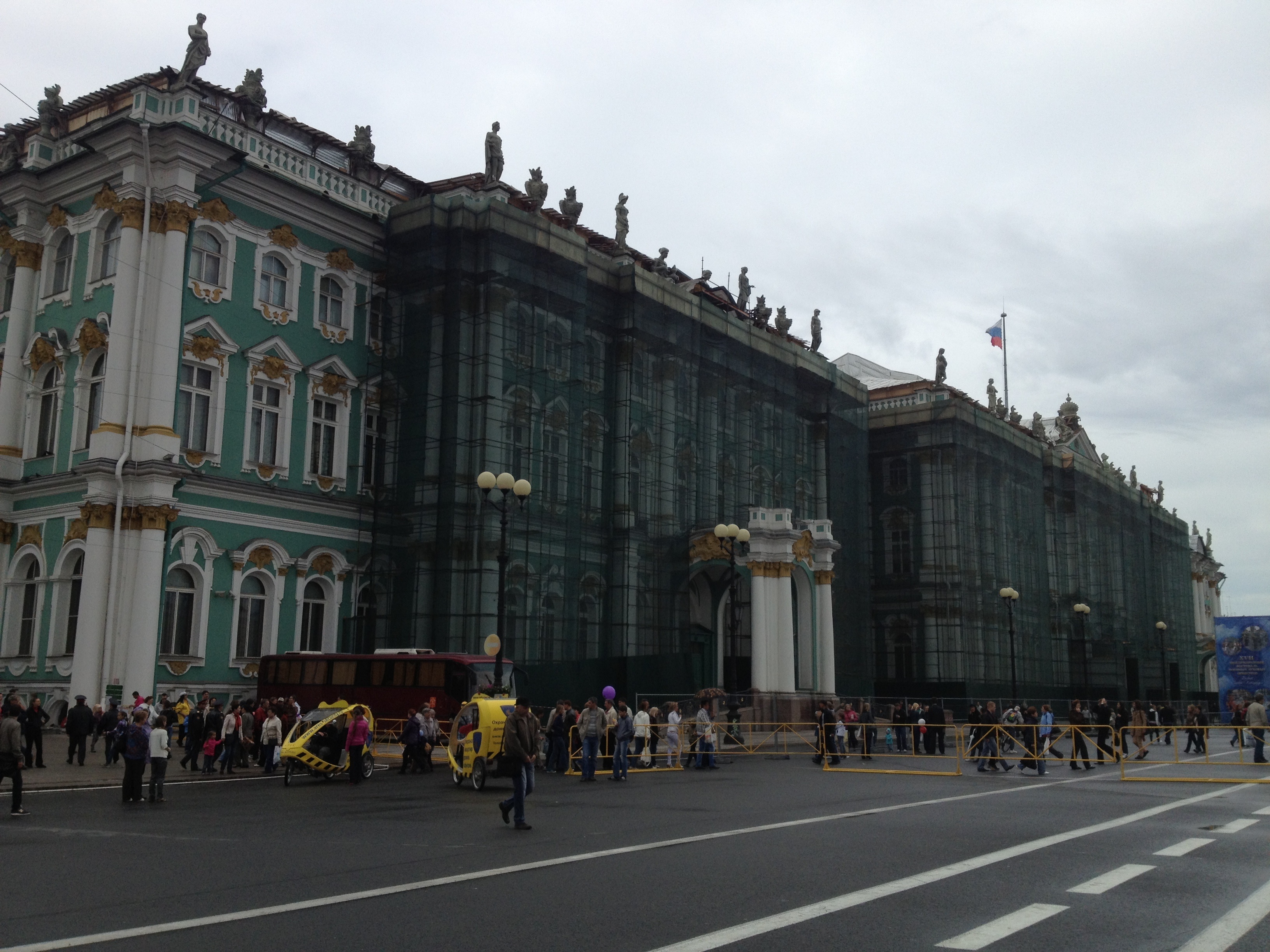
My grandmother had been constantly reminding me to visit the Hermitage, wishing she could have been there herself, so this one is for you, Nana! The main façade of the building, which had originally been used as a Winter Palace, was covered in scaffolding and construction materials, which seemed like a bit of a shame – especially since almost every major attraction I’d visited on this tour was undergoing some kind of reconstruction – but I wasn’t too worried, as it was what was inside the State Hermitage that interested me the most.

Outside the Hermitage.

Outside the Hermitage.

It did not disappoint. From the moment you enter the building, you feel as though you haven’t just visited a museum to view the works of art, but rather you’ve actually stepped into one yourself. The walls and ceilings were decorated with the most lavish and extravagant gold trimmings, and the images of gods and men were carved out of marble and extending their limbs into the cavernous rooms. I spent the first five or ten minutes with my eyes pointed upwards and my mouth agape with wonder, so much that stumbled up a few of the stairs. Alyson had wanted to go off and see the museum at her own pace, and I would have been happy to do the same, though I found myself sticking with Kaylah and Tim for most of the time.

There are several floors in the museum, and it was easy to get lost. A couple of times we found ourselves wandering into dead end rooms, or trying to get into rooms that were unfortunately closed for renovations or refurbishing. We moved through room after room of paintings and sculptures, seeing everything from early European art of classical portraits and flawless scene depictions, to the ambiguous and abstract work of Picasso, to the ancient sculptures of characters and gods from Greek and Roman mythology. I’d like to think I have a little bit of culture in me, but I’ll be the first to admit I’m no art critic, and I certainly know I couldn’t do any better. I liked some of them more than others, but I discovered that I had a particular love for the sculptures. I’d always been quite interested in the mythology of those cultures, and there was just something more interesting about a 3D piece of art that you can literally consider from a number of angles.

There was a statue of a man with an eagle perched upon his shoulder, to which Kaylah had said, “Look Robert, it’s you in Mongolia!” After that, I think we may have been a little delirious, because wandered through the rooms laughing at the simple, unoriginal names – such as Portrait of a Young Man – and generally just making humorous observations about the artworks. We also looked at some interesting Asian art, and I recognised many representations of Buddha that I had seen throughout South-East Asia, and together we also recognised quite a number a traditional Chinese and Mongolian styles of artwork. That made me a feel a little cultured, to know that I had come halfway around the world, and recognising the different styles of artwork and culture that I had seen along the way.

Posing with the statue Kaylah considered my likeness, due to the eagle perched on its shoulder.

Posing with the statue Kaylah considered my likeness, due to the eagle perched on its shoulder.

We spent a few hours at the Hermitage, getting lost in its beautiful and dazzling halls, but in the end my feet grew so sore I could barely stand up. I hadn’t had a shower since our last morning in Moscow, so after the copious amounts of sweating I’d done on that afternoon combined with the overnight train, I could tell I was starting to get a little foul again, and I was ready to head to lunch and then onwards to showering at the hostel. It had been a good day at the Hermitage, but I think the greatest feat of our day was that there had been absolutely no lines to buy tickets or get inside. Despite Vladimir’s warning of waits that can be up to several hours, we walked straight in with such an ease that it almost felt suspicious. We put it down to the fact that the parade had taken up most of the city’s attention, and were thankful that we had decided to visit the museum when we did.

Much More Moscow: Kremlin and State Armoury

After our first failed attempt at visiting the Kremlin, seeing it became the primary objective on our second morning in Moscow. We rallied in the hostel common room bright and early, then made our way back into the city centre. But before that, we had some goodbyes to say. Rach and Marti would be leaving us this morning, and travelling down into Eastern Europe rather and continuing on to St Petersburg. The two girls had definitely been a dynamic presence within our group, and I think most of us were sad to see them go. We went around the group taking turns to hug them goodbye, with warm wishes for the future and promises to stay in touch.

***

Maria had advised us that the tickets to all the Kremlin attractions, including the State Armoury, can sell out rather quickly, so we kept that in mind when we were planning our day. We were so punctual in arriving to purchase our tickets for the Kremlin that I wouldn’t have been surprised if we were the first people there, but somehow there was already a line of tourists waiting outside the security check point out the front of the complex. We purchased our tickets, checked our bags into the holding room and joined the end of the queue. I remembered back to something Kostya had said at Lake Baikal: “Yeah, in Russia… Russians don’t really understand the concept of a queue.” That can be very frustrating, especially in big crowded queues like this one. People would elbow their way in wherever possible, but I think by the end of our stay in Russia we’d learned to play by their rules, and we found that our group – small in comparison to some of the larger tours – was flexible enough to slip in between other people and slither ahead in the “queue”, non-existent in the eyes of Russians.

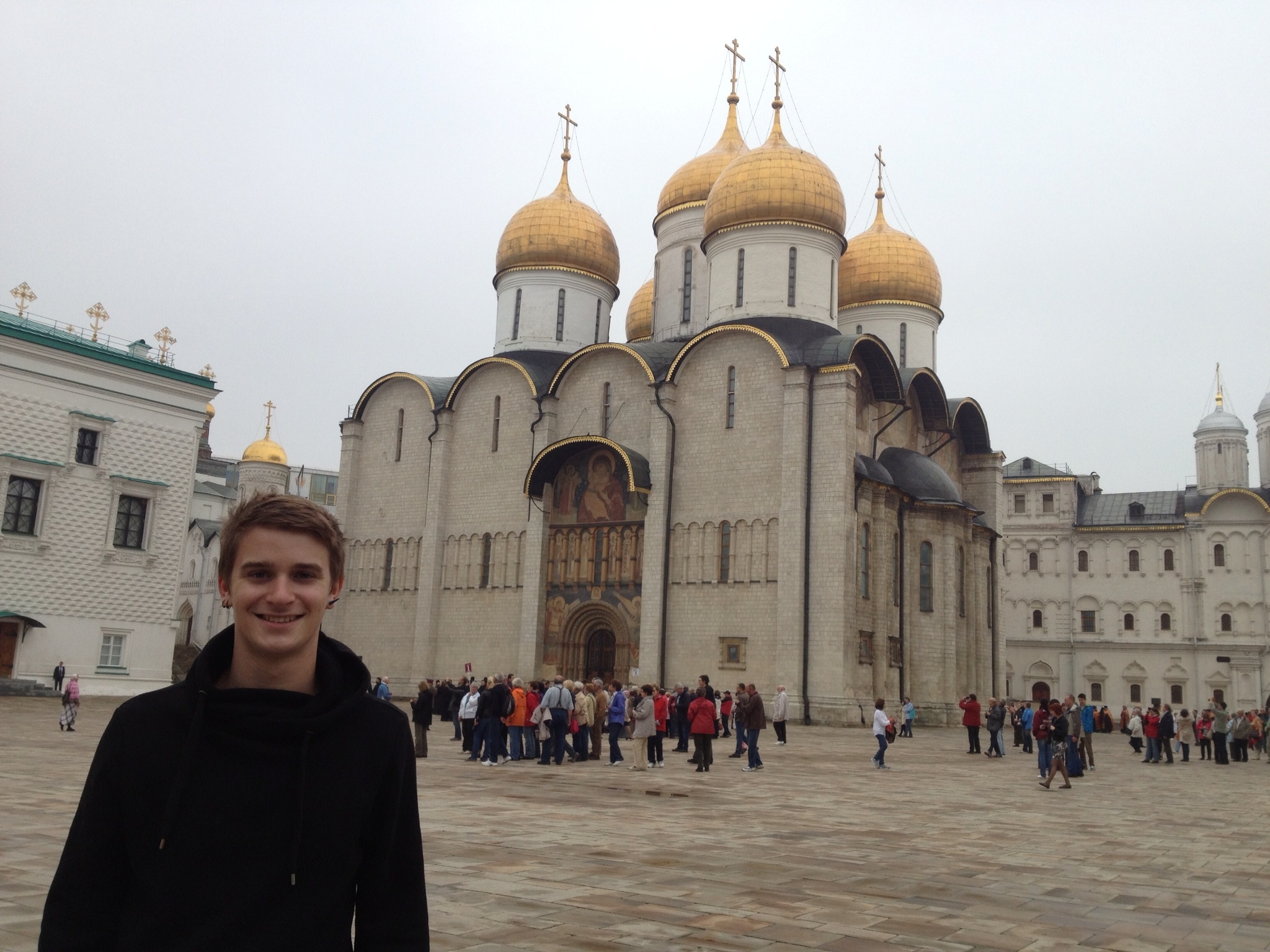
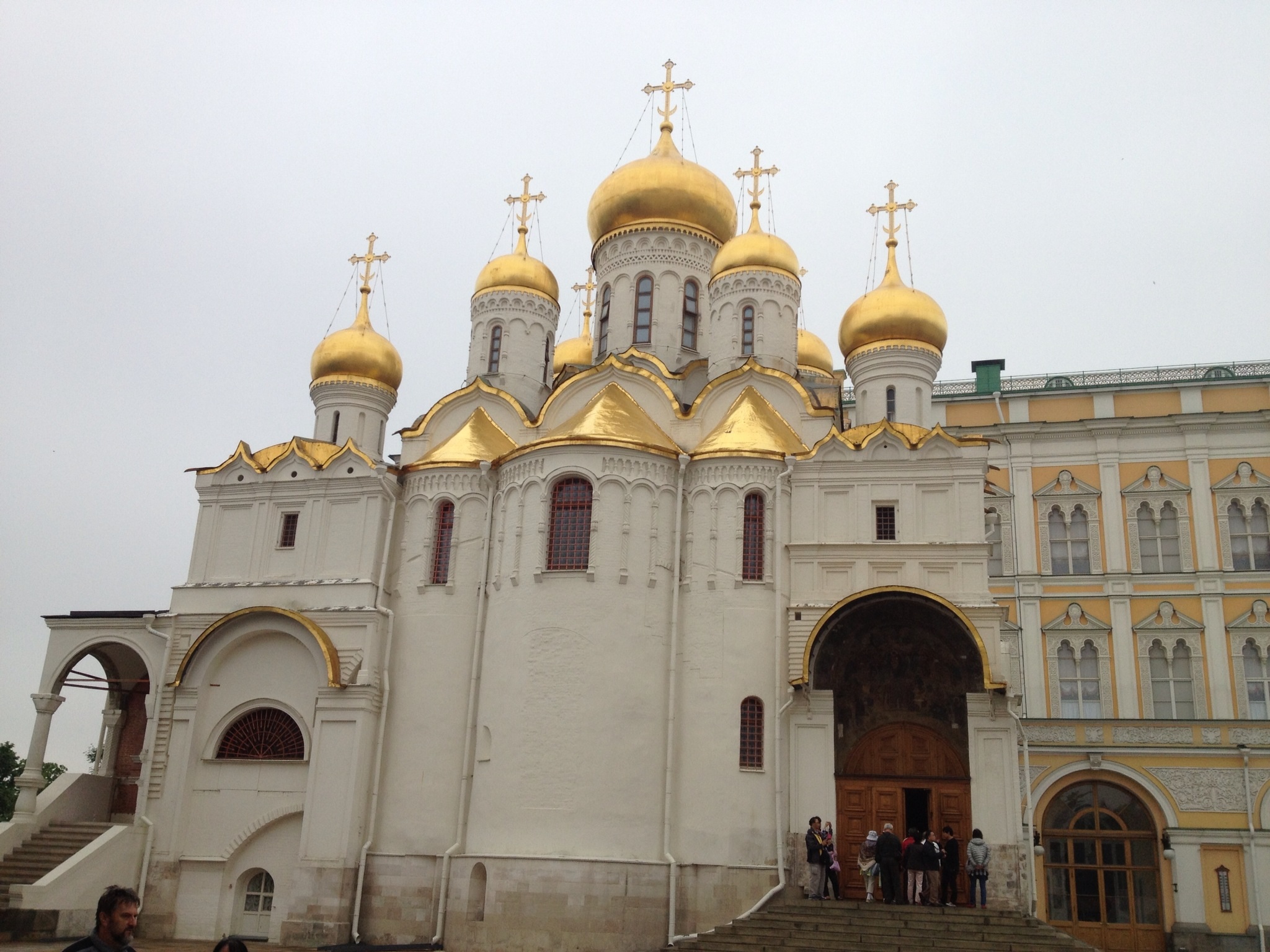
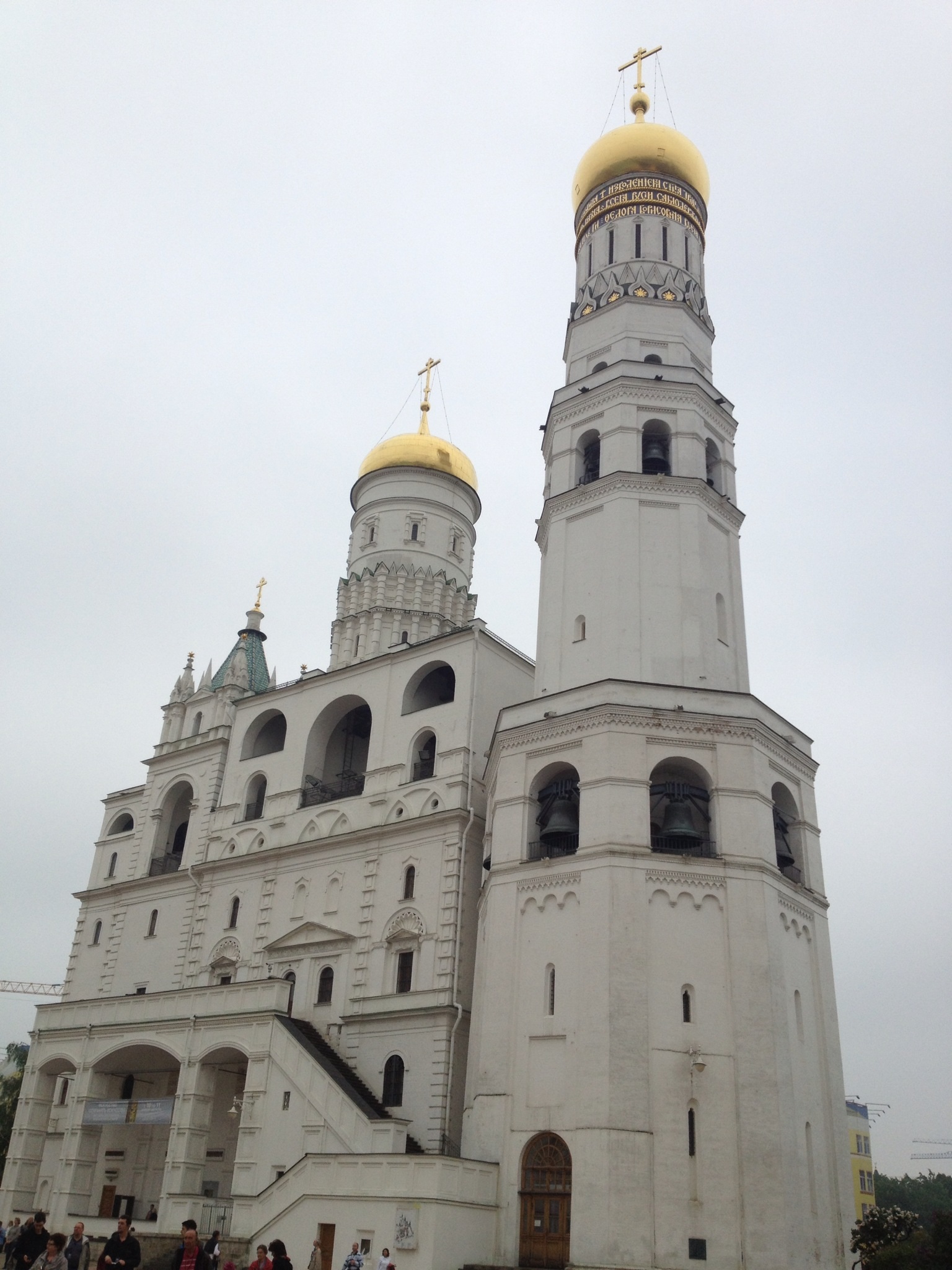
The Kremlin is essentially a huge palace complex that has been the hub of political power in Russia since forever, pretty much, and is surrounded by high walls made of blood red brick. It was once the centre of the Russian Orthodox Church, but also the central office for the royalty and tsars as well as communist leaders and democratic presidents alike. The red bricks surprisingly have nothing to do with the name of Red Square, and are no suggestion to communism either. Later, Maria would inform me that in Russian, the word for red has dual meanings, and that it had actually been the word for beautiful long before it was ever affiliated with the colour. The more you know. The main features of the Kremlin, though, are the churches inside, some of which have been transformed into museums and exhibitions. Most are still very well maintained in their original condition, designs that appeared to be far more modern than the palaces I observed throughout Asia, though can easily be admired as whole pieces of art in their architecture and decoration. They all follow similar Russian Orthodox designs on the outside, but the insides are far more intricate. Most places required the purchase of a permit to take pictures, but I don’t think any photos can really do justice to these places – especially not the camera on my iPhone.

Outside the Assumtpion Cathedral in the Kremlin.

Outside the Assumtpion Cathedral in the Kremlin.

The Annunciation Cathedral.

The Annunciation Cathedral.

The Ivan the Great Bell-Tower Complex.

The Ivan the Great Bell-Tower Complex.

An old Tsar Bell, now on display in the grounds of the Kremlin.

An old Tsar Bell, now on display in the grounds of the Kremlin.

On this particular day, there appeared to be a lot going on inside the Kremlin. Once we were inside the main complex, we stumbled upon a huge congregation of priests who were all dressed up in their very formal robes. We asked Maria what was going on, but she confessed that she wasn’t a very religious person and so didn’t really know much about the occasion.
“Some angels have days, that are holy days that are assigned to them. I think today must be some angels day, and so they are praying and celebrating or something. I’m not sure which one though.” I still didn’t really understand, so I just settled for observing the crowd of devout men and watching them meander about the courtyards, looking rather excited as they chatted amongst themselves. We waited around for a little while, watching the men and listening to some of their singing while we waited for everyone to come outside of the final museum, before heading out of the Kremlin and back towards the ticket box.

The crowd of priests who were standing around in the grounds of the Kremlin.

The crowd of priests who were standing around in the grounds of the Kremlin.

I’m not really sure of the specifics or details of what happened next, since I had been taking a pretty passive role in decision making, happy to visit whatever sights had been deemed must-see. We took our time looking through the churches and various exhibitions, and Maria told us that we would be able to arrive at the ticket booths at 11:15am in order to get tickets to the session at noon. Maria had collected the groups money in order to buy all the tickets, but I came along with her because I was going to attempt to buy a student ticket with my ID – it was my university student card from last year, and I was well aware that it had expired, but the foreign people rarely noticed the expiry date and the savings, particularly for entrance to the Armoury, were worth at least attempting to score the discount. However, literally as we got to the front of the line, the woman selling tickets announced something in Russian over the a loudspeaker. I waited tensely beside Maria, who finally turned to me to translate. “She said that there are no tickets left for the Armoury, so…” She shrugged her shoulders. “I don’t know, I guess we should see what the others want to do.”

The others weren’t impressed. There was another session in a few hours, but I think most of the group had given up and decided we had wasted enough time trying to see these places, when it seemed like a constant uphill battle to even get into them. We ended up separating again after having some lunch, with some people going shopping, and others going for a longer, scenic walk back to the hostel. I returned to Red Square with Kaylah to take some photos, but after that I returned to the hostel via the metro to have a rest. I didn’t gotten a very good sleep the night before, and after talking to Tim yesterday we had decided we might like to go out for a few drinks and see some of the nightlife in Moscow. However, it rained rather heavily that night, which put a bit of a dampener on the mood. We went out to the Moscow Circus and had a beer before the show, but afterwards no one really seemed to be in a partying mood, so we called it a night and headed back to the hostel in the wet weather.

***

I was woken up the next morning by a knock on the door of my dorm. It was Kaylah.
“Tracy and Jenna and I are gonna head back to the Armoury. It’s early enough that we should definitely get tickets.” It was a struggle, but I rushed to ready and head out with them – inside the State Armoury is an opulent collection of treasures and artefacts that is considered one of the major attractions in Moscow, and even though I’d had another terrible nights sleep, I couldn’t justify sleeping in when I knew there was a group planning to head out that way one more time. “Okay, but we need to get back here before noon – we have to check out by then and I’ll have to get my stuff together.”

So off we went to the Armoury. I tried to purchase a student ticket, but unfortunately the woman working had been more attentive than the woman who sold us our tickets to the Kremlin, because she picked up on the expiry date – I still figured it was worth a try. But finally, after three days in Moscow and our numerous trips to this part of the city centre, we finally got into the Armoury. The collection of treasures inside was definitely worth it – all I could think of was how many millions of dollars these items would be worth. Goblets and plates and portraits and books and tea sets and dresses and weapons and – well, the list goes on, but everything was decorated with lavish jewels and pearls and I’m almost at a loss of words for how extravagant it was. It was the kind of extravagance that you only ever really saw in movies, and even then you knew they were most likely props that were worth only a fraction of the real thing. The diversity of the collection was also impressive. Jewelled sword handles and horse armour were in the room next to elegant pearl inlaid gowns, which were in between classical horse drawn carriages and a room full of velvet-lined thrones. We followed the directions of the audio guide tour, seeing the most important and interesting pieces in the collection and learning a bit about their histories.

While seeing the Armoury had been worth the rushed trip, it definitely made the rest of my morning a little more stressful. Firstly, as we walked down the stairs out of the exhibits, I dropped my audio guide. Despite having the safety strap around my wrist for the entire time we were in the museum, is was on the hard marble stairs that it slipped from my grip. It landed with a clatter, and I clutched at Kaylah’s arm when I saw that one of the buttons had lodged loose. I quickly scooped the handheld device up and shoved the button back into place, but the LED screen was starting a flicker, a sure sign that the machines life was about to expire. An endless stream of mumbled profanities escaped my mouth – we’d only needed to leave one form of ID as insurance when we’d collected the devices, but it was Jenna who had left her drivers licence with the desk.
“Just be cool, be cool Robert,” Kaylah had assured me. Once we got the desk, we placed our devices face down, showing the woman behind the counter their numbers, and she returned Jenna’s licence.
“Okay, be cool, stay cool, but go! Go! Go!” I’d whispered to the rest of the girls as we scurried out of the museum and back into the sunshine.

The second thing that made my morning just that bit more stressful was our returning time from the Armoury. I literally ran from the metro station back to the hostel, arriving at 11:58am. Perfect, I’d thought to myself, I literally only need two minutes to gather my things into my bag, I’ll be fine. Unfortunately, the hostel hadn’t been to sure I would arrive back in time, and I found my bag on the floor of the main hall with most of my possessions thrown into two big black garbage bags. Which, honestly, wouldn’t have been that bad. What actually sucked about this was that it wasn’t just my possessions – the bags was a mixture of my clothes and what may have been the possessions of one, or maybe two other guys from the room who weren’t part of our group. I felt kind of bag for that guy(s), because I’m not even positive they were supposed to be checking out, yet they’d had all their things scooped into a bag and thrown into the hall. I had to sit in the common room of the hostel and sort through all the bags to make sure I’d recovered all my things, while the rest of the group sat around waiting for me.
“I’m so sorry guys, sorry for holding us up,” I must have said a dozen times, but they all dismissed my apologies and said it was fine.
“We’ve got the entire day where we don’t have anywhere to be, so we’re not on a tight schedule, don’t worry.” I was glad they were being so nice about it, and as far as I could remember this was the first time I’d ever really had a problem or held the group up in any way, so they seemed fine with it.

Still, I had run all the way back to the hostel, and combined with the embarrassment of sorting though my bag and packing everything while the others patiently watched on, I found myself dripping with sweat. It was a warm, sunny day in Moscow, and I ended up mopping myself down with my towel and changing into a singlet and shorts. When I’d finally packed all my stuff up and put my pack in the storage room, we headed off as a group to get some lunch.
“Wow, Robert,” Don had said as we walked beside me, “You look like you’ve just had a shower or something.”
“Yes, Don, I’m a little sweaty,” I said, feeling a little testy and unable to hold back the sarcasm. “Thanks for pointing that out. I would rather have had a shower, but I’m actually just really sweaty. ” I think it’s safe to say that I wasn’t in a very good mood for the rest of the afternoon.

***

The Russian Market we visited in the afternoon.

The Russian Market we visited in the afternoon.

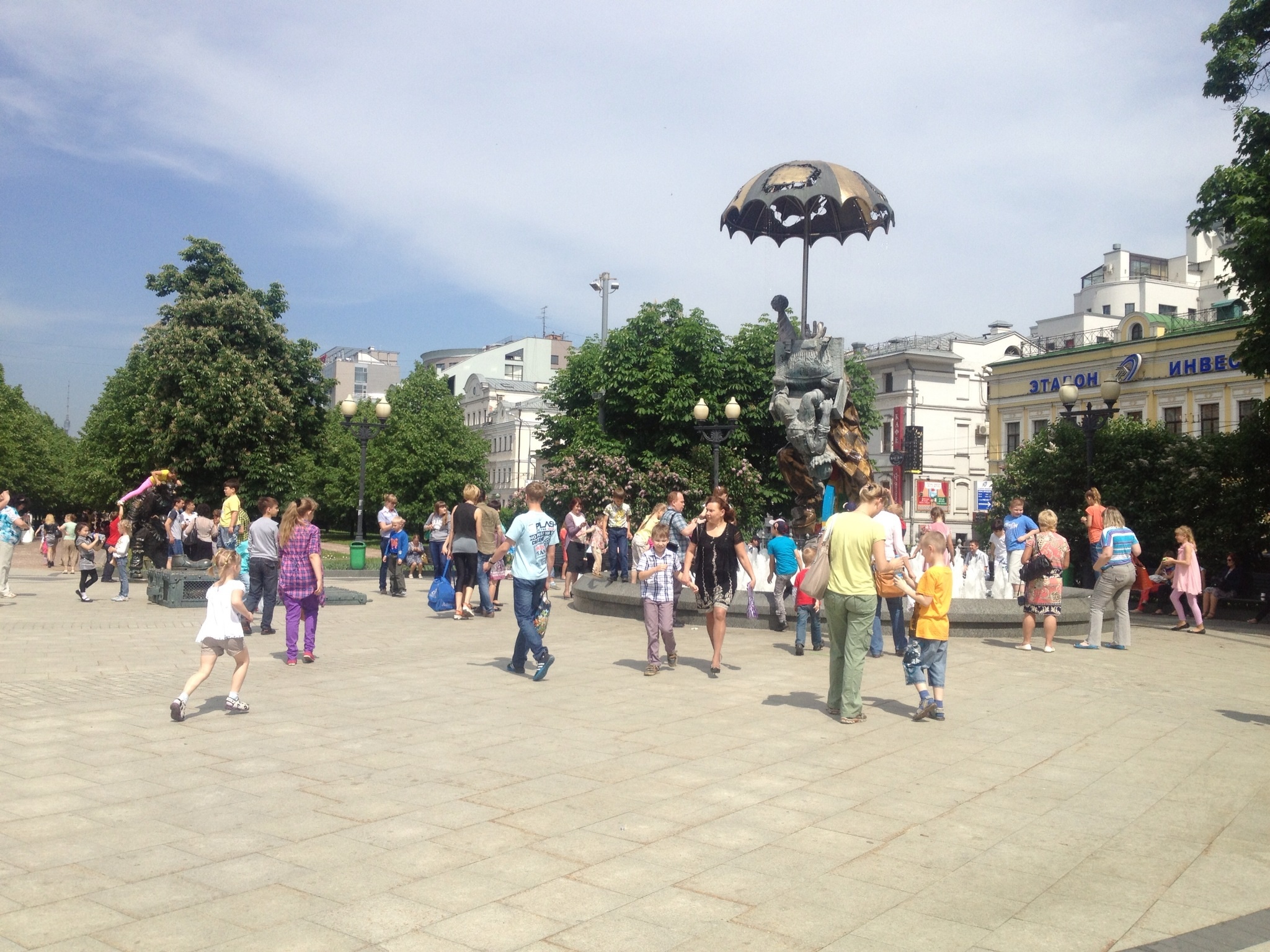
The park where we had lunch, watching the children frolic around in the warm weather.

The park where we had lunch, watching the children frolic around in the warm weather.

The rest of the day was spent as a group, hanging out in a park to eat some street food lunch, visiting a popular Russian market, and finding a few restaurants and bars to have a few drinks in and just hang out, enjoying each others company. I think the long train ride had really brought a lot of us together, but it was nice to hang out with each other in a different, relatively normal environment, although the absence of Rach and Marti was strangely noticeable. But after we whittled the afternoon away, Alyson and Tim and myself had a few more drinks at a pub just near the hostel, and eventually it was time to head to the train station to catch the midnight train to St Petersburg.

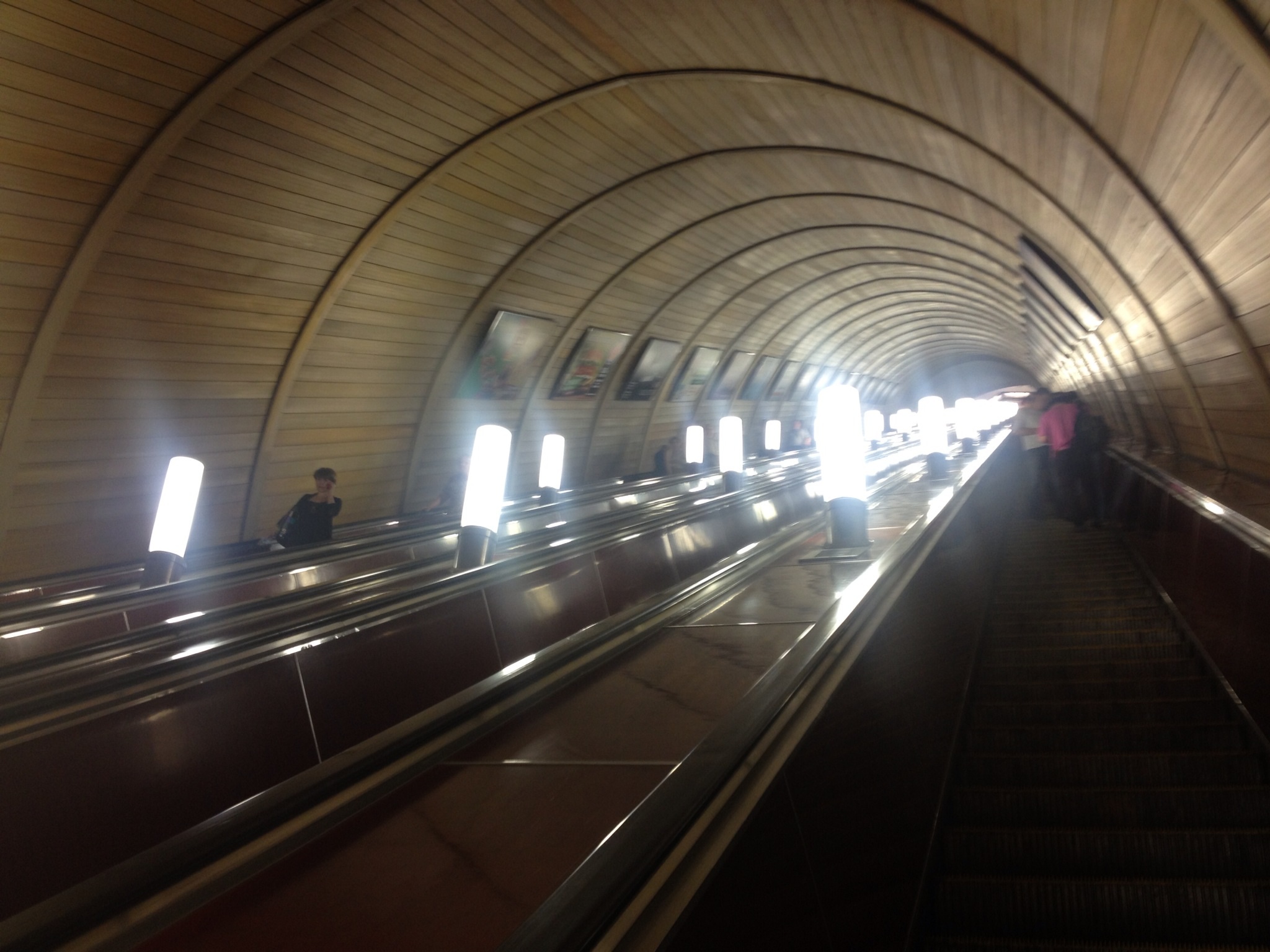
The long, cavernous escalator tunnel in one of the Moscow Metro stations.

The long, cavernous escalator tunnel in one of the Moscow Metro stations.

Maria had met us back at the hostel and taken us to the station, and made sure we’d all gotten on the train safely. “There’s two places empty?” she had asked us, and we reminded her that Marti and Rach had left us the day before, forfeiting their tickets for that section of the journey. “You should come with us to St Petersburg, Maria!” someone had said jokingly. At first she had just smiled and laughed, but five minutes later she stuck her head into our cabin, where Tim, Tracy, Jenna and I were preparing our beds for our final night in transit. “I think I am going to come to St Petersburg. I have a friend who I have been saying I will visit, but I have never been, and it’s been, oh, I have been saying I will go for four years or something.”

We were all a little stunned, but we couldn’t help but laugh. Maria had seemed like quite a lax and easy-going woman, and while it had been a little frustrating when she hadn’t known some things about Moscow that we might have expected from our guide, I couldn’t help but applaud her spontaneous nature that told her that getting a train to another city, with absolutely nothing except a phone, wallet and the clothes on her back, was a perfectly good idea. I guess I learnt something from Maria that night, because with my plans for the rest of my time in Europe being just as unplanned and flexible, I was going to have to learn to be just as swift and spontaneous when it came to making decisions about my travels.

Cabin Fever

When my friend Iain had suggested the Trans-Siberian railway to me, it had sounded like a pretty cool idea, although in retrospect I think I vastly underestimated the journey. I’d sent out a Facebook post last year when I was in stages of planning my trip, asking for the opinions of my well-travelled friends on things like round the world plane tickets, overland travelling, what was the best, what was most cost effective, and other details like that. Iain is a Scottish friend of mine who now lives in Australia, and he travelled the Trans-Siberian railway from Russia to China and continued his travels further south from there – essentially the reverse of what I would be doing. He recommended the tour he had gone with, a company called Vodkatrain, and the enthusiasm with which he talked about it almost sold it to me straight away. But I did my own investigation, and it turned out that this train route had been exactly the answer to the questions I had been asking.

I was a little taken aback by some of the reactions I got when I told my friends of my plans.
“The Trans-Siberian Railway?” my good friend Blythe had exclaimed. “Wow! Robert, that’s like an ultimate bucket list journey for some people!” Maybe I’d sounded a little nonchalant, I don’t know, but it was almost as if she didn’t believe me.
“Umm… Okay? Is that a bad thing for me?”
“What? No, it’s incredible! I know so many people who would be so jealous of you! You’re going to have such an amazing time, it’s supposed to be an awesome experience.”
I think that was the first time that I realised this journey was going to be quite unlike any kind of holiday I’d had before.

DAY 1

When we arrived back at Irkutsk train station, Kostya handed out the tickets and made sure we all got onto the train without any problems. He wished us luck and bid us farewell, and it all felt very similar to most of our other train journeys. There were a few major differences though. Firstly, the quality of the cabins. There wasn’t anything exactly wrong with them – they were just a bit older, a little rickety. Jen, Matt and Tracy had found rubbish in our cabin – we had to wonder if this train had even been cleaned at all before we got on.The previous trains we’d been on had had carpeted floors and hallways, but this train had a dull linoleum surface that made the soles of your feet a gross black colour if you forgot to wear shoes when you walked around. The trains were adequate, and I guess we’d just had some nicer trains on our previous trips so we had harboured some expectations. “I just think its hilarious,” Tracy had said with a giggle, “that we’ve had the more cushy trains for the short trips and now it’s back to basics for the long haul! I love it, bring it on!” Tracy had worked as a tour guide on bus trips through both South America and the Middle East – no doubt she’d seen far worse living conditions, and part of me suspected that ‘roughing it’ was simply more her style.

But there was another thing that none of us had really planned on. On the previous trains, we’d all been in cabins together, save the one extra person who was on their own – which so far had been myself from Beijing and Dan from Ulaanbaatar. So we were all very confused to find that all that had changed. We had two cabins all together – I was with the same three as last time, and Tim, Don, Marti and Rach were in another. But Claire and Alyson were in a room with two other Russian passengers, as were Kaylah and Jenna, and poor Dan was stuck in a cabin on his own again. It was a puzzling set up, considering pairs that had booked together – like Alyson and Kaylah, and Dan and Claire – weren’t supposed to be split up when it came to sleeping arrangements. In any other scenario, we would have spoken to the carriage attendants and asked them what had happened. As it happens, none of us could speak Russian, so in the end we all just ended up shrugging our shoulders and concluding that the one thing we can learn from the past 10 minutes was that the Russian train system is anything but consistent.

***

After we’d gotten over the slight drama, I was sitting on my bed eating some bread and cheese with salami, carefully managing my portions so as not to eat it all in one go and be left hungry come day four of this journey. As I nibbled away, Tim stuck his head into our cabin.
“Ah, on the vodka already then?” Matt asked, noticing the cup in Tim’s hand.
“Well, they don’t call it the Vodkatrain for nothing!” he laughed. “But yeah, I know it’s still early, but we’re getting the party started in our cabin if anyone wants to join.”
I never really need an excuse to drink, but having one always helps. I grabbed my vodka, Coke, and made my way to the neighbouring cabin. The vodka was flowing freely, and we managed to cram eight people into the bottom bunk seats without too much discomfort. When there are that many people in a confided space drinking alcohol, its inevitable that the drinking games are going to start.
“We’re not playing ‘Never Have I Ever’, not when we have couples present,” Tim said adamantly. “I’ve seen too many awkward fights start over that game.” Both Dan and Claire and Rach and Marti were part of the vodka party. Marti was trying to get us to play card games, but in the end I joined voices with Alyson to champion for a game of ‘Two Truths, One Lie’. Technically not a drinking game, but always better when drinking is involved, I figured it was a happy medium – people can still make those drunken confessions with their truths, instead of drinking to their own statements in Never Have I Ever. and people can still withhold all the secrets they want.

I’m not going to explain drinking game rules, but Two Truths, One Lie was a fun way to learn a few quirky things about my fellow travellers – Alyson played the violin for 14 years, Marti was a maths champion in the 9th grade and has a near photographic memory, and Dan once poured frozen peas down a toilet at a party at Johnny Wilkinson’s house. There was plenty more, and I probably did some lame confession about coming out when I was only 15 – my lack of dinner and the amount of vodka I ended up consuming meant that a lot of the finer details were lost on me. Later reports would inform me that I shakily stood up, announced to the cabin through slurred speech “I really need to go to bed now”, and sauntered my way into the hallway and back into my room. I woke up at some point in the night, face up and back arched over a mound in the middle of my bed that turned out to be both my pillow and my blanket, and only half aware of where I actually was. I crawled out of the uncomfortable position and very quickly slipped back into my drunken slumber.
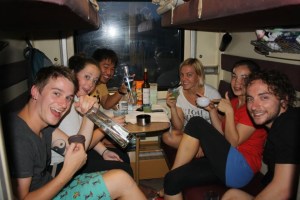
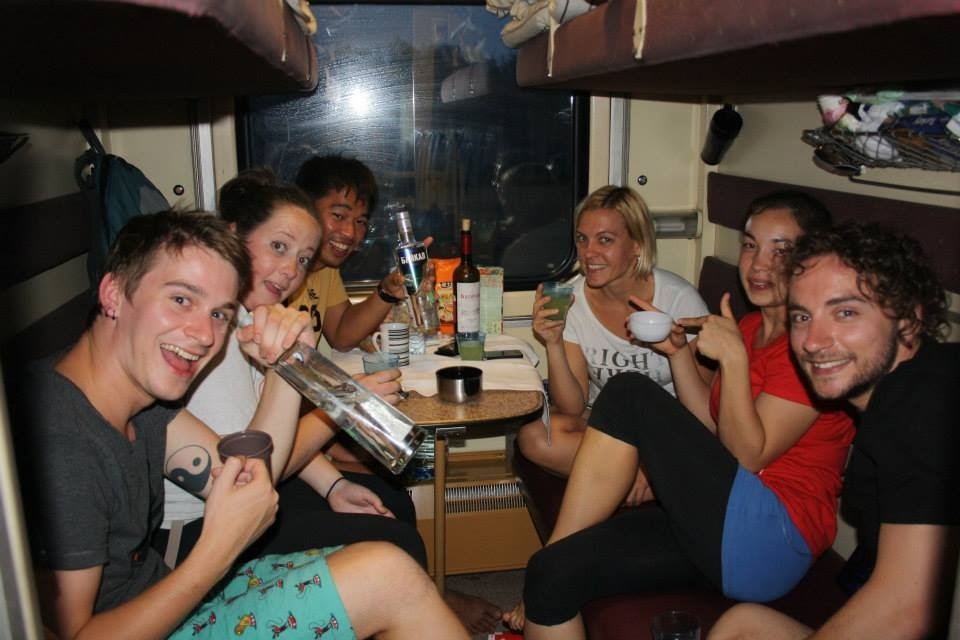
Vodka Party!

Vodka Party!

DAY 2

The following day was a complete write-off. Luckily, we didn’t exactly have anywhere to be. It wasn’t until midday that I was able to sit up in my bed and eat a few flakes of cereal, some super sweet version of honey coated corn flakes I’d picked up in Irkutsk. It was all I could really stomach, and though I felt absolutely awful, I found a silver lining in the fact that my food might last a little longer now. Kaylah eventually visited me on my top bunk, as I was strumming away clumsily on my ukulele.
“How’re you feeling?” she said with a knowing smile.
“Ugh,” was all I could manage at first, dropping the ukulele on my chest to rub the palms of my hands into my tired eyes. I then picked up the bottle of vodka – which for some reason I had been cradling in my sleep – to show that it only had about a quarter of the bottle remaining. “I shouldn’t drink vodka!”
“Aww, you poor thing,” she said as she rested a hand on my shin, sounding very genuine despite there being a giggle in her voice.
“But what happened to you last night?” I said, only now really realising that Kaylah had been absent from the vodka party.
“I don’t know!” she said. “I think I just started reading my book and… I fell asleep? I don’t know I just woke up and it was morning!” She just laughed it off, and I found myself rolling my eyes and laughing along with her infectious mirth.

I didn’t change out of my pajamas at all that day. Every time I even thought about it, part of my brain kicked in saying, Why? Who are you trying to impress? It was a fair point. Most of us had all seen each other at our various high and low points by now, and as long as I didn’t begin to smell incredibly offensive, I was more than happy to lounge around in my bed, read my book and watch the Siberian scenery pass us by. I was on he top bunk this time, which meant I wasn’t in anyone’s way if I didn’t get out of bed. On one of my toilet breaks I stuck my head in to say hello to Tim, Rach and Marti.
“Ah, he’s alive!” Marti had exclaimed as I appeared at the door. “You were so funny last night Rob, you nearly fell asleep in the corner there.” They recounted my final moments of the previous evening to me, and I asserted that it sounded exactly like something I would do, before dragging myself back up into my bunk and attempted to sleep off what was one of the worst hangovers I’d had in a while. I couldn’t seem to stick with one activity for more than half an hour, whether it was reading, sleeping, plucking at the ukulele or gazing out the window. That much restlessness after the first full day definitely couldn’t be a good sign, and I feared I might be climbing the walls sooner than I’d anticipated.

DAY 3

I woke up on my second morning on the train feeling gross again, but this time it wasn’t a hangover. Anyone who knows me or is familiar with my hygiene routine knows that I’m pretty regular when it comes to showering, usually twice a day, and I always use a fresh pair of underwear. But this wasn’t regular life – this was life on the Trans-Siberian, and showers were a luxury we didn’t have. I’d gotten lazy yesterday, and allowed myself to fester in my filth, but it couldn’t go on like that any longer. When you can’t stand your own BO, things are a stones throw away from getting very ugly, plus I hadn’t even brushed my teeth in at least 24 hours. Long story short: I was a hot mess.

So I had my first of what had been coined ‘Baby Wipe Showers’. They’re pretty self-explanatory – in the absence of a running water shower, you simply mop yourself down with baby wipes, or just a wet corner of your towel with some soap, and trick yourself into feeling just a little bit fresher. I also spritzed a little bit of cologne on my faux-fresh body, to keep the stale, unwashed scent at bay for a little longer. It was a far cry from an actual shower, but when you’re feeling the way I did, a slap of cold water to the face and even the slightest bit of a scrub down made me feel like a new man. About five minutes later, I ran into Marti out in the hallway.
“Hey Rob, were you just in the bathroom?”
I was struck with a moment of intense panic – had I done something wrong, broken the toilet, perhaps? I hadn’t even used the toilet, but I’ve had worse luck before, so who knew? A few of our group conversations on the trains had been about the lack of etiquette in some people when it comes to shared bathrooms. I’d hate to become one of the case studies.
“Ah, yeah I had a baby wipe shower just before,” I said tentatively.
“It just smells so nice in there!” she said with a laugh, and I relaxed a little. “I was expecting it to smell of like, you know, piss or whatever. But I stepped in and was like, ‘Ah, smells really nice in here!’ So thank you!”
“Ah.. Well you’re welcome, I guess?” I said as I laughed along with her. And to think, I nearly didn’t bring my two favourite colognes – out of a collection of seven – because they didn’t seem ‘essential’ enough.
A dull, dreary Siberian morning.

A dull, dreary Siberian morning.

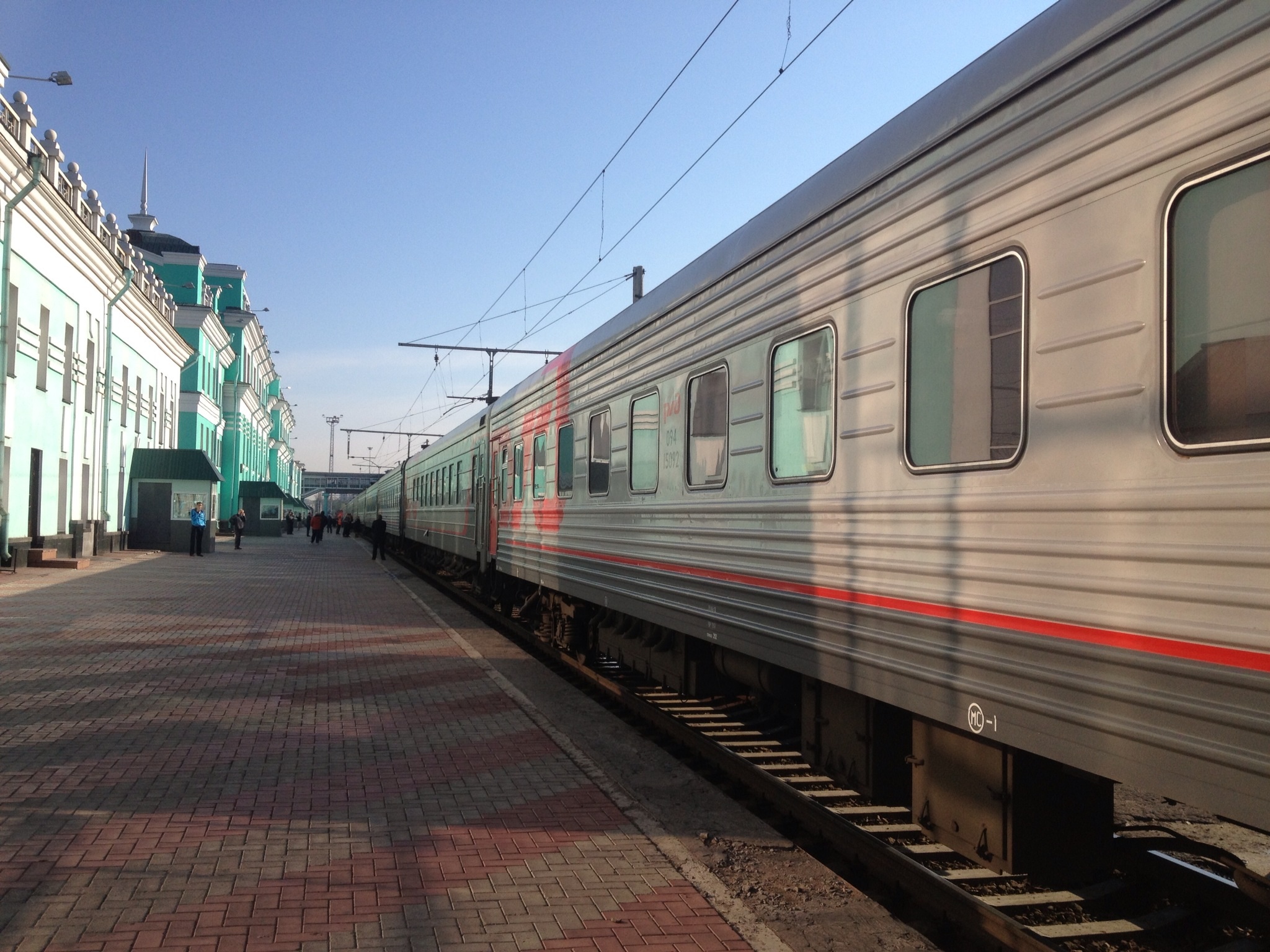
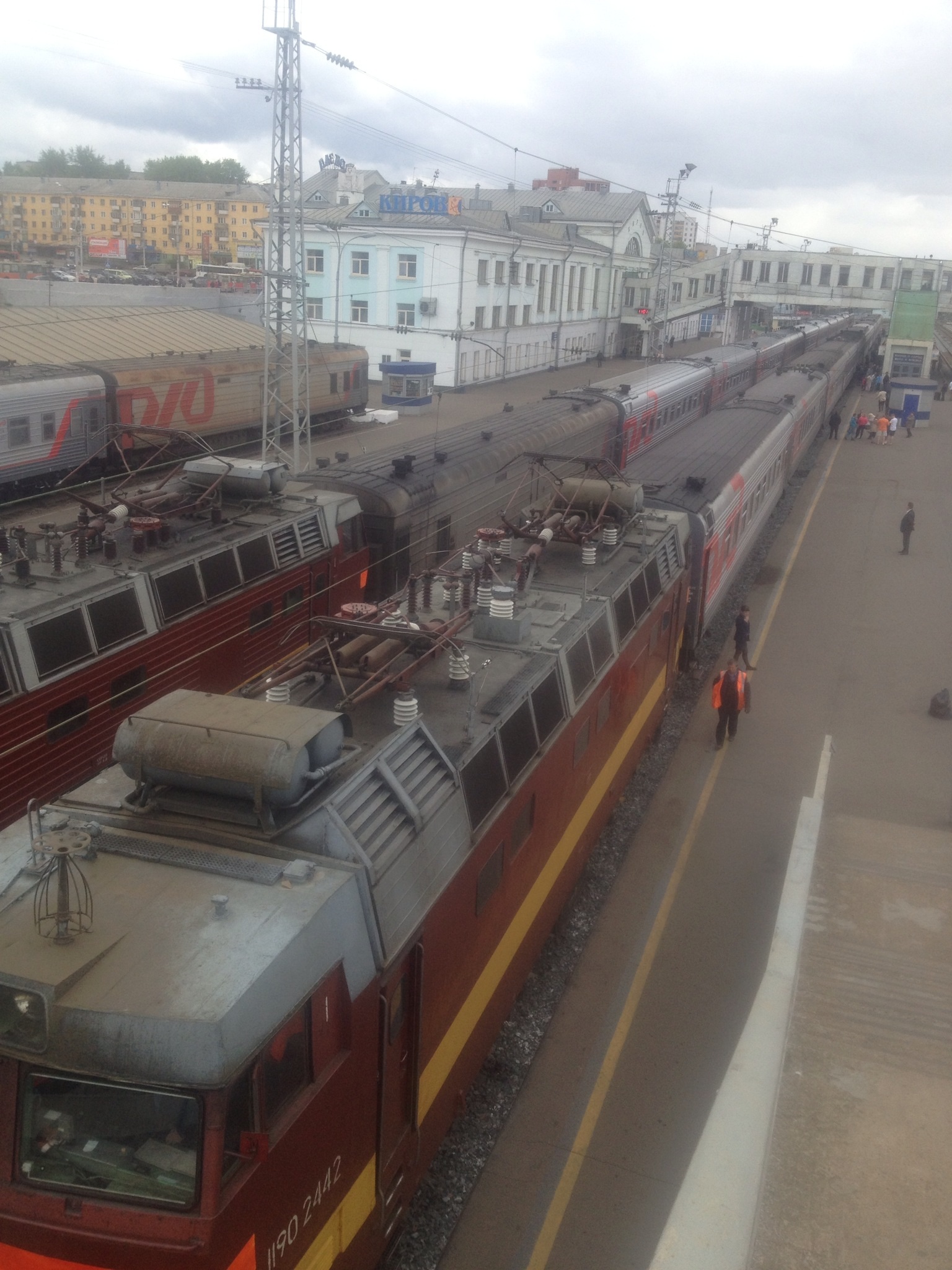
View of the train from the platform at one of our stops.
View of the train from the platform at one of our stops.

Train as seen from a platform bridge.

Train as seen from a platform bridge.

***

By now, the days had really started to drag on. We watched a movie called TransSiberian that Marti had on her hard drive. It was pretty cool to see the story begin in Beijing, recognising the very same train station hall that we’d sat in about a week ago, and we empathised with the main characters as the train attendants yelled at them in Russian. We had actually been much luckier on this train in that regard – the main train attendant was a much younger woman than the previous train, and while not exactly polite, such was much more mild mannered than the ranting woman on the train from Ulaanbaatar.

But the movie was a thriller about drug smuggling where everything that could go wrong did go wrong, and thankfully the rest of it was not quite so relatable. It killed some time though, and time was the one thing we had in complete excess. The entire Trans-Siberian route crosses 7 different time zones, with most of them occurring on this particular trip. Matt and Jen were very clued in to the changes, thanks to their Lonely Planet guide, and would give us the regular updates.
“So at about 12 o’clock it becomes 11 o’clock again”, said Matt as he studied one of the pages, while Jen consulted the timetable to check the next station we’d be passing through.
“Seriously? God, it’s like my lunch is trying to run away from me!”

While the socially dictated times for our meals kept slipping away from us, the food was well within reach, and many of us adopted a ‘Second Breakfast’ attitude. While I had previously feared for my food supplies, I managed to ration it all rather well, and soon enough these multiple meals became our own form of telling the time, creating a new meals through which to structure our day.
“They say it’s 2am somewhere, right? Well I say it’s noon somewhere in the world, so it’s time for lunch!” Tim had asserted.
“Yeah,” Rach had agreed. “We can have our Irkutsk lunch, and then our Moscow lunch later.”
“Mmm yeah, I could smash a second lunch!” added Marti, and we all laughed at what had become her own little catchphrase.
“It’s 3pm in Melbourne – this might as well just be my afternoon snack!” laughed Tim, and the banter continued as we all obsessed over our food. Soon we were laughing at pretty much anything.

Whenever Kaylah dropped by we would all end up in stitches – I can’t really put my finger on it, but her laugh was just so contagious that I can’t keep a straight face when she’s in a good mood. In the evening we tried to have another vodka party. I say tried because firstly, we didn’t have that much vodka left, and secondly, none of us seemed to really be in the mood – I personally just wanted to discard the bottle. However, alcohol goes straight to Kaylah’s head, and she was laughing like a maniac after only one drink. I, on the other hand, was definitely not in the mood for vodka, and only managed about one small drink before volunteering it up to the rest of the cabin. They were more than happy to help me finish it.
“Oh dear,” Tim had said with a sigh, after we’d settled down from a bout of hysterical laughter about something I honestly don’t even remember. “I think cabin fever has well and truly sunk in.”

DAY 4

On our final full day on the train, I woke up with the intention of changing out of my dirty clothes and freshening up like I had the day before – I had been wearing the same pair of underwear since the morning we’d left Lake Baikal, and was feeling pretty rank in general. Though the devil on my shoulder of personal hygiene argued that I only had to stick it out for one more day, and then I could actually have a shower before putting on clean underwear. I have this weird thing about putting clean clothes on a dirty body – I just hate doing it – so in the end I decided to fester in my well-worn clothes for another 24 hours and hold out until Moscow. For anyone who knew me before this train trip – I’m definitely a changed man.

***

The last day was mostly spent doing the same activities – watching episodes of TV shows on laptops, making tea, coffee and two minute noodles, chatting with each other, staring out the window and – something that had become a personal favourite – playing cards. Tim and Alyson taught us how to play a game called ‘Asshole’, where the objective is to get rid of all your cards lest you become the Asshole in the next round, suffering a relative disadvantage. It’s a fun game, but in the heat of cabin fever, when we’ve all been up in each others personal space for the last few days, our investment into the game was close to maniacal.

Though it was over one of these card games that the craziest and most brilliant idea of all was formed.
“You know what I really want?” said Marti as we took turns throwing our cards into the pile in the middle of the table. “I could totally smash a chicken right now. A big juicy chicken with some potatoes! Mmm, that would be the best!”
Having lived predominantly of bread, cheese, cold meat and two minutes noodles, you could almost hear the salivation from everyone in the cabin as soon at Marti mentioned it.
“That would be so amazing!” Tim exclaimed.
“When’s our next longer stop?” asked Rach. The train made short stops at some of the local stations along the way – sometimes they were five minutes, other times they were as long as 45 minutes.”
“There’s a 30 minute stop in about an hour,” Marti said as she checked the schedule, and looked up to grin at us. “What do you think guys – wanna see if we can get some chicken?!”
There were various rounds of agreement from Tim, Rach, Kaylah – I had rationed enough of my food to last me, but the thought of a hot roast chicken was just absolutely mouth watering, so I tagged along in the quest for poultry.

As we rolled into the stop though, our hopes sunk. Some of the stations had been quite big, with people selling all kinds of food on the platforms. However, this station was a tiny town, with a platform that wasn’t even long enough for the train. Marti and Kaylah had to jump down from the train and walk along the unsealed road to get back to the platform, but they did it in their desperate attempt to find chicken. Rach, Tim and I stayed back in the train to hold the fort, but we all agreed that we didn’t like their chances, and so had already really accepted the fact it would be one final night of noodles and bread.

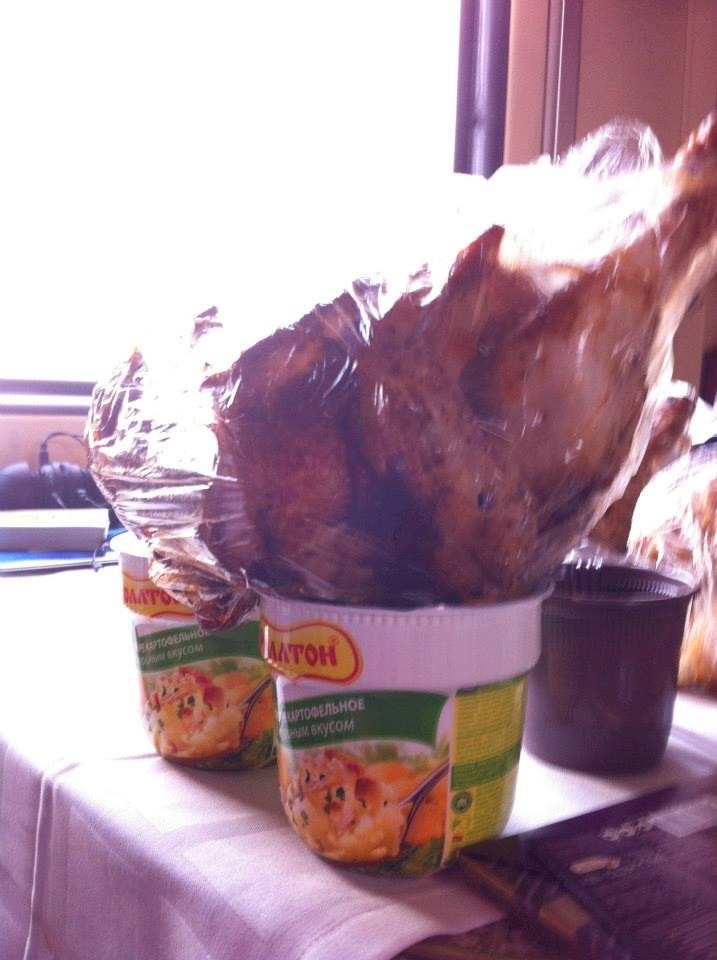
So you can imagine our surprise when the girls burst back into the cabin with two roast chickens.
“Chicken run was a success!” Marti shouted gleefully as she put the birds down on the table in the middle of the cabin. Claire and Dan had also bought a third one, and Kaylah had picked up some instant mash potato that only required the hot water, and so together we all had a final train meal together, a feast for our last night on the Trans-Siberian.
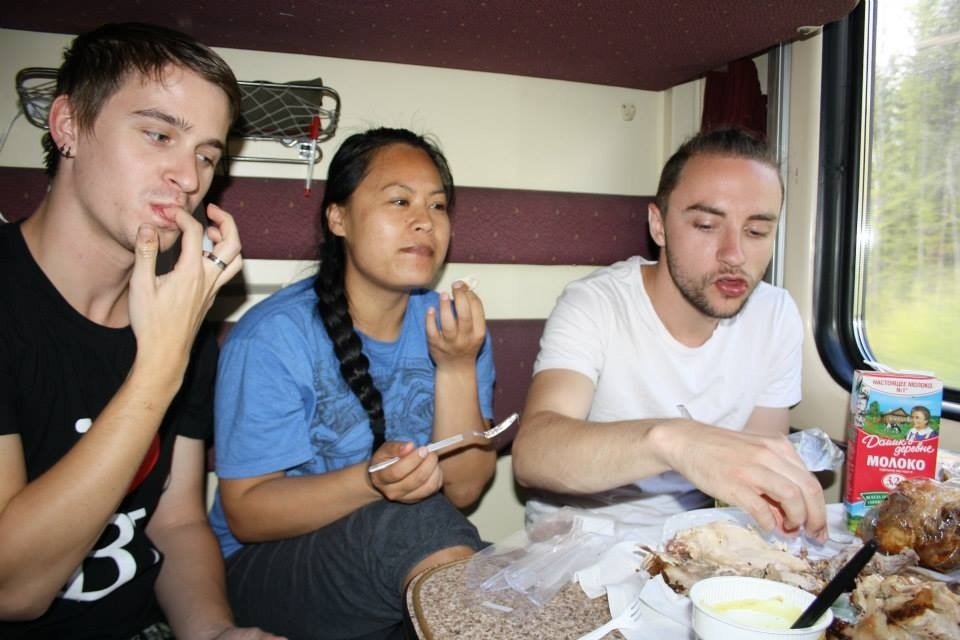
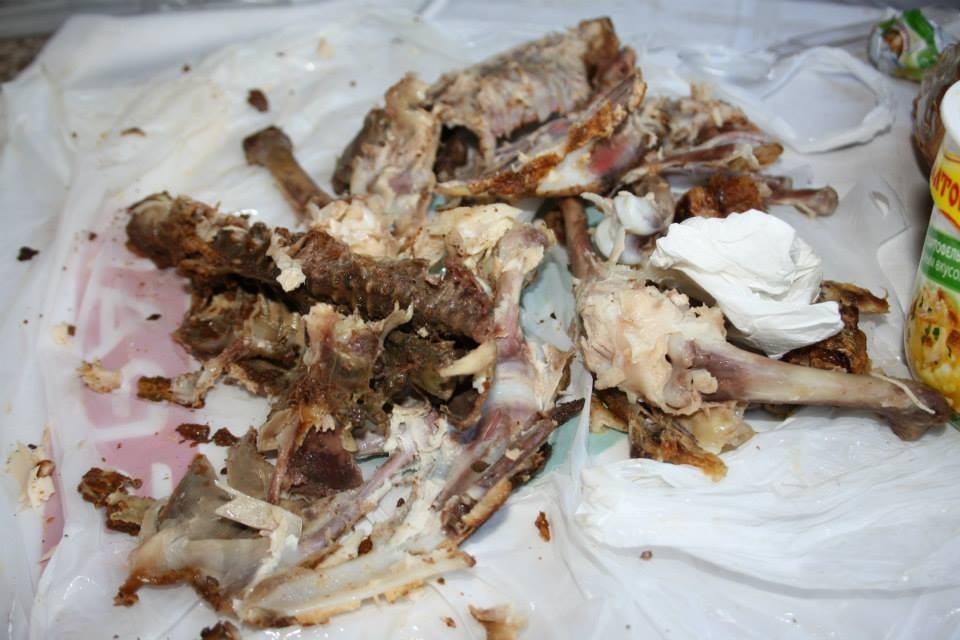
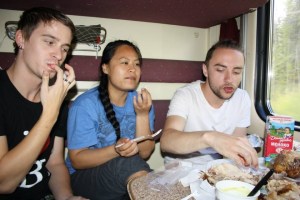
“Smash that chicken!” Marti said with a laugh, and we all literally pulled the carcasses apart, ripped the meat off and sucking the bones clean, leaving no edible scrap to go to waste. We must have looked like starved savages, but the freshly cooked meat was such a welcome change that I don’t think any of us cared in the slightest.
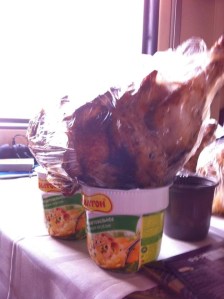
Operation Chicken Run: Success
Operation Chicken Run: Success

Kaylah, Tim and myself gorging on the hot chicken.

Kaylah, Tim and myself gorging on the hot chicken.

The aftermath.

The aftermath.

When the feast was over and we’d eaten our fill, we all started to prepare for bed. We were due to arrive in Moscow at 4am, and most of us wanted to get some semblance of a decent sleep. As I readied myself for bed, I had a brief chat with Jen:
“I can’t believe it’s almost over – it felt like this train ride was never going to end,” I said with an exhausted laugh as I fell back onto my pillow.
“It’s been rather interesting though. I mean I’ve enjoyed it, but it’s not the kind of thing I’d ever do again. Do you know what I mean?”
“Absolutely. I guess there’s a reason why it’s described as a ‘once in a lifetime’ experience, right?”
“Exactly!” she said with a smile. “Although it would be pretty to see the scenery of Siberia in the winter… but no. I think it’s definitely more than a journey. It’s a challenge, really, isn’t it?”
I didn’t have to consider that question long. “Definitely. Well, I know I found it a little challenging at times. But hey, we did it! We travelled the Trans-Siberian railway!”

***

Despite going to bed relatively early, I didn’t get a lot of sleep that last night. I don’t know if it was the train, the tracks, or some other factor, but it was one of the roughest and bumpiest sections of any of the train journeys we’d been on so far. Loud and rickety creaks continued through the whole night, and several times I felt as though I was about to be thrown out of my bed. Another downfall about these cabins was the the windows didn’t open, and so four sleeping bodies in that tiny space had turned it into somewhat of a mild oven.

Yet I must have slept for a little bit, because I was woken up as we were approaching Moscow station, at some ungodly hour that didn’t agree with any of the multiple body clocks I had been running on for the past few days. When we arrived, we jumped off the train and were greeted by a small woman, who informed us that she wasn’t our guide, but another Vodkatrain employee who would take us to our hostel. “We should also decide on a time to meet you guide”, she had said to the group. “But it’s still quite early, and I’m guessing that most of you would like to have a shower, yes?”

I don’t think I have to tell you what our unanimous group response was.

Russian Around

The next train on our journey would see us crossing another border, out of Mongolia and into the Siberian wilderness in Russia. We were all on a bit of a high after enjoying our time in Mongolia so much, so this two night journey would be a chance to debrief and prepare ourselves for our entry into Russia. Armed with two minute noodles and bottles of red wine, we said our goodbyes to Oko on our final evening in Ulaanbaatar and climbed aboard the train bound for Irkutsk.

***

The order of the cabins had been changed around since last time, and as the tickets were passed around I realised that I wouldn’t be isolated from the rest of the group this time. I was bunking with Tracy and the other British couple, Matt and Jen. The best word I could use to describe Matt and Jen is ‘organised’ – nothing was left spontaneous or unplanned, and they always liked to be two steps ahead of the game. I’m usually more than happy to play things by ear and go with be flow to see how things turn out, so sharing a cabin with the two of them was something of a juxtaposition, although there are definitely shorter straws to draw when it comes to close confines roommates.

Crossing the border to get into Russia from Mongolia was never going to be a fun ordeal – it took approximately four and half hours at the check points in both countries. To do what, I’m not entirely sure – Mongolia and Russia share a common gauge on their railways so there was no need to change the bogies. I know it’s necessary to check paperwork and visas and do the routine check for stowaways in the luggage compartment, which we’d all become very used to, but 10 hours just to cross a border just seems a little excessive. Not that it affected us very much at all – you could still do all the things you usually do on the train, with the exception of using the toilet, which you could use the station for – it just feels a little more frustrating to be sitting at a train station platform rather than watching the rolling hills of the countryside pass you by. I found myself pacing the corridor of our carriage, popping my head into other people’s cabins to say hello and see what they were doing, unable to sit for too long in any one place while the train was stationary, almost as though I was trying to make up for the lack of movement that was going on.

When the train finally did get moving again I joined two of the Australian girls, Rachel and Martina, in their cabin, along with Tim, Kaylah, Alyson, Dan and Claire. Rach and Marti were actually a couple who both work in travel and tourism, and have been travelling around the world together for the past several years. They both had their laptops and hard drives, so we set up a little theatre, cracked open a few bottles of wine, and watched a few episodes of Family Guy,The Amazing Race, and An Idiot Abroad, with the vast landscape of Siberia stretching out and beyond behind the screen. The Amazing Race was fun to watch with a group of travellers, as we speculated how we would fare in the challenges if we were contestants, and the episode of An Idiot Abroad was in China, so we pointed out all the familiar places we had been earlier in the week. Combined with dark chocolate and red wine, it was a fun and effective way of passing the time – after a while we realised we’d been there for about 4 hours. It was almost eight o’clock, yet the sunlight outside was deceptive, and back home the daylight could have passed for three or four in the afternoon. It was something we would all quickly get used to, but this time it had caught all of us by surprise.

***

Our interaction with the train staff was probably the most eventful part of our trip. On the previous trains we’d hardly spoken to the uniformed women who marched up and down the corridor, cleaning and tidying and I suppose helping anyone who needs assistance. The attendants on this train were Russian rather than Mongolian, and on the second day of our trip, before the border crossing, the woman who had been working on our carriage came in with a basket of chocolates, chips and drinks that she was selling. She started speaking in Russian and motioning to her products, but obviously none of us understood.
“No, thank you,” Tracy said slowly, and I shook my head to indicate that we didn’t want anything. Matt and Jen were contemplating some of the chocolate bars, and asked if they could borrow some Russian rubles, as they hadn’t managed to exchange any currency yet.
“One Twix, please”, Jen said, pointing at the Twix bars and holding up one finger. The lady took the 100 ruble note and gave her two bars.
“No, one,” Jen repeated, holding up her index finger to try and communicate the number. The woman said something in Russian, took away one of the Twix bars and replaced it with a Snickers.
“No, I have allergies. Nut allergies,” said Matt. I don’t know if the train attendant understood, but if she did then she certainly didn’t like what she heard. She started rambling again in Russian, pulled the Snickers back and then put three bottles of soft drink of the table in front on us. She placed her hand on each one, each time saying something in Russian, then motioning back to the chocolates, all the while speaking Russian at us.

“We don’t speak any Russian,” Matt said, before turning to find his Lonely Planet book. “Maybe we can get some translation happening.” The Russian woman liked that even less. Her voice got louder, and she picked the book up out of Matt’s hands, and slammed it back onto the table.
“No,” she said, the first word of intelligible English so far, and then pointed at the book, said something that sounded like “your culture”, then motioned back to the chocolates and said “Here in Russia.”
Not only were we a little confused at what was going on, but it was a little annoying to know she had been screaming at us in Russian when she clearly knew some English words – no matter how small they had been, it would have been better than our almost non-existent knowledge of Russian. The drift of the conversation seemed to be that Matt and Jen would not be getting any change from the transaction, so they just settled for taking two Twix’s and letting the grumpy train attendant go on her way.

Later in the afternoon, in a conversation in Rach and Marti’s cabin, I learnt that everyone else had gone through a similar ordeal, with the attendant threatening to cut off our access to the hot water on the train if we refused to buy anything. The hot water was a boiling urn that could be used to make tea, coffee, and two minute noodles, so naturally it was a key ingredient to us surviving these long train treks. Personally, I was just surprised that they had managed to get even that much of a translation, although Marti is originally from Slovakia and does have a bit of a knack for European languages. When I relayed this story to the others in my cabin, Matt said it was just part of a more general bribe that is probably a regular occurrence. Whatever the case, after the train attendant had acquired her fee, she became one of the most pleasant people I’ve ever met, even talking to us a couple of times in nearly perfect English. That annoyed my slightly, however, because it meant that her initial tantrum and almost definitely been a complete sham. It was a small amount though, and in the end didn’t come out of my pocket, so it was easy to write it off as just another cultural custom to recognise, familiarise ourselves with, and get used to.

***

Our short ride from Beijing to Ulaanbaatar felt like nothing after the amount of time it took from Ulaanbaatar to Irkutsk. I don’t think the distances are all that different – it was just the time spent at border crossings and the time of our departures that had made the second trip seem longer, given that we’d spent two nights on that train rather than one. It was a sweet, freezing breath of relief as I stepped off the train and onto the platform at Irkutsk, and I tried to not think about the fact that our next train journey would be at least twice at long, both in distance and in time.

A Nomads Life For Me

Luckily we were only staying in Ulaanbaatar for one night, because there didn’t appear to be a great deal of tourist attractions left to see in the city. The rest of our time in Mongolia would be spent at a ger camp about two hours away, far off in the Mongolian wilderness. A ger is a sort of semi-permanent tent that the nomadic people of Mongolia live in – while Ulaanbaatar does have a population of about 3 million, there is a remarkable amount of people who still live the nomadic life out in the wilderness and the Mongolian national parks, moving from place to place with the seasons and taking their home with them, as well as their herds of livestock.

***

We had one stop in the morning on our way to the ger camp. The Gandantegchenling Monastery was a beautiful structure, and Oko explained that Buddhism is one of the major religions of Mongolia. It’s quite interesting how the landlocked country has so many different cultural influences from the surrounding nations, yet it truly becomes a melting pot that breaks all of them down and recombines everything into their own culture that is quite unique. We walked through the temple, silently moving around the people who had come to light candles and incense and to pray, before stopping at the monastery to watch the monks begin their morning rituals and listen to their chanting. I hate to admit it, but ever since my bizarre incident with the shady Buddhist monk in Lop Buri, I’ve been unable to look at any monk the same way again, and even just seeing one creates a rising anxiety within me. It really is such a shame, because I used to hold such a fascination for ideals and spirituality behind the religion, and now those beliefs have been well and truly tainted. I listened to the chanting for only a few moments before stepping out of the low-hanging canopy of incense and into the fresh morning air.

The main building of the monastery complex.

The main building of the monastery complex.

Outside, in front of the main temple, there was a big pair of golden feet. Oko explained to us that the Mongols were attempting to build the worlds largest human structure, a Buddha even bigger than the Statue of Liberty. However, all of the money for the project comes from donations, so there is no scheduled finish date because no one really knows when they will be able to finish it. Oko had also mentioned yesterday that the weather in Mongolia only allows for construction to be done for two or three months every year, which is why there were so many construction sites and unfinished buildings in Ulaanbaatar, adding to the ugly, incomplete cityscape.

Golden feet - all there is of the statue so far.

Golden feet – all there is of the statue so far.

However, the most interesting, or at least entertaining, part of the monastery visit was the swarm of pigeons outside. As we first approached the monastery, we heard the low cooing noise steadily growing louder, and we soon found ourselves in front of a formidable sea of feathers. There were thousands of pigeons, and their call almost seemed to have an eerie echo as it rippled through the flock of birds in the courtyard. Some people were feeding them with seed they had bought from a little old lady wandering through the birds, while other children ran through the crowds to scatter the pigeons and sent them flying. They always came back though. Someone asked Oko about their significance. “The pigeons? No… They just live here, I don’t know why. But they are not special, not at all.”

The mass of pigeons outside the monastery.

The mass of pigeons outside the monastery.

***

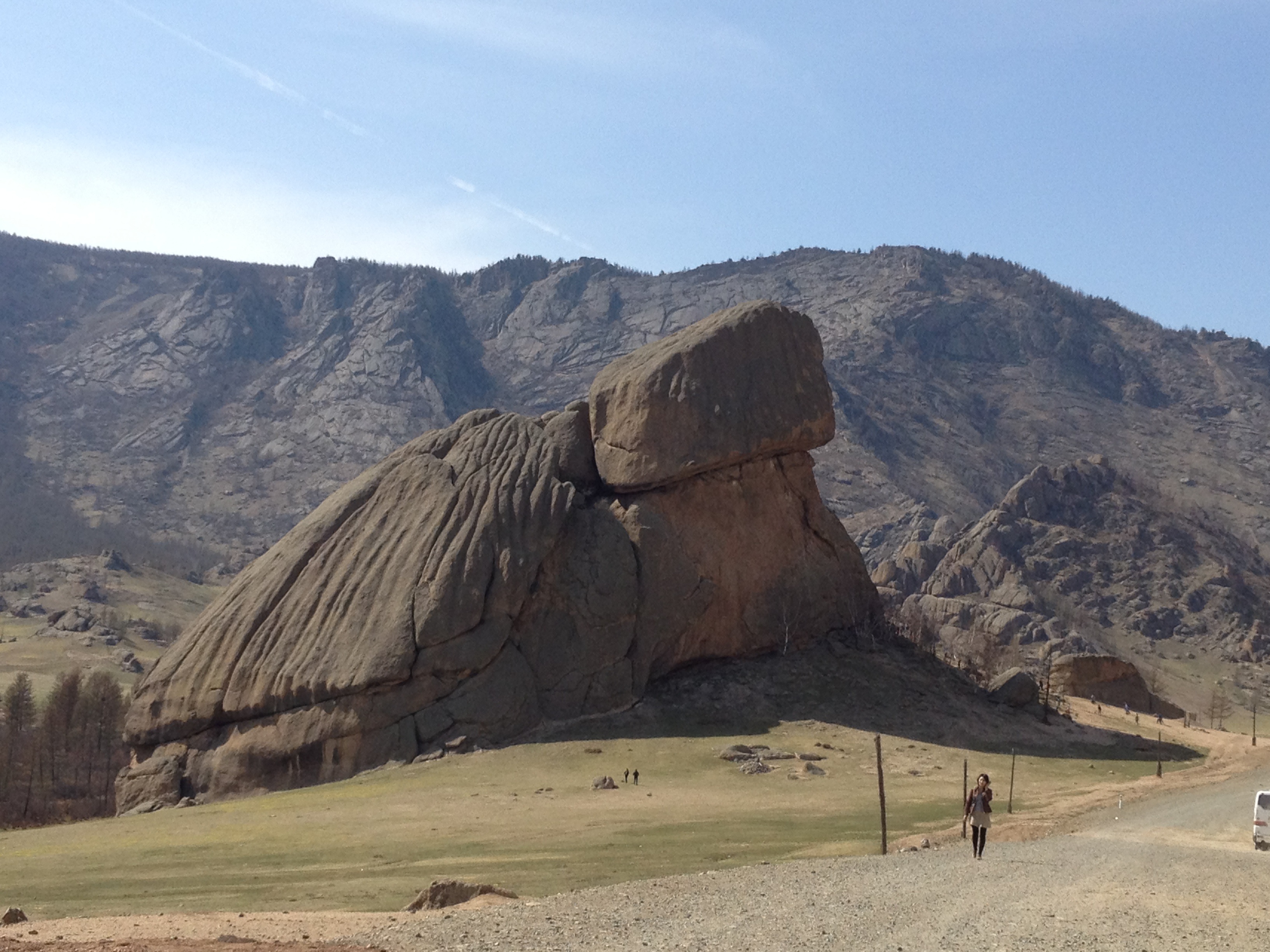
After the monastery it was onto the ger camp. The place we were staying at was in a region called Terelj National Park. It was more of a permanent set up that was obviously designed for tourists, but they were the same style of ger that the real nomads live in. Each circular tent was several metres wide in diameter, and had a wood-fire stove set up in the middle, which were traditionally used for cooking all the meals, but would serve only as a heater for us during our stay. I was sharing my ger with Tim and Don, the other Australian guy on our tour, and after we unloaded our bus and settled into the gers, we went for a short drive to a small landmark known as Turtle Rock.

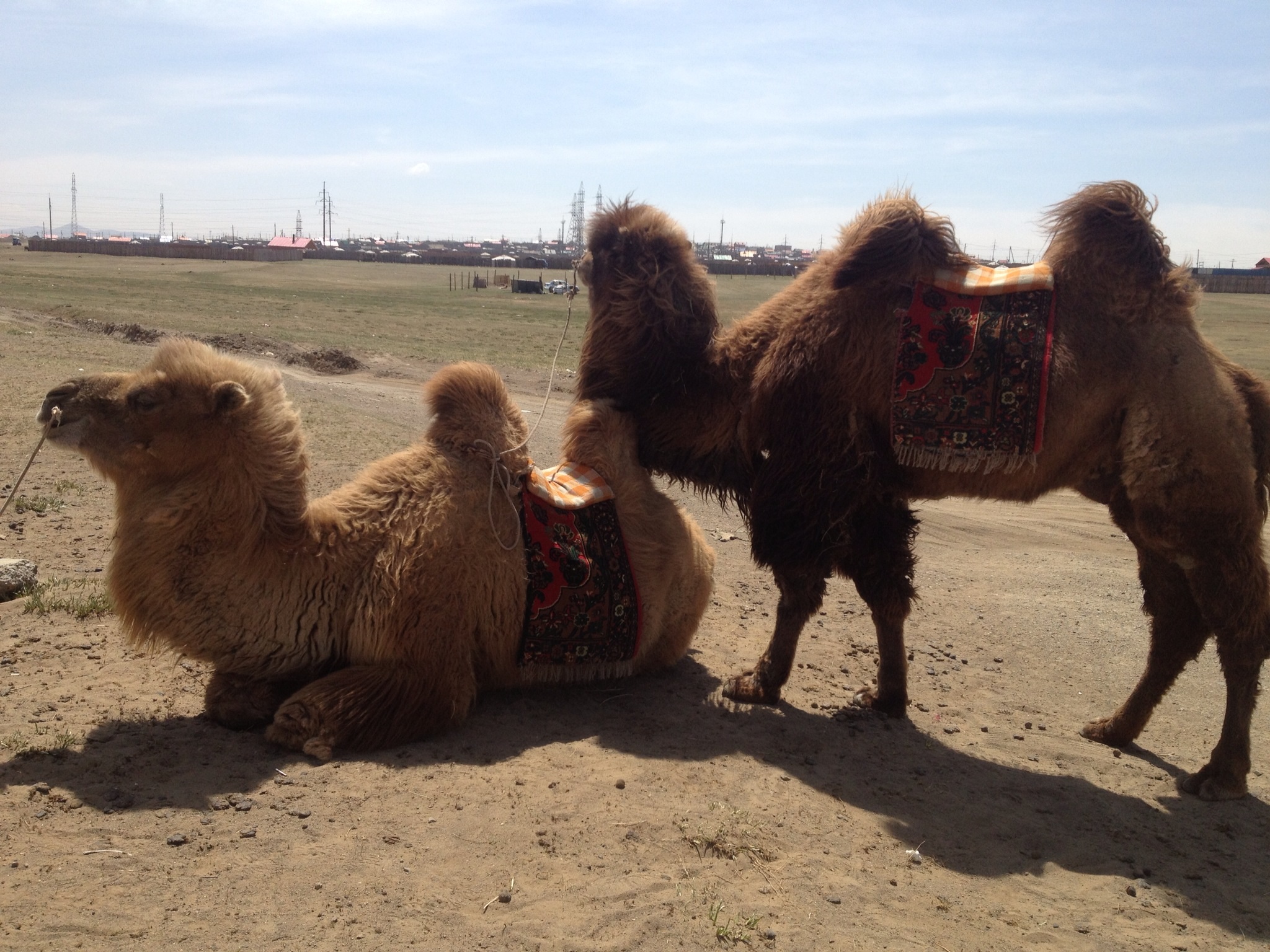
Some camels we passed on the way to the ger camp.

Some camels we passed on the way to the ger camp.

Turtle Rock.

Turtle Rock.

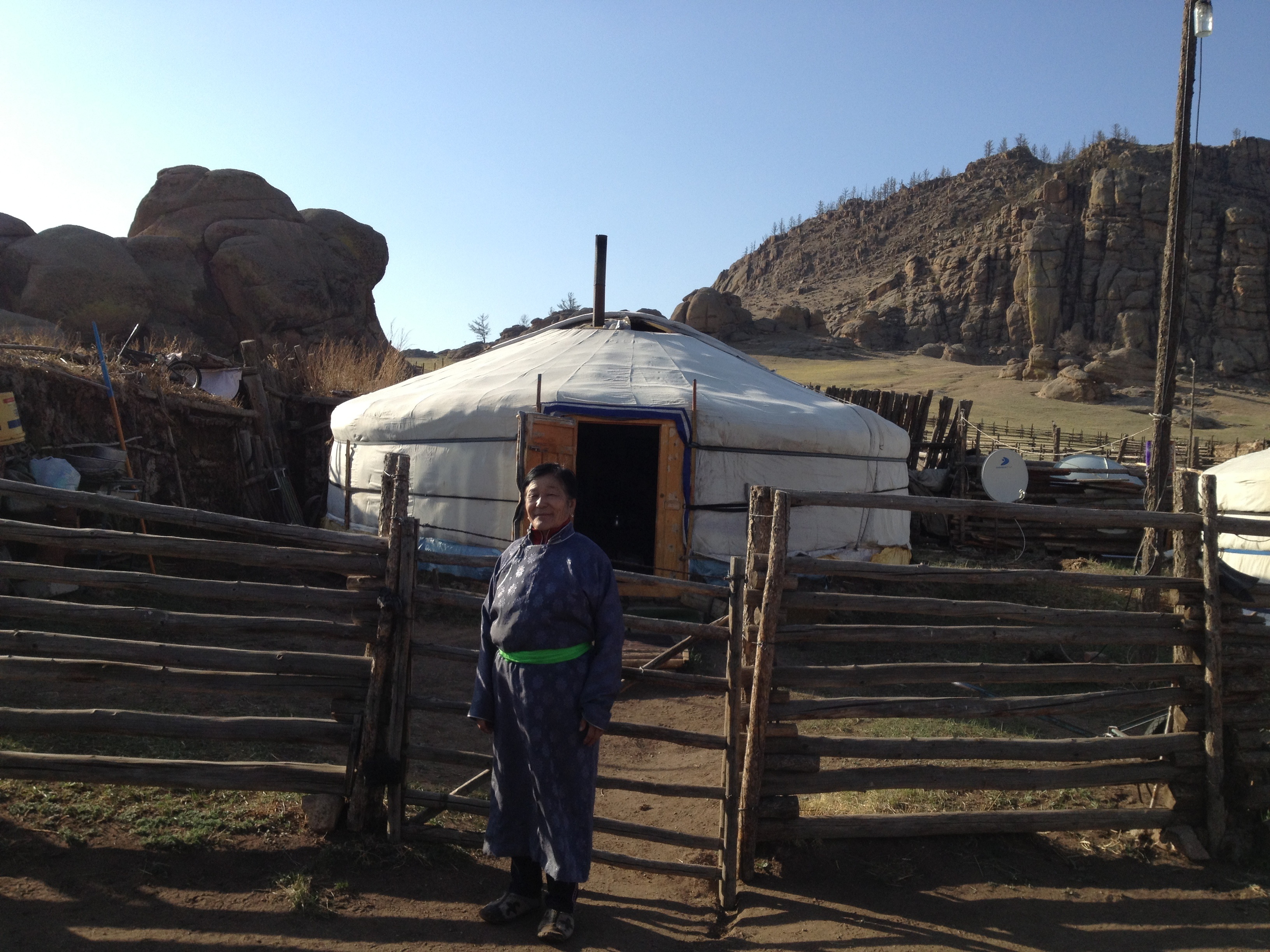
We climbed to the top of the rock to appreciate the view. The Mongolian countryside really is beautiful. I spent a lot of time with my family in the Snowy Mountains as a child, and it was a familiar feeling of watching the virtually untouched landscape stretch out for what seemed like forever. Such sights always remind me of my fathers words about cities being similar from country to country, and I was even more pleased that we’d escaped Ulaanbaatar to explore the rest of Mongolia. After Turtle Rock, we visited the ger of a real nomadic Mongol, and got to see what the inside of a truly inhabited ger looked like. The walls were lined with rugs to retain the warmth and heat, there was a TV and a fridge and a whole kitchen set up, and it felt like an actual home compared to our gers, which were essentially the hotel versions of the traditional Mongol dwelling. There was only one woman who lived in this ger, and she had prepared some food for us, so we asked her questions about Mongolian nomadic life, with Oko as translator, while we nibbled on homemade cheese and bread, dried yoghurt, and sipped on warm milk tea. I didn’t care much for the tea, and the dried yogurt was so hard I thought I was chewing bone, but after spending so long in South-East Asia it was quite a treat to have some hearty, homemade cheese.

The view from the top of Turtle Rock.

The view from the top of Turtle Rock.

The ger of the Mongolian woman who we paid a visit to.

The ger of the Mongolian woman who we paid a visit to.

It was definitely surprising how permanent the set up looked – apparently when they move, the nomads travel anywhere from a few kilometres down the road to hundreds of kilometres to a new region, usually for reasons of weather and climate or the availability of grass for their herds of cows, horses, goats, sheep or camels. It only takes 8 hours to completely dismantle the ger, which was deemed an impressive feat by our group. “It took me 8 hours just to pack for this trip!” Alyson exclaimed. We all had a bit of a laugh, but I suppose it was a reminder to all of us just how content people can be with so little in their lives. It feels like I have one of those epiphanies every time I visit a non-Western country, but I do think its important to retain that perspective throughout life, so I never end up taking for granted all the things I do have in life.

***

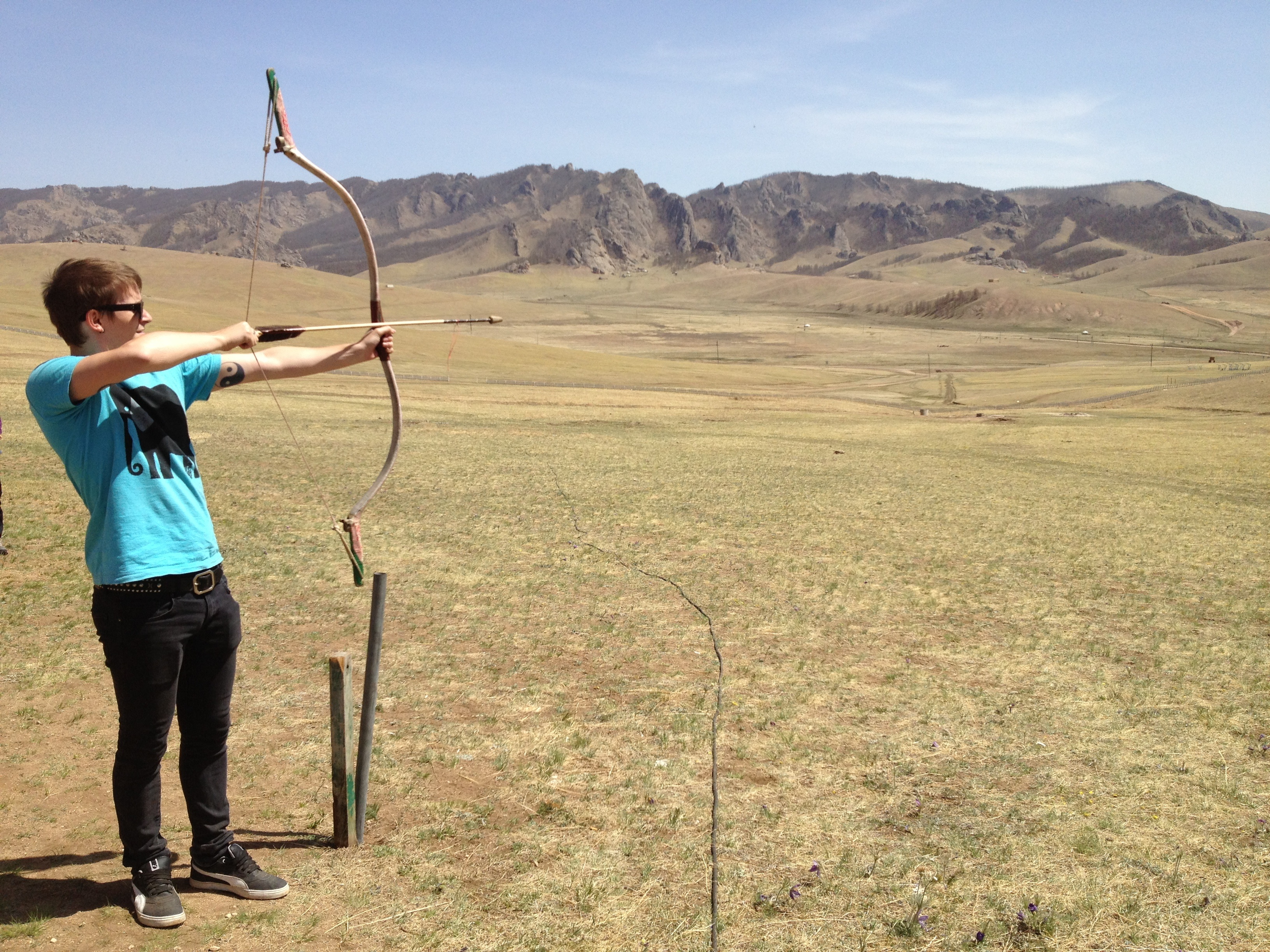
Our days at the ger camp were mostly spent outside, doing things like horse riding and archery. The warriors of the fearsome Mongolian Empire did both of those things are the same time, though horseback archery isn’t an easy skill to master in a few days, so we kept our attempts separate. We also made several small hikes up the hills and rocks that created the valley that our ger camp was in, and admired the awesome views. The hills rolled on in every direction, and in the neighbouring valleys we could see more clusters of gers, demonstrating just how common this nomadic way of life really is in Mongolia. The food in the ger camp was also amazing. Traditional Mongolian soups, salads and meat dishes, broths full of mutton and meat that melted in your mouth right off the bone, and hearty fillets of steak served with rice and potato. I wasn’t sure if there were any Mongolian restaurants around where I live, but I made a mental note to find out when I go back home – the cuisine is absolutely delicious, and I didn’t go to bed hungry once.

Oko tending to my horse just after I dismounted.

Oko tending to my horse just after I dismounted.

Trying out my archery skills - there's a reason there's no photos of the target...

Trying out my archery skills – there’s a reason there’s no photos of the target…

However, on one of the nights I did go to bed a little tipsy. As a group we’d decided we might get on the piss and have a little bit of a party in one of the gers. Some brought vodka, some brought beer or wine. I myself brought a semi-dry red that was made in Bulgaria, surprisingly delicious for the price that I paid for it. The conversation flowed freely, as is always the case when alcohol is involved, and I chatted a little more to some of the Australian girls who I hadn’t seen much of during the course of the trip. It was incredibly warm and toasty with the fire going inside the ger, and we frequently had to prop the door open for a little bit of relief, sometimes even stepping outside to cool off a little. The wine went to my head pretty quickly, but I remember standing outside with Dan and marvelling at the stars that were spread out across the dark blue night sky, thinking back to my night of stargazing on Koh Rong Samleon in Cambodia and still being a little bit excited that the constellations were all different in this hemisphere – and I don’t even think that was the wine talking.

***

While the Mongolian countryside is breathtakingly beautiful, there are a few things about it that are a little upsetting. When you’re gazing out from the peaks of a rocky outcrop the land looks untouched, but the reality is that the life of the nomadic people takes a toll on the land. Some people burn or bury their rubbish, but there is still an incredible amount of pollution. You’re just as likely to see a plastic bag take flight into the wind as you are a native bird, and at regular intervals there are huge mounds of trash that are most likely the remnants of a ger camp that has since packed up and moved on. I remember as a kid going out on Clean Up Australia Day and picking up all the trash in my local area – I think realistically this country would need a Clean Up Mongolia Year. I absolutely loved my time in Mongolia and out in the ger camp, but it was always a little bit disheartening to walk past what appeared to be a small forest of plastic bag trees, the skeleton of what was once lively greenery smothered with black and blue and translucent plastic.

The ger camp where we slept and lived for two days.

The ger camp where we slept and lived for two days.

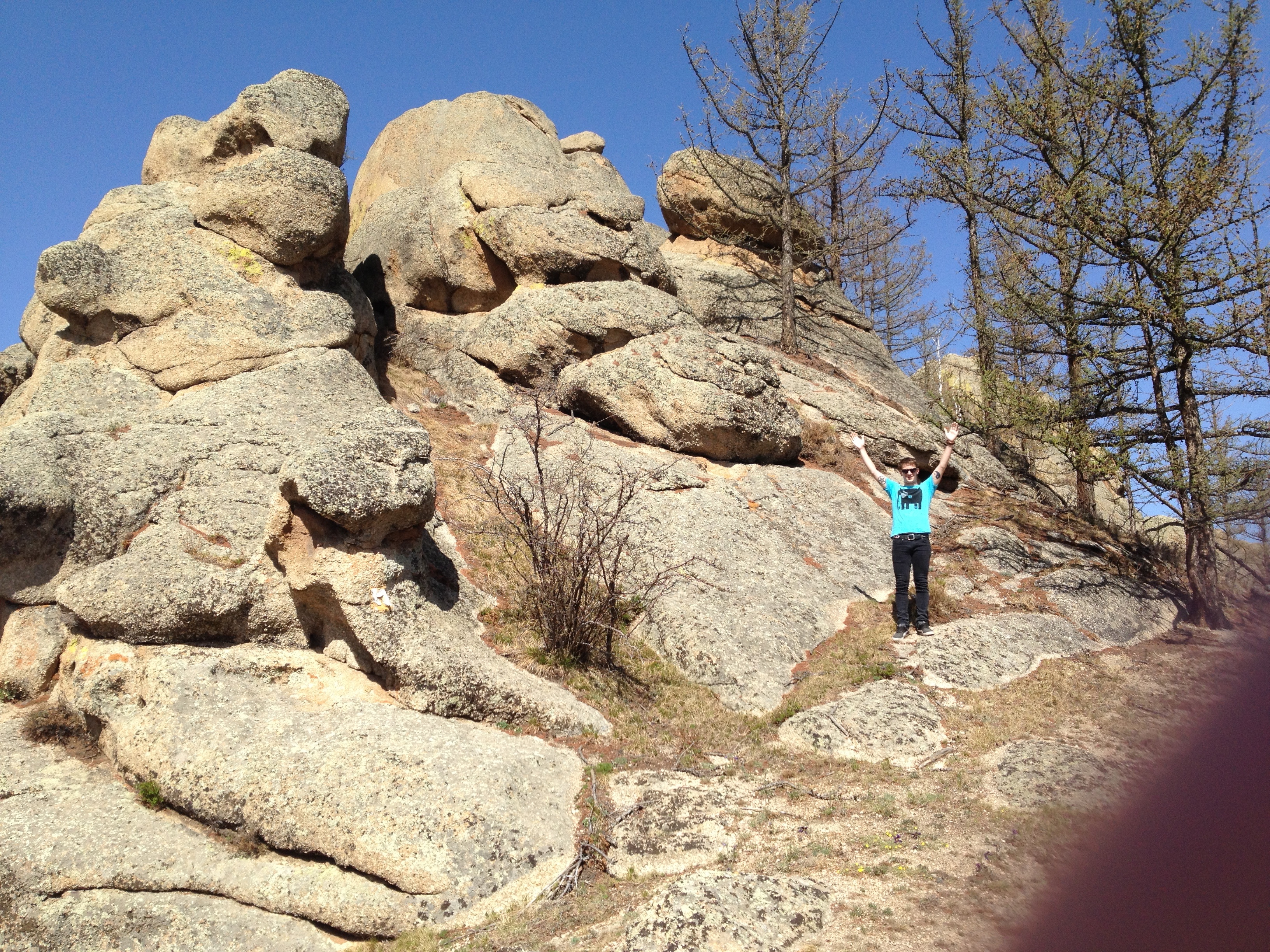
On top of some rocks after one of our many short hikes through the hills.

On top of some rocks after one of our many short hikes through the hills.

***

When we finally returned to Ulaanbaatar, we had an afternoon to kill before jumping on a train to Siberia that evening. We had lunch at a buffet style Mongolian barbecue, which was amazing – I ate so much I felt sick – and then spent some time at the National Museum. The more I learnt about the native Mongolian people and the mighty empire of warriors they had once been, the more I suspect that they as a people were the inspiration for the Dothraki tribes in Game of Thrones. Fierce warriors with highly revered leaders and a lifestyle that revolves largely around their horses, they were nomads that travelled across their vast country and were constantly at war to expand their territory. Modern Mongolia is a different story though, but I still got a little kick out of my geeky comparison. I also saw some exhibits about musical instruments – the name of the Mongolian instruments I’d seen in the show last time we were in Ulaanbaatar was morin khuur, a name that translates to ‘fiddle with a horses head’. The end of each instrument is finished of with a carved wooden horse head, and the morin khuur is considered something of a national treasure for Mongolia.

As I wandered through the museum, I realised that most of the signs and information boards were in Mongolian, with no English translation. I hate being one of those tourists who just expects everyone to be able to speak English, and get angry when they can’t – I frequently struggle silently through awkward language barriers rather than go on a “Can anyone speak English?” spree – but I have to admit I was taken aback. Almost everywhere in South-East Asia had had signs in English, which I suppose I completely took for granted while I was there. English is a common and widespread language, but it’s by no means global or universal, and I think it took being in an official building like a museum, yet there still being very little English, for that fact to truly sink in.

***

Overall, my time in Mongolia was incredibly interesting and unique. Combined with the fact that I wasn’t scammed, tricked, injured or molested, I think I can safely say its been my favourite place on my journey so far, and my only regret is that I couldn’t stay for longer. But the tour schedule was pretty set when it came to transport, and we were due to catch our next train into the heart of Siberia.

Reflections on South East Asia

After my stressful trip back to Bangkok, I spent my last days in Thailand with Rathana, just chilling out and doing relatively normal things – going out for dinner, having a few drinks at a sky bar, watching a movie, doing a bit of shopping and chilling by the pool. When I think about it, it’s those little things that I really enjoyed about my time abroad. While it is fine to be a big ol’ tourist and gush over temples and beaches and resorts and all that jazz, I love the feeling of spending time just being in a foreign city and really living there, doing all the regular stuff as well as all the typical holiday things. I haven’t really figured out what I want to do with my life when, God forbid, this incredible journey comes to an end, but I must say that I’ve really developed a taste for living abroad. That issue is a can of worms in itself, though, and for now I just want to reflect on some things I’ve noticed, lessons I’ve learnt, and the life I’ve experienced during my time in South East Asia.

***

One thing that I was expecting, yet still deeply shocked by, was the prevalence of poverty in these countries. It broke my heart to see so many children in the streets, whether it was the boy in Saigon performing gruesome tricks such as breathing fire, chewing hot coals and eating razor blades, then approaching the crowds of beer-drinking tourists for a donation, or the little girl following me through the temples of Angkor Wat desperately trying to sell me five fridge magnets for a dollar, or the little girl carrying her baby brother, standing next to my table at a cafe in Siem Reap pleading, “Please, I don’t want money, I just want food.” It makes you want to run to the ATM and empty your accounts into their starving little hands, but I’ve been warned by so many about the poverty traps that evolve from giving these kids money, encouraging the very behaviour that keeps them on the streets and out of school. Back in Ho Chi Minh City, Allistair told me he sometimes gave them a little bit of money, but made them promise that they would get off the streets and use the money to go to school. Yet I wonder how many kids actually listen to his advice, and how many just see it as another reason to continue with their begging.

Other people suggest that sitting them down and actually buying them a meal is a thousand times better than giving them money could ever be. However, I had a rather unpleasant experience in restaurant in Phnom Penh when it came to offering food. I had ordered pizza and a beer, and was sitting on a table facing out into the street, catching up on some blog posts and sending a few emails home on my iPad. Cambodia is full of people selling things on the street, whether its sunglasses, books, bracelets or marijuana, but it always tugs your heart strings a little to see children working on the streets like that. So when a little girl failed to interest me in the bracelets she was selling and her eyes fell hungrily onto the pizza in front of me, I finally caved in. “Sure,” I said with a smile, “I’m probably not gonna eat the whole thing anyway.” I pushed the plate slightly in her direction, and she leant over and lifted a cheesy triangle out and took a bite. What I hadn’t anticipated, however, were her three smaller companions all wanting their own pieces of my pizza too. “Oh, ah… Sure, take two,” I mumbled mostly to myself, because the little boy hadn’t waited for my permission to take a piece. I still wanted to have some of the pizza myself, so after that I pulled the plate back towards myself and took a bite out of one of the remaining pieces. Another little boy stood staring at me expectantly.

“Can’t you guys share?” I asked, motioning to the second piece that the first little boy had taken. I realise how awful and selfish that sounded, but I was trying to strike a balance between enjoying the food I’d ordered for myself and helping these little kids out. Yet they seemed so angry when I refused to give them any more of my pizza. “Look what you have, you have so much!” they yelled, pointing at my iPad and my beer. I’d have felt a little more guilty if they hadn’t started to harass me so much, with one of the boys sneaking around into the restaurant and behind my chair. I pulled my backpack close under my legs, huddling over my table, and I felt like someone with a bag of hot chips who had just been discovered by a flock of seagulls. The boy got so bold as to reach over and touch my iPad – I’m not sure if he was hoping to achieve anything, perhaps disturb the file I was working on, or simply just annoy me. He failed in the former, but definitely succeeded in the later. I’m not proud to admit it, but after that I ended up losing my temper and swearing at them, in an attempt to scare them off. Yet the girl, who seemed to be the leader of the small group, only came back with a greater fury, spitting my curse words back at me. I was in shock – how did what I thought was a simple gesture of kindness turn so bitter so quickly? The ordeal finally ended when the restaurant owner came out and had a word with the kids in their local tongue, and I relocated to a table further inside the restaurant. It had been a prime example of biting the hand that feeds, and I hate to admit that those children ruined it for all the others – I couldn’t bring myself to donate to any more street children, be it food, money, or anything else, because I was afraid of it escalating into another nasty situation.

***

To revisit a topic from a previous blog, I found the notion of love and relationships to be quite peculiar in South East Asia. As Anna had pointed out to me earlier on in my trip, their definition of love is something very different to our Western ideals of romance.There is a huge emphasis on tradition and family, which is a whole topic worthy of analysis in itself, but in this culture it’s probably similar to what we would call “living the dream” back at home – a white picket fence, happy marriage, two point five kids and an SUV parked in the driveway. Yet in Western culture, it’s becoming increasingly more common to break from the mould and live the life you want to live, not the life that’s expected of you.

That trend hasn’t caught on in Asia. One of the conversations I had with my host while I was Couchsurfing in Vietnam was about relationships. “I really want a boyfriend,” he had told me. “I want to start a family. I know I have my studies to finish, but I really want to start my life now.” When I suggested that there was more to life than relationships and family – or rather, one didn’t need to start a family to feel complete – he practically scoffed at the idea. I told him about several of my previous boyfriends where the topic of children had been discussed – not specially about us having them, but our individual views on the idea – and how every time I had been sure that I had a lot more life to experience before I was ready to settle down, let alone have a baby or start a family. But for him, all he could hear was the ticking of his biological clock. Being gay is one thing, and I was glad that while he wasn’t out, at least my host himself accepted his homosexuality. Yet for him the idea of disappointing his family, and not doing all he could to support and foster those basic traditional values, was a worse crime than loving a man would ever be.

And as my journey continued I saw this theme continue. Any local Asian boy was never just interested in a playful flirt or casual fun. It seemed as though they were all on a similar mission as my Couchsurfing host – to find the love of their life, to cherish and treasure and protect and look after. Which is an admirable quality – God knows it’s one I struggle with – but I can’t ignore the fact that they seem to be rushing through life without appreciating being young. I scoff and roll my eyes at the Westerners I know who are married at age 20, almost exclusively for religious reasons, and I would be quick to do the same again now if it weren’t for my realisation that its so ingrained into the culture, insofar that any other way of life just seems ludicrous.

***

Which I guess is only the tip of the iceberg that is the essential difference in culture. I know it sounds obvious, and I’ve read dozens of books on the subject during my sociology degree, but it really took being and living in these places to comprehend the enormous differences in culture. ‘They do things differently in Asia’ is such an incredible understatement. It’s not just a different way of doing things, it’s a different way of thinking things – a different state of mind. You especially notice it when you run into other Westerners, and they seem just as confused as you do about some of those things.

Because the list is endless. I’ve had waiters who don’t understand the concept of tipping, and will actually refuse to take your money. I’ve bought items at a third of their original marked price, all because I didn’t seem interested at the beginning – the shopkeeper literally haggled herself down. As a white person I feel as though I’ve been both the receiver of special treatment and the target of multiple scams, all based on the idea that anyone from the Western world is insanely rich. Which, comparatively, most of us are. It’s a slightly uneasy feeling when it comes to haggling over an amount which literally converts into a couple of dollars back home. In Australia, I would have written it off as a couple of dollars, nothing major. Being in South East Asia almost had the reverse effect on me – in a place where the currency goes a lot further, we seem to want to make every cent count. Yet when we’re shaving a couple of dollars of the price that we’re paying, most of us don’t think about the money that the local seller is not getting, and how much more that money might mean to them than it means to us.

***

Cultural differences aside, I’ve had an amazing beginning to this year-long journey. I’ve been molested by monks and monkeys, run through the crowded streets of Thailand with super soakers, been moved to tears by the histories of Vietnam and Cambodia, won a game of Trivial Pursuits in the suburbs of Saigon, fallen off a motorbike in the middle of Phnom Penh, crammed myself into multiple night buses, and drunk an excessive amount of beer. Just to name a few things.

Saying farewell to South East Asia at Suvarnabhumi Airport BKK.

Saying farewell to South East Asia at Suvarnabhumi Airport BKK.

As I board my plane to Beijing, I definitely feel a sense of accomplishment. I’ve only been travelling for six weeks, and a lot of people would say that that isn’t a long time at all. Which it isn’t – perhaps about a seventh of my journey in total. But I’ve seen so many places and met so many people that it definitely feels as though its been a long time. In the monotonous routine of life, six weeks can pass in the blink of an eye, so I feel confident that I’ve made the most of every second I’ve been away, experiencing the highs and the lows, the good and the bad, the wild and the crazy and the awe-inspiring. Yet the truth is that I rushed through South East Asia. There’s still a handful of other countries I would loved to have visited had I had more time, and definitely scores of new and exciting things to see when I eventually return.

But now the next stage of my adventure is calling me, along with what I’m sure – and actually hope – are a host of crazy new stories to be told.

Riding Solo

After four weeks on the road, it’s safe to say I’ve seen quite a bit and had some new worldly experiences. However, something I never expected was that travelling by myself would play such a crucial part in the way that my journey unfolded. At the time of planning all I envisioned was complete, unbridled freedom. While that still might be true, travelling alone isn’t without its drawbacks, a few of which I am slowly learning to navigate.

***

Perhaps the first time the realities of traveling solo really hit me was when I was waiting for my train south to Krabi, sitting at a table on the elevated café level of Hua Lamphong Railway Station in Bangkok. All around me, I saw so many travellers in pairs: whether they were partners or friends, or sometimes even groups of three or four, almost everybody had somebody. And that started to make me feel a little lonely.

And I don’t necessarily mean the ‘longing for human contact’ kind of loneliness. It’s the practical advantages of having a travelling partner that I really began to notice when I was finally by myself. For example, I had an hour and a half wait at the train station. There was no table service in the area I was sitting in – if I wanted to order food, I would have to pick up my bags and take them to the counter with me. If I wanted to go to the bathroom… well, I couldn’t. Unless I either hiked in there with all my bags or left them out in the open when I went, completely unattended.

Luckily I didn’t need to use the bathroom, but it just made me realise how much easier some things are when you have a traveling partner. Initially I was quite drawn the freedom of being able to do exactly what I wanted and travelling whenever I wanted, but when you’re making these grandiose plans, those little details are often the first thing you lose sight of. They say that solo travelling can be much cheaper, but even that freedom still comes with a different kind of cost.

***

When I was on the beach at Ao Nuang beach at Krabi, I had no choice but to leave my bag unattended. It probably probably says something more about my paranoia or anxiety that I pretty much backed into the ocean, facing the beach, so that I could keep an eye on my belongings. But you loosen up eventually, for better or worse, and in the end you just have to calculate the risk and do your best to enjoy whatever it is you’re doing. And I did, eventually. Train stations are very different settings to beaches, and there was just the right amount of people present on the sand for me to feel more comfortable about walking away from my bag – enough people to be witnesses to a theft, but not enough for a thief to be lost in the crowd.

When I was at Rai Leh, I was able to ask Sam and Sarah to watch my bag while I went into the ocean. But eventually they wanted to swim as well, so we all just had to leave our bags in a cluster on the beach and keep an eye on them every now and then. Although again, maybe that’s my paranoia talking. As we walked out of the warm Thai water, Sarah peered out onto the vast expanse of sand and asked “Where are our bags?” We’d floated a little way down the beach, but I was immediately able to point out the location of our belongings. Seems not everyone is so highly strung as me when it comes to the location of their valuables.

***

Then there is the freedom of travelling solo – both a blessing and a curse. For starters, I know that had I not been travelling alone, I probably wouldn’t be on this mammoth nine month journey. Most people don’t have the time, or have too many commitments to take such a long term vacation from their real lives. But I did, so I set out with the intention of not letting anyone get in the way of doing exactly what I wanted to do.

But I felt it was impossible to plan an entire nine month holiday completely in advance, so I left a lot of the fine details up to chance and circumstance. Booking hostels and overland transport as I go, seeing wherever the wind takes me – it sounds like the ultimate travellers dream. I know for a fact I wouldn’t have done half the things I’ve done so far if I’d brought a travelling companion from home – beers with the British boys in Thailand, Couchsurfing in the Vietnamese slums, being sexually harassed by a monk, or even the SCUBA diving tour that I booked myself into on a last minute whim.

Then there’s even the freedom to do nothing. Those days or nights when you’re just too exhausted, and all you want to do is sit in the hostel and read a book or make a Skype call. You don’t have to make excuses to anyone or apologise for not going out and having fun. I accept the reality that out of my 275 days of travel, not every single one is going to be jam-packed with activities.

Yet this does run the risk of complacency. In a brand new city with so much to explore, after a few a days you can easily become overwhelmed. With a travelling partner, you always have someone else’s energy to bounce off and keep ideas coming, always planning something to keep the ball rolling. By yourself, it’s easy to feel at a loss, and waste days trying to decide what to do. I thought that hostels would help with this – it certainly did while I was in Krabi – but of the three nights I’ve spent in my hostel at Ho Chi Minh City, for two of them I’ve been one of two people staying in a 9 bedroom dorm. The other guy hardly speaks, and has spent the entirely of his time in the room editing videos and photos on his laptop. So it’s really up to me, and me alone, to get out there and explore this big city.

River Tour on the Mekong Delta - you get used to taking tourist selfies when travelling on your own

River Tour on the Mekong Delta – you get used to taking tourist selfies when travelling on your own

***

Being alone gives you a lot of time to think, which is also a problem. You end up thinking about home, and things and people that you miss in that state of loneliness, when you know you should be out there having fun and exploring the world. But I hope that writing about this will be cathartic in some way, so I might be able to let go of these difficulties in travelling solo and to fully appreciate the experiences that I’m having.

The weekends coming up, so I’ll probably hit the nightclubs and use alcohol as a social lubricant and find some new people to hang out with. No matter where you are in the world, some things never change.

Prologue

Six months ago, I started planning a trip. At first it was just a few plane trips to visit a couple of international friends, but when it came to the question of when I would be able to make these journeys, I came to the startling realisation that I had absolutely no concrete or definite plans for my future. I was about the conclude my sixteenth year of education, on the cusp of finishing my three year undergraduate degree at university, and somewhere in the back of my mind, it became very clear to me that I was ready to shelve the textbooks for a while and get out there and join the real world.

Yet the idea of getting a full time job was particularly daunting, considering I lacked even the slightest sliver of a career path. And that’s when it hit me: I shouldn’t try to fit these travels around my year – I should make them my year. I’ve had far too many of my older friends lament to me about how they wished they traveled more when they were younger and had the time, how their biggest regret was not doing an exchange semester while in university. I did not want to be another brick in that wall. With my studying behind me and an open-ended future, it didn’t take long to come to the conclusion that I did – I was going to see the world.

Now, on the morning of my departure from Sydney, it all seems a little surreal. After reiterating my travel itinerary about a hundred times as I’ve said goodbye to all my friends and family, my future plans have rushed up to meet me as the present. This 9 month journey will take me further from home than I’ve ever been, completely removed from anything familiar, and this morning I’m filled with equal parts of excitement and nervousness. But heading off into the unknown is all part of the adventure – to see what I’ve not seen before, to go where I have never been, and to create my own story from the various journeys along the way.

Which brings me to this – my travel blog. I’ve been a writer for a long time now, in both a personal and semi-professional capacity. If there was a specific point to this whole trip, I suppose it would be to learn a little more about myself, and discover enough to maybe one day open up a clearer path to my future. Writing is one of the few things I do know, and so I hope to combine my known with the unknown in order to make sense of the vast and ever changing world around me.

And hopefully, I will be able to include my readers in my discovery of the world around me. So I look forward to my next experience on this journey, so that I may live it, write it, and share it back into the world.

Bon voyage!