Rollin’ On A River

During my stay in Ho Chi Minh City, I thought it was only appropriate that I explore a little more of Vietnam before heading off to the Cambodian border. After sussing out the logistics of my various options, I decided that heading south to the Mekong River delta would be the most interesting and diverse experience. The day trip involved a two hour bus ride out of the city, so I rose uncharacteristically early that morning and trudged onto the bus still half asleep, yet curious to see what the wider country of Vietnam would have in store for me.

***

The Mekong River is the largest river in Asia, starting in Tibet, and flowing through China, Laos, Cambodia and Vietnam, where it divides into 9 tributaries that all flow out separately into the South China Sea. The south of Vietnam is known as the ‘Rice Bowl’ due to the established crops and farms throughout the region. The real tour started at a riverside town called My Tho, and from there we walked through the jungle on a small undergrowth trail until we reached the river.

From there we got into small wooden row boats that took us down a narrow river system that was surround by thick vegetation on each side. We weren’t too far from the main roads, but we were well and truly out of the city now, and floating down the river in the long rowboat really gave me an idea of Vietnamese culture that was probably a little more traditional then either of the living situations I had experienced so far. The short trip took us to a modest little business that turned out to be a factory for making coconut candy. We were able to taste some of the sweet substance right as it came out from melting and thickening over the fire – it tasted a bit like fudge – and were given the opportunity to buy some. That was the first inkling that I was on a tour that I’d heard been referred to as a “tourist trap”, where the initial cost of the tour is cheap, but all the extras come at an additional cost, and almost every stop along the way tries to sell you something.
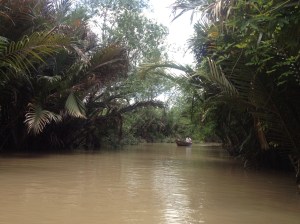
The smaller, secluded sections of the Mekong River.

The smaller, secluded sections of the Mekong River.

After we had concluded business at the candy factory, our tour guide fetched a hessian bag, reached inside and produced a snake from within the depths of the sack, immediately offering it to individuals in the group to pose with it and take photos. Luckily I had faced and conquered my fear of snakes back in Bangkok, otherwise my reaction to the surprise might have been extremely embarrassing. On the contrary, I couldn’t wait to get my hands on the reptile – or to be more accurate, to get the reptile around my shoulders. I thought back to the fearless little ten-year-old boy I had been when I visited the Steve Irwin’s Australia Zoo in Queensland, itching to get my photo taken with the huge python, and realised that I’d come full circle again. I didn’t even flinch as the tour guide draped the snake over my shoulders and looped it around my neck.

Getting friendly with the locals.

Getting friendly with the locals.

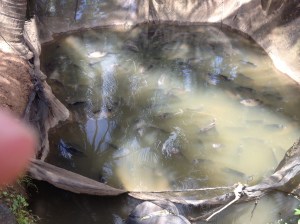
After the reptilian meet-and-greet, we jumped on another larger boat and headed down and across the river to another town named Ben Tre. We had lunch at an elephant fish ear farm – large flat fish that resemble their namesake. However, that particular delicacy was another tourist trap that wasn’t included in the price of the tour, though I’m not a huge fan of fish and was able to settle with tour included beef and rice dish. I sat at a table with two couples – a pair of British 27-year-olds taking their annual holiday, and another retired British couple who now lived on the Sunshine Coast in Australia. They were all very nice and interesting to talk to, although I’d been hoping I might meet some more people like myself, solo travellers or backpackers. Groups and couples tend to already have their itineraries firmly set out, so I just had to enjoy their company for the day before writing them off as what Tyler Durden would call “single serving friends”.

Photo on the larger boat, taken by my new temporary friends.
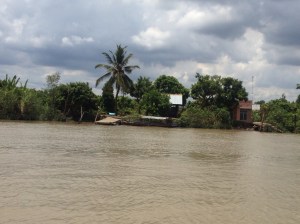
Photo on the larger boat, taken by my new temporary friends.

View of the wider part of the river from our larger boat.
View of the wider part of the river from our larger boat.

Pool of elephant ear fish at the farm.

Pool of elephant ear fish at the farm.

The last stop of the tour was the centre of the town, where there was a temple complex with several pagodas and statues of Buddha. I hadn’t gotten around to visiting a similar site in Saigon, so I was glad to be able to make up for it here instead, though the more I saw of South East Asia, the more similarities I began to see in all these temples and monuments. Which doesn’t make them any less holy or worthy of reverence – it just means you can’t spend quite as long marvelling in awe at them when you saw that temples bigger cousin in a different city. Overall, my day tour on the Mekong River was pretty average. I guess being a day tour it was obviously going to feel a little rushed, but there was nothing particularly amazing or breathtaking about it. Although it was nice to get out of the city and see some more the of the country of Vietnam, no matter how briefly.
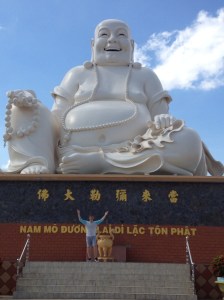
Happy Buddha!
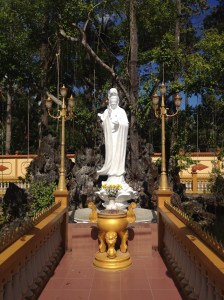
Happy Buddha!

One of the more solemn shrines at the temple.

One of the more solemn shrines at the temple.

***

That trip happened during the middle of my week in Vietnam. To stick to my river theme and spare you from any more river references in my blog titles, I’m going to throw chronology to the wind even further and tell the short story of my departure from Ho Chi Minh City…

After a slow day of recovery from my last night in Saigon, I hopped on an overnight bus towards the riverside town of Chau Doc. Not wanting to travel all the way to Cambodia via bus, I had decided to split the trip up by traveling to a border town on the Mekong River, staying there for a night or two, and then catching a boat up the river to Phnom Penh. It wasn’t as cheap as a bus, but I figured it would be a great way to see some more of the countryside, as well as being one of those rare opportunities to listen to Lonely Island’s I’m On A Boat and giggle smugly to yourself at the accuracy of the content.

Though for all the research I had put into transportation, I hadn’t bothered to investigate too much into the town of Chau Doc itself. Crawling off the bus at 5:30am, I was unimpressed (mainly with myself) to find myself alone in a tiny riverside town, where hardly anyone spoke English, at a time where hardly anything was open. “Cheap hostel,” I managed to convey to a motorbike taxi, and we roamed the streets for about 20 minutes, moving from closed hotel to closed hotel. Eventually I gave up and repeated “boat” while pointing at an address in the Lonely Planet guide, and my taxi driver seemed to figure out what I wanted. I found myself sitting at a dock on the river, half asleep while I waited for the world itself to wake.

The town of Chau Doc in the grey light of dawn.

The town of Chau Doc in the grey light of dawn.

Despite the dull light of the dawn, my short ride around the city had proved to be very illuminating. There didn’t appear to be any major tourist attractions here, and the level of English speaking locals seemed to be at a concerning low. I could see things going very wrong very quickly in a place like this, and after the bus ride I had just had, it was something I did not want to deal with. In a split second decision I changed my mind, and my stopover in Chau Doc went from a couple of days to a couple of hours, in a couple of seconds.

Setting out as the sun rises.

Setting out as the sun rises.

Luckily there was room on that mornings boat, so after only a couple of hours of being in Chau Doc, I was speeding up the Mekong River to the Cambodian border. My companions for this voyage turned about to be a bunch of Americans from Philadelphia who were doing a tour through South East Asia as part of a masters program. They were all extremely friendly, and they took me under their wing when we went through the border crossing process, which I was thankful for, since this was the first overland border crossing I’d ever done. It’s a feeling of sheer terror handing your passport over and one check point and then not getting it back until the next one. Once we got back on the boat from the Vietnamese exit point, the rest of the Americans had their passports returned, but mine didn’t come back. I knew it must have been because I still had to get my visa, while the others had obtained theirs in advance, but all the same, it’s still an uneasy feeling.
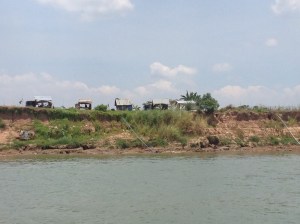
The boat provided some scenic views of rural Cambodia I might not have otherwise seen.

The boat provided some scenic views of rural Cambodia I might not have otherwise seen.

But it all went up without a hitch, and I spent rest of the 6 hour boat ride to Phnom Penh chatting to my new American friends, admiring the rural scenery and nodding in and out of consciousness – to say the least, it had been a very long morning.

Getting to Know You: Miss Saigon

My first impression of Ho Chi Minh City was that it seemed like a baby version of Bangkok. It has the backpacker district with the flashing lights and street hawkers, it has the numerous food carts selling a variety of local cuisines, and it has a lot of busy traffic. However, it’s almost as if the vehicles are in baby form, with the motorcycles being to cars what tadpoles are to frogs, and the motorcycles are everywhere. I know I’ve said it before, but literally everywhere – they put the gangs of Central Coast NSW to shame. So the city may feel a little smaller than Bangkok, but in no way does that make it feel any less busy, at least in District 1 in the central part of the city.

So. Many. Motorbikes.

So. Many. Motorbikes.

Vietnamese flag out the front of the Ho Chi Minh City Museum.

Vietnamese flag out the front of the Ho Chi Minh City Museum.

There is also a confusing aspect in that this city has two names – something that puzzled me to no end in the early stages of planning my side-step detour to Vietnam. Pretty much all the native locals call it Saigon, even a lot of the travel agencies do too. Ho Chi Minh City, taken from the name of the Vietnamese leader during the wartime period, is the name used by the government and officials and anyone else of relative importance. As a traveller, I don’t really have a preference, and will use both interchangeably throughout this blog, just to keep y’all on your toes.

***

My first few full days in Saigon were spent doing some sight seeing. I decided to tackle the city on foot – after letting my guard down and being scammed into paying an exorbitant amount of money for a brief ride in a cyclo, which is basically a bike with an oversized basket for passengers, I became a little mistrusting of all the locals who approached me, offering rides on their various street vehicles. I also found myself slightly terrified of the traffic, although I quickly learnt that in Saigon, being a pedestrian is just as hazardous as being behind the wheel of a car or on a motorbike. Which is not necessarily saying that it’s risky – you simply need to really keep your wits about you at all times… although, it is risky. I’ve had a number of extremely close encounters where my attention lapsed for just a moment, and I came this close to being far too acquainted with the front end of a motorbike. Look both ways, amnd look all four ways at intersections. Sometimes it’s easier to just slowly wander out onto the road and let the bikes move around you. This is particularly terrifying though and by no means safe – sometimes I just got impatient waiting for a legitimate gap in traffic.

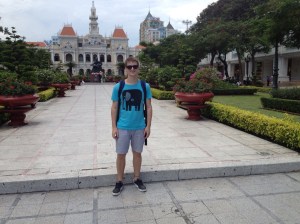
Outside the Ho Chi Minh City People's Council People's Committee Building .

Outside the Ho Chi Minh City People’s Council People’s Committee Building .

French-designed Cathedral in the city centre.

French-designed Cathedral in the city centre.

Reunification Palace.

Reunification Palace.

Another thing Ho Chi Minh City seems to have a lot of is museums. As well as the War Remnants Museum, I visited the Fine Arts Museum and the Museum of Ho Chi Minh City. I took some refuge from the bustling city outside to observe some of the paintings and sculptures in the Fine Arts Museum, almost all of which are created by Vietnamese artists. I’m no art critic, and I don’t know the first thing about techniques or designs or any of the fine details when it comes to the fine arts, but the museum did have a huge variety of works on display, much of which represented lots of aspects of Vietnamese culture. As I wandered through the halls, I noticed that many of the paintings depicted soldiers and other wartime themes. Despite being beautiful works, that saddened me a little bit, and I was beginning to understand just how much the war has affected the mindset of so many local people here, and had branded their cultural history with a very distinct and conspicuous mark. It was a mark of remembrance and mourning, but also hope for the future.

Then I came across a piece called ‘Agent Orange’, where the oil painting had been textured so that it recreated the horrific deformities of the victims of the harsh poison, to a point where the art was almost three dimensional, and the suffering reached out from within canvas to force you to feel the emotions it depicted. I both loved and hated the painting, because it was so confronting, and because it filled me with the similar feelings I felt at the War Remnants Museum. I took a few photos, which I think I probably was not supposed to do, so I won’t upload them. I also feel like these works are best experienced in their true medium, and not from within a computer screen.

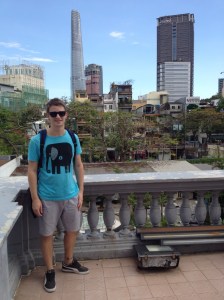
The other museum was also interesting, learning about the history of the the city. I don’t really care to regurgitate everything I read though, so make sure you check it out if you’re ever in Saigon. The building did, however, have a nice view.

View of city from the Ho Chi Minh City Museum.

View of city from the Ho Chi Minh City Museum.

***

My first evening in the hostel was when I began to experience the tourist nightlife. As people began slowly arriving home from their days activities and trawling into the dorm room, one of the guys made an open invitation to anyone who was interested in joining him and a few other guys in getting some dinner. Having no plans and nothing to lose, I tagged along and found myself with four guys, respectively originating from Germany, Wales, America and New Zealand, and a Hungarian girl. Our small international party set out looking for cheap street food. I’d always been a bit of a fan on Vietnamese food back home, so it was kind of a novel thrill to sit on a tiny plastic chair on the side of the road, like all the local people did in District 1, and eat my pho noodle soup. After that we were joined by two Argentinians and headed to a bar to drink some beer. I say “bar”, but in reality it was a little hole-in-the-wall joint with tiny plastic chairs (and slightly bigger plastic chairs that were used as tables) littering the footpath out front, sprawling out onto the road when it got busy enough. Later in the week, when I explained this scene to a New Zealander expat now residing in Ho Chi Minh City, he merely chuckled and said, “Yep, we call that a bar here.”

However, what the place lacked in bells and whistles, it made up with value for money. Draught beer was 7000 Vietnamese dong per glass. That converts into approximately 35 Australian cents. It seemed criminal to drink anything else when you could drink for so ridiculously cheap, and not for the first time on this trip I found myself succumbing to peer pressure and going in for a round of beers, only to be surprised that I actually quite enjoyed the taste of it. I didn’t love it, but for a few quiet drinks on a Tuesday night it doesn’t get much better than three beers for a buck.

The weekend was a different story though – I met a bunch of Australians who had been in Vietnam for the last month or so for work, and they took me out to some of the nearby nightclubs. The bars were a little more sophisticated then plastic stools on the pavement, and the drinks were more than 35c, but they were still exponentially cheaper than back home and the cocktails were lethal. Two Long Island Ice Teas later and I have to confess that I couldn’t tell you much about the difference between the clubs in Saigon and the clubs back home. Except that in one of them I ran into a Tasmanian couple casually smoking a hukka, and I’m pretty sure the flavour was “blue”. And security guards loved to pose for photos, something I have never seen in Australia.

In an e-mail to my father about my trip down to Krabi, I had mentioned how good it had been to get out of the city for a while and see the rest of the country. His response triggered something in me that I’d never really considered before: “Yes, cities tend to all feel the same after a while. It’s best to get out and see the real country”. While I could see comparable differences in each city I had visited, I promised myself that I would make my best effort to see a little more than just the major cities in each country went to, wherever I could.

Because at the end of the night, whether its beer or spirits, Sydney or Saigon, hangovers are generally all the same too.

Riding Solo

After four weeks on the road, it’s safe to say I’ve seen quite a bit and had some new worldly experiences. However, something I never expected was that travelling by myself would play such a crucial part in the way that my journey unfolded. At the time of planning all I envisioned was complete, unbridled freedom. While that still might be true, travelling alone isn’t without its drawbacks, a few of which I am slowly learning to navigate.

***

Perhaps the first time the realities of traveling solo really hit me was when I was waiting for my train south to Krabi, sitting at a table on the elevated café level of Hua Lamphong Railway Station in Bangkok. All around me, I saw so many travellers in pairs: whether they were partners or friends, or sometimes even groups of three or four, almost everybody had somebody. And that started to make me feel a little lonely.

And I don’t necessarily mean the ‘longing for human contact’ kind of loneliness. It’s the practical advantages of having a travelling partner that I really began to notice when I was finally by myself. For example, I had an hour and a half wait at the train station. There was no table service in the area I was sitting in – if I wanted to order food, I would have to pick up my bags and take them to the counter with me. If I wanted to go to the bathroom… well, I couldn’t. Unless I either hiked in there with all my bags or left them out in the open when I went, completely unattended.

Luckily I didn’t need to use the bathroom, but it just made me realise how much easier some things are when you have a traveling partner. Initially I was quite drawn the freedom of being able to do exactly what I wanted and travelling whenever I wanted, but when you’re making these grandiose plans, those little details are often the first thing you lose sight of. They say that solo travelling can be much cheaper, but even that freedom still comes with a different kind of cost.

***

When I was on the beach at Ao Nuang beach at Krabi, I had no choice but to leave my bag unattended. It probably probably says something more about my paranoia or anxiety that I pretty much backed into the ocean, facing the beach, so that I could keep an eye on my belongings. But you loosen up eventually, for better or worse, and in the end you just have to calculate the risk and do your best to enjoy whatever it is you’re doing. And I did, eventually. Train stations are very different settings to beaches, and there was just the right amount of people present on the sand for me to feel more comfortable about walking away from my bag – enough people to be witnesses to a theft, but not enough for a thief to be lost in the crowd.

When I was at Rai Leh, I was able to ask Sam and Sarah to watch my bag while I went into the ocean. But eventually they wanted to swim as well, so we all just had to leave our bags in a cluster on the beach and keep an eye on them every now and then. Although again, maybe that’s my paranoia talking. As we walked out of the warm Thai water, Sarah peered out onto the vast expanse of sand and asked “Where are our bags?” We’d floated a little way down the beach, but I was immediately able to point out the location of our belongings. Seems not everyone is so highly strung as me when it comes to the location of their valuables.

***

Then there is the freedom of travelling solo – both a blessing and a curse. For starters, I know that had I not been travelling alone, I probably wouldn’t be on this mammoth nine month journey. Most people don’t have the time, or have too many commitments to take such a long term vacation from their real lives. But I did, so I set out with the intention of not letting anyone get in the way of doing exactly what I wanted to do.

But I felt it was impossible to plan an entire nine month holiday completely in advance, so I left a lot of the fine details up to chance and circumstance. Booking hostels and overland transport as I go, seeing wherever the wind takes me – it sounds like the ultimate travellers dream. I know for a fact I wouldn’t have done half the things I’ve done so far if I’d brought a travelling companion from home – beers with the British boys in Thailand, Couchsurfing in the Vietnamese slums, being sexually harassed by a monk, or even the SCUBA diving tour that I booked myself into on a last minute whim.

Then there’s even the freedom to do nothing. Those days or nights when you’re just too exhausted, and all you want to do is sit in the hostel and read a book or make a Skype call. You don’t have to make excuses to anyone or apologise for not going out and having fun. I accept the reality that out of my 275 days of travel, not every single one is going to be jam-packed with activities.

Yet this does run the risk of complacency. In a brand new city with so much to explore, after a few a days you can easily become overwhelmed. With a travelling partner, you always have someone else’s energy to bounce off and keep ideas coming, always planning something to keep the ball rolling. By yourself, it’s easy to feel at a loss, and waste days trying to decide what to do. I thought that hostels would help with this – it certainly did while I was in Krabi – but of the three nights I’ve spent in my hostel at Ho Chi Minh City, for two of them I’ve been one of two people staying in a 9 bedroom dorm. The other guy hardly speaks, and has spent the entirely of his time in the room editing videos and photos on his laptop. So it’s really up to me, and me alone, to get out there and explore this big city.

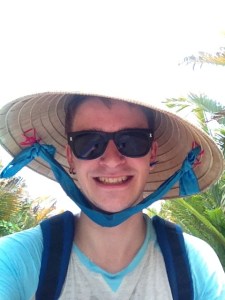
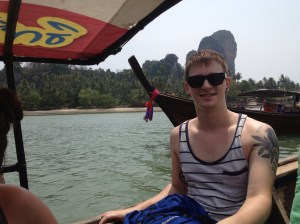
River Tour on the Mekong Delta - you get used to taking tourist selfies when travelling on your own

River Tour on the Mekong Delta – you get used to taking tourist selfies when travelling on your own

***

Being alone gives you a lot of time to think, which is also a problem. You end up thinking about home, and things and people that you miss in that state of loneliness, when you know you should be out there having fun and exploring the world. But I hope that writing about this will be cathartic in some way, so I might be able to let go of these difficulties in travelling solo and to fully appreciate the experiences that I’m having.

The weekends coming up, so I’ll probably hit the nightclubs and use alcohol as a social lubricant and find some new people to hang out with. No matter where you are in the world, some things never change.

Happy New Year! Songkran Water Festival

The end of my time in Thailand was rapidly approaching. It had only been three weeks since I first departed from Sydney, yet already I had experienced so much, seen some incredible things, and met some amazing new people. Yet there was one final event I was to attend in my final weekend in Bangkok – the Theravada Buddhist New Year festival celebrations, better known by its traditional name, Songkran.

Songkran is celebrated throughout South East Asia in Thailand, Myanmar, Cambodia and Laos. It’s traditional origins as a water festival come from a practice where the younger generation pours water on the hands and feet of the older generations, symbolic of a recognition of the knowledge and wisdom of their elders, and as a sign of respect. While I’m sure these traditional values are still upheld, the modern translation of Songkran is a huge water fight, where major roads in the city are closed off and people flood into the streets with hoses, buckets, water pistols and super soakers, and anybody on the streets becomes fair game for a hearty drenching. All throughout my time in Bangkok, people would repeatedly ask me, “Wait, when are you leaving? Are you gonna be here for Songkran?” Truth be told, the timing was a complete coincidence, but my flight out of Thailand was to be on the Monday after this wet and wild long weekend. As the weeks passed by I saw many of the corner shops stocking up and selling small waterproof pouches for money and valuables, and water guns of virtually every shape and size, and I began to think I was underestimating the significance of this festival.

“The whole city basically turns into a mosh pit”, Brendon had told me. “The Saturday afternoon of Songkran, this road will just be completely full of people. You’ll barely be able to move.” We were in a taxi going down Silom Road, and I peered out the window. The traffic was a blurry rush of taxis and tuk-tuks, cars and buses, the blaring of horns all around us. This was a major road in this area of Bangkok, and it was then that it really hit me that Songkran meant business.

***

As fate would have it, Silom Road was to be the destination of my very first Songkran. Nervous, excited, and not knowing what to expect, I set out with Rathana and his friends and caught the BTS to Sala Daeng. When we exited the platform and descended the steps down to Silom, I realised that Brendon’s description had not been an exaggeration in the slightest.

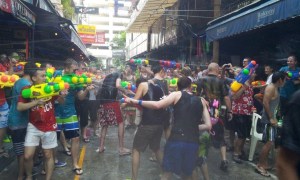
Silom Road packed with people celebrating Songkran.

Silom Road packed with people celebrating Songkran.

The road was packed. In place of the regular traffic was a steady flow of humans, almost like herds of cattle, being pushed along the street by the momentum of the crowd. Every man, woman and child was armed with a water pistol of some description. As we merged into the congregation, I could already feel the splashes of water coming from basically every direction. It was basically a free for all – I shot a random passerby with my super soaker, and he immediately whirled around and returned fire. But it was the normal thing to do – people were expecting to get wet, so no one seemed to get upset or annoyed. I’d been a little terrified at the though of entering such a massive crowd in a relatively unfamiliar city, but the whole vibe of the festival was one of complete, unabashed fun, indulging in the simple pleasures of a mass water fight in the streets. Even when I was copping a water pistol to the face, nothing could wipe the enormous, goofy grin off my face.

Except for maybe the flour. The were lots of people running around with buckets of (what I hope was) flour mixed with water, painting the faces of passers by with their hands. While I’m not afraid of getting a little dirty, some of the attackers weren’t as gentle with their application of the white paste, and a couple of times I got a stinging eyeful of floury finger. After that, I viciously defended my face, giving anyone who approached me with a bucket of flour a heaving dousing to the face from my super soaker.

We took to the streets with our own arsenal of water guns.

We took to the streets with our own arsenal of water guns.

The streets were wild. At various points there were what appeared to be fire trucks, or at least huge tanks of water with huge hoses attached. They rained down on the streets, and everyone cheered and screamed as we all got absolutely drenched. On the sides of the streets, people were selling more water guns, bottles of water for refills, beer and food, but their were joining in with the drenching just as much as the rest of the soggy mass of people.

We moved up and down through the packed street a couple of times before taking a turn down Silom Soi 4 – because obviously the gays really know how to throw a party. As we walked down the narrow street, people in the bars on either side assaulted us with an onslaught on water. We ran through, screaming and laughing, attempting to squirt them back. We ran into more of Rathana’s friends, and soon we were part of the mobs of people squirting water at the passers by, and engaging in water warfare with the groups on the other side of the street. While the only water refills available out on Silom Road came from bottles that we had to buy, the bars at Soi 4 had big buckets for us to refill our water guns, so the water fights continued long into the afternoon.

The water fights were raging in Silom Soi 4.

The water fights were raging in Silom Soi 4.

At one point there was a lull in the madness, and a parade emerged from the throng of people. Boys, and a few girls, in matching outfits and shiny black thigh-high high heeled boots marched down the strip, and they were showered with lots of cheering and even more water.

The parade marching down the drenched Soi 4.

The parade marching down the drenched Soi 4.

But after the procession passed, it was back to the water fight. As the sun begin to go down, some of us decided to leave Silom, go get dry and celebrate with dinner somewhere else. We ran back through the torrential rains that were the water guns of Soi 4 and back out onto the main road. If I’d thought that the streets were packed when I first arrived in the early afternoon, I really got the shock of my life on our return trip back to the BTS station. Earlier, we’d been able to move with relative ease in the mass of people, as long as we followed the flow of the crowd. However, now the flow of people had practically come to a standstill. Moving in either direction was difficult, and numerous times we found ourselves trapped, surrounded by either people who were going the wrong way, or walls, carts, and other stationary obstacles. There was a mild hysteria brewing in some of the crowd, as we were forced to move in the wrong directions, or simply stand still in a crush of people while waiting for the chance to move at all.

As the day progressed the crowd of people only grew bigger and bigger.

As the day progressed the crowd of people only grew bigger and bigger.

Deaths at these kind of festivals aren’t unheard of – tourists that got trapped in the wrong place at the wrong time, and other travelling horror stories. Luckily we all made it out alive, only slightly traumatised, and I commented to my companions that despite being an absolute logistical nightmare, the vibe and mood within the crowd of people never strayed from that of lighthearted fun and enjoyment. Had a similar thing happened at an Australian event, I have no doubt there would have been aggressive vibes, pushing and shoving, and inevitably break outs of violence and fights. So despite being packed into such a throng of people, and there not being any security guards or crowd control to speak of, I never at any point really felt unsafe.

***

Songkran traditionally lasts the whole weekend, but I needed to spend the Sunday getting my things together and finalising plans for my next destination. But I was also exhausted from the celebrating that I did do – the water festival was unlike anything I’ve ever seen before, and it’s always pretty amazing to see how another culture reinterprets historical events in their own fun modern ways. I had so much fun in my first Songkran, and somehow I have a feeling it’s not going to be my last.

Life’s a Beach

While Bangkok may be a glistening gem of a city, full of flashing lights, broken streets and chaotic, life-threatening traffic, the country of Thailand is home to a huge range of other travel destinations, particularly the beaches and islands that are scattered all around the Andaman Sea and the Gulf of Thailand. My time spent in this mega city had been incredibly eye-opening, but once again that travelling itch was gnawing in the back of my mind, and I felt like I’d been stationary for too long. I needed to keep moving – to keep travelling – and so I decided to make the most of my time left in Thailand by making my way south to explore some of the coastal delights that the country has to offer. After a quick search through locations and hostels, I set my destination as the small coastal town of Krabi.

***

Sticking to my commitment to travel as cheaply as possible – and to also get the most “experience” out of my journeys, I booked a ticket on the overnight train from Bangkok. It was a 12 hour journey from there to a town called Surat Thani, from where I would travel via bus for a few more hours before finally reaching Krabi. Including delays and waiting time, it took me about 17 hours before I finally set foot in the hostel – a long time considering Krabi has an airport which is a one hour flight from Bangkok, but it was also remarkably cheaper. Getting the train also felt like an adventure itself – the staff working on board came down the aisles and set up the beds, and an hour into the journey I was curled up in my own private bunk, watching the countryside pass by under the cover of night. It was actually kind of fun – I felt a little bit like a child again, hiding in a cubby house or a fort made out of pillows. I admit that it may not have been the best sleep of my life, but it was adequate, and the option had the advantage of covering both transport and accommodation for the night, killing two birds with one stone. The morning of my arrival in Surat Thani was a confusing wild goose chase, with buses and vans taking me from place to place until I finally arrived at the hostel in Krabi. It was a little unnerving when you weren’t 100% sure where you were going, but sometimes you really have no choice but to go along with it and pray whoever is taking you wherever just knows where they’re going.

I soon learnt that I should probably put a bit more effort into my research in the future, as I made a startling discovery upon arriving in Krabi – the town itself doesn’t actually have any beaches. I was a little put out – gone were my fantasies of strolling down to the beach, with nothing but a towel and my ukulele, and strumming little ditties among the backdrop of paradise. But I hadn’t come through 17 hours of transit to sit and feel sorry for myself. After showering and changing out of my soiled traveling clothes, I enquired with the hostel staff and learnt of a “local bus” that could take me straight to one of the nearby beaches. So away I went, in the back of what was essentially a ute with a roofed cage mounted in the tray. I rode for about 20 minutes before we turned onto a long strip of road that ran parallel to a long beach called Ao Nang. I alighted and made my way down to the sand.

It was early afternoon at this point, and I was faced with another problem that I hadn’t properly considered – low tide. The beaches in Thailand are particularly shallow, so when the tide goes out, it really goes out. I probably had to walk about half a kilometre before the water was even above my thighs. Since the water is so shallow, it also stays very warm. As I crouched down in the shallows to fully submerge my body, it felt more like I was taking a sandy, saltwater bath than a dip in the ocean. It was still quite pleasant, but not exactly the refreshing dip I had been expecting, or that I really needed in the sticky Thai humidity. Nevertheless, I was glad to be out of the city and washing away the rest of my worldly cares on a beach somewhere.

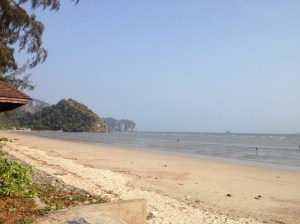
Ao Nang beach

Ao Nang beach

I had been told by a few travellers that he beaches down in this part of Thailand were some of the most beautiful in the world, with clear waters and pristine white sand. Yet as a made my trek through the waves breaking around my ankles and back go the shore to walk along the beach, I was quite shocked at what a found. All along the sand and in the wash along the shoreline, the beach was polluted with all kinds of litter. T-shirts wrapped in pieces of driftwood, lost shoes, beer bottles and other shards of broken glass, beer cans, plastic bags, water pistols and other toys – after closer inspection the sand along the beach resembled somewhat of a dumping ground. “Untouched” was a word I had heard used to describe these so-called pristine beaches. Maybe Ao Nag was an exception, or maybe that person hadn’t visited this area in a long time, but as the sun set on the otherwise beautiful seaside setting, I couldn’t help but feel slightly disappointed in what I’d found. I climbed aboard the local bus and headed back to the hostel, making a determined promise to myself to continue my search for the pristine beaches tomorrow.

***

My trip to Krabi also marked the first time that I would be staying in a hostel. I’d heard some horror stories about stolen possessions and other traveling nightmares, so I wasn’t sure what to expect. After showering and changing I ran into a couple of guys in my room and introduced myself. We sat around chatting for a while – Jens was a traveller from Sweden and Sam was from London – and we ended up going down to the local night markets for some cheap Thai food dinner. Back in hostel room, we got chatting to a Moroccan traveller, a girl named Sarah. The four of us, complete strangers until that evening, made an unlikely group of friends, yet we ended up chilling out on one of the hostels balconies, drinking and smoking and just talking about our lives. It was at that moment that I really felt like a traveller – just an individual in a collection of wanderers, making our way through the world, whose paths intertwined for that one night, for that brief moment in time.

The quiet streets of Krabi Town at night

The quiet streets of Krabi Town at night

The next day, after trading tips among the hostel dorm room, Sarah, Sam and myself decided to catch a boat to a beach called Rai Leh. A pair of Norwegian girls had promised us beautiful beaches there, and I figured we could trust the word of someone who had visited the area just days before. And we were not disappointed – as the boat cruised in to anchor just off the beach, even the towering sheer limestone cliffs that filled the scenery around us were breathtaking. Sam said it looked like something out of Jurassic Park, and as a fan of the movie I most definitely agreed. This place was simultaneously beautiful, soothing, and awe-inspiring – this is what tropical paradise was supposed to look like. Rai Leh was a strip of land that had two beaches, with the eastern side acting as more of a port for the various boats bringing people in, so we made our way over to the western side which had been a little more developed for the tourist population. There were lots of bars and resorts just beyond the edge of the sand, so we had a few drinks before making our way into the water.

On the boat pulling into East Rai Leh.

On the boat pulling into East Rai Leh.

I soon discovered that the shallow beach at Ao Nang wasn’t a one-off thing. The water at West Rai Leh was a similar depth to begin with, and I had to walk out a long way before the water even came up to my chest. But when it did, the water became much cooler, and it was lovely swimming around, diving under the waves, and then kicking back and marvelling at the sweeping scenery that surrounded the beach. While the water wasn’t as deep as I would have preferred in a beach – or probably more accurately, what I was used to – it was definitely the visuals of the location that made it so appealing. The sand and water was also a lot clearer than Ao Nang, so I was satisfied to have finally founded these fabled, pristine beaches.

On the stunning shores of West Rai Leh.

On the stunning shores of West Rai Leh.

I also learnt a few travelling tips from Sarah that day. As we boarded the boat to take us to Rai Leh, she had brought along her large rucksack, while Sam and I only had our smaller backpacks. “You must never book more than one night in a hostel,” she said to us in a thick French accent, when we asked her why she had checked out and brought all her gear with her. “You never know where you might end up, or where you might want to stay. Krabi Town has no beaches! I do not want to spend another night there.” She had been travelling around the Thai islands for months now, and she had definitely mastered the tricks of the trade. And she was right, of course. When we got to Rai Leh, she sniffed out some budget accommodation – a mattress on the floor of a bamboo hut on the east side – and checked in straight away. “The beaches… This is where I want to be.” Sam and I still had our beds booked back at the hostel, so when it came time to get the last boat back to Krabi, as the sun set behind the clouds and turned the sky a glowing pink, we bid Sarah goodbye and good luck in her new home for the night.

The sun turning the sky a beautiful shade of pink on the boat ride home.

The sun turning the sky a beautiful shade of pink on the boat ride home.

***

My original plan had been to leave the next day, but I felt like my time in the beaches had come to a premature end. So after sniffing around some of the tourist information centres in the street, I booked a full day SCUBA diving tour for the following day, and secured my room at the hostel for one more night. I hit the hay early that night, to rise for an 8am pick up, in a car that took me back Ao Nang beach. From there, a boat took the group – the dive instructor and a pair of stern looking European men who spoke very little, and when they did, it was rarely in English – about 40 minutes out into the sea. We geared up, and soon we were descending into the deep blue.

I had completed my Open Water SCUBA Diving course when I was only 12 years old, on a family holiday in the Maldives. I had been diving periodically since then, but it had been about 4 or 5 years since my last dive. So I was a little nervous, but as I flipped over the edge of the bloat and plunged below the surface, it all came flooding back to me – unfortunately, like the sea water into my mask. But other than that, it was like riding a bike – some things you just never forget.

The first dive reached a depth of about sixteen metres. The visibility wasn’t the greatest, which meant the distance you could see through the water was limited, but it wasn’t awful, and we were still able to see all the marine life that was just teeming in the water around us. Schools of fish that looked like walls in front of us parted as we swam in their direction, and our guide pointed out some other less obvious creatures, such as sea horses clinging to the coral, or small stingrays that would gently hover above the surface, and then take off once we got too close. It really was like another world down there on the ocean floor, and I realised just how much I loved and missed SCUBA diving, as I marvelled at the marine alien world. I made a promise to myself at that very moment that I would make more time for diving in my life, and later went on to scope potential diving destinations on the rest of my year long world tour.

After the first dive, we had a break in which I was able to do some snorkelling. This far out to sea, the water was clear and cool, and an absolute dream to swim through. The boat was anchored to a small limestone island jutting out from the sea, and as I swam around the perimeter I discovered a cuttlefish nestling in the safety of the rocks. The second dive was going to be in a cave – something I was a little nervous about, knowing some of the potential dangers. Armed with flashlights, we descending a second time, not just into the deep blue sea, but through the mouth of a cave below the limestone island, and into a black abyss. I experienced a strange sense of vertigo in the darkness of the cave. The ground can be rushing up to meet you one moment, and the next you’re bumping your head on the roof. It found it difficult to maintain a stable neutral buoyancy at the best of times, so trying to do so with no real idea of where I was proved a little stressful. I made a point of not losing sight of our guide though, not only because I knew he wouldn’t be lost, but also because he was pointing out some of the marine life with his torch. We saw a couple of nurse sharks, a few more stingrays and seahorses, plenty more fish, and a strange creature that looked like an octopus but had far too many legs, so I can only assume it was either a type of cave dwelling squid or jellyfish.

The island above the cave, and the surrounding blue water.

The island above the cave, and the surrounding blue water.

As I followed our guide in what appeared to be in upward direction, we moved through a small grotto before coming to a halt. When he shone his light at the walls around us, I saw about 5 or 6 lobsters at several points, all curiously climbing out of their hiding holes to get a better look at us. It was odd to see a lobster in the wild – the closest I’d ever really come was seeing them was in tanks at Chinese restaurants. We continued up through the grotto when, to my surprise, I broke the surface of the water. I pulled off my mask to look around to discover we’d found ourselves in a little pocket of air inside the cave, completely closed off from the outside world – the only way in was the way we’d come, through the sea. Sunlight was coming through from somewhere below, so the caves entrance wasn’t too far off, and the water lapped the edges of the rocks so that the cavern echoed around us. The light and the sounds and the serenity of the whole place made it strangely beautiful, despite being quite visually uninteresting. I’d been unable to bring my camera and so couldn’t photograph the cavern, but similar to the temple of the Emerald Buddha in Bangkok, being unable to take a photo made the experience feel that much more special – a little personal memory that was mine to keep and treasure.

(NB: I did take a few photos with my underwater camera while I was snorkelling, but until I have access to a computer with an SD card reader I’ll be unable to upload them.)

After we made our way back to the boat and then back to the shore, clouds began rolling in over the ocean and eventually a downpour of rain was released upon Krabi Town. The driver who took me back to my hostel said it was a good thing, and that it hadn’t rained there in about a month. I spent the rest of the evening with Jens, Sam, and a couple of other British guys, who introduced me to some of the local beers, the most notable being Chang. I’m not usually a big beer drinker. Maybe it’s because it was just cheaper and easier, or maybe it was the peer pressure of hanging out with four straight guys – I guess we’ll never know – but the local beer was much easier for me to stomach than any of the brews I’d tried back home in Sydney. Chang was supposed to be particularly potent though – and the next morning, after about 5 or 6 drinks and a round of beer pong, I can vouch for that supposition.

Changover.

Changover.

Getting out of bed with one of my highest ranking hangovers ever – dubbed a “Changover” by the boys – and getting out of the hostel by 11am check out time was not an easy task. The rest of my day was spent navigating various modes of transport in an attempt to get back to Bangkok. It took just as long as it did to get there, although since the overnight trains were all booked out due to the upcoming Songkran holiday, I had to catch a bus for the 12 hour stint of the journey. Overland travel can be long and tedious like that, but I eventually made it home to Bangkok in one very tired and worn out piece.

***

My trip to Krabi marked an important step for me on my gap year world tour. It was the first time I’d really gone out on my own for more than just a day. Finding a place to stay that wasn’t a friends house, organising and booking transport merely hours before it actually leaves for the destination, and making friends with the fellow travellers around me were all things that I’d been very keen to do since I’d set out on my journey. I was only heading back to Bangkok to celebrate Songkran and gather my things before heading off to Vietnam, an entire country where I truly don’t know anyone. I’d had a blast in my short time at Krabi, so now I was more excited than ever to travel to more new places and really live the life of a world wanderer.

Culture Lesson in Review: “Normal” Love

My first weekend in Bangkok felt like a throwback to my previous lifestyle in Sydney – you can take the boy from the party, but you can’t take the party from the boy.

Silom Soi 4 on a Saturday night.

Silom Soi 4 on a Saturday night.

Earlier in the week, Rathana had put me in touch with a few of his friends in Bangkok, and they had agreed to take me out and show me around while he was still in San Francisco. After dinner, and several jugs of margaritas, I found myself back at Silom Soi 4, though it was a Saturday night this time so the street was a little busier than last time I’d been there. The four guys I was with were all good friends, a couple of them having known each other for nearly as long as I’ve been alive, but they were fantastic company and welcomed me warmly into the group. Conversation was flowing fast and freely, and it usually does between such good friends, and I was privy to some hilarious, provocative, and thoughtful conversations. One in particular that I want to reflect on was a topic that was sparked when we spotted a peculiar couple on the other side of the street. One half of the couple was a young Thai boy with pretty, delicate features – I’m terrible with guessing, ages but I’d say somewhere in his mid- to late-twenties at the most. The other man was older… much, much older. I’m no stranger to age gaps in my relationships, but even I have to confess to feeling a little uncomfortable watching these two canoodle on the balcony of the bar.

Some cheeky remarks were made about the couple couple, and the discussion about such pairings being a common occurrence in the area turned to questions of why they occur in the first place. One of our group, who has only just recently moved to Bangkok himself, suggested that some of the younger local boys were almost driven to those types of relationships due to poverty, while the older Caucasian gentlemen use their wealth to effectively buy affection. In response to that suggestion, one of the guys – who we shall call ‘Anna’ – made a point that I personally had never really considered.

“The definition of love in their culture is very different from our Western ideas of what love is supposed to be. For them, love is about taking care of someone, or them taking care of you. I wouldn’t say that they’re driven to these relationships, or even that they’re being coerced, or that these men take advantage of them. It’s just how their culture defines love – they’re in love. Who are we to come in with our Western ideas about love and tell them what they have isn’t normal?”

I paraphrase, of course, but the idea really stuck with me. Even in a Western setting, I’ve had people question the integrity of my relationships with a number of previous boyfriends, whether it be due to ages or otherwise. And the more I thought about it, the more I agreed with Anna. As two consenting adults, these two men have a relationship. Are they in love? Who can say? We didn’t ask them –  I know plenty of people in our own Western society who are in loveless relationships, but seeming a little more “normal” helps them avoid much scrutiny at all. The idea that love means different things in different cultures was intriguing, and while I’m sure there’s a multitude of complexities regarding love and relationships in Thai culture that I have little to no idea about, I think the discussion reaffirmed a value in me that I’d temporarily forgotten – love doesn’t play by any set rules, and there’s no such thing as a “normal” relationship. That particular age gap may have given me the heebie-jeebies, but hey, if they’d said that they were in love, then that would have been good enough for me.

Dancing in a cage in a Bangkok club - don't ask me which one, because I can't for the life of me remember.

Dancing in a cage in a Bangkok club – don’t ask me which one, because I can’t for the life of me remember.

My period of deep reflection on such complex emotional processes didn’t last long, though. A few more margaritas later and I was ready to hit the dancefloor. I think that’s what I like about a good gay bar – you can be millions of miles away in a foreign city, surrounded by people that you’ve never met and probably never will, but when you’re shaking your stuff on a crowded dancefloor to a Britney Spears remix, it’s always going to feel like home.

The Travel Bug

One of the big tourist destinations that you just have to see (or so I’d been told) when you are in Bangkok is the Grand Palace and the Royal Monastery of the Emerald Buddha. Even if temples aren’t really your thing, this one is so spectacular that its supposedly the one everyone has to see. But having studied mediation under the guidance of a Buddhist nun during my last few years of high school, I would definitely say I have an interest, or at least curiosity, in Eastern spirituality, and a certain sense of awe for their places of worship. So after seeing having seen some of the party destinations that are frequented by tourists, I decided I would begin this week by exploring some of the more traditional cultural attractions that Bangkok has to offer.

The Grand Palace is located towards the west of central Bangkok, on the eastern side of the Chao Phraya River. Since the palace is the official residence of the Thai royal family, the inside is not open to the public, but the monastery compound that houses various shrines, temples and monuments is usually considered the main attraction anyway. The temple that houses Emerald Buddha, while being a popular sight-seeing spot among tourists, is also still a frequently used place of worship for both the Thai royal family and local commoners. Therefore, respectful and modest clothing is required before tourists are allowed to enter the compound within which the temple is located. This means no exposed shoulders or knees, no singlets or shorts, so I made sure I packed my jeans into my backpack to change into once I got there. The midday sun was scorching and the heat and humidity had basically drenched my whole upper torso before I’d even made it inside the gates, so actually wearing long pants the whole day was definitely not a valid option.

Once inside, it was easy to see why this place was considered a “must see” destination – the intricacy of the beautiful and delicate designs is absolutely breath-taking.

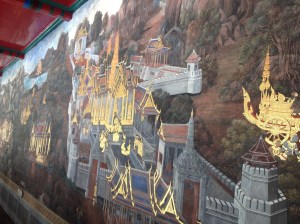
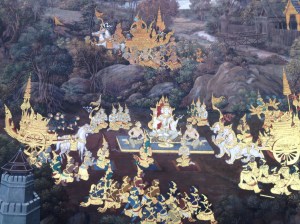
The beautiful hand painted murals that line the outer perimeter of the temple compound.

The beautiful hand painted murals that line the outer perimeter of the temple compound.

The murals depict the story from an epic poem in Thai mythology.

The murals depict the story from an epic poem in Thai mythology.

The cloisters that run along the inside perimeter of the compound are decorated with exquisite hand painted murals that depict the storyline in a famous epic poem from Thai mythology. Princes and princesses, armies of soldiers, monkeys, demons, giants, gods, temples, palaces – the detail is incredible and the work is flawless. Much of the subjects within the murals are laced with gold, and the walls glow and shine, beautiful and incredible works of art. Within the rest of the compound there are dozens of other structures the are wondrous to behold, with glass, jewels, gold leaf, mother of pearl, and a score of other materials decorating them in a way that lets them command the reverence they deserve, as such sacred and holy monuments. Some of my favourites were the golden statues of the mythical creatures that were half animal and half celestial beings, crafted with the finest, most precise detail, glowing magnificently in the sunlight.

One of the golden statues of a creature from Thai mythology.

One of the golden statues of a creature from Thai mythology.

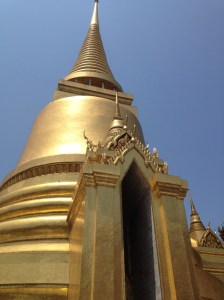
Phra Sri Ratana Chedi - one of the shrines covered in gold mosaic

Phra Sri Ratana Chedi – one of the shrines covered in gold mosaic

Myself standing in front of Prasat Phra Thep Bidon, the Royal Pantheon

Myself standing in front of Prasat Phra Thep Bidon, the Royal Pantheon

The highlight of the compound, however, is the Royal Chapel of the Emerald Buddha. Built on consecrated ground, all who enter the area are required to remove their shoes. I slipped off my sneakers, ascended the stairs onto the outer platform, and entered into the temple. The walls were vast and tall, decorated with beautiful murals similar to ones on the outer walls, depicting scenes from the life of Buddha, as well as other concepts of Thai mythology. Though it is the shrine in the centre of the room that truly captures your attention. Mounted high atop the shrine, on a golden throne made of gilded-carved wood, is the tiny Emerald Buddha, actually crafted from green jade. He is sitting in a stance of peaceful and relaxed mediation. The statue is hard to make out at first, such a small idol atop such an extravagant display, but the sight of the entire shrine is impressive, golden and glittering amongst the glow of they prayer candles, and for me it did feel like quite a spiritual experience. Perhaps it was because you cannot take photos inside the main temple, so being there really feels as though you are witnessing something truly special. I made my way past the standing tourists the where the prayer-goers were situated, and kneeled among them while I gazed up in awe at the shimmering golden shrine. It had been quite a while since I’d practiced mediation on a regular basis, so I sat there amongst the prayer and worship, absorbing the sacred presence within the temple and taking a moment to reflect on my own personal spirituality.

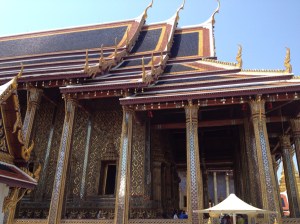
View from outside the temple of the Emerald Buddha.

View from outside the temple of the Emerald Buddha.

Myself  in front of the Grand Palace.

Myself in front of the Grand Palace.

The guards are apparently favourites for taking photos outside the palace.

The guards are apparently favourites for taking photos outside the palace.

Some marching guards that passed me on my way out of the palace grounds.

Some marching guards that passed me on my way out of the palace grounds.

After spending some time within the temple, I emerged to continue the rest of my tour around the grounds of the Grand Palace. However, after wandering around in the sun for a couple of hours, I’d become quite exhausted, and so decided to make my way home. After wandering the streets looking for a taxi, and now avoiding basically every tuk tuk I encountered, I finally found a taxi rank for motorbikes. They asked me where I was going and named a price – it wasn’t too dissimilar from what I’d paid in the taxi in the way over that morning, so I accepted. Motorbikes also had the advantage of being able to weave in and out of places that cars and tuk tuks are unable to, making them a convenient choice for peak hour traffic. Knowing that my mother would possibly have a field day when she heard eventually heard about this, I climbed onto the back of the motorbike and we took off into the street.

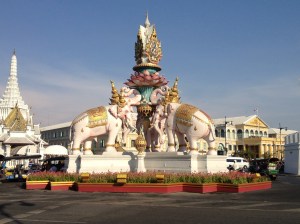
Monument that serves as a roundabout near the palace - taken before I was on the motorbike!

Monument that serves as a roundabout near the palace – taken before I was on the motorbike!

It was such an exhilarating rush. Sitting with my arms pressed heavily into the sides of my driver, we weaved in and out of traffic, between lanes, cutting in front of cars and tuk tuks, zooming through the streets among the pack of other motorcycles. The wind was flying through my hair, as the driver was the only one who had a helmet, and while I know that’s incredibly dangerous, I had a weird sense of absolute trust in this driver and his knowledge of the roads. I’d had some other locals say that driving in Bangkok isn’t scary or unsafe at all, and that only driving out in the more regional areas is something they hate or refuse to do, with city driving being considered relatively safe. I hadn’t believed them at first, but as I zoomed through the open air and soaked up the scenery as we weaved between vehicles, I think I finally understood what they meant. The city almost operates like a well-oiled machine – except in the traffic jams, where a little oil mightn’t go astray – or a living organism, where no matter how hectic or chaotic the environment may seem, everything is aware of and in sync with everything else. I’ve yet to see a single accident on the roads of Bangkok – plenty of what we would call “near misses” back home, but sometimes it feels as though the drivers of Bangkok know their roads so well that they can intentionally come so close with a much lower risk of accident. A tight-knit, well-oiled machine.

Towards the end of our trip, my driver even mounted the footpath and weaved between pedestrians to get me on the right side of the road and home as quickly as possible. When I paid the driver and slipped off the back of the motorbike, he smiled at me and placed a hand on my chest, and waited a moment before chuckling to himself. I must have had a rather puzzled look, because he proceeded to mimic the action on himself, then beat his chest a coupe of times with the palm of his hand. He repeated action on my chest, and then I realised what he was trying to communicate – my heartbeat. Placing my own hand on my chest, I felt it pulsing at a ridiculous speed that I hadn’t even noticed myself. Perhaps I was still a little high from the adrenaline of soaring down the tiny streets and open roads alike on the back of that motorbike, but it wasn’t until he drove off that I realised just how much of a thrill the simple trip home had been, and how much I had really enjoyed it.

It was a short walk home from where I’d alighted the motorbike, and I skipped off down the street with a new spring in my step. For perhaps the first time during this trip I finally felt like a traveler – not just a tourist, running around trying to see the cities greatest hits, but a real traveler just taking pleasure in the simple activities and cultural quirks that my new temporary home has to offer. I’d had a few difficulties getting used to being on the road and settling into my new, inconsistent lifestyle, but it was only a matter time before the travel bug finally kicked it, and I’m now more eager than ever to see not just the rest of this sprawling city, but to keep moving and behold the wonders that this country, this continent, and indeed this world, has to offer.

“Bangkok’s got him now”

Sitting on the Skytrain from Suvarnabhumi Airport to the heart of Bangkok, I peered out the windows at the vaguely familiar landscape. I had spent a couple of days here in my brief South-East Asian stint a little over a year ago, and the expansive field and countryside, littered with small, modest dwellings and the occasional billboard, hadn’t changed too dramatically. I suppose there are a few more modern developments and built-up environments closer to the railway line, and that these elements of the landscape would dwindle the further you went into the countryside – but I won’t pretend I know a great deal about the geography, or even the culture, of Thailand. All I know is that the views frommy seat on the train were as paradoxical as some of the scenic juxtapositions of Singapore, but to an even further, exaggerated extent. It makes for an interesting observation, but from my vantage point it all seemed rather other-worldly in a textbook kind of fashion. But it wouldn’t be that way for long…

***

I was staying with my friend Rathana, another person whom I knew from Sydney but had since moved to live abroad. However, his work frequently takes him to all kinds of places across the globe, and as fate would have it he was to be in San Francisco when I touched down in Bangkok, though he’d generously offered for me to stay in his place without him until his return. I used my basic directional knowledge from last time I’d been in Bangkok to make the short walk from the BTS (another name of for the Skytrain – an above ground railway system just as efficient as Singapore’s MRT) station to his condo, where I met one of his co-workers to collect his keys. After spending the afternoon resting and enjoying having a private space to myself, I began to feel hungry, so I decided to take a wander through the streets of Bangkok and see what I could discover.

Within half an hour I was back in the condo, feeling more than a little shellshocked. I’m not sure what I was expecting – I was well aware that I was in a foreign country, with its own language, rules, customs and culture, but I think it was more of an overestimation of my own ability to adjust and adapt. You can read all the books and reviews in the world, and somehow I don’t think anything can totally prepare you for the real thing. I set out into the streets, taking note of my surrounds yet heading in no particular direction, making turns here or there, wherever there seemed to be something interesting happening. I found myself in what I later discovered was the tiny and localised Muslim district of Bangkok. Street vendors lined the narrow road, young children played in the streets naked, stray cats prowled the gutters and whole families were lounging around in what seemed to be one room houses, surrounded by fans and in various stages of undress, in order to combat the sweltering heat and humidity. Motorbikes weaved between the people, and even cars nudged their way through the street like they were just oversized pedestrians. Determined to not look like the nervous tourist which I so obviously was, I trudged through up the street keeping mainly to myself, occasionally stopping to contemplate some of the street food carts, but moving on when my presence was either ignored, or met with a bored indifference. Of course, I don’t blame them for probably resenting my gawking – I was the one who had wandered off the main concourses into the tiny street which had little to no obvious tourist attractions. Yet in the end the whole thing became so overwhelming that I navigated my way through an alley or two until I reached the main roads, grabbed a handful of snacks the convenience store and dragged my shaken self back home. Maybe it was the fact I had set out into Bangkok by myself for the first time in the cover of night, or maybe it was just because I’d really had no idea what I was doing – I resolved that from now on I would always have a plan of attack.

***

The next day I tried to wind it back and ease myself into the culture shock a little more gently, spending the day revisiting some of the areas I’d been to before. I had lunch in the predominantly English-speaking area of Ari, and then headed to Siam to wander through some of the biggest malls in Asia. I’d noticed my throat becoming quite sore since the morning I left Singapore, so I found a pharmacy with an English-speaking doctor, who gave me a simple three day course of antibiotics. After that, I decided to lay low the rest of the day in an attempt to recover. Another of Rathana’s friends was to be staying at his place for a few days while he was away, so I ventured down to the BTS station to collect her and introduce her to Bangkok as best I could. She was in town for a conference over the weekend, so I would end up seeing very little of her during our shared time in the condo.

The next day I was feeling a bit better, so I set myself some challenges for the day, to help me get used to traveling solo around Bangkok. After doing a bit of research, I picked one restaurant for lunch and a nearby tourist attraction, studied the maps, and head off into the city. I never found the restaurant, and trudged around the streets in the hot sun for close to 40 minutes, getting lost and confused by the mostly non-English street signs, before I eventually stumbled upon a very Western looking burger joint. At that point I was willing to trade a cultural experience for a bit of cool air-conditioning, so I stopped and ate. From there it was on to the Queen Saowaphat Memorial Institute and Snake Farm. A couple of years ago, I developed a pretty intense snake phobia through a bizarre incident that is a whole other story of its own, and have been working ever since to try and overcome my fear. The snake farm is affiliated with the Red Cross Institute in Bangkok, where a lot of research into toxicology and the creation of snake bite anti-venom takes place, but it also offered snake handling shows in the afternoon, so I’d chosen the attraction in the hopes that maybe I could overcome some fears and gain some confidence I had lost after my first shaky night in Bangkok.

The words “snake farm” bring to mind images of pits full of writhing snakes, bred en masse and used like cattle. It would have been a disturbing sight, not to mention a likely case of animal cruelty, so it was a little reliving to see that the farm was actually just a small serpentine zoo. I found a lot of the cobras intriguing, and realised I would never be able to tell I had encountered one in the wild until if was spreading out those iconic hood scales and hissing and/or spitting venom at me – though in reality I doubt I’d ever let a wild snake of any kind get quite so close. However, it wasn’t until the handling show that I came face to face with my scaly demons. I’d turned up slightly late, distracted by the exhibitions, and so missed a seat in the amphitheatre and had to watch from down the sides at the bottom, which happened to be right next to the demonstration area…

Cobra in the exhibition area.

Cobra in the exhibition area.

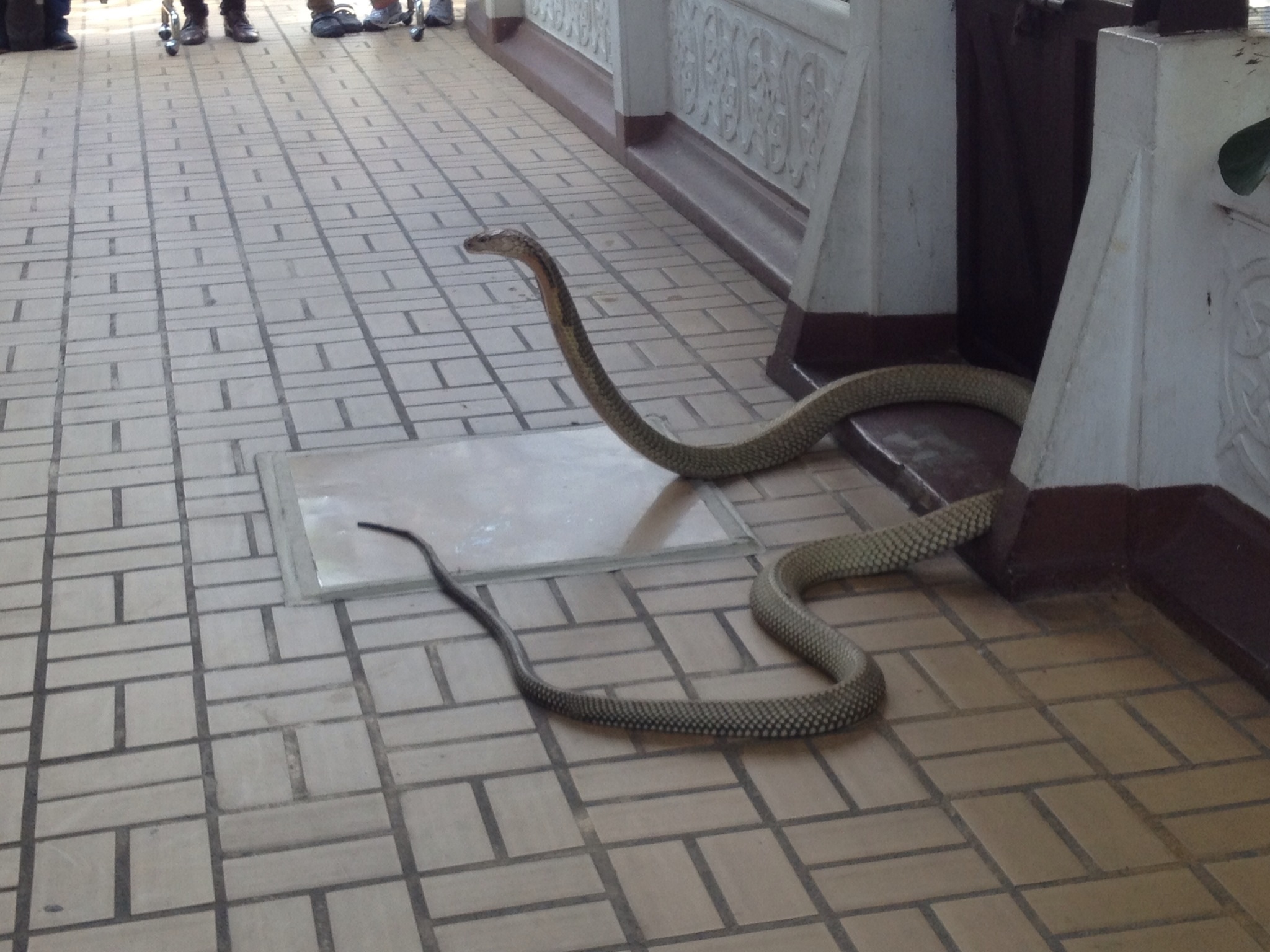
And the King Cobra that was a little close for comfort!

And the King Cobra that was a little close for comfort!

Looking quite fierce, and most displeased.

Looking quite fierce, and most displeased.

So you can imagine my horror when the first thing they do is dump a King Cobra on the ground, no more than 4 or 5 metres from where I was standing. The snake itself would have been more than half that distance had it been fully extended, but instead it writhed around and coiled itself, its hood scales fully spread and hissing angrily at the handlers around it. After the initial shock, and realising there were quite a few people between the cobra and myself, I managed to calm down and watch the show without being too anxious or nervous at all – quite a feat for someone who had to watch scenes in the last Harry Potter film between slits in my fingers to avoid seeing Voldemort’s giant pet snake. Come the end of the show, they called for a volunteer, and I was standing too close to the demonstration area to not get selected. I’d seen shows like this before, and I knew what was coming – but as per the challenge to myself, I didn’t resist, and allowed for the huge python to be draped across my shoulders. It was such a thrill, and I was surprised to find that I wasn’t really scared at all – phobia smashed! I even held it long enough to ask to get my picture taken, in case nobody back home would believe actually me.

Finally squashing my snake phobia for good!

Finally squashing my snake phobia for good!

Maybe all the attention tired the poor thing out?

Maybe all the attention tired the poor thing out?

***

As I left the snake farm, I was accosted by a tuk tuk driver who asked if I needed a ride. I knew the way back to the station, yet I let myself be dragged into a conversation. “For just 20 baht, my friend, I will take to back to the Sala Daeng BTS station. But please, can we make one other stop along the way?” I told him that I didn’t have anywhere I needed to be, and as he explained I realised that he was trying to get me to visit a shop, presumably that of a friend, or an employer of sorts. Assuring me I only needed to have a look and not necessarily buy anything, I threw caution to the wind and gave in to what might actually be my first authentic Bangkok experience. The store turned out to be a tailor, and I soon realised it wasn’t quite so easy to browse a store that doesn’t actually have a great deal of products already made. I was quite insistent to my salesman that I didn’t need a suit, but in the end I caved, I ended up walking out of the store having been measured up and paid for two tailor made shirts. They were supposed to be delivered to Rathana’s condo the next evening, but are yet to arrive, and now I’m starting to feel I may have been swindled by an elaborate scam. Though I’ll hold my breath just a little longer, in case there was a legitimate delay.

The tuk tuk driver was delighted I’d made a purchase, and I think that was a sign to him that maybe he could pump even more upselling into me. As we continued on our way, he turned and called back to me, over the drone of the traffic, “Lady? You want a lady? Ping pong show, yes?” I politely declined, though I ended up browsing through a jewellery store before I firmly insisted that I needed to go back to the station. He was a very cheery man, though. “I like you, you’re a cool guy,” he repeated several times. He asked me if I was going out partying that night, and when I alluded to it being a possibility, he wanted to get my phone number. Given the tricky nature of my travel SIM card, I managed to squeeze my way out of that one, but in retrospect it seems he had made a pretty big squeeze out of me, in one way or another.

***

After finally returning home and showering, I was off again to catch up with a friend. Brendon was the older brother of one of my best friends from high school, and had spent the better part of the last 3 or 4 years living and studying throughout Asia. He’d gotten in touch when he realised we would both be in Bangkok at the same time, and invited me to dinner with his group friends from his time at university here. Having spent most of the past three days on my own, I jumped at the chance to hang out with some locals and people who actually knew the city. We had dinner at a nice restaurant where I was introduced to the group, but it was what happened after dinner that was the real Bangkok experience. Rich, one of the girls, was going out to help celebrate her brothers birthday, and she urged Brendon and I to join them. Brendon was only in town for two nights and wanted to make the most of it, and I literally had no where else to go, so we jumped in a cab and I let them lead the way.

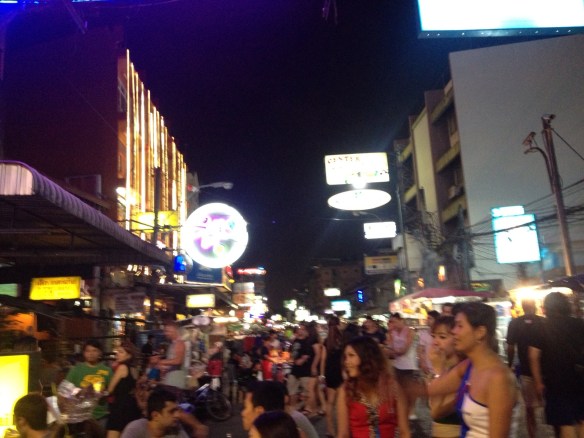
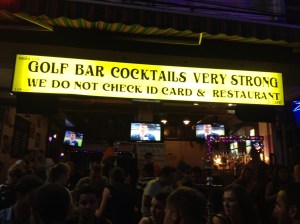
Our destination was Khao San, the backpacker district of Bangkok. Part of me wishes I’d paid more attention when watching The Beach, the begin of which is famously set in this busy party street. As we made our way through the crowds, I could see that this was definitely the tourist experience of Bangkok that serves as a unanimous reference point among travellers. The wide street was lined with bars, hotels, nightclubs and tattoo parlours, and dozens of pop-up shops filled the street, selling food, drinks and a huge range of souvenirs. It felt like a combination of Kings Cross/Surfers Paradise with Paddy’s Markets in Sydney, with the addition of small children also running through the crowds peddling their wares. After my encounters with over friendly sales people earlier that day, I was quick to shoo away the small children before they had the opportunity to tempt me. We finally found the birthday boy sitting at a table outside this bar:

That's one way to get a target market?

That’s one way to get a target market?

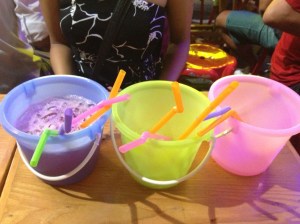
I chuckled to myself at the name, another of the novelty clues highlighting that we were definitely not in any regular Australian party strip. We sat down and ordered drinks – table service in clubs is another thing that I wasn’t used to, although I’m now under the impression it’s pretty common in most places in Thailand, or at least Bangkok. As we sipped on our Singapore Sling cocktail buckets (the only drink worth getting here, Rich assured us), various other street sellers would approach us from the busy road and insistently push their products upon us. Among some of my favourites were the material wrist bands that contained all kinds of messaged woven into them, from sweet to naughty to just plain strange, and what appeared to be char-grilled scorpion skewers. I didn’t buy anything though – the wrist bands because I couldn’t decide on one hilarious slogan without wanting to choose them all, and the scorpions because… Well, nothing about them looked appetising in the slightest. I usually say I’ll try anything once, but after watching a British backpacker dry wretch and nearly vomit everywhere after eating her scorpion, I decided it was an experience I could live without.

Charming.
Charming.

Less charming.
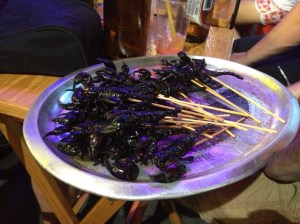
Less charming.

Singapore Slings - where else but Thailand?

Singapore Slings – where else but Thailand?

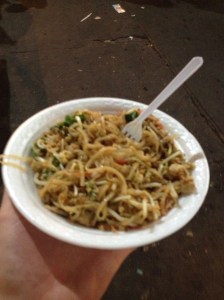
When we’d decided we’d drank enough, we retreated to the neighbouring nightclub, partly because we wanted to dance and mostly because we knew the place was air conditioned. We danced for a while before we decided to leave and head to another district. After getting some Pad Thai from a street vendor, who cooked the whole meal in under two minutes right before our very eyes, we were in a taxi bound for Silom Soi 4. It was the gay district, Brendon explained to me, which was why Rich found herself there so often. “I just feel so much safer there”, she said with a laugh, while Brendon made a remark about feeling quite the opposite. I was unsurprised that I’d managed to find a fag hag on my first night in Bangkok, and I was pretty excited to check out what kind of gay scene existed here. Unfortunately it was a Thursday night and already well past 1am. We all ordered one more drink each, but by then we were all starting to feel pretty tired. I said my goodbyes to Brendon, and exchanged numbers with Rich in case I should need any more help navigating the party scene of Bangkok, then we all found cabs and made our separate ways home.

The bustling district of Khao San.

The bustling district of Khao San.

Pad Thai as a drunk meal is a bit of a novelty for me, but there were dozens of carts serving them along Khao San.

Pad Thai as a drunk meal is a bit of a novelty for me, but there were dozens of carts serving them along Khao San.

It had taken a few days, but I felt like I was starting to get the hang of Bangkok. There were the obvious language barriers in some places, which I was expecting, but you’re usually never too far from someone who can speak English, or provide a basic translation. The night out with Brendon and his friends had been a nice change from trying to discover and navigate the city on my own, and I began to think that while free accommodation with friends was definitely a bonus, I hadn’t anticipated it to be quite so lonely without Rathana actually being here. I figured it would be easier to make friends when I’m staying in hostels, surrounded by other backpackers, than it was when I was tucked away in my own private apartment. I’d spoken to a few friends back home during my brief periods of feeling a bit lonely, and they all assured me that it would get easier, and I had to remind myself that I’d really only been out of Sydney for a week. That was nothing in the grand scheme of my planned world tour, though sometimes it already felt like I’d been gone for such a long time. I knew all that would change with time though, and so I just took it in my stride as one of the many more personal challenges I’d face this year.

Though the weekend has only just begun, so for now, Bangkok is still calling…

The Transition: Singapore

A lot of people seemed pretty confused when I told them what the first stop was on this round the world tour of mine.
“Singapore? But that’s not an actual destination, right? It’s just a connecting stop over?”
Assuring them that it was indeed my first destination, I was queried as to how long I would be staying in the city of Singapore, on the tiny island country of the same name.
“Five days?” my uncle had exclaimed. “Well, that’s plenty of time for Singapore, I reckon. You wouldn’t want to be staying any longer.”

I suppose these reactions aren’t completed unjustified. Singapore isn’t exactly a hotspot for backpackers and partying 20-something-year-olds: alcohol is expensive, laws regarding drugs are terrifyingly harsh, and even male homosexuality is technically illegal (though those laws are not as strictly enforced). However, my reasons for visiting Singapore were on a slightly more personal note. An old high school friend of mine named Timothy lives there studying musical theatre, and I had timed the beginning of my journey so that I would be able to stop in Singapore and watch him perform in one his final productions before he graduates from his degree. I’d also visited him once before, so as well as already having seen a few of the typical tourist attractions such as Universal Studios and the night safari, I was descending into an environment that I was already semi-familiar with, with knowledge of where I would be going but not exactly what I would be doing…

Singaporean flag on top of the Ministry of Information, Communication and the Arts, formerly Singapore's first police station.

Singaporean flag on top of the Ministry of Information, Communication and the Arts, formerly Singapore’s first police station.

***

The first thing I noticed when I hopped off the plane at Changi Airport, other than the overwhelming humidity, was that one of my two travel money cards was missing. The one that I could find refused to work at any of the ATMs that I could find at the airport – because that’s just the kind of luck that travelers have, right? Luckily, my travel SIM card did work, so I got in contact with Tim and hopped into a taxi to head over to his apartment. The taxi accepted card payment and, much to my relief, this time the temperamental card decided to work. After heartfelt greetings and stressful explanations, I called my mother in Sydney to confirm that I had left the second card at home. While still a little annoyed at myself, I felt a wave of relief in knowing that it was safe, and not out racking up an illegitimate bill somewhere else in the world.

For the rest of the evening the two of us caught up and exchanged stories, as reunited friends usually do, so it wasn’t until the next day that I set out into the city as an explorer. After a lazy brunch with Tim’s family, who were also visiting Singapore to see him in his graduation show, Tim had to return to college for rehearsals and then preparation for that evenings performance. But he only had one set of keys to his place (his family were staying in a nearby hotel – I was the designated couch-surfer), and negotiation worked out that he would require them today. So I set out into the muggy afternoon, knowing I wouldn’t be able to return home until after that Friday night performance.

Without a doubt, the first thing you notice in Singapore is the humidity. Sydney was trying its hardest to make me sweat when I was back home, but it really doesn’t even come close to the sheen across my forehead as I wandered down Orchard Road. It eventually gets to the point where you abandon even attempting to look fresh – it’s hot, it’s humid, and no one expects anything less than a giant ball of perspiration. On this particular afternoon, however, the humidity reached breaking point, and a monsoonal thunderstorm was unleashed upon the city. Rain bucketed down as I scampered into a 7-11 to buy a cheap umbrella (although I’d already been dripping wet with sweat), and the skyscrapers and shopping malls turned the streets into huge metallic tunnels that boomed and echoed with every clap of thunder. I ended up passing through a lot of those shopping malls to avoid the rain, but the air conditioning inside was so chilly that I would continually have to drag my damp self back into the natural air so that I didn’t freeze to death.

One of the many small gardens that break up the mass of buildings along Orchard Road.

One of the many small gardens that break up the mass of buildings along Orchard Road.

The number of shopping malls in Singapore is astounding. I saw virtually every label I know, and plenty more that I’d never even heard of. The thought of walking through them with the intention of actually shopping seemed particularly overwhelming, but the prices in Singapore aren’t exactly competitive on an international scale, especially within South East Asia, so I decided to put off any intended purchases and try again in a more favourable economic climate. Something that I did take a particular interest in was the amount of greenery that fills the streets of Singapore. You won’t go a block or two without finding a small park or garden, or a huge tree holding its own among all the modern architecture. Tim mentioned that it might have been some sort of initiative of the city in order to maximize the space in the city without turning it into a stock standard concrete jungle void of any real kind of natural elements. Then there are buildings like the School Of The Arts, Singapore (SOTA), with its extreme proximity to the surrounding trees and surfaces covered in luscious vines and foliage, which are perfect examples of just how seamlessly this city is able to integrate the man-made and natural worlds.

View from below of the School Of The Arts, Singapore.

View from below of the School Of The Arts, Singapore.

Later in the afternoon, after the thunderstorm has passed, I emerged from the malls and headed south on the MRT train system (which, I must add, are insanely efficient that it makes Sydney’s CityRail look like even more of a joke), down to Clark Quay to take one of the boat tours that operated on the river. The leisurely trip took us on a guided historical tour, down to bay with some impressive views of the equally impressive Marina Bay Sands, a relatively new casino, bar/nightclub and hotel. I was happy quietly taking my own photos, but I couldn’t turn down the offer from the friendly and enthusiastic staff to take some photos of myself with the scenery, and so I ended up with my first, of what I’m sure will be many, awkward solo holiday snaps.

"Hold the flower, hold the flower!" the river tour guide shouted eagerly. I'm still not sure what the building is, but the towering Marina Bay Sands is visible behind me.

“Hold the flower, hold the flower!” the river tour guide shouted eagerly. I’m still not sure what the building is, but the towering Marina Bay Sands is visible behind me.

On the river tour, with the Singaporean CBD in the background.

On the river tour, with the Singaporean CBD in the background.

The Merlion, a popular tourist attraction in the bay.

The Merlion, a popular tourist attraction in the bay.

***

After the tour, I strolled around the streets of Clark Quay, but the ritzy upmarket restaurants and bars didn’t feel like the best option for a sweaty, lonely backpacker, so I jumped back on the MRT and looked for a new destination (Did I mention how efficient the MRT is? No, really, maximum waiting time for a train going anywhere is about 6 minutes – you don’t even look at the timetables and plan ahead, you just go!). I had intended to alight at Marina Bay and explore on foot what I had seen from the boat, but following the instructions on some of the signage, I alighted at Bayfront and found myself on the other side of the towering Marina Bay Sands. Instead of being greeted by the water, I found myself in Gardens By The Bay, an area of roughly 100 hectares of reclaimed land that has been transformed into a huge garden, but with a futuristic twist. The area is sprinkled with structures called the Supergrove, which look like huge wire frames in the shape of trees that are slowly being taken over by a climbing garden. By this stage it was dark, and the odd structures were twinkling and shining with bright, multi-coloured lights, though I was unable to ascertain just what they were, exactly – other than the central and tallest Supergrove tree housing a Chinese restaurant on the top floor.

The Supergrove trees in the Gardens By The Bay.

The Supergrove trees in the Gardens By The Bay.

If I’d thought that the design of Orchard Road had been the integration of modern technology with the natural world, then this little number had taken it to whole new level. There were a couple of ticketed exhibits in the Gardens By The Bay, but they were closing by the time I had arrived there, so I just settled for wandering around in the muggy air and soaking in the beautiful, illuminated sights. Without the harsh equatorial sun beating down on you, the climate was actually kind of pleasant, and with the mood-lit surrounding, I realised given the right company, the setting would have been quite romantic – I began to wish I’d had someone there to share it with. From there, the solitude of my day finally caught up with me, and I decided to call it a day and head back to the city and wait for Tim to arrive home.

***

The next day was Saturday, and that evening I would be attending the Tim’s show. He was busy for most of the day with a matinée performance, so I decided to continue the theme of exploring the paradoxical man-made natural environments of Singapore by visiting the Botanic Gardens. I don’t know what I was expecting, but you can colour me impressed. The gardens are huge, but they also feature an extensive collection of plants from all kinds of environments. There were walks through rainforest areas, gardens of cacti and other desert plants, hundreds of varieties of flowers and orchids, scented gardens full of beautiful and invigorating floral fragrances, and even an area dedicated to plants and herbs that have medicinal properties, categorised by their purpose and function. I spent several hours wandering through the gardens, taking pictures and studying the plants, and I found it quite fascinating. I live in the heart of the city back in Sydney, and while the area does have its share of parks and greenery, there’s nothing quite like the Singapore Botanic Gardens. As the afternoon continued, though, the weather cycle of the previous day repeated itself, and I was caught in another torrential downpour. Having seen the best that the gardens had to offer, I called it quits and headed back home – luckily I had the keys to the apartment that day, so I was able to dry off and spruce myself up for the theatre.

Tree from the rainforest walk in the Botanic Gardens.

Tree from the rainforest walk in the Botanic Gardens.

Arid environment/desert plants.

Arid environment/desert plants.

One of the hundreds of varieties of flowers in the Orchid Garden.

One of the hundreds of varieties of flowers in the Orchid Garden.

Some giraffe statues in the Orchid Garden - figured I should have at least a photo or two with myself in it.

Some giraffe statues in the Orchid Garden – figured I should have at least a photo or two with myself in it.

***

The performance was excellent – it was especially a thrill for myself, considering I knew almost all of the starring cast. Gypsy is probably one of my favourite musicals, but this isn’t a musical review so that’s all I’ll really say on that topic. However, the shows after party was the setting of what was probably the biggest culture shock in Singapore. The party was held at a bar down at Marina Bay Sands, a swish little place called South Coast, which is owned by a lesbian couple who are originally from the central coast of New South Wales – small world, huh? After Tim’s brother bought a round of drinks, I approached the bar to take my turn. I ordered a cider for myself, one for Tim to congratulate him on a fantastic final show, and beer for his brother to repay the drink he bought me. When the bartender added up the cost, I was barely able to stifle a small shriek when he told me the total was just shy of $50. That’s in Singapore dollars, but even with the conversion, it was a hefty bill that I wasn’t expecting. It cleaned out all the cash in my wallet, to say the least. Alcohol in general is just more expensive in Singapore (pro tip: DUTY FREE!!!), so when you go out to nicer places it can only be expected that it will be more expensive.

Luckily for me, this was a musical theatre party. There was no shortage of homosexual men, and I worked the room to my advantage and scored a few frozen margaritas free of charge. Drinks turned to cocktails, cocktails turn to shots, and before long I was sitting there at the bar convincing myself that now was not the time to be sick. I kept it together, thankfully, though in retrospect I’m just a lot more grateful I wasn’t footing the bill of whatever had gone down. As the bar closed around us at 4:30, those still standing stumbled through the hotel lobby to the taxi rank. I may have accidentally given Tim a hickey, and shared a few cheeky moments with one of my suitors in the back of a taxi, but it was all harmless fun, and Tim and I eventually stumbled back into his apartment very close to sunrise, and spent most of the rest of the weekend sleeping off our hangovers.

***

The rest of my stay in Singapore was quite relaxed and mellow, spending time with Tim, his family, and his classmates. We visited the bar at the top of Marina Bay Sands, sipping on some expensive cocktails while enjoying the panoramic views of the 57th storey, but that was the only other tourist-type activity I did. On my previous visit I had wandered the streets of Little India, experiencing the dramatic cultural shifts at every turn of a corner. The extent of the multiculturalism in such a small geographical space is actually quite amazing. Though this time around, I spent my remaining time with my friends, now that they had the stresses and pressures of their show behind them.

Tim and I with our cocktails on top of Marina Bay Sands.

Tim and I with our cocktails on top of Marina Bay Sands.

Panoramic view from the 57th level of Marina Bay Sands at night.

Panoramic view from the 57th level of Marina Bay Sands at night.

As I reflect on the five nights I spent in Singapore, I would say that it was a good place to start my journey, because while it was in a completely new country, eight hours away from my hometown, it was still full of places, people, and experiences that still felt quite familiar. It was a good transitioning period, where my life was a strange mix of the schedules of other people and my own freedom from any specific restraints or responsibilities. In a way it didn’t even feel like the real adventure had begun yet – it was just one last pit stop before I threw myself into the real unknown. It took me away from my home, but not quite out of my comfort zone. I watched other people go about their daily routines while I woke up on their couches, and the fact that I was not going to have that kind of regularity for the next nine months was able to slowly sink in, rather than simply being thrust upon me. A couple of times I felt lonely, and I’d be lying if I said I hadn’t wanted to steal a few kisses in that taxi, but that can only be expected within the first week of leaving your old life behind, and something I’m sure I’ll get used to in time. Now the transition phase is over and I’m truly setting out on my own, and while I’m still a little nervous about the rest of what South East Asia has in store for me, I feel like my time in Singapore was an adequate stepping stone of preparation.

So onwards with the adventure – Bangkok, here I come!

Prologue

Six months ago, I started planning a trip. At first it was just a few plane trips to visit a couple of international friends, but when it came to the question of when I would be able to make these journeys, I came to the startling realisation that I had absolutely no concrete or definite plans for my future. I was about the conclude my sixteenth year of education, on the cusp of finishing my three year undergraduate degree at university, and somewhere in the back of my mind, it became very clear to me that I was ready to shelve the textbooks for a while and get out there and join the real world.

Yet the idea of getting a full time job was particularly daunting, considering I lacked even the slightest sliver of a career path. And that’s when it hit me: I shouldn’t try to fit these travels around my year – I should make them my year. I’ve had far too many of my older friends lament to me about how they wished they traveled more when they were younger and had the time, how their biggest regret was not doing an exchange semester while in university. I did not want to be another brick in that wall. With my studying behind me and an open-ended future, it didn’t take long to come to the conclusion that I did – I was going to see the world.

Now, on the morning of my departure from Sydney, it all seems a little surreal. After reiterating my travel itinerary about a hundred times as I’ve said goodbye to all my friends and family, my future plans have rushed up to meet me as the present. This 9 month journey will take me further from home than I’ve ever been, completely removed from anything familiar, and this morning I’m filled with equal parts of excitement and nervousness. But heading off into the unknown is all part of the adventure – to see what I’ve not seen before, to go where I have never been, and to create my own story from the various journeys along the way.

Which brings me to this – my travel blog. I’ve been a writer for a long time now, in both a personal and semi-professional capacity. If there was a specific point to this whole trip, I suppose it would be to learn a little more about myself, and discover enough to maybe one day open up a clearer path to my future. Writing is one of the few things I do know, and so I hope to combine my known with the unknown in order to make sense of the vast and ever changing world around me.

And hopefully, I will be able to include my readers in my discovery of the world around me. So I look forward to my next experience on this journey, so that I may live it, write it, and share it back into the world.

Bon voyage!