Borderline Insanity

This short anecdote will double as a warning for anyone who might be making a similar journey in the future: when travelling between Cambodia and Thailand, do not – I repeat, do not – book a bus ticket. Catch taxis, tuk tuks, trains, rent a car – anything but try to book a bus ticket. There are probably some services that operate smoothly and according to plan, but after the mess that I walked away from on my journey back to Bangkok from Siem Reap, it is certainly not a gamble I would ever be willing to make again.

***

So far in my journey, I had been happy fairly happy with the night bus services I’d caught. Krabi to Bangkok was a comfortable coach with reclining chairs, Saigon to Chau Doc was a little cramped but I had still had my own private space, and my Sihanoukville to Siem Reap journey had bed-seat hybrids that allowed your legs to stretch out completely flat, and even had free WIFI on the bus. I booked a ticket with that same company from Siem Reap to Bangkok, hoping to kill two birds (transport and accommodation) with one stone, and getting a similar satisfactory service. After waiting around since my check out at noon, wandering the the town and visiting the museum, I was picked up at 2am (yes, that’s a 14 hour wait) by a shuttle bus to take to me where the main bus was leaving from.

Scheduled departure time was 2:30am. No buses showed up until 3:00. Then we watched as a group of Khmer men unloaded three motorcycles from the cargo bins below. Myself and the other two tourist, a young German guy and an older man from Washington DC, shot each other uneasy looks as we were told this was our bus to Bangkok. They took our bags and I climbed on board. It was not a sleeper bus. Most of the seats were already full, and the majority of them were filled not by tourists, but rowdy local Khmer men. They had loud conversations over the top of my head while I was trying to sleep. The bus driver played music that was essentially a loop of cheesy instrumental music that belonged in a pornographic sound track. The whole bus smelt of bodily gases and other sickening scents. As I thought back to the slogan on the anti-piracy ads on my old VHS tapes, I certainly wasn’t getting what I had paid for.

***

At some point, through the stench and the racket, I suppose I managed to catch a little bit of sleep – after 15 hours of being awake it was bound to happen eventually, no matter the circumstances. It wouldn’t have been any more than half an hour though, and at around 6 o’clock, after just under three hours of transit, the bus jerked to a stop. It was dawn outside, and slowly and but surely all the Khmer men stood up and shuffled off the bus. I figured that we had reached the border, and would be required to alight so we could have our passports checked and stamped. “You get out here now”, said one of the bus company workers to me and my two other Western companions. “Another bus take you to the border.” As I climbed down the steps and out into the bus station, I watched the Khmer men who had been on my bus all climb into the back of a ute, which sped off down the road and into the dust. It was obvious that rather than put us on a chartered bus, the company had decided the throw their few clients on any old bus that was heading in the right direction, and deal with the rest once we got to the Thai-Cambodian border.

We met a bunch of British girls who had just climbed off another bus who were also heading to Bangkok. After being sent on a small wild goose chase, crossing the road several times in an attempt to find someone who knew what the hell was going on, we were ushered onto a bus – I was disgruntled, though not surprised, to find myself on the very same bus I had alighted from only moments before. We were only on board for a couple of minutes though, before the bus pulled up directly outside the border crossing. “You cross border now,” said the bus company guy, as he took our tickets and stuck little yellow stickers to the front of our shirts. “Crossing take one hour. Someone will meet you on other side. Sticker is your ticket now.” I was mortified, but there was nothing else I could do, so as a sleepy pack of tourists we climbed off the bus and made our way to the border crossing.

Only to discover that the check point itself didn’t open until 7 o’clock, which was still almost an hour away. When I had booked the ticket, I had been given an estimated time of arrival in Bangkok of about 9:30am. I had already long ago given up on that hope, but with every passing minute I became more and more unsure of how I was actually going to get to Bangkok at all. After an hour of waiting, plus another hour to go through both departures in Cambodia and arrivals in Thailand, I finally found myself on the other side of the border. It was far from a feeling of relief though – it was a terrifying moment, plagued with doubt and the endless possibilities of the next unpleasant surprise they would spring upon us.

The busy border crossing just after opening.

The busy border crossing just after opening.

As I trudged through the crowd of pilgrims, I heard a shout and saw a wave of hands. “Yellow sticker! Yellow sticker over here!” For all that had not gone accordingly to plan this morning, being greeted in Thailand was like clockwork. I had been sticking with the man from Washington, so we made our way over to the waving man, where we were asked to sit on plastic chairs and wait for the rest of the travellers with yellow stickers. Once they arrived, we were taken to a small travel agent just a few minutes away, where we were informed we would be catching a minibus all the way to Bangkok. It certainly wasn’t a sleeper, but I figured it would get us there faster than a regular bus, so I felt a little better about that. However, when the bus arrived 15 minutes later, the agents face sported a look of concern as one by one, we piled into the bus. I was at the end of the line with my American companion, and as he scanned down his line of clients, he agent called out, “Who is relaxed? You relaxed, yeah? Time is no problem?” It seemed no one had taken into account the space needed for all of our luggage, and we weren’t all going to fit on this bus. Washington and I took two for the team, with the agent assuring us it would only be a half hour wait for the next bus.

***

An hour and a half later, the tiny travel agency was beginning to fill up with people, mostly locals this time, and I grew uneasy at the thought that they would try and squeeze all of us onto the next bus. Washington and I were given priority, since we had forfeited our places on the last bus, so I can’t say for sure if there was anyone who didn’t make the cut. It was 10 o’clock by the time we finally boarded our bus and continued our journey towards Bangkok. However, we hadn’t been travelling long before our bus was pulled over by the police. All the exchanges were in Thai, and no one offered any explanation, but we were sitting there for another solid half an hour while the police made phone calls and wrote on bits of paper, which I can only assume was a ticket of some sort – perhaps our driver was speeding? In all honesty, at this point I was beyond caring. We were still hours away from Bangkok and I hadn’t had a proper sleep in about 24 hours.

The journey back to the city went up without a hitch, other than the minibus stopping every now and then and the driver having short, disjointed conversations with some of the other passengers, and dropping them at various points around the city.

However, when it came to dropping me and Washington off, things became a little more difficult. We finally reached the city of Bangkok, but I had yet to see any familiar landmarks in order to gain my bearings. “Where are we?” I called out to the driver. I got no reply, and it was only then that I realised that while the travel agent assured us we would be dropped in the middle of the city, this driver spoke hardly any English, so could not tell us where we were or where we were going. So you can imagine my frustration when, after driving through the streets of Bangkok for nearly two hours, we didn’t seem to be anywhere near the familiar the city centre. It didn’t help that it was now well into the afternoon, and we were caught in the gridlock of peak hour traffic. I even got my map out and motioned the driver to show me where we were, but he gave it a blank, vacant stare that filled me with horror – the idea that our driver didn’t even know where we were was too much to bear. I’d now been more or less awake for 27 hours, and 15 of them had been in transit. I wanted to scream, and yell and swear at the driver, at the incompetence of both him and the agent and the whole mess of an ordeal that had been my journey back to Bangkok. I was exhausted and furious, but I knew that getting mad would achieve absolutely nothing, so I resigned to my fate and crawled to the back of the minibus to lie down along the back seats, since by now Washington and I were the only passengers left.

Eventually I saw a landmark that I recognised, Victory Monument, which was actually the drop off point we had agreed upon with the travel agent in the beginning. So I guess the driver had known where he was going all along. All the same, I scrambled out of that minibus and onto the streets of Bangkok as fast as my tired little legs could carry me. I never thought I would have been so happy to be back on the streets of Bangkok, but after being at the mercy of the minibus driver for so many hours it was a glorious feeling to know exactly where I was, and have control over my own direction and movements.

***

I made it back home to Bangkok in the end, but it definitely hadn’t needed to be such an ordeal. I’m not saying that all bus trips will be like that, but when you’re booking for a route as disjointed and unpredictable as Siem Reap to Bangkok, or probably anything that involves that border crossing, there’s a lot of wiggle room for transit companies to shove you in wherever you fit and make a great profit on the sleeper ticket that you thought you were purchasing. Thankfully most of my travels for the next few months will be exclusively on trains, because the couple of weeks I spent travelling back to Bangkok from Siagon had seen me on enough buses to last me for quite some time.
First Impressions: Phnom Penh

I was a little nervous as I climbed off the boat and onto the dock at Phnom Penh. I wasn’t sure what to expect from Cambodia. I was under the impression that it was a relatively poor country, but so far on my tour through South East Asian countries I’d been surprised by the diversity of living conditions and levels of development within single cities, let alone entire nations. Phnom Penh is the capital city of Cambodia, but in the back of my mind I was quite certain it wasn’t going to be anything like Bangkok or Ho Chi Minh City, and most definitely not like Singapore. And I wasn’t wrong.

It’s hard to describe. It wasn’t a city in the way that Bangkok was a city, it with networks of public transport and numerous towering skyscrapers.There was certainly some parts of the city that were more built up and developed, with busy roads and crazy traffic, but there were also smaller streets with a slightly suburban feeling, though not without busy roads and crazy traffic. As I would later learn during my stay in Phnom Penn, while most of the time the locals make it seem like a fine tuned art from, driving in pretty much any major South East Asian city is a perilous affair.

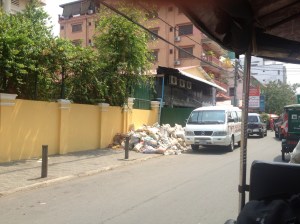
View of the street from my tuk tuk to the hostel.

View of the street from my tuk tuk to the hostel.

Ultimately, what made Phnom Penh different was the not-so-seamless integration of tourist attractions, middle class living, and extreme street poverty. In Bangkok, the city is almost separated into layers like a rainforest, with the wealth in the canopy descending down to the poverty on the forest floor, and Saigon has a tourist-focused centre which sprawls outward to the more authentic and local experience. From what I could gather, there was no method to the madness with was the design of Phnom Penh. The official currency is the Khmer riel, although US dollars are so widely accepted that menus and price lists of everything are shown in dollars, and even the ATM machines dispense dollars rather than riel. The use of the dollar, however, meant that I found Cambodia a little more expensive than Vietnam. I’m no economist so I can’t even try to explain the way it works, but that’s just a little something that did surprise me.

***

I decided to spend my first day in Phnom Penh seeing all the major tourist attractions, so I enlisted the help of a tuk tuk driver who would take me from place to place and wait for me while I visited each destination. We came to an agreement, though only after several minutes of myself insisting that I did not want to visit the shooting range and fire a bazooka. The driver seemed disappointed, but nevertheless took me around for my day tour of the city. The first stop was the Grand Palace, the home of the current king of Cambodia which doubles as a beautiful tourist attraction. As I wandered through the various temples and buildings that the public was allowed to visit, I noticed that a lot of the architecture was similar to the Grand Palace in Bangkok. They even had murals on the inner surface of the walls that surrounded the silver pagoda – named for its floors of solid silver – which depicted the same epic poem from Hindu religion. However, unlike the murals in Bangkok, these ones were not so maintained, and there was fadedpaints and cracks in the walls, and the whole thing had more of an ancient wonder appeal to it, rather than the glittering magnificence of the palace in Bangkok. There was also an Emerald Buddha in the silver pagoda, and like the one in Bangkok, it was actually made of jade, and I wondered how many more trends there could have been between two such temples in completely different countries.

The silver pagoda.

The silver pagoda.

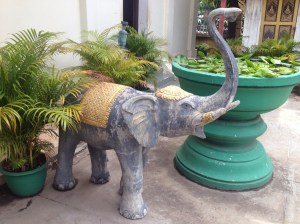
Elephant statue near the old elephant stables.

Elephant statue near the old elephant stables.

Nagas are mythical serpents that frequently appear in this holy South East Asian architecture.

Nagas are mythical serpents that frequently appear in this holy South East Asian architecture.

In front of the main temple.

In front of the main temple.

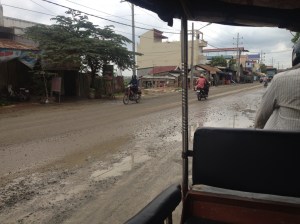
After the palace was the Killing Fields, which was about a half an hour drive out of town. The trip there was an experience in itself, as it had rained heavily the night before, and some of the dirt roads had turned to mud and were littered with puddles and pot holes. We had definitely reached the outer limits of the city, and there were no pubs, hostels our other tourist attractions. “Definitely not in Kansas anymore”, I muttered to myself, watching the mud fly and cursing myself for not wearing ruby slippers – or at least more appropriate footwear.

The muddy trek out to the Killing Fields.

The muddy trek out to the Killing Fields.

The fields themselves weren’t so muddy though, so my canvas slip-ons would live to see another day. The 3 million Cambodians who were brought here by the Khmer Rouge during the rise of Communism, however, did not. As I entered the complex and purchased my ticket, I found myself surrounded by the group of Americans who I had met the day before on the boat from Chau Doc to Phnom Penh. I had a quick chat with Mike, one of the guys I’d spoken to at length during the boat ride, discussing how our first nights in the city had gone down. They were just on their way out as I was arriving, so when it came time for us to part ways again, Mike looked around gloomily and said, “Well, I’d tell you to enjoy… but that’s not really the right word for this place. But go and soak it in, it’s pretty intense.” He bid me farewell, along with the rest of the group, and I set off to see the fields.

Mike has been spot on when he had described the place as intense. It was such a harrowing experience, to walk through the site and learn of the atrocious acts of genocide that occurred here, all because the victims didn’t want to subscribe to the Khmer Rouge Communist regime. It’s a little frightening to realise how unknown these tragic events are on an international level, with I myself only truly learning about the history of this genocide for the first time. Even worse is that it happened just over 30 years ago – worse that we still don’t know more about it, and even worse that these kind of things were still happening in such recent history. There is a real emphasis in this place on remembering the tragedies and the stories, so that future generations will learn, and not make the same mistakes of the past.

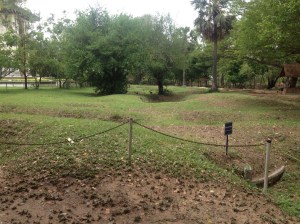
Depressions in the earth that used to be mass graves for the genocide victims.

Depressions in the earth that used to be mass graves for the genocide victims.

Broken and shattered skulls of victims, now housed in a memorial shrine.

Broken and shattered skulls of victims, now housed in a memorial shrine.

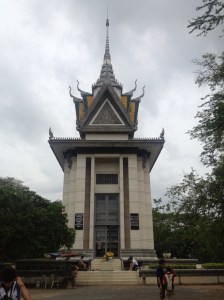
The monument that holds layer upon layer of the skulls and bones of the genocide victims.

The monument that holds layer upon layer of the skulls and bones of the genocide victims.

There is also a torture museum back in the city of Phnom Penh, but after spending so long at the Killing Fields I was feeling quite exhausted, both emotionally and physically, so I spent a short while looking around the school-turned-prison and house of torture. It was the place where many people were tortured, interrogated, and made to sign false confessions before being sent to the Killing Fields to be thrown into a mass grave. In the end it was too much for me, and I ended up heading back to the hostel to debrief myself.

***

My time in Phnom Penh provided me with a handful of peculiar tales that deserve posts of their own, but one thing that defined my time in the city in general was the acquisition of a new friend, Laura. On my second night in the Phnom Penh hostel, I stumbled into the dorm after a few beers – in order to change my outfit before going out again – to discover that someone new had checked into the hostel. She was sitting down on the bunk next to mine, unpacking her things, so I said hello and gave her a smile as I rummaged through my bag. Rather than the passing “Hey” mumbled under herbreath before returning to what she was doing, something not uncommon in these situations, this woman was very receptive to my greeting. We briefly introduced ourselves and had a quick chat before I had to head out again. It was nice to have met and got along with someone so quickly and so easily, though the fact that I had been drunk, and thus prone to random babbling at strangers, wasn’t lost on me.

I saw Laura again the next day, and we properly introduced ourselves and had a bit of a chat. She was a backpacker from Newcastle in England, and had been travelling around South East Asia for a few months now, in the similar unplanned method that I had been employing. She was also travelling alone, and so while we spent our days separately, doing our own sight seeing at our own paces, each night we would catch up for a few drinks, sharing our stories and experiences of both Cambodia and the greater region of South East Asia, and one night we even hit up the night club across the road from the hostel, which had been surprisingly busy for a Wednesday night.

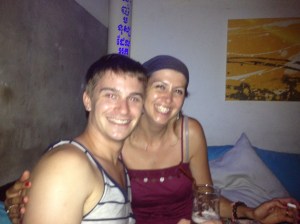
Laura and I sharing a drink.

Laura and I sharing a drink.

On my last night in Phnom Penh, we had gone to a nearby restaurant that was run by disadvantaged youth and street children who were receiving training in hospitality, and was also known for serving some interesting foods that were considered Cambodian specialities. I have to admit, I was a little nervous at first, but I found the crispy fried tarantulas to be delicious! The legs were my favourite bit, tasting like crispy fries with chicken salt. The thorax was also nice and crunchy, but the abdomen was a little chewy for my liking, though still tasted fine.

Fried tarantulas are actually quite tasty!

Fried tarantulas are actually quite tasty!

***

Further into my travels through Cambodia, I met people who had not spent any time in Phnom Penh. After a girl had insisted that she couldn’t visit the Killing Fields because she knew she could not handle it emotionally, I had to agree with her assertion that she hasn’t missed much by simply passing through. Yet I feel as though I definitely grew as a person during my time in Phnom Penh. I was faced with quite a few challenges that I doubt I would have come across many other places in the world (which will appear in forthcoming blogs). So in the end I’m glad I made it a destination on my travels – it definitely ranks up high with the rest of my memorable cities.

Searching For My Comfort Zone: A Trivial Pursuit

The week I’d spent in Vietnam was a bit of a mixed bag when it came to experiences. I’d been confronted by the local culture, I’d experienced some of the tourist nightlife, and I’d seen most of the iconic sights. The one thing I hadn’t done is meet many people or make many friends, so I decided that once the weekend had passed I would continue on my travels. So naturally, my last night is Saigon ended up being incredibly fun, and one of the best experiences on my journey so far.

***

For those of you who aren’t aware, the are a host of social networking websites and smartphone applications that are designed specifically for men in the gay community. They’re marketed in a number of different angles, but the main idea is that they use GSP technology to find other gay guys nearby to meet up with, whether its for a casual coffee or casual sex. The reality is that most people use these apps for the latter, but as a traveller I recognised its possibility to put me in touch with local people who might be able to show me around the area. That is, if I can find the people who aren’t just looking for sex.

But luck was smiling upon me that Saturday afternoon. I got a friendly message from a guy named Allistair, an expat from New Zealand who had been living in Ho Chi Minh City for about a year, just saying hello and hoping my travels were going well. Pleased that it wasn’t another solicitation from a faceless torso, and his comments indicated that he’d read my profile and not just looked at my picture, so I continued chatting to Allistair, and before long we had decided to meet up and continue the conversation over a few afternoon beers. I was slightly hungover from the night before, but I figured I could use a little hair of the dog.

Allistair and I hit it off straight away. We had eerily similar tastes in music, we both loved the same kind of books, we talked about our tattoos and our lives, and ended up having very similar philosophies about life. He told me how he’d ended up coming to live in Vietnam, and I told him all about the long journey I had ahead of me, as well as a few of the interesting tales that I already had to tell.

After a couple of hours and a few beers each, Allistair asked me if I had any plans for the evening.
“Well… You know, I actually have absolutely nothing planned. I guess I was doing the whole ‘play it by ear’ thing and hoping something would turn up.”

“Okay, well… I’m having dinner with a group of my best friends later. It’s not too far from where I live, which is about 20 minutes from here. I don’t normally do this – in fact, I never do this – but you seem like a really cool guy, so if you wanted to, you’re totally welcome to join us. I’ve even got a spare room at my place, you know, if you wanted to get away from the hostel for a little while.”
I told him that that sounded fantastic, and was only sorry that I hadn’t met him sooner, given that I was only in Saigon for one more night. I know I’d had an uneasy experience earlier in the week, but things definitely felt more relaxed and less awkward this time. So we went back to my hostel, gathered my things, bought some beers and jumped in a taxi to District 2.

***

Allistair lived in a nice apartment in what could be considered the expat district, and we spent the rest of the afternoon in his rooftop pool, drinking more beer, listening to music, and watching the sunset. He told me that tonight would be a pretty similar affair, very easy-going and chilled out, with about six other people.
“That sounds really awesome”, I said to him between swigs of Saigon Green. “Back at home, I used to go out partying all the time because I lived so close to Oxford Street. It sort of became a bad habit – maybe even an addiction. Even when we tried to have nights in, my friends and I would just end up drinking enough to be tempted to go out and party. I don’t remember the last time that I had a chilled night in like that.”
It was a little strange to be opening up like that to someone I’d just met, though we’d been having similar conversations all afternoon, and the beer probably helped. It made me realise what I was looking for on this journey of mine. I’d gone out partying the night before, and while it had been fun, in the end it had just felt like another night out. There has to be more to life, and that’s the kind of thing I was trying to discover, even if it was just hanging with the locals of the city, as opposed to other partying backpackers. I told Allistair that, and he smiled, and said he’d try to show me the best of what his little corner of Saigon had to offer.

When we arrived at Allistair’s friends house, we were greeted by a British guy wearing a sarong. That pretty much set the tone for the whole evening – chilled, casual, and a little bit kooky. There were a few Americans, the British guy and an Australian girl, and we sat around eating and drinking and talking about all sorts of things. I sat back and listened for a while, but my tongue loosened up with each sequential beer, and in the end I found myself chatting with them as easily as I had when I first met Allistair this afternoon.

And then someone pulled out Trivial Pursuits. This might require some background knowledge: as a child, I played this board game with my family quite a lot. However, we had a fairly old version of the game, and as a young children my sister and I often got frustrated because we never knew any of the answers, and the game very quickly lost its appeal when it turned into the adults arguing over whether the answers on the cards were still even correct in the current era. Now, as an adult with a little more knowledge under my belt, I get incredibly enthusiastic when it comes to Trivial Pursuits, and get quite excited when I know the answers. This, combined with a solid afternoon of drinking, turned me into a great big ball of quivering excitement. Knowing the answers to questions such as ‘Which a British pop group had 5 number one hits in 1997?’ (Answer: The Spice Girls) and ‘In which film did Jack Twist tell his lover “I wish I knew how to quit you.”?’ (Answer: … Seriously if you don’t know… I don’t even…) caused me exclaim “I love being gay!” at several points throughout the game (Another answer I knew was Madonna, though I can’t for the life of me remember the question).

My enthusiasm must have paid off because in the end my team won, and my team praised me as being a key contributor to the win, something that has never been said about me in a game of Trivial Pursuits before. The night was full of more jokes and laughter until the early hours of the morning, when Allistair and I called it a night and retired back to his apartment to crash.

***

The following evening, when it came time for me to leave and head to the border, I felt a little wave of sadness wash over me. After a week of relative loneliness, I had had such an awesome time on my last night in Saigon, meeting new people and actually making a bit of a connection. I felt really comfortable, and now I felt a little angry that that was going to be ripped away from me. Allistair had offered a place to stay if I had decided to stay longer, but I had already booked my bus ticket and didn’t want to stray from the plans I’d already made. Which, in retrospect, seems incredibly foolish. The whole point of travelling by myself was that I could make the rules up as I went along, making decisions on a whim and tailoring the experience so that I was going to have the most fun. But when the opportunity came to make such a decision, I stuck so rigidly to my plan, a bus ticket that cost me less than $10. I said my goodbyes to Allistair, feeling oddly emotional for someone I’d only known a little over 24 hours, and thanked him for inviting me along for such a fun evening, promising to stay in contact.

I had a lot of time to think, as I sped towards Phnom Penh on the speedboat, and I had mixed feelings about the situation. On one hand, I had packed up and walked away from one of the best experiences I’d had on this trip, and I couldn’t help feeling like that was a mistake, that I was compromising my enjoyment for reliability and planning, something that I thought I had despised. But then I also realised that I’d enjoyed my time with Allistair and his friends because it had felt so comfortable, and while I’m thankful for that feeling, this journey that I’m on has also been extremely challenging. If I stayed for too long and got too comfortable in one place, I may be more reluctant and go out on a whim such as the one that led me to that evening in the first place. In a way, that search of my comfort zone ends up being a trivial pursuit in itself – because what do you do when you find it? You think it’s what you want, but all you end up doing is pushing yourself further from it in the thirst for more adventure.

So it was probably for the best that I left. I ended my time in Vietnam on an all time high, listening to our favourite band All Time Low, and I still had plenty of South East Asia left to explore in what was quickly becoming a short amount of time. But I’ll always remember my last night on Saigon as a lesson, a reminder to always go beyond what you know or what feels comfortable, because you never know the amazing things that could be waiting around the corner.

Getting to Know You: Miss Saigon

My first impression of Ho Chi Minh City was that it seemed like a baby version of Bangkok. It has the backpacker district with the flashing lights and street hawkers, it has the numerous food carts selling a variety of local cuisines, and it has a lot of busy traffic. However, it’s almost as if the vehicles are in baby form, with the motorcycles being to cars what tadpoles are to frogs, and the motorcycles are everywhere. I know I’ve said it before, but literally everywhere – they put the gangs of Central Coast NSW to shame. So the city may feel a little smaller than Bangkok, but in no way does that make it feel any less busy, at least in District 1 in the central part of the city.

So. Many. Motorbikes.

So. Many. Motorbikes.

Vietnamese flag out the front of the Ho Chi Minh City Museum.

Vietnamese flag out the front of the Ho Chi Minh City Museum.

There is also a confusing aspect in that this city has two names – something that puzzled me to no end in the early stages of planning my side-step detour to Vietnam. Pretty much all the native locals call it Saigon, even a lot of the travel agencies do too. Ho Chi Minh City, taken from the name of the Vietnamese leader during the wartime period, is the name used by the government and officials and anyone else of relative importance. As a traveller, I don’t really have a preference, and will use both interchangeably throughout this blog, just to keep y’all on your toes.

***

My first few full days in Saigon were spent doing some sight seeing. I decided to tackle the city on foot – after letting my guard down and being scammed into paying an exorbitant amount of money for a brief ride in a cyclo, which is basically a bike with an oversized basket for passengers, I became a little mistrusting of all the locals who approached me, offering rides on their various street vehicles. I also found myself slightly terrified of the traffic, although I quickly learnt that in Saigon, being a pedestrian is just as hazardous as being behind the wheel of a car or on a motorbike. Which is not necessarily saying that it’s risky – you simply need to really keep your wits about you at all times… although, it is risky. I’ve had a number of extremely close encounters where my attention lapsed for just a moment, and I came this close to being far too acquainted with the front end of a motorbike. Look both ways, amnd look all four ways at intersections. Sometimes it’s easier to just slowly wander out onto the road and let the bikes move around you. This is particularly terrifying though and by no means safe – sometimes I just got impatient waiting for a legitimate gap in traffic.

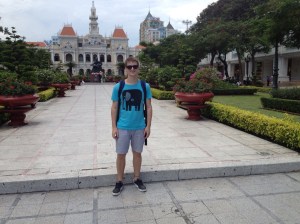
Outside the Ho Chi Minh City People's Council People's Committee Building .

Outside the Ho Chi Minh City People’s Council People’s Committee Building .

French-designed Cathedral in the city centre.

French-designed Cathedral in the city centre.

Reunification Palace.

Reunification Palace.

Another thing Ho Chi Minh City seems to have a lot of is museums. As well as the War Remnants Museum, I visited the Fine Arts Museum and the Museum of Ho Chi Minh City. I took some refuge from the bustling city outside to observe some of the paintings and sculptures in the Fine Arts Museum, almost all of which are created by Vietnamese artists. I’m no art critic, and I don’t know the first thing about techniques or designs or any of the fine details when it comes to the fine arts, but the museum did have a huge variety of works on display, much of which represented lots of aspects of Vietnamese culture. As I wandered through the halls, I noticed that many of the paintings depicted soldiers and other wartime themes. Despite being beautiful works, that saddened me a little bit, and I was beginning to understand just how much the war has affected the mindset of so many local people here, and had branded their cultural history with a very distinct and conspicuous mark. It was a mark of remembrance and mourning, but also hope for the future.

Then I came across a piece called ‘Agent Orange’, where the oil painting had been textured so that it recreated the horrific deformities of the victims of the harsh poison, to a point where the art was almost three dimensional, and the suffering reached out from within canvas to force you to feel the emotions it depicted. I both loved and hated the painting, because it was so confronting, and because it filled me with the similar feelings I felt at the War Remnants Museum. I took a few photos, which I think I probably was not supposed to do, so I won’t upload them. I also feel like these works are best experienced in their true medium, and not from within a computer screen.

The other museum was also interesting, learning about the history of the the city. I don’t really care to regurgitate everything I read though, so make sure you check it out if you’re ever in Saigon. The building did, however, have a nice view.

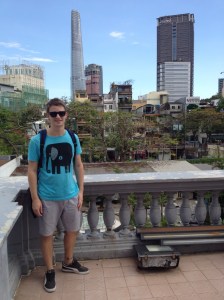
View of city from the Ho Chi Minh City Museum.

View of city from the Ho Chi Minh City Museum.

***

My first evening in the hostel was when I began to experience the tourist nightlife. As people began slowly arriving home from their days activities and trawling into the dorm room, one of the guys made an open invitation to anyone who was interested in joining him and a few other guys in getting some dinner. Having no plans and nothing to lose, I tagged along and found myself with four guys, respectively originating from Germany, Wales, America and New Zealand, and a Hungarian girl. Our small international party set out looking for cheap street food. I’d always been a bit of a fan on Vietnamese food back home, so it was kind of a novel thrill to sit on a tiny plastic chair on the side of the road, like all the local people did in District 1, and eat my pho noodle soup. After that we were joined by two Argentinians and headed to a bar to drink some beer. I say “bar”, but in reality it was a little hole-in-the-wall joint with tiny plastic chairs (and slightly bigger plastic chairs that were used as tables) littering the footpath out front, sprawling out onto the road when it got busy enough. Later in the week, when I explained this scene to a New Zealander expat now residing in Ho Chi Minh City, he merely chuckled and said, “Yep, we call that a bar here.”

However, what the place lacked in bells and whistles, it made up with value for money. Draught beer was 7000 Vietnamese dong per glass. That converts into approximately 35 Australian cents. It seemed criminal to drink anything else when you could drink for so ridiculously cheap, and not for the first time on this trip I found myself succumbing to peer pressure and going in for a round of beers, only to be surprised that I actually quite enjoyed the taste of it. I didn’t love it, but for a few quiet drinks on a Tuesday night it doesn’t get much better than three beers for a buck.

The weekend was a different story though – I met a bunch of Australians who had been in Vietnam for the last month or so for work, and they took me out to some of the nearby nightclubs. The bars were a little more sophisticated then plastic stools on the pavement, and the drinks were more than 35c, but they were still exponentially cheaper than back home and the cocktails were lethal. Two Long Island Ice Teas later and I have to confess that I couldn’t tell you much about the difference between the clubs in Saigon and the clubs back home. Except that in one of them I ran into a Tasmanian couple casually smoking a hukka, and I’m pretty sure the flavour was “blue”. And security guards loved to pose for photos, something I have never seen in Australia.

In an e-mail to my father about my trip down to Krabi, I had mentioned how good it had been to get out of the city for a while and see the rest of the country. His response triggered something in me that I’d never really considered before: “Yes, cities tend to all feel the same after a while. It’s best to get out and see the real country”. While I could see comparable differences in each city I had visited, I promised myself that I would make my best effort to see a little more than just the major cities in each country went to, wherever I could.

Because at the end of the night, whether its beer or spirits, Sydney or Saigon, hangovers are generally all the same too.

Riding Solo

After four weeks on the road, it’s safe to say I’ve seen quite a bit and had some new worldly experiences. However, something I never expected was that travelling by myself would play such a crucial part in the way that my journey unfolded. At the time of planning all I envisioned was complete, unbridled freedom. While that still might be true, travelling alone isn’t without its drawbacks, a few of which I am slowly learning to navigate.

***

Perhaps the first time the realities of traveling solo really hit me was when I was waiting for my train south to Krabi, sitting at a table on the elevated café level of Hua Lamphong Railway Station in Bangkok. All around me, I saw so many travellers in pairs: whether they were partners or friends, or sometimes even groups of three or four, almost everybody had somebody. And that started to make me feel a little lonely.

And I don’t necessarily mean the ‘longing for human contact’ kind of loneliness. It’s the practical advantages of having a travelling partner that I really began to notice when I was finally by myself. For example, I had an hour and a half wait at the train station. There was no table service in the area I was sitting in – if I wanted to order food, I would have to pick up my bags and take them to the counter with me. If I wanted to go to the bathroom… well, I couldn’t. Unless I either hiked in there with all my bags or left them out in the open when I went, completely unattended.

Luckily I didn’t need to use the bathroom, but it just made me realise how much easier some things are when you have a traveling partner. Initially I was quite drawn the freedom of being able to do exactly what I wanted and travelling whenever I wanted, but when you’re making these grandiose plans, those little details are often the first thing you lose sight of. They say that solo travelling can be much cheaper, but even that freedom still comes with a different kind of cost.

***

When I was on the beach at Ao Nuang beach at Krabi, I had no choice but to leave my bag unattended. It probably probably says something more about my paranoia or anxiety that I pretty much backed into the ocean, facing the beach, so that I could keep an eye on my belongings. But you loosen up eventually, for better or worse, and in the end you just have to calculate the risk and do your best to enjoy whatever it is you’re doing. And I did, eventually. Train stations are very different settings to beaches, and there was just the right amount of people present on the sand for me to feel more comfortable about walking away from my bag – enough people to be witnesses to a theft, but not enough for a thief to be lost in the crowd.

When I was at Rai Leh, I was able to ask Sam and Sarah to watch my bag while I went into the ocean. But eventually they wanted to swim as well, so we all just had to leave our bags in a cluster on the beach and keep an eye on them every now and then. Although again, maybe that’s my paranoia talking. As we walked out of the warm Thai water, Sarah peered out onto the vast expanse of sand and asked “Where are our bags?” We’d floated a little way down the beach, but I was immediately able to point out the location of our belongings. Seems not everyone is so highly strung as me when it comes to the location of their valuables.

***

Then there is the freedom of travelling solo – both a blessing and a curse. For starters, I know that had I not been travelling alone, I probably wouldn’t be on this mammoth nine month journey. Most people don’t have the time, or have too many commitments to take such a long term vacation from their real lives. But I did, so I set out with the intention of not letting anyone get in the way of doing exactly what I wanted to do.

But I felt it was impossible to plan an entire nine month holiday completely in advance, so I left a lot of the fine details up to chance and circumstance. Booking hostels and overland transport as I go, seeing wherever the wind takes me – it sounds like the ultimate travellers dream. I know for a fact I wouldn’t have done half the things I’ve done so far if I’d brought a travelling companion from home – beers with the British boys in Thailand, Couchsurfing in the Vietnamese slums, being sexually harassed by a monk, or even the SCUBA diving tour that I booked myself into on a last minute whim.

Then there’s even the freedom to do nothing. Those days or nights when you’re just too exhausted, and all you want to do is sit in the hostel and read a book or make a Skype call. You don’t have to make excuses to anyone or apologise for not going out and having fun. I accept the reality that out of my 275 days of travel, not every single one is going to be jam-packed with activities.

Yet this does run the risk of complacency. In a brand new city with so much to explore, after a few a days you can easily become overwhelmed. With a travelling partner, you always have someone else’s energy to bounce off and keep ideas coming, always planning something to keep the ball rolling. By yourself, it’s easy to feel at a loss, and waste days trying to decide what to do. I thought that hostels would help with this – it certainly did while I was in Krabi – but of the three nights I’ve spent in my hostel at Ho Chi Minh City, for two of them I’ve been one of two people staying in a 9 bedroom dorm. The other guy hardly speaks, and has spent the entirely of his time in the room editing videos and photos on his laptop. So it’s really up to me, and me alone, to get out there and explore this big city.

River Tour on the Mekong Delta - you get used to taking tourist selfies when travelling on your own

River Tour on the Mekong Delta – you get used to taking tourist selfies when travelling on your own

***

Being alone gives you a lot of time to think, which is also a problem. You end up thinking about home, and things and people that you miss in that state of loneliness, when you know you should be out there having fun and exploring the world. But I hope that writing about this will be cathartic in some way, so I might be able to let go of these difficulties in travelling solo and to fully appreciate the experiences that I’m having.

The weekends coming up, so I’ll probably hit the nightclubs and use alcohol as a social lubricant and find some new people to hang out with. No matter where you are in the world, some things never change.