River Deep, Mountain High: The Great Outdoors in Zürich

The following morning, I bid farewell to Umer as he set off on his own trip. Before he left, he gave me his dads monthly travel pass again. “My father said he won’t need this today, so you can borrow it for one more day while you’re staying here. It let’s you go a lot further around the city than one of the standard daily tickets, so perhaps you’d like to make use of that while you can.” It was the last of the numerous suggestions and tips that Umer had offered me, and I thanked him for his stellar advice as he headed off to the airport.

***

The first thing I did that morning was head back to the centre of town to the dock at Lake Zürich. The monthly pass that I was using today also covered use of the ferry, which made round trips around the lake to certain points much further down the shore. There were long trips that went to the other end, as well as shorter ones that did rotations to closer docks. Umer had said it was a nice relaxing way to spend the morning, and it was a beautiful day to be out on the water. I took one of the shorter trips, which still took the better part of an hour, and watched the shoreline glide past, admiring all the adorable traditional houses that were situated right by the water. One thing that I would continue to notice during my time in Zürich is that the Swiss love their outdoor activities. It has something to do with the seasons – during the winter there is very little daylight, and the cold doesn’t permit people to be outside for too long, so when summer rolls around and the sun doesn’t set until after 10pm, people seem to take full opportunity of as many daylight hours as possible.

Statue of Ganymed and Zues, represented as an eagle, beside the lake.

Statue of Ganymed and Zues, represented as an eagle, beside the lake.

One of the smaller docks on the edge of Lake Zürich.

One of the smaller docks on the edge of Lake Zürich.

Cute little houses beside the lake.

Cute little houses beside the lake.

There were lots of pools and parks along the edge of the lake, and plenty of people were out sunbathing and swimming and kicking balls and all sorts of recreational activities. I sat in the sheltered shade of my seat in the ferry and just took it all in. I had just come from the small coastal town of Ancona, and I had been expecting to be returning to my tour of major cities when I arrived in Zürich, but I was pleasantly surprised to find that there was a small village feeling very much entrenched into the essence of this place. Even in the major intersections where trams tracks overlapped and cars seemed to be turning in all sorts of random directions, there were no skyscrapers, no obvious central business district, and no particularly large or overwhelming buildings. The feeling was cute and quaint, and it suited the city perfectly.
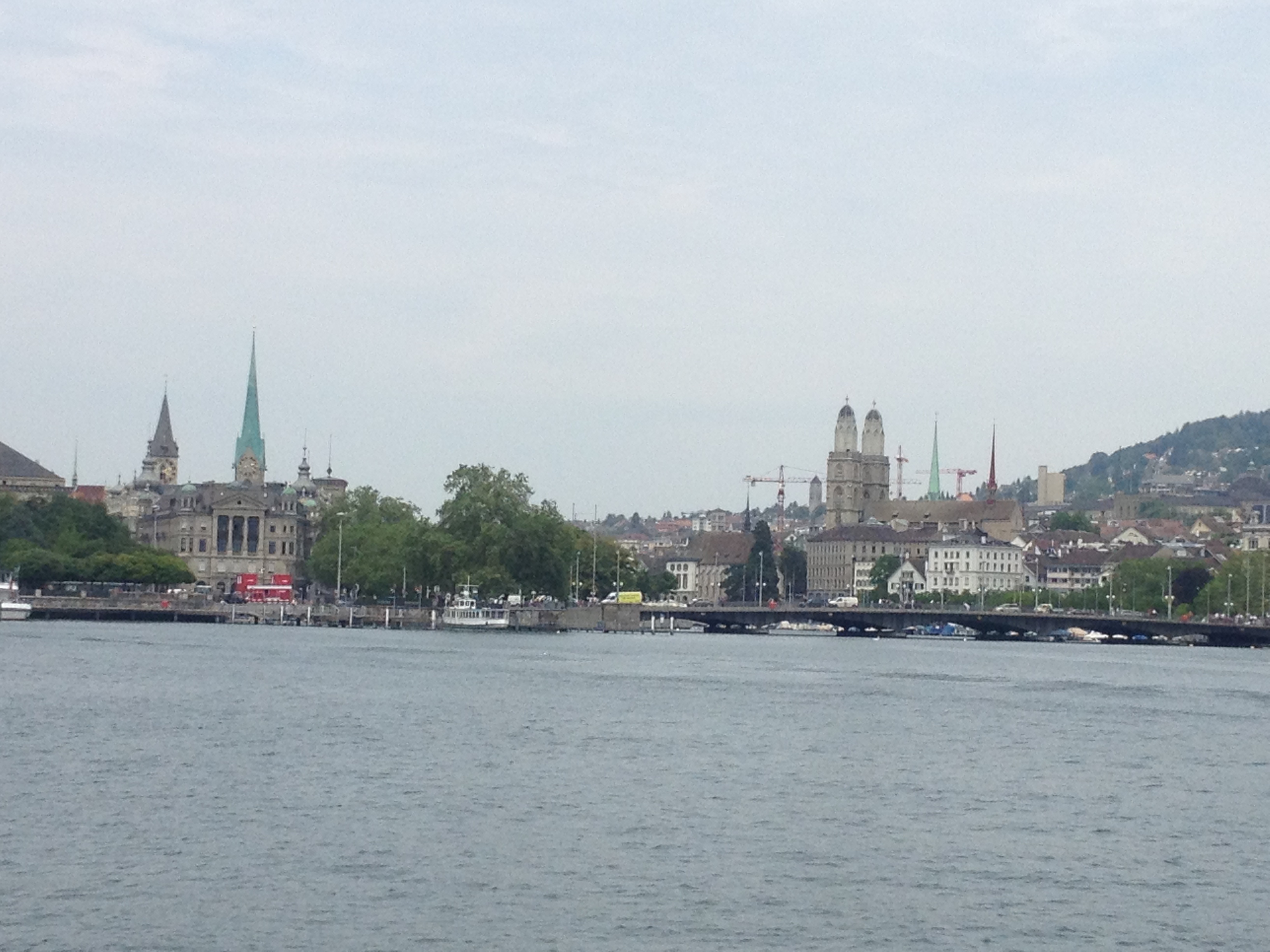
The main centre of Zürich as seen from the ferry on the lake.

The main centre of Zürich as seen from the ferry on the lake.

***

After my tour across the lake, I returned to the shore where I had plans to meeting some. Robin was to be my second Couchsurfing host in Zürich. Originally I had had three lined up: Umer had been the first and Robin the third, but my second host had to cancel at the last minute, which was why I was staying an extra night with Umer’s parents. Robin currently had a friend staying with him, which is why I could not come to stay with him any earlier, but when I told him Umer was going away he said he would be more than happy to meet up to see some more of Zürich with me. When I told him about the pass I was using for the day, he suggested we catch the train south west, just outside of Zürich to the mountain Uetliberg, which was another popular site for recreational activities in the city. Robin’s friend Tammy was busy filling out an application – the two of them were Chilean, with Robin living and studying here and Tammy visiting him, but also applying for courses so that she might be able to come back and live here too – so it was just the two of us as we hopped on the train and set off up the mountain.

As I chatted with Robin, he confirmed what I had observed from the boat – that everyone in Zürich was slightly obsessed with physical activities and outdoor recreation. The bike on the train up the mountain had quite a few people with mountain bikes, which they would ride down steepest parts of the mountain, following the popular trails before turning around and riding back up again. The public transport passes in Zürich ran on 24 hour period, so you could ride as many times as you liked as long as you were in a zone that was covered by your ticket. Robin had to buy an extension on his regular ticket, and off we went along the train towards the mountain. We got chatting along the way up – Robin was a sweet, short and soft-spoken guy who spoke with a pretty heavy accent. He was currently living in Zürich doing research and writing a Masters thesis, about a particular niche in microbiology that I would struggle to reiterate in any further detail, but it was definitely quite interesting.

When we reached the Uetliberg station – it was only about a 20 minute trip – we headed along the short hiking trail that led to a lookout. On the way we saw dozens more people out and about, who were doing a whole manner of exercising such as running, jogging, riding bicycles, and even taking part in what seemed to be some kind of boot camp drill work out. Robin and I casually trekked our way up the hill and dozens of people passed us by – we had all afternoon while Tammy filled in her application, so there was no rush. We eventually reached the lookout at the top peak of Uetliberg and gazed out over the impressive view. There was a metal tower that looked something like a huge lightning rod that we were able to climb, so Robin and I marched up the stairs to the viewing platform at the top. From there you could see the around the whole mountain, the horizons lined with even higher mountains that were cloaked in clouds and a pale pink afternoon sunlight. Up there the air was so fresh, and I breathed in a lungful as I soaked in all my surroundings. Robin pointed out a few of the natural features of the area, and we chatted about each of our home countries, our travelling experiences, and our impressions of Zürich. The nice thing about Couchsurfing is that no matter who you end up meeting or staying with, there’s always at least one thing you usually have in common – a passion for travelling. It’s the reason most people get involved – to be able to go travelling themselves – and in turn allows other people to go travelling and see the world. The more experience I had with the website and organisation, the more amazed and impressed I was at such a simple idea that very could very literally change lives.

The sun setting behind the clouds, as seen from Uetliberg.
The sun setting behind the clouds, as seen from Uetliberg.

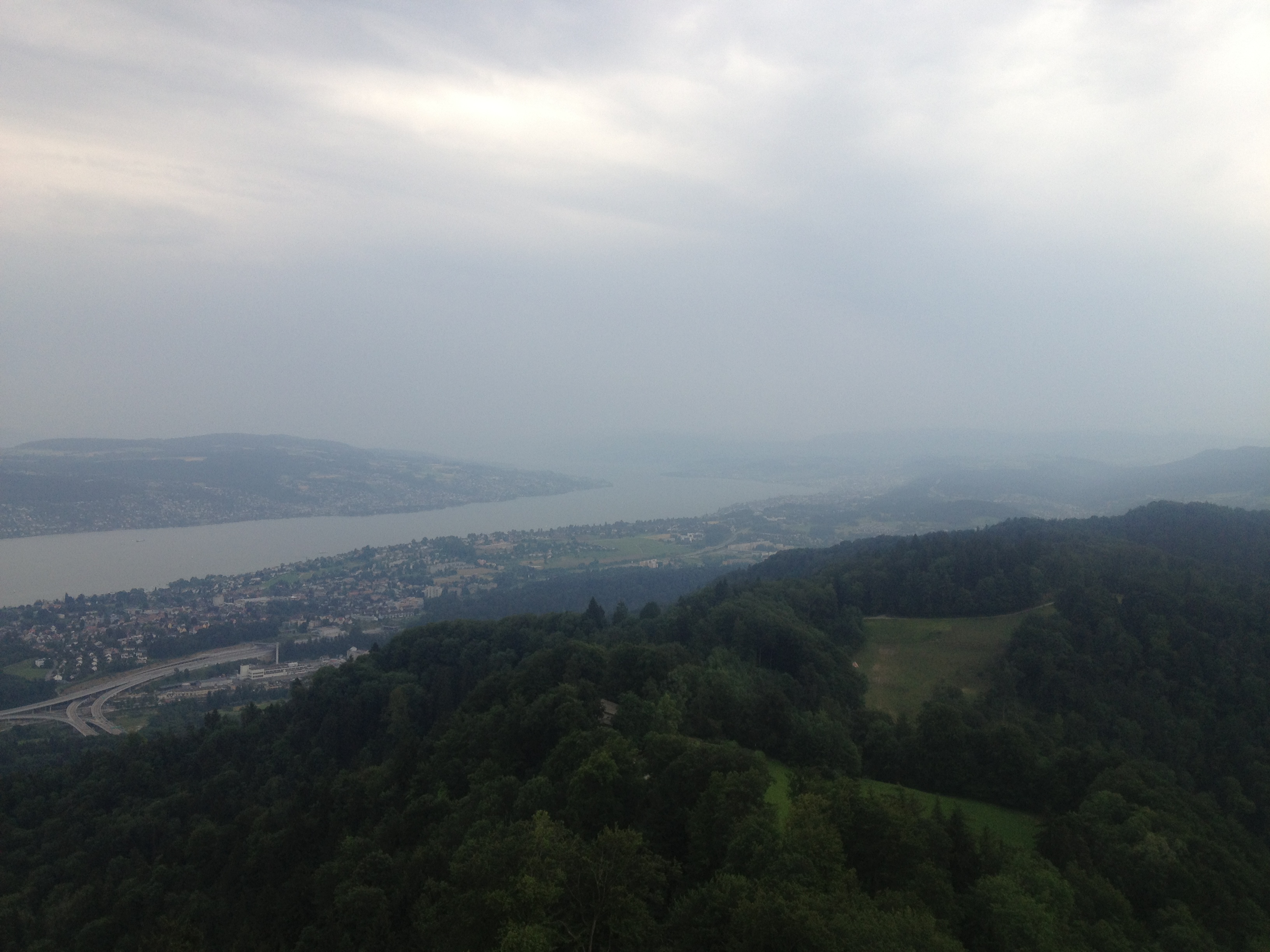
The view from the tower at the top of Uetliberg.

The view from the tower at the top of Uetliberg.

After soaking in the sights from the top of Uetliberg, Robin and I headed back to Zürich to meet up with Tammy, and once we did we headed to the west of the city, where Robin told us there was an outdoor concert happening. He didn’t have too many details, but he thought it might be something cool to check out, so we jumped on a bus across the city. When we arrived, we found what seemed like a huge picnic in a park, with people spread out across the relatively small stretch of grass. In the corner, a large folk band was playing all kinds of music, and there was a crowd who had gathered around them to watch. We bought some snacks from a nearby store and laid out on the grass, listening to the music from across the park and just hanging out, enjoying the cool, pleasant evening air. It was actually getting quite late, but twilight was still lingering over the city, and there didn’t appear to be any signs that the party would be dissipating any time soon. I had to get home though – I hadn’t told Umer’s parents what time I was expecting to be home, so I didn’t want to keep them waiting too late into the evening. I bid farewell to Robin and Tammy for the evening, making plans to see them again when I arrived at Robin’s place the next morning to stay with him for my last two nights in Zürich.

***

The following morning I left Umer’s parents place and made my way to Robin’s. He would be working during most of the day, so that’s when I would do my typical and touristic sightseeing, but in the afternoons when he was free Robin introduced me to some of the activities he did during his spare time and, like any typical resident of Zürich, those were outdoor activities. Enter slacklining: a sport that holds a lot of similarities to tightrope walking – you are required to balance on, and walk across, a piece of nylon or polyester webbing that is tensioned between two anchor points. However, the main difference is that while a tightrope is rigid and taut, a slackline gets its name in having a considerable amount of slack – it is stretchy and bouncy, almost like a long and narrow trampoline. The more extreme variations of slacklining involve doing it unsupported in crazy places such as between skyscrapers or mountain peaks, but Robin was taking me to learn in a much safer but still rather exciting place: over the River Limmat.

We got to one of the bridges that crossed the river, down near the riverside bars where everyone had congregated on the warm, sunny afternoon. We weren’t the only ones setting up a slackline over the river – there were two other guys setting up a much longer one than Robin’s, from the bridge to the rivers edge. “That guy is very, very good. He does it professionally,” Robin said as we set up our slackline. There were a couple of guys walking along the other slackline, but one of them was obviously extremely experienced. He would stop in the middle of the line and do all sorts of acrobatic tricks, bouncing on the line and landing on one foot, or even on his hands, pushing himself back up to keep bouncing and even walking across the line. It was seriously impressive. Robin had only been getting into slacklining recently, he assured me, so he wasn’t that good. I assured him he would be better than me, but nevertheless I was still keen to give it a go.

Once I first stepped onto the line, I realised how sensitive and reactive the slackline was to my body. It wasn’t too windy that afternoon, but as soon as I stepped out onto the line it violently shook from side to side, like a leaf in a hurricane. Robin held my hand to steady me as I took my first step, but he couldn’t take me the whole way. I tried my best to stay balanced, but as soon as I took my first step on my own, I came tumbling down to land in the river. I plunged into the cool and deep blue water, and when I finally resurfaced I realised that I had already floated a couple of metres downstream. The river was flowing exceptionally fast, to the point where if I tried to swim upstream, it was the equivalent to running on a treadmill – going nowhere fast. I quickly swam back to the edge of the river to rejoin the others on the bridge. Robin was definitely a lot better than myself at the slackline – for the first time ever he managed to cross the whole way across the slackline without falling off. That only happened once though – most of the times we both always ended up plunging into the river. I quickly learnt that you can’t be afraid of falling, and when you do fall you have to let it happen and not fight it. The one time I panicked and tried to stay on the line, I fell so awkwardly that I landed on my back in the water, and the impact left a huge red mark on my back that attracted quite a lot of comments from passers by.

Slow and steady across the slackline...

Slow and steady across the slackline…

... keeping his balance...

… keeping his balance…

... and he made it!

… and he made it!

Getting ready for my first attempt on the slackline.

Getting ready for my first attempt on the slackline.

The first, and only, step...

The first, and only, step…

... and down I go.

… and down I go.

Splash!

Splash!

That wasn’t the only reason strangers talked to us, though. The shared love of outdoor activities seems to seamlessly bring all surrounding people from all walks of life together, and make new friends out of complete strangers. Robin and I had plenty of people come up to us and ask us questions about slacklining – most of which I couldn’t answer, though – and asking if they could have a turn. The area was already pretty social with the bars lining the river, as well as a bunch of other cool things – there was a restaurant that also doubled as a DIY garage where people could come and use tools to fix and customise their bikes – so the slacklines on the bridge were just another added element to that friendly social vibe that seemed to be almost everywhere in Zürich. It made for a fun and interesting social experience – all the activities that were happening around the city made me realise something about my life back home: I didn’t have very many hobbies. The closest thing I had to a hobby was playing guitar and writing music – other than that, I just spent a lot of time drinking with my friends and going clubbing. It was a refreshing change, and I think that afternoon was when I made a pledge to myself that when I got home, I was going to find fun new things to do with my time other than drink myself stupid.

It was also an exhausting afternoon though, so afterwards Robin and I headed home for a relatively early night. We sat up for a while just chatting in his room though – there’s just something unnatural about going to bed before the sun does.

***

The following evening we set out after Robin finished work to meet some people in a nearby park. “I haven’t met these people, but there’s a group on Couchsurfing that organises hikes and other outdoor trips and stuff,” Robin told me as we made our way there. “We’re planning something for this weekend, so we’re meeting up to go over the details.” It made me realise that Couchsurfing wasn’t just a place to stay – it was a global, online community. When we arrived at the park, it was a similar sight to my first night in the park with Robin and Tammy, except instead of lazily enjoying the outdoors, everyone was extremely active. There were games of volleyball and soccer, people doing yoga and other aerobic activities, people throwing balls and frisbees, and Robin even brought along his slackline again, and set it up between two trees. It was quite remarkable to see so many people outside until the very limits of daylight. “It really is the summer drawing everyone out,” Robin later said. “The winter was horrible this year – it lasted five months and it was terribly cold, so everyone is very excited now that the warmer weather has finally arrived.” It was a familiar story that I had been hearing for the last month from all over Europe, from Finland and Sweden to Germany and even France. Not so much in Spain and Italy, but I had started heading north again, away from the Mediterranean.

It made me realise just how lucky we are with the weather in Australia, especially the temperate climate in Sydney. It’s never exceptionally cold, and only very occasionally does it get extremely hot. We get a healthy balance of rain and sunshine and we never have days with extreme excess, or lack, of sunlight. Watching these people flock outside to enjoy the weather made me realise just how little I appreciate the weather here, and so in Zürich I made a pact to myself to not only get a few more hobbies when I got home, but also to get out and enjoy the outdoors a little more too.
Recovery: From the city to the sea

I watched the Italian countryside whizz past me as the train carried me away from Rome. Eventually the train tracks became parallel with the seaside, and I gazed out into the distance over the Mediterranean. In one short trip I was going from coast to coast in Italy, from the capital city of Rome to the tiny port town of Ancona. “Ancona?” Valerio had asked me with a very confused expression, when I had informed him of my next destination. “Nobody… I mean nobody, goes to Ancona. Pass through maybe, but… well, there’s nothing there!” Ancona was a regular port for ferries that routinly carried passengers from the east coast of Italy to Croatia and Greece. It hadn’t exactly been on my high priority list of places to see, but while I had been searching desperately for a place to stay in Rome via Couchsurfing, I had received a message from Ike.

The interesting thing about Couchsurfing is that you can send requests to potential hosts, but you can also publicly post your travel itinerary so that hosts in areas where you are planning to travel are able to find you and invite you to stay with them. The majority of people who I have spoken to about this assured me that that was way too creepy for them, and that they wouldn’t just accept offers from random people they didn’t know, but my journey so far had showed me that taking a chance on the generosity of strangers can sometimes have the most rewarding results. I had been looking for other places to stay in while travelling Italy, but so far all my other searches had been unsuccessful. Meanwhile, Ike had sent me a message saying he had noticed I was travelling through Europe, and that if I ever made it to Ancona he would be happy to host me. We had stayed in correspondence during my frantic search for hosts in Rome and my breakdown in Madrid, and from what I could gather he seemed to be a nice and rather genuine guy. So when I arrived in Rome and had to make plans for my next upcoming destination, I agreed to visit Ike in his sunny little corner of Italy. Four days later, and I was stepping off the train into the blistering afternoon sun, where he was waiting to pick me up.

Ike was a fun and outgoing guy with a cheeky sense of humour, and just like when I had met Stefan – who had also stayed with Ike – we got on well straight away. I knew I had made the right decision in coming here – better to spend a couple of days in a town you’d never heard of with a fun stranger than wander around a well known city by yourself. I’d done plenty of that in Rome, so during my time in Ancona I was determined to do absolutely no sightseeing. I needed a break from all that. When we got back to his place, Ike showed me a map of the area and a bunch of information pamphlets about things to see and do. “There’s a short historical walk through the main centre,” he said, pointing at the map to a spot in the centre of town – Ike lived a little further up one of the many rolling hills that surrounded the port, about a 10 minute drive from the train station. “Stefan was very into that kind of thing, but I’m not sure what you want to do while you’re here.” I told Ike that I would be happy to find a spot on the beach and just chill out, so he gave me a few options for the nearby beaches that I could try, most of which were pretty easily accessible by bus. “I’d love to come with you if I had the time, but unfortunately I’ve got to work.” Ike even had to go back to work that afternoon, so he left me at his place to do some laundry and get some rest. When he got home, Ike cooked dinner and we had a night of great conversation over a bottle of wine. We talked about travelling, our Couchsurfing experiences, and he even taught me a couple of phrases in Italian. It was a fun and carefree evening, and I was already very pleased with my decision to stop by Ancona and take some time out in this Italian hideaway.

***

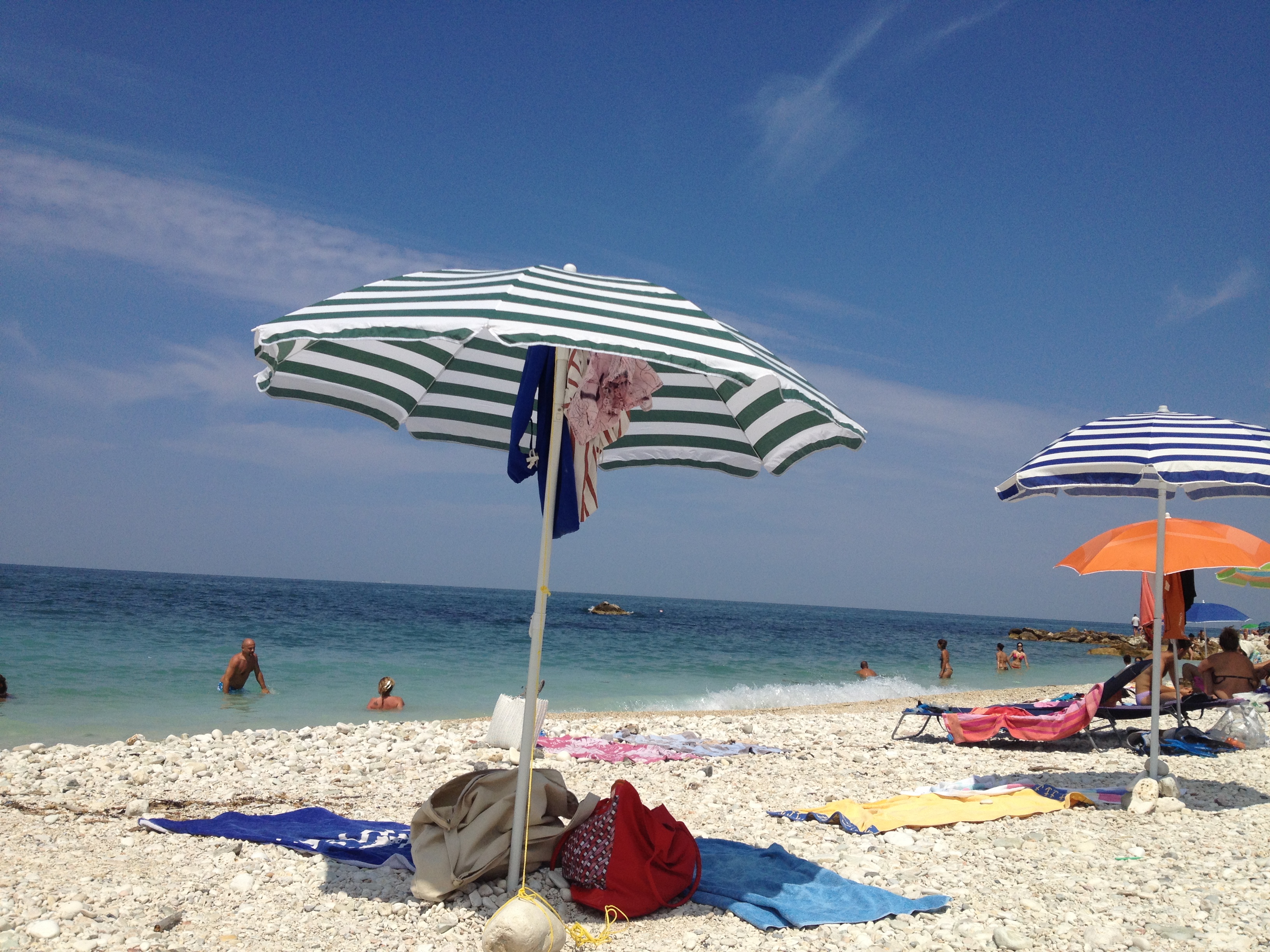
The next day Ike had to go to work again, so after a bit of a sleep in and a lazy morning, I caught a bus down the hill to the city centre and then transferred to another bus that would take me to the nearby beach of Portonovo. The bus was crowded with lots children and teenagers, and it was only then that I realised it was the height of summer and that school was probably out, and everyone in town would be heading for the beach. It also took a little longer to get there than I had anticipated – I was on the bus for over half an hour, going up and down the twisting and winding hills of the outskirts of Ancona before we finally arrived at Portonovo. I wandered through some of the shrubbery around the bus stop and down through a small woodland area before emerging onto the beach. The area had a handful of restaurants and other overpriced-looking places where you could hire beach chairs, but I bypassed all that and went straight to the waters edge.

There, I faced a problem that I hadn’t really faced since I’d been in Thailand – I was alone on a beach with a backpack containing valuables such as my phone and wallet, and I had no way of properly securing them. Even if I was to put a lock on my bag, there was nothing stoping someone from simply running away with it. The beach was fairly crowded, but not so much that I wouldn’t be able to see my things if I left them in plain sight from the water, and it was too hot to not go swimming. In the end I just had to take a chance and leave my backpack while I went into the water. I never swam too far from where I’d left it, but I was a little more relaxed than I had been on the beach at Ao Nang. And it was worth it – with the hot sun beating down on the crowds of beach goers, the cool blue water felt absolutely amazing to dive into. When I’d had enough of that, I crawled back onto the beach, lathered myself in sunscreen, and laid down to soak up some rays. I think it was something I’d first noticed lying in the park in Christiana during my time in Copenhagen, but the sun in Europe just doesn’t seem to be as strong as it does down in Australia. Obviously Italy has a lot stronger sunshine than Denmark – Ike told me he regularly uses 50+ SPF sunscreen – but compared to the sun in Australia it felt like a casual warm day. I was very conscious of my sunscreen use though, which allowed me to relax enough to actually doze off into a state of semi-sleep more than a couple of times. It was the perfect temperature, and I stayed there on the beach for as long as I dared before I thought there really was a chance of me getting significantly burnt.

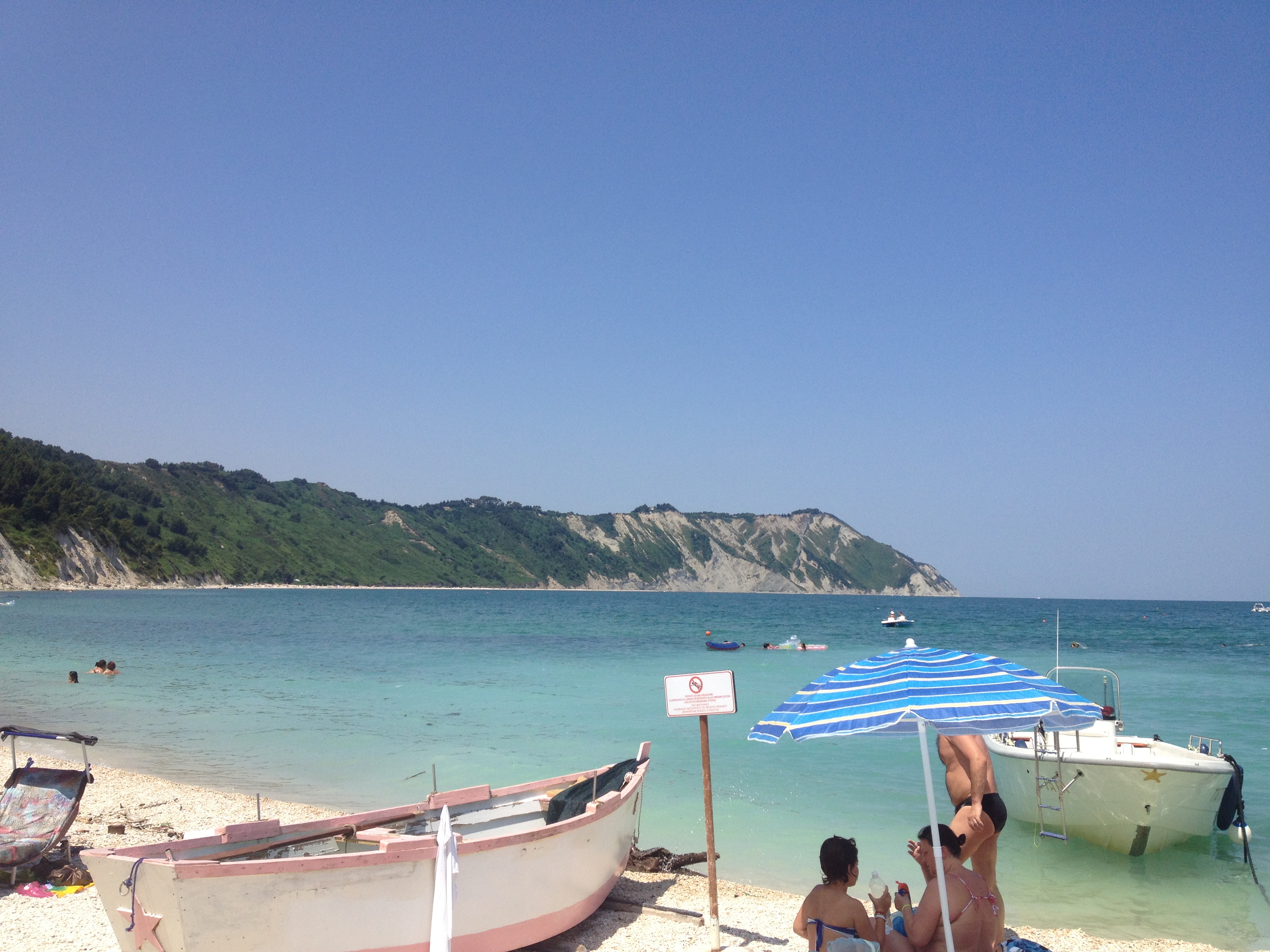
The refreshing blue waters of Portonovo Beach.

The refreshing blue waters of Portonovo Beach.

Lots of people set up camp for a day on the beach in the gorgeous sunshine.

Lots of people set up camp for a day on the beach in the gorgeous sunshine.

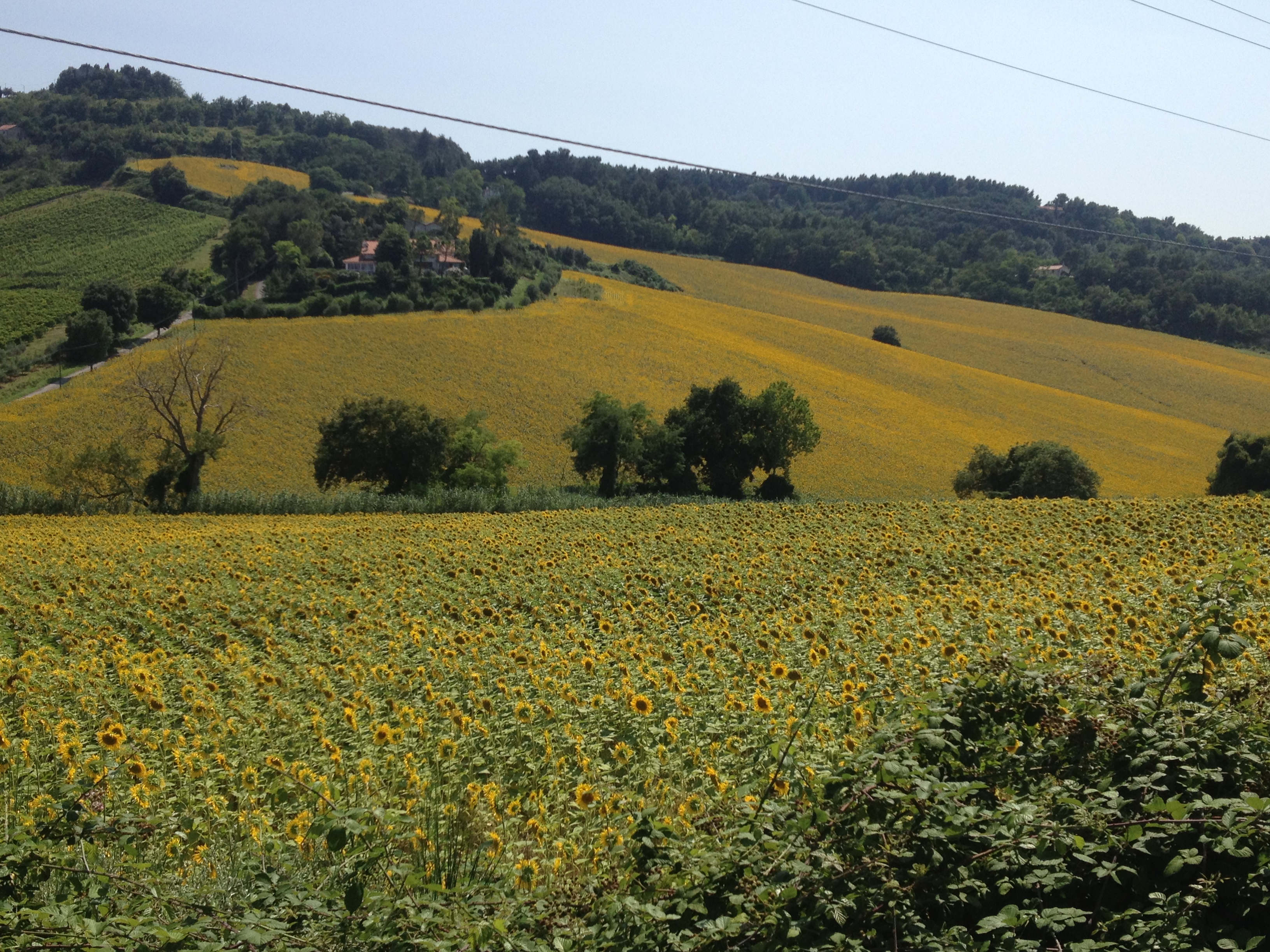
I took one final dip in the ocean before heading back to the bus stop, and indulging in some amazing Italian gelato while I waited for the bus. When the bus finally arrived, slowly making its way down the hill from the highway, I hopped on board, thinking it would take me back to the centre of Ancona. I was surprised to find that its final stop was simply at the top of the hill. “Last stop – everyone off,” the bus driver called out to me. It was definitely up there in my travel nightmare scenarios – being forced off the bus but having absolutely no idea where I was or how I was going to get back. However, when I hopped off the bus I was momentarily distracted by the field of sunflowers that spread out in front of me in the paddock beside the road. I took the opportunity to take a few photos, and just sit back and marvel at the Italian countryside and the picture perfect landscape I had laid my eyes on.

The sunflower fields just next to the bus stop by the beach.

The sunflower fields just next to the bus stop by the beach.

But then it was back to panicking. Another bus with the right number came along, so I hopped on. It took me… back down to the beach. What the Hell was going on? I decided to swallow my pride, realising I needed help, and approached the bus driver, crossing my fingers and praying he spoke some English. I explained where I wanted to go, and he knew enough to understand and give me a reply: “Ahh – next bus!” I sighed, knowing it was about as much help as I was going to get, and stepped off the bus. It wasn’t too long before the next bus came trundling down the hill, and when it finally did I was relieved to feel it make the turn onto the main road that led back to Ancona. I had given up trying to understand how public transport timetables – or indeed, any kind of timed service – operated in Italy. I’m not one for generalising stereotypes, but I can honestly say that chronic lateness was something that I experienced in pretty much all public services in Italy. Countries like Italy and Spain are currently suffering from unbelievably high levels of youth unemployment, but I can’t help but wonder if the people who were actually employed were doing any more work than the people who weren’t.

***

That evening was my second and final night staying in Ancona, so when Ike got back from work we decided to go for a little drive to see some of the other parts around the area that I hadn’t been able to see by myself. We headed south down the coast, admiring the countryside in the dying daylight. At the small town of Sirolo, we stopped the car and got out to watch the sunset behind one of the cliffs. It was nice to be outside of the huge cities for a change, and to experience some very natural beauty such as this. I took a few photos before we continued on to the next small town of Numana. There we got out and walked around the town. It was a little more tourist-orientated than the centre port of Ancona had been, and the streets were quite well preserved in an older, historical style, with uneven tiling and cobblestones lining the streets. We walked down to the docks and looked out over the water as twilight settled in. It wasn’t quite as prominent as the white nights in St Petersburg, but even in southern Europe it still took a very long time for nighttime to actually become dark – often there was still a lot of natural light and visibility as late as 10pm. It was a strange phenomenon that I was only now getting used to.

Overlooking the beach at Sirolo at sunset.

Overlooking the beach at Sirolo at sunset.

The ocean view from our vantage point near Sirolo.

The ocean view from our vantage point near Sirolo.

Overlooking the town of Numana.

Overlooking the town of Numana.

Ocean views as dusk settles over the province of Ancona.

Ocean views as dusk settles over the province of Ancona.

After wandering through the old, steep streets, we headed back to the car and went home. I didn’t ask, but in a small town like Ancona I assumed that there wasn’t much of a nightlife scene, gay or otherwise. Even if there was, I don’t think I would have bothered going. My time in Ancona had been all about relaxing and taking the down time that I had been unable to take in the past couple of weeks. I helped Ike make some dinner and we had some more wine before retiring to bed. He was leaving for a work trip the following day, and I had several trains to catch. But I’d had a fun and memorable few days with Ike in Ancona. He’d told me that it was often just a passing through town for so many people, and that people rarely discovered the little gems of beauty it contained. At that moment, I was eternally grateful that I’d decided to travel the way I was travelling: solo, using Couchsurfing, and meeting all kinds of interesting locals along the way. It assured me that not only was I having an amazing once in a lifetime trip, but that I was seeing parts of the world that many other travels might breeze over without a second glance.

Borderline Insanity

This short anecdote will double as a warning for anyone who might be making a similar journey in the future: when travelling between Cambodia and Thailand, do not – I repeat, do not – book a bus ticket. Catch taxis, tuk tuks, trains, rent a car – anything but try to book a bus ticket. There are probably some services that operate smoothly and according to plan, but after the mess that I walked away from on my journey back to Bangkok from Siem Reap, it is certainly not a gamble I would ever be willing to make again.

***

So far in my journey, I had been happy fairly happy with the night bus services I’d caught. Krabi to Bangkok was a comfortable coach with reclining chairs, Saigon to Chau Doc was a little cramped but I had still had my own private space, and my Sihanoukville to Siem Reap journey had bed-seat hybrids that allowed your legs to stretch out completely flat, and even had free WIFI on the bus. I booked a ticket with that same company from Siem Reap to Bangkok, hoping to kill two birds (transport and accommodation) with one stone, and getting a similar satisfactory service. After waiting around since my check out at noon, wandering the the town and visiting the museum, I was picked up at 2am (yes, that’s a 14 hour wait) by a shuttle bus to take to me where the main bus was leaving from.

Scheduled departure time was 2:30am. No buses showed up until 3:00. Then we watched as a group of Khmer men unloaded three motorcycles from the cargo bins below. Myself and the other two tourist, a young German guy and an older man from Washington DC, shot each other uneasy looks as we were told this was our bus to Bangkok. They took our bags and I climbed on board. It was not a sleeper bus. Most of the seats were already full, and the majority of them were filled not by tourists, but rowdy local Khmer men. They had loud conversations over the top of my head while I was trying to sleep. The bus driver played music that was essentially a loop of cheesy instrumental music that belonged in a pornographic sound track. The whole bus smelt of bodily gases and other sickening scents. As I thought back to the slogan on the anti-piracy ads on my old VHS tapes, I certainly wasn’t getting what I had paid for.

***

At some point, through the stench and the racket, I suppose I managed to catch a little bit of sleep – after 15 hours of being awake it was bound to happen eventually, no matter the circumstances. It wouldn’t have been any more than half an hour though, and at around 6 o’clock, after just under three hours of transit, the bus jerked to a stop. It was dawn outside, and slowly and but surely all the Khmer men stood up and shuffled off the bus. I figured that we had reached the border, and would be required to alight so we could have our passports checked and stamped. “You get out here now”, said one of the bus company workers to me and my two other Western companions. “Another bus take you to the border.” As I climbed down the steps and out into the bus station, I watched the Khmer men who had been on my bus all climb into the back of a ute, which sped off down the road and into the dust. It was obvious that rather than put us on a chartered bus, the company had decided the throw their few clients on any old bus that was heading in the right direction, and deal with the rest once we got to the Thai-Cambodian border.

We met a bunch of British girls who had just climbed off another bus who were also heading to Bangkok. After being sent on a small wild goose chase, crossing the road several times in an attempt to find someone who knew what the hell was going on, we were ushered onto a bus – I was disgruntled, though not surprised, to find myself on the very same bus I had alighted from only moments before. We were only on board for a couple of minutes though, before the bus pulled up directly outside the border crossing. “You cross border now,” said the bus company guy, as he took our tickets and stuck little yellow stickers to the front of our shirts. “Crossing take one hour. Someone will meet you on other side. Sticker is your ticket now.” I was mortified, but there was nothing else I could do, so as a sleepy pack of tourists we climbed off the bus and made our way to the border crossing.

Only to discover that the check point itself didn’t open until 7 o’clock, which was still almost an hour away. When I had booked the ticket, I had been given an estimated time of arrival in Bangkok of about 9:30am. I had already long ago given up on that hope, but with every passing minute I became more and more unsure of how I was actually going to get to Bangkok at all. After an hour of waiting, plus another hour to go through both departures in Cambodia and arrivals in Thailand, I finally found myself on the other side of the border. It was far from a feeling of relief though – it was a terrifying moment, plagued with doubt and the endless possibilities of the next unpleasant surprise they would spring upon us.

The busy border crossing just after opening.

The busy border crossing just after opening.

As I trudged through the crowd of pilgrims, I heard a shout and saw a wave of hands. “Yellow sticker! Yellow sticker over here!” For all that had not gone accordingly to plan this morning, being greeted in Thailand was like clockwork. I had been sticking with the man from Washington, so we made our way over to the waving man, where we were asked to sit on plastic chairs and wait for the rest of the travellers with yellow stickers. Once they arrived, we were taken to a small travel agent just a few minutes away, where we were informed we would be catching a minibus all the way to Bangkok. It certainly wasn’t a sleeper, but I figured it would get us there faster than a regular bus, so I felt a little better about that. However, when the bus arrived 15 minutes later, the agents face sported a look of concern as one by one, we piled into the bus. I was at the end of the line with my American companion, and as he scanned down his line of clients, he agent called out, “Who is relaxed? You relaxed, yeah? Time is no problem?” It seemed no one had taken into account the space needed for all of our luggage, and we weren’t all going to fit on this bus. Washington and I took two for the team, with the agent assuring us it would only be a half hour wait for the next bus.

***

An hour and a half later, the tiny travel agency was beginning to fill up with people, mostly locals this time, and I grew uneasy at the thought that they would try and squeeze all of us onto the next bus. Washington and I were given priority, since we had forfeited our places on the last bus, so I can’t say for sure if there was anyone who didn’t make the cut. It was 10 o’clock by the time we finally boarded our bus and continued our journey towards Bangkok. However, we hadn’t been travelling long before our bus was pulled over by the police. All the exchanges were in Thai, and no one offered any explanation, but we were sitting there for another solid half an hour while the police made phone calls and wrote on bits of paper, which I can only assume was a ticket of some sort – perhaps our driver was speeding? In all honesty, at this point I was beyond caring. We were still hours away from Bangkok and I hadn’t had a proper sleep in about 24 hours.

The journey back to the city went up without a hitch, other than the minibus stopping every now and then and the driver having short, disjointed conversations with some of the other passengers, and dropping them at various points around the city.

However, when it came to dropping me and Washington off, things became a little more difficult. We finally reached the city of Bangkok, but I had yet to see any familiar landmarks in order to gain my bearings. “Where are we?” I called out to the driver. I got no reply, and it was only then that I realised that while the travel agent assured us we would be dropped in the middle of the city, this driver spoke hardly any English, so could not tell us where we were or where we were going. So you can imagine my frustration when, after driving through the streets of Bangkok for nearly two hours, we didn’t seem to be anywhere near the familiar the city centre. It didn’t help that it was now well into the afternoon, and we were caught in the gridlock of peak hour traffic. I even got my map out and motioned the driver to show me where we were, but he gave it a blank, vacant stare that filled me with horror – the idea that our driver didn’t even know where we were was too much to bear. I’d now been more or less awake for 27 hours, and 15 of them had been in transit. I wanted to scream, and yell and swear at the driver, at the incompetence of both him and the agent and the whole mess of an ordeal that had been my journey back to Bangkok. I was exhausted and furious, but I knew that getting mad would achieve absolutely nothing, so I resigned to my fate and crawled to the back of the minibus to lie down along the back seats, since by now Washington and I were the only passengers left.

Eventually I saw a landmark that I recognised, Victory Monument, which was actually the drop off point we had agreed upon with the travel agent in the beginning. So I guess the driver had known where he was going all along. All the same, I scrambled out of that minibus and onto the streets of Bangkok as fast as my tired little legs could carry me. I never thought I would have been so happy to be back on the streets of Bangkok, but after being at the mercy of the minibus driver for so many hours it was a glorious feeling to know exactly where I was, and have control over my own direction and movements.

***

I made it back home to Bangkok in the end, but it definitely hadn’t needed to be such an ordeal. I’m not saying that all bus trips will be like that, but when you’re booking for a route as disjointed and unpredictable as Siem Reap to Bangkok, or probably anything that involves that border crossing, there’s a lot of wiggle room for transit companies to shove you in wherever you fit and make a great profit on the sleeper ticket that you thought you were purchasing. Thankfully most of my travels for the next few months will be exclusively on trains, because the couple of weeks I spent travelling back to Bangkok from Siagon had seen me on enough buses to last me for quite some time.

Rollin’ On A River

During my stay in Ho Chi Minh City, I thought it was only appropriate that I explore a little more of Vietnam before heading off to the Cambodian border. After sussing out the logistics of my various options, I decided that heading south to the Mekong River delta would be the most interesting and diverse experience. The day trip involved a two hour bus ride out of the city, so I rose uncharacteristically early that morning and trudged onto the bus still half asleep, yet curious to see what the wider country of Vietnam would have in store for me.

***

The Mekong River is the largest river in Asia, starting in Tibet, and flowing through China, Laos, Cambodia and Vietnam, where it divides into 9 tributaries that all flow out separately into the South China Sea. The south of Vietnam is known as the ‘Rice Bowl’ due to the established crops and farms throughout the region. The real tour started at a riverside town called My Tho, and from there we walked through the jungle on a small undergrowth trail until we reached the river.

From there we got into small wooden row boats that took us down a narrow river system that was surround by thick vegetation on each side. We weren’t too far from the main roads, but we were well and truly out of the city now, and floating down the river in the long rowboat really gave me an idea of Vietnamese culture that was probably a little more traditional then either of the living situations I had experienced so far. The short trip took us to a modest little business that turned out to be a factory for making coconut candy. We were able to taste some of the sweet substance right as it came out from melting and thickening over the fire – it tasted a bit like fudge – and were given the opportunity to buy some. That was the first inkling that I was on a tour that I’d heard been referred to as a “tourist trap”, where the initial cost of the tour is cheap, but all the extras come at an additional cost, and almost every stop along the way tries to sell you something.

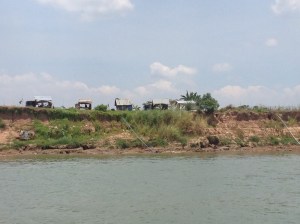
The smaller, secluded sections of the Mekong River.

The smaller, secluded sections of the Mekong River.

After we had concluded business at the candy factory, our tour guide fetched a hessian bag, reached inside and produced a snake from within the depths of the sack, immediately offering it to individuals in the group to pose with it and take photos. Luckily I had faced and conquered my fear of snakes back in Bangkok, otherwise my reaction to the surprise might have been extremely embarrassing. On the contrary, I couldn’t wait to get my hands on the reptile – or to be more accurate, to get the reptile around my shoulders. I thought back to the fearless little ten-year-old boy I had been when I visited the Steve Irwin’s Australia Zoo in Queensland, itching to get my photo taken with the huge python, and realised that I’d come full circle again. I didn’t even flinch as the tour guide draped the snake over my shoulders and looped it around my neck.

Getting friendly with the locals.

Getting friendly with the locals.

After the reptilian meet-and-greet, we jumped on another larger boat and headed down and across the river to another town named Ben Tre. We had lunch at an elephant fish ear farm – large flat fish that resemble their namesake. However, that particular delicacy was another tourist trap that wasn’t included in the price of the tour, though I’m not a huge fan of fish and was able to settle with tour included beef and rice dish. I sat at a table with two couples – a pair of British 27-year-olds taking their annual holiday, and another retired British couple who now lived on the Sunshine Coast in Australia. They were all very nice and interesting to talk to, although I’d been hoping I might meet some more people like myself, solo travellers or backpackers. Groups and couples tend to already have their itineraries firmly set out, so I just had to enjoy their company for the day before writing them off as what Tyler Durden would call “single serving friends”.

Photo on the larger boat, taken by my new temporary friends.

Photo on the larger boat, taken by my new temporary friends.

View of the wider part of the river from our larger boat.

View of the wider part of the river from our larger boat.

Pool of elephant ear fish at the farm.

Pool of elephant ear fish at the farm.

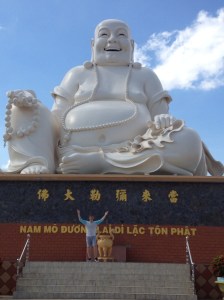
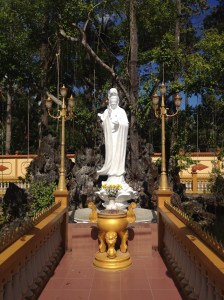
The last stop of the tour was the centre of the town, where there was a temple complex with several pagodas and statues of Buddha. I hadn’t gotten around to visiting a similar site in Saigon, so I was glad to be able to make up for it here instead, though the more I saw of South East Asia, the more similarities I began to see in all these temples and monuments. Which doesn’t make them any less holy or worthy of reverence – it just means you can’t spend quite as long marvelling in awe at them when you saw that temples bigger cousin in a different city. Overall, my day tour on the Mekong River was pretty average. I guess being a day tour it was obviously going to feel a little rushed, but there was nothing particularly amazing or breathtaking about it. Although it was nice to get out of the city and see some more the of the country of Vietnam, no matter how briefly.

Happy Buddha!

Happy Buddha!

One of the more solemn shrines at the temple.

One of the more solemn shrines at the temple.

***

That trip happened during the middle of my week in Vietnam. To stick to my river theme and spare you from any more river references in my blog titles, I’m going to throw chronology to the wind even further and tell the short story of my departure from Ho Chi Minh City…

After a slow day of recovery from my last night in Saigon, I hopped on an overnight bus towards the riverside town of Chau Doc. Not wanting to travel all the way to Cambodia via bus, I had decided to split the trip up by traveling to a border town on the Mekong River, staying there for a night or two, and then catching a boat up the river to Phnom Penh. It wasn’t as cheap as a bus, but I figured it would be a great way to see some more of the countryside, as well as being one of those rare opportunities to listen to Lonely Island’s I’m On A Boat and giggle smugly to yourself at the accuracy of the content.

Though for all the research I had put into transportation, I hadn’t bothered to investigate too much into the town of Chau Doc itself. Crawling off the bus at 5:30am, I was unimpressed (mainly with myself) to find myself alone in a tiny riverside town, where hardly anyone spoke English, at a time where hardly anything was open. “Cheap hostel,” I managed to convey to a motorbike taxi, and we roamed the streets for about 20 minutes, moving from closed hotel to closed hotel. Eventually I gave up and repeated “boat” while pointing at an address in the Lonely Planet guide, and my taxi driver seemed to figure out what I wanted. I found myself sitting at a dock on the river, half asleep while I waited for the world itself to wake.

The town of Chau Doc in the grey light of dawn.

The town of Chau Doc in the grey light of dawn.

Despite the dull light of the dawn, my short ride around the city had proved to be very illuminating. There didn’t appear to be any major tourist attractions here, and the level of English speaking locals seemed to be at a concerning low. I could see things going very wrong very quickly in a place like this, and after the bus ride I had just had, it was something I did not want to deal with. In a split second decision I changed my mind, and my stopover in Chau Doc went from a couple of days to a couple of hours, in a couple of seconds.

Setting out as the sun rises.

Setting out as the sun rises.

Luckily there was room on that mornings boat, so after only a couple of hours of being in Chau Doc, I was speeding up the Mekong River to the Cambodian border. My companions for this voyage turned about to be a bunch of Americans from Philadelphia who were doing a tour through South East Asia as part of a masters program. They were all extremely friendly, and they took me under their wing when we went through the border crossing process, which I was thankful for, since this was the first overland border crossing I’d ever done. It’s a feeling of sheer terror handing your passport over and one check point and then not getting it back until the next one. Once we got back on the boat from the Vietnamese exit point, the rest of the Americans had their passports returned, but mine didn’t come back. I knew it must have been because I still had to get my visa, while the others had obtained theirs in advance, but all the same, it’s still an uneasy feeling.

The boat provided some scenic views of rural Cambodia I might not have otherwise seen.

The boat provided some scenic views of rural Cambodia I might not have otherwise seen.

But it all went up without a hitch, and I spent rest of the 6 hour boat ride to Phnom Penh chatting to my new American friends, admiring the rural scenery and nodding in and out of consciousness – to say the least, it had been a very long morning.

Life’s a Beach

While Bangkok may be a glistening gem of a city, full of flashing lights, broken streets and chaotic, life-threatening traffic, the country of Thailand is home to a huge range of other travel destinations, particularly the beaches and islands that are scattered all around the Andaman Sea and the Gulf of Thailand. My time spent in this mega city had been incredibly eye-opening, but once again that travelling itch was gnawing in the back of my mind, and I felt like I’d been stationary for too long. I needed to keep moving – to keep travelling – and so I decided to make the most of my time left in Thailand by making my way south to explore some of the coastal delights that the country has to offer. After a quick search through locations and hostels, I set my destination as the small coastal town of Krabi.

***

Sticking to my commitment to travel as cheaply as possible – and to also get the most “experience” out of my journeys, I booked a ticket on the overnight train from Bangkok. It was a 12 hour journey from there to a town called Surat Thani, from where I would travel via bus for a few more hours before finally reaching Krabi. Including delays and waiting time, it took me about 17 hours before I finally set foot in the hostel – a long time considering Krabi has an airport which is a one hour flight from Bangkok, but it was also remarkably cheaper. Getting the train also felt like an adventure itself – the staff working on board came down the aisles and set up the beds, and an hour into the journey I was curled up in my own private bunk, watching the countryside pass by under the cover of night. It was actually kind of fun – I felt a little bit like a child again, hiding in a cubby house or a fort made out of pillows. I admit that it may not have been the best sleep of my life, but it was adequate, and the option had the advantage of covering both transport and accommodation for the night, killing two birds with one stone. The morning of my arrival in Surat Thani was a confusing wild goose chase, with buses and vans taking me from place to place until I finally arrived at the hostel in Krabi. It was a little unnerving when you weren’t 100% sure where you were going, but sometimes you really have no choice but to go along with it and pray whoever is taking you wherever just knows where they’re going.

I soon learnt that I should probably put a bit more effort into my research in the future, as I made a startling discovery upon arriving in Krabi – the town itself doesn’t actually have any beaches. I was a little put out – gone were my fantasies of strolling down to the beach, with nothing but a towel and my ukulele, and strumming little ditties among the backdrop of paradise. But I hadn’t come through 17 hours of transit to sit and feel sorry for myself. After showering and changing out of my soiled traveling clothes, I enquired with the hostel staff and learnt of a “local bus” that could take me straight to one of the nearby beaches. So away I went, in the back of what was essentially a ute with a roofed cage mounted in the tray. I rode for about 20 minutes before we turned onto a long strip of road that ran parallel to a long beach called Ao Nang. I alighted and made my way down to the sand.

It was early afternoon at this point, and I was faced with another problem that I hadn’t properly considered – low tide. The beaches in Thailand are particularly shallow, so when the tide goes out, it really goes out. I probably had to walk about half a kilometre before the water was even above my thighs. Since the water is so shallow, it also stays very warm. As I crouched down in the shallows to fully submerge my body, it felt more like I was taking a sandy, saltwater bath than a dip in the ocean. It was still quite pleasant, but not exactly the refreshing dip I had been expecting, or that I really needed in the sticky Thai humidity. Nevertheless, I was glad to be out of the city and washing away the rest of my worldly cares on a beach somewhere.

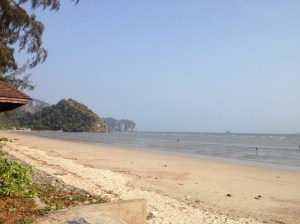
Ao Nang beach

Ao Nang beach

I had been told by a few travellers that he beaches down in this part of Thailand were some of the most beautiful in the world, with clear waters and pristine white sand. Yet as a made my trek through the waves breaking around my ankles and back go the shore to walk along the beach, I was quite shocked at what a found. All along the sand and in the wash along the shoreline, the beach was polluted with all kinds of litter. T-shirts wrapped in pieces of driftwood, lost shoes, beer bottles and other shards of broken glass, beer cans, plastic bags, water pistols and other toys – after closer inspection the sand along the beach resembled somewhat of a dumping ground. “Untouched” was a word I had heard used to describe these so-called pristine beaches. Maybe Ao Nag was an exception, or maybe that person hadn’t visited this area in a long time, but as the sun set on the otherwise beautiful seaside setting, I couldn’t help but feel slightly disappointed in what I’d found. I climbed aboard the local bus and headed back to the hostel, making a determined promise to myself to continue my search for the pristine beaches tomorrow.

***

My trip to Krabi also marked the first time that I would be staying in a hostel. I’d heard some horror stories about stolen possessions and other traveling nightmares, so I wasn’t sure what to expect. After showering and changing I ran into a couple of guys in my room and introduced myself. We sat around chatting for a while – Jens was a traveller from Sweden and Sam was from London – and we ended up going down to the local night markets for some cheap Thai food dinner. Back in hostel room, we got chatting to a Moroccan traveller, a girl named Sarah. The four of us, complete strangers until that evening, made an unlikely group of friends, yet we ended up chilling out on one of the hostels balconies, drinking and smoking and just talking about our lives. It was at that moment that I really felt like a traveller – just an individual in a collection of wanderers, making our way through the world, whose paths intertwined for that one night, for that brief moment in time.

The quiet streets of Krabi Town at night

The quiet streets of Krabi Town at night

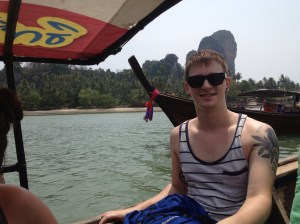
The next day, after trading tips among the hostel dorm room, Sarah, Sam and myself decided to catch a boat to a beach called Rai Leh. A pair of Norwegian girls had promised us beautiful beaches there, and I figured we could trust the word of someone who had visited the area just days before. And we were not disappointed – as the boat cruised in to anchor just off the beach, even the towering sheer limestone cliffs that filled the scenery around us were breathtaking. Sam said it looked like something out of Jurassic Park, and as a fan of the movie I most definitely agreed. This place was simultaneously beautiful, soothing, and awe-inspiring – this is what tropical paradise was supposed to look like. Rai Leh was a strip of land that had two beaches, with the eastern side acting as more of a port for the various boats bringing people in, so we made our way over to the western side which had been a little more developed for the tourist population. There were lots of bars and resorts just beyond the edge of the sand, so we had a few drinks before making our way into the water.

On the boat pulling into East Rai Leh.

On the boat pulling into East Rai Leh.

I soon discovered that the shallow beach at Ao Nang wasn’t a one-off thing. The water at West Rai Leh was a similar depth to begin with, and I had to walk out a long way before the water even came up to my chest. But when it did, the water became much cooler, and it was lovely swimming around, diving under the waves, and then kicking back and marvelling at the sweeping scenery that surrounded the beach. While the water wasn’t as deep as I would have preferred in a beach – or probably more accurately, what I was used to – it was definitely the visuals of the location that made it so appealing. The sand and water was also a lot clearer than Ao Nang, so I was satisfied to have finally founded these fabled, pristine beaches.

On the stunning shores of West Rai Leh.

On the stunning shores of West Rai Leh.

I also learnt a few travelling tips from Sarah that day. As we boarded the boat to take us to Rai Leh, she had brought along her large rucksack, while Sam and I only had our smaller backpacks. “You must never book more than one night in a hostel,” she said to us in a thick French accent, when we asked her why she had checked out and brought all her gear with her. “You never know where you might end up, or where you might want to stay. Krabi Town has no beaches! I do not want to spend another night there.” She had been travelling around the Thai islands for months now, and she had definitely mastered the tricks of the trade. And she was right, of course. When we got to Rai Leh, she sniffed out some budget accommodation – a mattress on the floor of a bamboo hut on the east side – and checked in straight away. “The beaches… This is where I want to be.” Sam and I still had our beds booked back at the hostel, so when it came time to get the last boat back to Krabi, as the sun set behind the clouds and turned the sky a glowing pink, we bid Sarah goodbye and good luck in her new home for the night.

The sun turning the sky a beautiful shade of pink on the boat ride home.

The sun turning the sky a beautiful shade of pink on the boat ride home.

***

My original plan had been to leave the next day, but I felt like my time in the beaches had come to a premature end. So after sniffing around some of the tourist information centres in the street, I booked a full day SCUBA diving tour for the following day, and secured my room at the hostel for one more night. I hit the hay early that night, to rise for an 8am pick up, in a car that took me back Ao Nang beach. From there, a boat took the group – the dive instructor and a pair of stern looking European men who spoke very little, and when they did, it was rarely in English – about 40 minutes out into the sea. We geared up, and soon we were descending into the deep blue.

I had completed my Open Water SCUBA Diving course when I was only 12 years old, on a family holiday in the Maldives. I had been diving periodically since then, but it had been about 4 or 5 years since my last dive. So I was a little nervous, but as I flipped over the edge of the bloat and plunged below the surface, it all came flooding back to me – unfortunately, like the sea water into my mask. But other than that, it was like riding a bike – some things you just never forget.

The first dive reached a depth of about sixteen metres. The visibility wasn’t the greatest, which meant the distance you could see through the water was limited, but it wasn’t awful, and we were still able to see all the marine life that was just teeming in the water around us. Schools of fish that looked like walls in front of us parted as we swam in their direction, and our guide pointed out some other less obvious creatures, such as sea horses clinging to the coral, or small stingrays that would gently hover above the surface, and then take off once we got too close. It really was like another world down there on the ocean floor, and I realised just how much I loved and missed SCUBA diving, as I marvelled at the marine alien world. I made a promise to myself at that very moment that I would make more time for diving in my life, and later went on to scope potential diving destinations on the rest of my year long world tour.

After the first dive, we had a break in which I was able to do some snorkelling. This far out to sea, the water was clear and cool, and an absolute dream to swim through. The boat was anchored to a small limestone island jutting out from the sea, and as I swam around the perimeter I discovered a cuttlefish nestling in the safety of the rocks. The second dive was going to be in a cave – something I was a little nervous about, knowing some of the potential dangers. Armed with flashlights, we descending a second time, not just into the deep blue sea, but through the mouth of a cave below the limestone island, and into a black abyss. I experienced a strange sense of vertigo in the darkness of the cave. The ground can be rushing up to meet you one moment, and the next you’re bumping your head on the roof. It found it difficult to maintain a stable neutral buoyancy at the best of times, so trying to do so with no real idea of where I was proved a little stressful. I made a point of not losing sight of our guide though, not only because I knew he wouldn’t be lost, but also because he was pointing out some of the marine life with his torch. We saw a couple of nurse sharks, a few more stingrays and seahorses, plenty more fish, and a strange creature that looked like an octopus but had far too many legs, so I can only assume it was either a type of cave dwelling squid or jellyfish.

The island above the cave, and the surrounding blue water.

The island above the cave, and the surrounding blue water.

As I followed our guide in what appeared to be in upward direction, we moved through a small grotto before coming to a halt. When he shone his light at the walls around us, I saw about 5 or 6 lobsters at several points, all curiously climbing out of their hiding holes to get a better look at us. It was odd to see a lobster in the wild – the closest I’d ever really come was seeing them was in tanks at Chinese restaurants. We continued up through the grotto when, to my surprise, I broke the surface of the water. I pulled off my mask to look around to discover we’d found ourselves in a little pocket of air inside the cave, completely closed off from the outside world – the only way in was the way we’d come, through the sea. Sunlight was coming through from somewhere below, so the caves entrance wasn’t too far off, and the water lapped the edges of the rocks so that the cavern echoed around us. The light and the sounds and the serenity of the whole place made it strangely beautiful, despite being quite visually uninteresting. I’d been unable to bring my camera and so couldn’t photograph the cavern, but similar to the temple of the Emerald Buddha in Bangkok, being unable to take a photo made the experience feel that much more special – a little personal memory that was mine to keep and treasure.

(NB: I did take a few photos with my underwater camera while I was snorkelling, but until I have access to a computer with an SD card reader I’ll be unable to upload them.)

After we made our way back to the boat and then back to the shore, clouds began rolling in over the ocean and eventually a downpour of rain was released upon Krabi Town. The driver who took me back to my hostel said it was a good thing, and that it hadn’t rained there in about a month. I spent the rest of the evening with Jens, Sam, and a couple of other British guys, who introduced me to some of the local beers, the most notable being Chang. I’m not usually a big beer drinker. Maybe it’s because it was just cheaper and easier, or maybe it was the peer pressure of hanging out with four straight guys – I guess we’ll never know – but the local beer was much easier for me to stomach than any of the brews I’d tried back home in Sydney. Chang was supposed to be particularly potent though – and the next morning, after about 5 or 6 drinks and a round of beer pong, I can vouch for that supposition.

Changover.

Changover.

Getting out of bed with one of my highest ranking hangovers ever – dubbed a “Changover” by the boys – and getting out of the hostel by 11am check out time was not an easy task. The rest of my day was spent navigating various modes of transport in an attempt to get back to Bangkok. It took just as long as it did to get there, although since the overnight trains were all booked out due to the upcoming Songkran holiday, I had to catch a bus for the 12 hour stint of the journey. Overland travel can be long and tedious like that, but I eventually made it home to Bangkok in one very tired and worn out piece.

***

My trip to Krabi marked an important step for me on my gap year world tour. It was the first time I’d really gone out on my own for more than just a day. Finding a place to stay that wasn’t a friends house, organising and booking transport merely hours before it actually leaves for the destination, and making friends with the fellow travellers around me were all things that I’d been very keen to do since I’d set out on my journey. I was only heading back to Bangkok to celebrate Songkran and gather my things before heading off to Vietnam, an entire country where I truly don’t know anyone. I’d had a blast in my short time at Krabi, so now I was more excited than ever to travel to more new places and really live the life of a world wanderer.