Unknown's avatar

About Tiny Tino

Writer, musician, traveller, drunk.

Down the Danube

Thankfully, unlike my trek from Ancona to Zürich, I only had to catch one train to get me to Austria. I did have to travel from the western tip to the eastern tip of the country though, but travelling through the mountainous terrain did provide some pretty spectacular, picture perfect views. After the long day of travel I finally arrived in the beautiful city of Vienna and was greeted by my next Couchsurfing host. Kathi was the first female that I was staying with whom I had connected with through Couchsurfing – Susanna in Finland had been a family friend – but I had still found her within my search for hosts in the Queer Couchsurfing group. Robin had showed me how Couchsurfing can be used not just to find places to stay, but also to connect with people who had common interests. I decided that I would probably feel more comfortable staying with gay people while I was travelling, since most of my friends back home are gay, and they would be able to show me some of the queer hotspots – but up until now I had only stayed with other guys. It wasn’t a conscious choice – I think there were just more male hosts available, in general – but when I’d stumbled across Kathi’s profile I’d gotten a really good feeling from it, and she had happily accepted my request to stay with her. I had been tossing up between trying to visit Vienna, or travelling slightly more north to visit Holger – who I met in Barcelona – in Munich, but I had had trouble getting in touch with him, so once again my potential Couchsurfing host had been a real game changer in the direction of my travels.
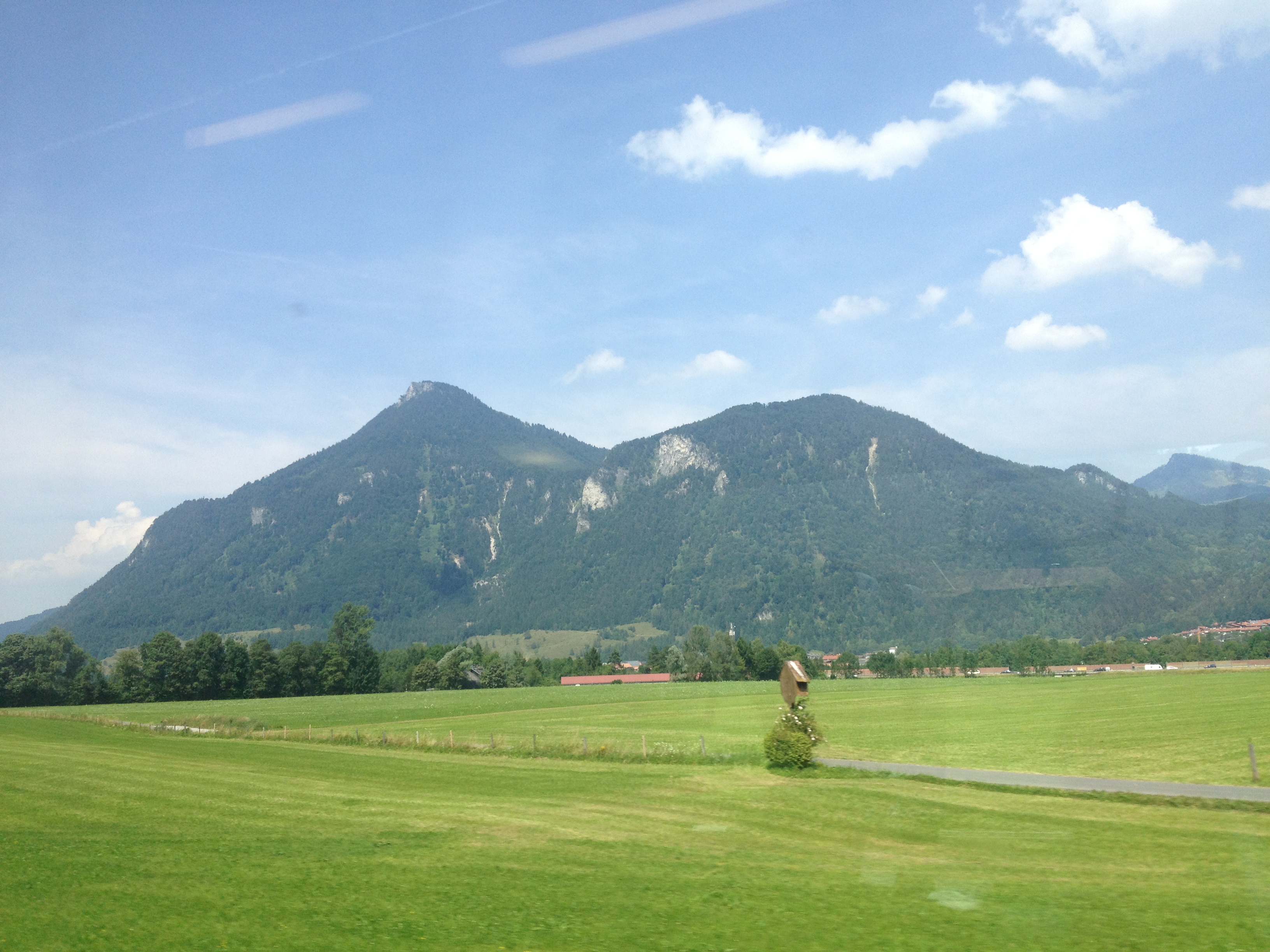
View of the Austrian countryside as I sped towards Vienna in a train.

View of the Austrian countryside as I sped towards Vienna in a train.

There was a kind and carefree air about Kathi from the moment I met her at the train station. She was also relatively new to Couchsurfing, so she was pretty excited about having me stay with her. I think the fact that I was Australian helped win over a lot of my hosts – to all of them I must have seemed exceptionally foreign and exotic, all the way from that mysterious land down under. She explained some of the culture of Vienna and the basics of the city to me – such as the ringed town layout and the different zones – while we got caught the metro to her apartment, which she shared with two roommates. “The coffeehouse culture is a really big thing in Vienna”, she advised me. “That’s something most people want to check out. The centre Vienna is divided up into rings, in particularly the main ring that encloses the city centre. Most of the things you’ll want to see or do will be there.” I wondered how I would have coped on this trip I hadn’t had hosts like Kathi, Umer, Ike and Valerio to help know these things about their various cities. I imagine I would have done a lot of unintentional aimless wandering around – as opposed to a lot of the intentional aimless wandering around that I still did.

It was a Friday afternoon the day that I arrived in Vienna, and both of of Kathi’s housemates were away for the weekend. One of them wouldn’t bet returning until after I left, so rather than sleep on the couch in her bedroom, Kathi told me that she would sleep in her housemates room, so and that I could sleep in her bed and have the room to myself. It was more than I had been expecting when I had sent the request to Kathi, and it was probably one of the best set ups I’d had through Couchsurfing so far. As soon as we got to Kathi’s, I had a well needed shower – the countryside views through the Austrian mountains had been postcard-worthy beautiful, but the 7 hour trip had left me feeling less than fresh. “Be careful with the water temperature”, Kathi had said as I entered the bathroom. “It tends to just alternate between… Antarctica and Mordor.” I laughed, appreciating the reference. After the shower I joined my new host in the kitchen. “Are you hungry? I was thinking I could show you how to cook some traditional Austrian food, maybe.” I assured her that her national cuisine of schnitzel had made it down to Australia, but all the same it was fun to help out in the kitchen and do some cooking. We cooked the schnitzel and vegetables, and she introduced me to an Austrian drink called Radler. “It’s basically beer mixed with lemonade,” she said, placing a bottle in front of me. “You can mix yourself or buy it like this.” It was a little fizzy from the added soft drink, but the taste was extremely refreshing, the sweetness balancing our the flavour of the beer perfectly, and I enjoyed it much more than the Rivella I had tried in Switzerland. We sat and ate and chatting, getting to know each other as we downed a few bottles of Radler.

Kathi was particularly interested in picking my brains about the gay culture down in Australia. “What’s it like for gay girls in Sydney? Here, it can be really difficult for…” She was choosing her words carefully. “For more… feminine, girls. Like… sometimes I’m never really sure… You know, of where – and who – they are?” I realised she was talking about her gaydar – her ability to identify other queer people on sight alone. I must admit, the more feminine lesbians have always been the least obvious blips on my gaydar, but luckily stopping them had never been quite such a pertinent issue for myself. Kathi went on to tell me that queer girls also had less places to meet people, citing the recent pride festivities in Vienna, where there had been multiple parties aimed at all the gay men, and only one event that specifically targeted same-sex attracted females. I had to regretfully tell her that gender ratio of gay bars and parties in Sydney was of a similar level, though I won’t pretend I know much about the lesbian scene – not for the first time I pondered on the curious fact that the party scenes for gay guys and gay girls were so divided in the first place.

We continued to talk for hours about gay life, travelling and Couchsurfing, and even music. Kathi was learning how to play the ukulele, so as part of the condition of me staying with her I had promised her that I would show her a few tips I had picked up along the way. I was only teaching myself, but as an acoustic guitar player of nearly 10 years I didn’t have too much difficultly figuring it out. But before it we knew it, it had gotten quite late, so I said goodnight to Kathi and hit the hay after the exhausting day of travelling.

***

The next day, at Kathi’s suggestion, we caught the train north of her rather centrally located apartment to the banks of the Danube River. It was a gorgeous sunny day, and we had lunch at a little restaurant next to the river that served some excellent Austrian dishes, and of course, more Radler. That wasn’t the most exciting part about this restaurant though – after we had finished eating, I followed Kathi down to the small jetty that was actually a part of the restaurant. There, we hired a small electric motorboat and went for a cruise down the river. “There’s some nice views of the city from the water. Perhaps we could bring our ukulele’s and have a sing-a-long, or something?” Kathi had suggested the previous evening before we had gone to bed. I had told her that that sounded absolutely marvellous, so once we got out on the river I pulled out my ukulele and started strumming away.
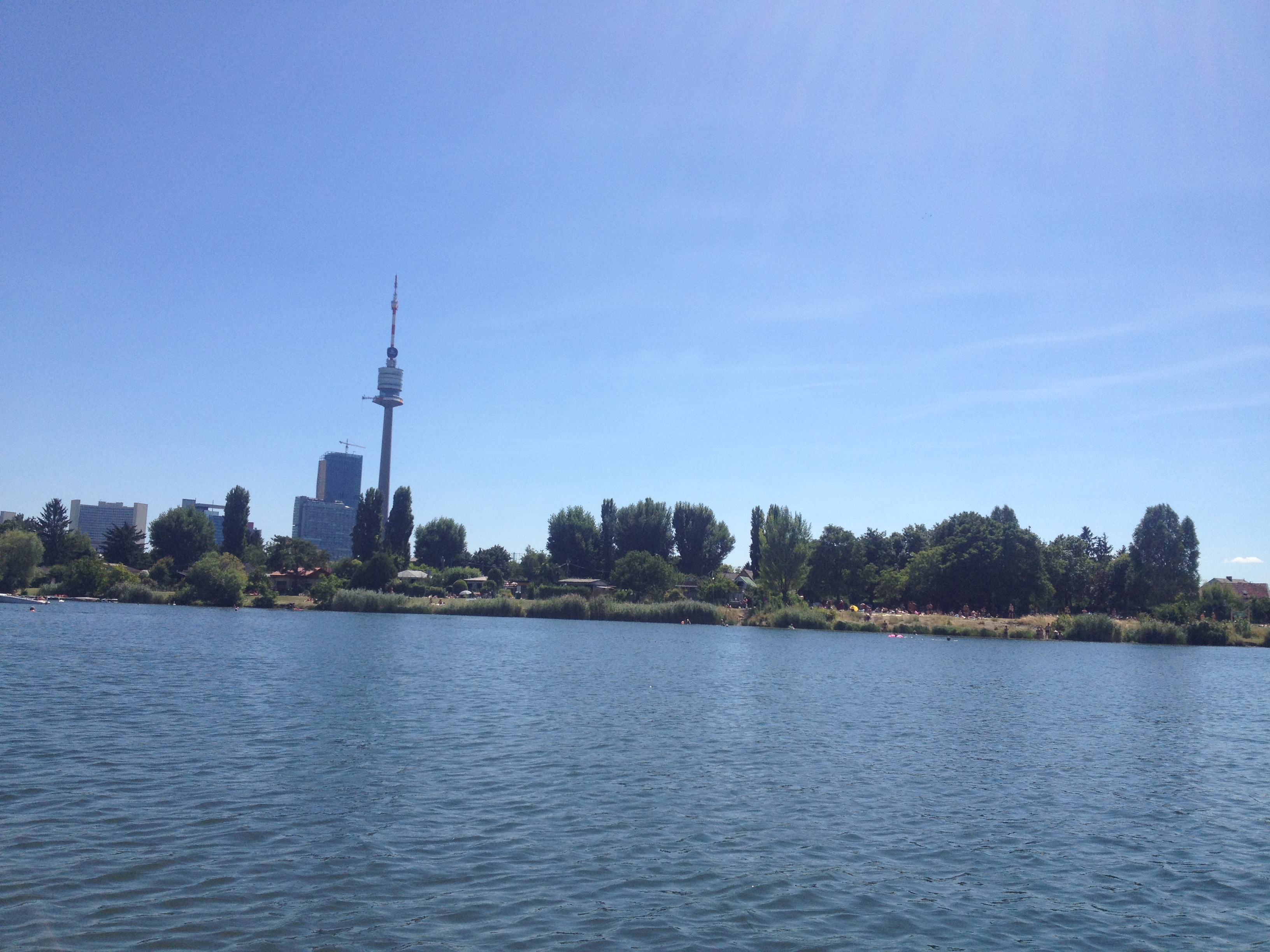
The view of the city from out on the Danube.

The view of the city from out on the Danube.

The sunshine was streaming down on us as I worked my way through the small repertoire of songs that I had managed to teach myself over the last few months, and Kathi steered the boat up the river. We passed a couple areas that were substitute beaches for the Austrians – the idea of living in a landlocked country with no nearby coastal area still seemed so odd to me – but I have to say, they weren’t as nice as the riverside swimming areas in Zürich, probably because the water in the Danube wasn’t quite clean enough to be drinking quality. But it was still beautiful, and Kathi told me how she often comes down here to bathe in the sun and go for a swim. When we reached a wider part of the river, Kathi killed the engine and we just floated for a little while, watching others glide by us on their paddle boats, and soaking it all in while I strummed away on the ukulele. “It’s so nice,” Kathi said between songs, with a huge smile plastered across her face. “It’s just a nice, holiday feeling, to have the ukulele going in the background while we’re out on the water in the sun.” It was no tropical island getaway, she but was right. Kathi didn’t even end up playing her ukulele, and in the end I was just playing random chords to give the scene a nice and cheerful soundtrack. On our way back to the jetty we passed many boats full of other people, both locals and tourists, and they all smiled at us or exclaimed with delight when they saw or heard the ukulele. It really did feel like a scene from a movie, or even a travel brochure, but it was so much fun, and I couldn’t have thought of a better way to spend the afternoon.

Kathi took a sneaky photograph of me while I was playing the ukulele.

Kathi took a sneaky photograph of me while I was playing the ukulele.

The Churches of Old Town Zürich

When I wasn’t exploring the great outdoors with Robin in Zürich, I took time out of the busy, active lifestyle to do a little bit of sightseeing. The city centre of Zürich itself wasn’t exactly huge, or full of iconic landmarks, but simply wandering around the charming little streets and up the cobblestone footpaths was a pleasure in itself, appreciating the quaint and classical beauty that the city maintained.

A cute little Swiss street that is obviously very proud to be a Swiss street.

A cute little Swiss street that is obviously very proud to be a Swiss street.

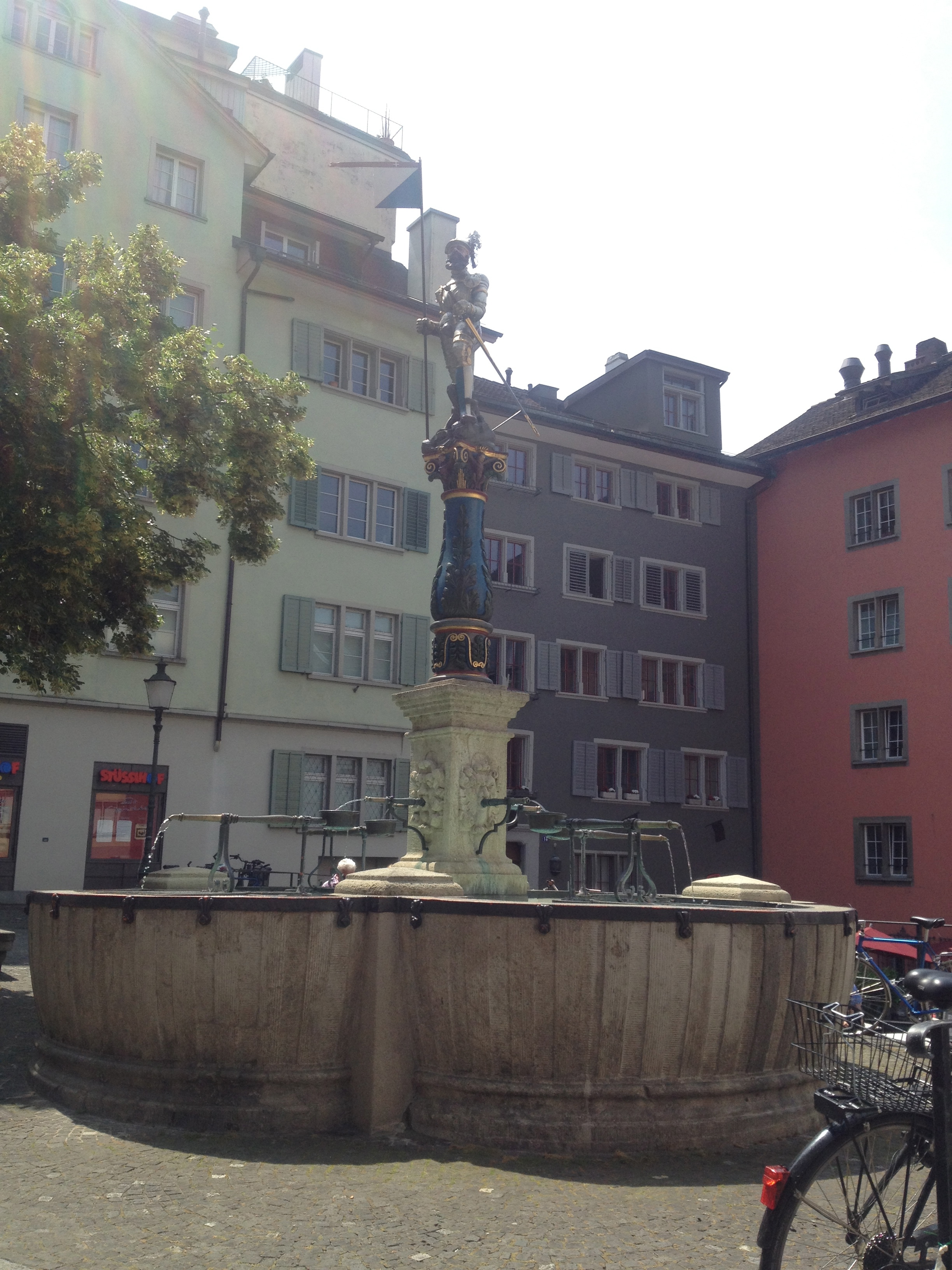
Gedenkbrunnen für Bürgermeister Stüssi, or Stüssi's Fountain, which I accidentally stumbled across in my roaming.

Gedenkbrunnen für Bürgermeister Stüssi, or Stüssi’s Fountain, which I accidentally stumbled across in my roaming.

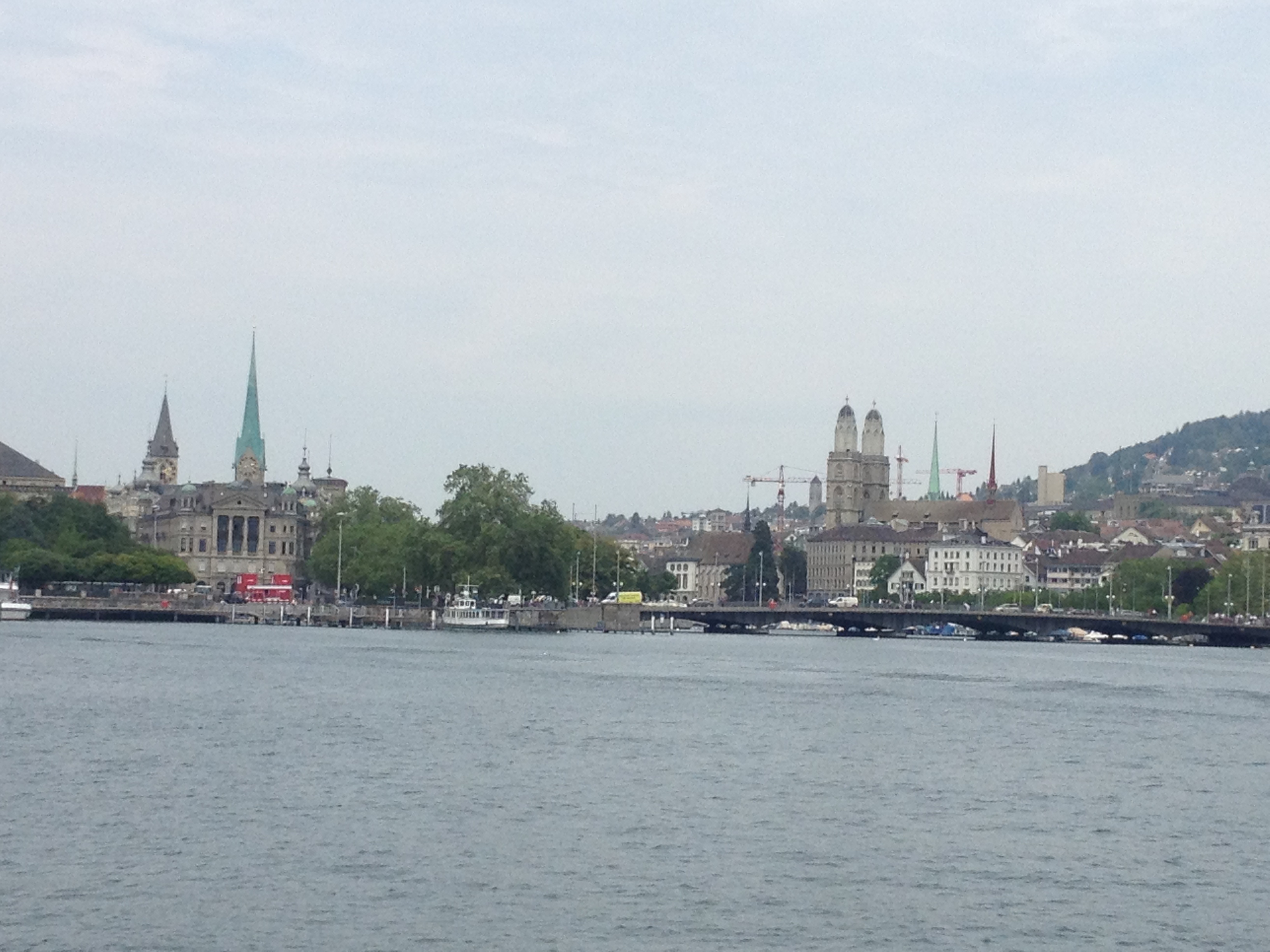
The most notable sights worth seeing in Zürich were probably the small handful of churches located in the city centre. While I had sworn I was done with churches after my trek through the Vatican City in Rome, these Swiss churches couldn’t be more different from the St Peters Basilica in Italy. They were a fraction of the size, modestly squeezed in between all the surrounding buildings, though the classical design suggested that the holy buildings had been there much longer than their neighbouring structures. The first of the three main churches in Zürich that I passed is called Grossmünster, which translates into “great minister”. It is located along the banks of the River Limmat and served as a monastery church when it was first inaugurated some 800 years ago. The Romanesque architecture was impressive from the outside from where I admired it, but it was a beautiful day outside, and I just wasn’t in the mood for trailing through another church museum.

The grand Grossmünster.

The grand Grossmünster.

So on I moved across the Limmat, where the other two main churches were situated – next was St Peterskirche, or St Peters church. The structure itself was significantly smaller than Grossmünster, and it was in the midst of a sea of buildings to the point where I couldn’t actually find the building itself. However, the main feature of St Peterskirche rose above the sea of buildings so that it could be seen from a great distance – the clock tower. Again, I wasn’t particularly interesting in seeing the inside of yet another church, and the main feature was best viewed from a distance anyway. “The clock on that steeple is the largest clock face in Europe,” Umer had said to to me as we’d breezed through the city on my first afternoon in Zürich. It has a diameter of 8.7 metres, but I hadn’t previously managed to capture any photographs of the impressive clock, so I took a few snapshots before moving on to the third and final church.

The clock tower of St Peters church.

The clock tower of St Peters church.

Fraumünster was the only church in Zürich that I actually went inside, but in retrospect I’m glad that I had made the time to take a quick peek. The English translation is “women’s minister” and the church, which is built directly across the Limmat from Grossmünster, was built on the remains of a former abbey. From the outside, Fraumünster doesn’t seem particularly impressive. However, once you set foot inside the cool and quiet halls, you quickly realise that it’s the inside perspective and the view from within that truly matters in these sacred rooms. I’m talking, of course, about the stained glass windows. From the outside on a bright sunny day they look incredibly unremarkable: black holes leading into the depths of the church. But from the inside, that sun streaming in lights up the coloured panes of glass to produce something beautiful, mystical, and even a little breathtaking. I reiterate that I’m not exactly religious and have no affinity with the Christian faith, especially after the disillusionment that came with my visit to the Vatican, but something about being in Fraumünster recaptured my sense of mysticism.

Fraumünster, looking deceptively plain from the outside.

Fraumünster, looking deceptively plain from the outside.

Back in my days at university I took quite a variety of sociology courses, one of them being a class titled the Sociology of Religion. In the first lecture, our teacher read us a metaphor about religion being like a stained glass window. You can study a religion from the outside – the rituals, the doctrine, the history, the beliefs – but the real meaning of a religion requires an understanding that one can only get from being inside of the fold, and being a part of that religion. Perhaps thats why, whenever I step into any of these beautiful churches far and wide across this continent, I get that superstitious sense that I just can’t quite put my finger on. Until you’re ready to fully accept it and be a part of it, maybe you’ll never be able to truly understand what it means to be part of a religion. I doubt that I ever will fully know what that is like, but for the meantime I was definitely understanding the stained glass window metaphor first hand. I tried to take a couple of photos, but the quality of my camera did absolutely no justice to the images I was seeing in front of me. Not for the first time, I took it as a sign that some things we experience in this world as just so significant to ourselves as individuals, that attempting to share them with others would simply fail to have the same effect on them as it did on us. So I momentarily lost myself there, in the cold stone chambers of Fraumünster, before saying a silent prayer – to who, I’m still not sure – and exited back out into the sunshine.

***

After my church sightseeing and soulful contemplation, I lightened the mood of my day with a stroll through the sunshine by the lake. This was before the afternoon of slacklining with Robin, so I hadn’t been swimming in the lake or river at that point. I found a seat on a bench and read my book for most of the afternoon, but I did come across a huge diving platform from which people were jumping off, and plunging into the depths of the crystal clear water. I considered doing it myself, but at that stage I wasn’t exactly feeling 100% healthy – I was still feeling a little under the weather, and recovering from the effects of prolonged partying in Madrid during Pride. I knew I would  inevitably be getting wet when I went slacklining over the river, but I didn’t want to wait around in wet clothes for the rest of the afternoon, so instead I contented myself with watching others jump off the huge platform and into the water.

The huge structure that had been set up in the lake, from which people were jumping off into the water.

The huge structure that had been set up in the lake, from which people were jumping off into the water.

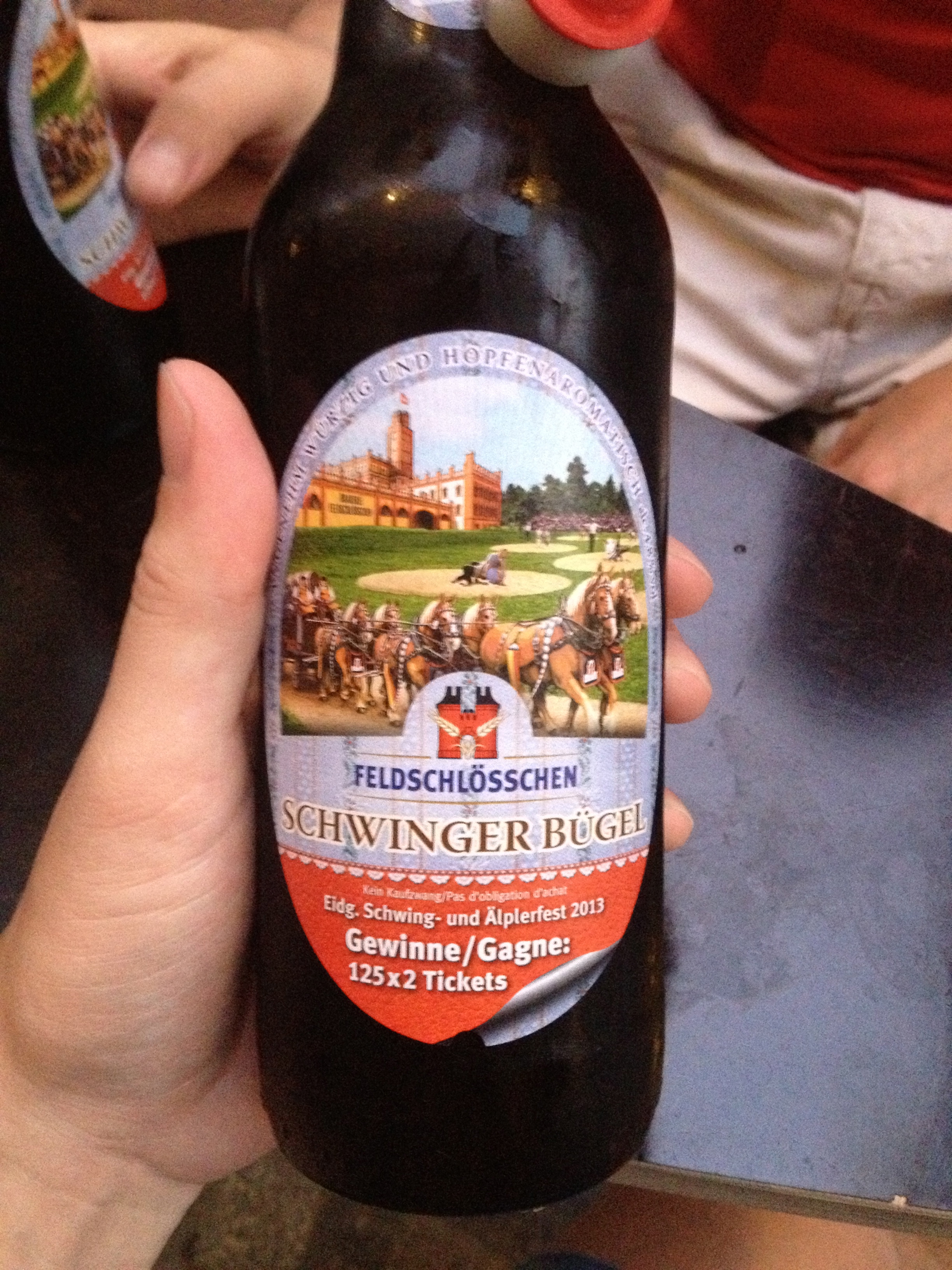
There is one thing that I found shocking about Switzerland, even though it wasn’t exactly unexpected, and that was the cost of living. I had been warned about it, but it still hit me like a slap in the face. I wasn’t even paying for my accommodation, but my time spent in Zürich was fairly limited simply due to the fact that I didn’t have the budget to do very much. Even eating was a ridiculously pricey affair. I went to get lunch from what seemed to be a relatively cheap sausage stand – they love their wurst in Switzerland – and ended up paying around 6 francs for a simple sausage and a small piece of bread. I felt like that would have almost bought me a meal in any other country, but from what I had seen of the rest of Zürich, I had basically stumbled across a bargain. I considered it a blessing in disguise that I wasn’t feeling too well during my time in Zürich, because it meant that I didn’t have the desire to go out and investigate many of the bars or nightclubs – something that I just didn’t have the funding to do there. Robin and I visited a bar or two and sampled some delicious Swiss beer, made in various microbreweries around the country, but for the most part Switzerland was a continuation of my much needed down time. My pride tour down western Europe had really gotten the better of me.

One of the Swiss beers I shared with Robin.

One of the Swiss beers I shared with Robin.

***

Eventually necessity required me to move on from Zürich – there were a handful of other destinations I still had to hit before my Eurail pass expired, and I just couldn’t afford to stay in Switzerland any longer. So on my final morning I packed up my bags, thanked Robin for his hospitality, for introducing me to the world of slacklining, and inspiring me to be that little bit more physically active in my life. Then it was onto the station for another train, another country, and another city on on my ‘greatest hits’ tour of Europe.

River Deep, Mountain High: The Great Outdoors in Zürich

The following morning, I bid farewell to Umer as he set off on his own trip. Before he left, he gave me his dads monthly travel pass again. “My father said he won’t need this today, so you can borrow it for one more day while you’re staying here. It let’s you go a lot further around the city than one of the standard daily tickets, so perhaps you’d like to make use of that while you can.” It was the last of the numerous suggestions and tips that Umer had offered me, and I thanked him for his stellar advice as he headed off to the airport.

***

The first thing I did that morning was head back to the centre of town to the dock at Lake Zürich. The monthly pass that I was using today also covered use of the ferry, which made round trips around the lake to certain points much further down the shore. There were long trips that went to the other end, as well as shorter ones that did rotations to closer docks. Umer had said it was a nice relaxing way to spend the morning, and it was a beautiful day to be out on the water. I took one of the shorter trips, which still took the better part of an hour, and watched the shoreline glide past, admiring all the adorable traditional houses that were situated right by the water. One thing that I would continue to notice during my time in Zürich is that the Swiss love their outdoor activities. It has something to do with the seasons – during the winter there is very little daylight, and the cold doesn’t permit people to be outside for too long, so when summer rolls around and the sun doesn’t set until after 10pm, people seem to take full opportunity of as many daylight hours as possible.

Statue of Ganymed and Zues, represented as an eagle, beside the lake.

Statue of Ganymed and Zues, represented as an eagle, beside the lake.

One of the smaller docks on the edge of Lake Zürich.

One of the smaller docks on the edge of Lake Zürich.

Cute little houses beside the lake.

Cute little houses beside the lake.

There were lots of pools and parks along the edge of the lake, and plenty of people were out sunbathing and swimming and kicking balls and all sorts of recreational activities. I sat in the sheltered shade of my seat in the ferry and just took it all in. I had just come from the small coastal town of Ancona, and I had been expecting to be returning to my tour of major cities when I arrived in Zürich, but I was pleasantly surprised to find that there was a small village feeling very much entrenched into the essence of this place. Even in the major intersections where trams tracks overlapped and cars seemed to be turning in all sorts of random directions, there were no skyscrapers, no obvious central business district, and no particularly large or overwhelming buildings. The feeling was cute and quaint, and it suited the city perfectly.

The main centre of Zürich as seen from the ferry on the lake.

The main centre of Zürich as seen from the ferry on the lake.

***

After my tour across the lake, I returned to the shore where I had plans to meeting some. Robin was to be my second Couchsurfing host in Zürich. Originally I had had three lined up: Umer had been the first and Robin the third, but my second host had to cancel at the last minute, which was why I was staying an extra night with Umer’s parents. Robin currently had a friend staying with him, which is why I could not come to stay with him any earlier, but when I told him Umer was going away he said he would be more than happy to meet up to see some more of Zürich with me. When I told him about the pass I was using for the day, he suggested we catch the train south west, just outside of Zürich to the mountain Uetliberg, which was another popular site for recreational activities in the city. Robin’s friend Tammy was busy filling out an application – the two of them were Chilean, with Robin living and studying here and Tammy visiting him, but also applying for courses so that she might be able to come back and live here too – so it was just the two of us as we hopped on the train and set off up the mountain.

As I chatted with Robin, he confirmed what I had observed from the boat – that everyone in Zürich was slightly obsessed with physical activities and outdoor recreation. The bike on the train up the mountain had quite a few people with mountain bikes, which they would ride down steepest parts of the mountain, following the popular trails before turning around and riding back up again. The public transport passes in Zürich ran on 24 hour period, so you could ride as many times as you liked as long as you were in a zone that was covered by your ticket. Robin had to buy an extension on his regular ticket, and off we went along the train towards the mountain. We got chatting along the way up – Robin was a sweet, short and soft-spoken guy who spoke with a pretty heavy accent. He was currently living in Zürich doing research and writing a Masters thesis, about a particular niche in microbiology that I would struggle to reiterate in any further detail, but it was definitely quite interesting.

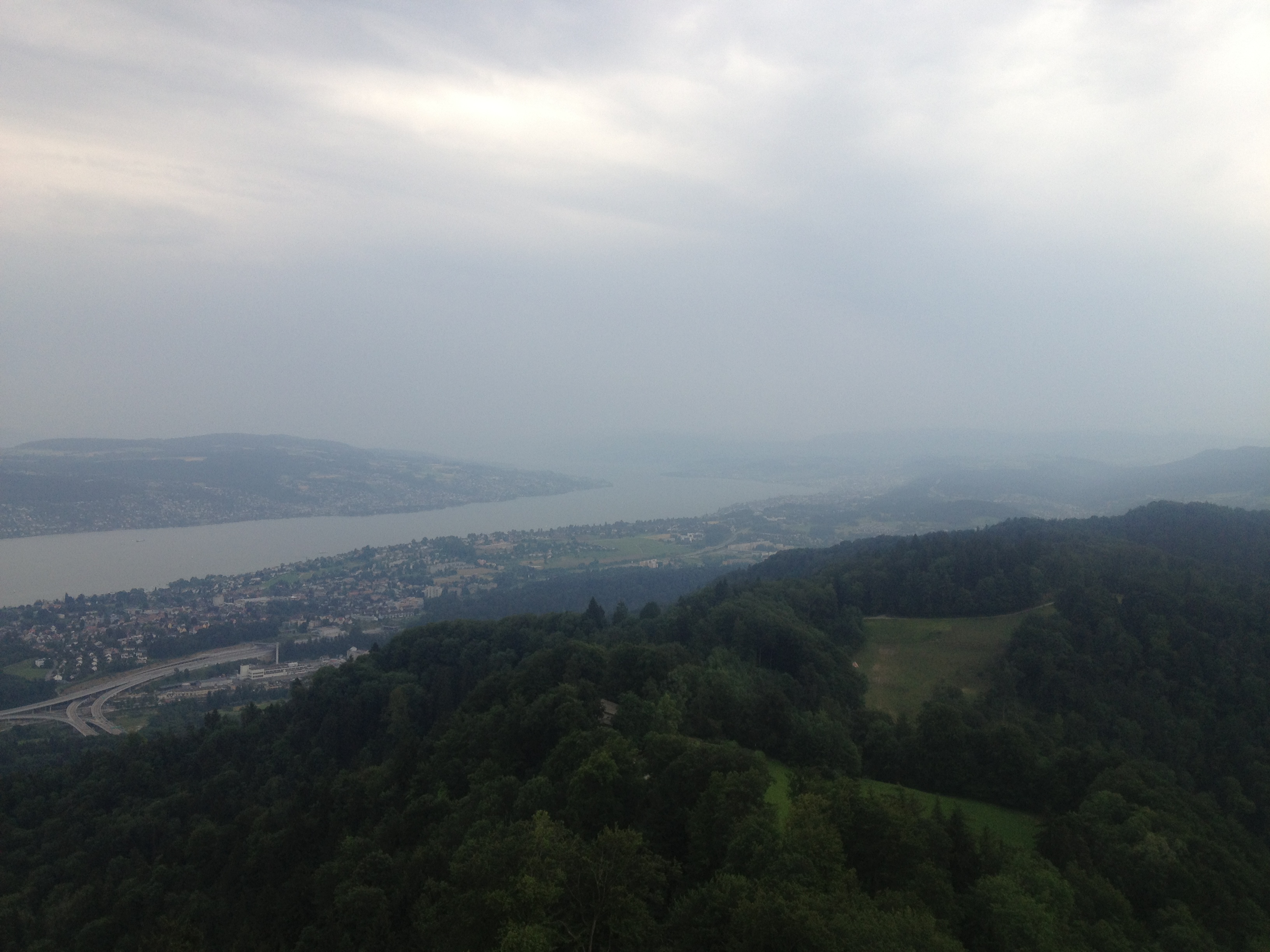
When we reached the Uetliberg station – it was only about a 20 minute trip – we headed along the short hiking trail that led to a lookout. On the way we saw dozens more people out and about, who were doing a whole manner of exercising such as running, jogging, riding bicycles, and even taking part in what seemed to be some kind of boot camp drill work out. Robin and I casually trekked our way up the hill and dozens of people passed us by – we had all afternoon while Tammy filled in her application, so there was no rush. We eventually reached the lookout at the top peak of Uetliberg and gazed out over the impressive view. There was a metal tower that looked something like a huge lightning rod that we were able to climb, so Robin and I marched up the stairs to the viewing platform at the top. From there you could see the around the whole mountain, the horizons lined with even higher mountains that were cloaked in clouds and a pale pink afternoon sunlight. Up there the air was so fresh, and I breathed in a lungful as I soaked in all my surroundings. Robin pointed out a few of the natural features of the area, and we chatted about each of our home countries, our travelling experiences, and our impressions of Zürich. The nice thing about Couchsurfing is that no matter who you end up meeting or staying with, there’s always at least one thing you usually have in common – a passion for travelling. It’s the reason most people get involved – to be able to go travelling themselves – and in turn allows other people to go travelling and see the world. The more experience I had with the website and organisation, the more amazed and impressed I was at such a simple idea that very could very literally change lives.

The sun setting behind the clouds, as seen from Uetliberg.

The sun setting behind the clouds, as seen from Uetliberg.

The view from the tower at the top of Uetliberg.

The view from the tower at the top of Uetliberg.

After soaking in the sights from the top of Uetliberg, Robin and I headed back to Zürich to meet up with Tammy, and once we did we headed to the west of the city, where Robin told us there was an outdoor concert happening. He didn’t have too many details, but he thought it might be something cool to check out, so we jumped on a bus across the city. When we arrived, we found what seemed like a huge picnic in a park, with people spread out across the relatively small stretch of grass. In the corner, a large folk band was playing all kinds of music, and there was a crowd who had gathered around them to watch. We bought some snacks from a nearby store and laid out on the grass, listening to the music from across the park and just hanging out, enjoying the cool, pleasant evening air. It was actually getting quite late, but twilight was still lingering over the city, and there didn’t appear to be any signs that the party would be dissipating any time soon. I had to get home though – I hadn’t told Umer’s parents what time I was expecting to be home, so I didn’t want to keep them waiting too late into the evening. I bid farewell to Robin and Tammy for the evening, making plans to see them again when I arrived at Robin’s place the next morning to stay with him for my last two nights in Zürich.

***

The following morning I left Umer’s parents place and made my way to Robin’s. He would be working during most of the day, so that’s when I would do my typical and touristic sightseeing, but in the afternoons when he was free Robin introduced me to some of the activities he did during his spare time and, like any typical resident of Zürich, those were outdoor activities. Enter slacklining: a sport that holds a lot of similarities to tightrope walking – you are required to balance on, and walk across, a piece of nylon or polyester webbing that is tensioned between two anchor points. However, the main difference is that while a tightrope is rigid and taut, a slackline gets its name in having a considerable amount of slack – it is stretchy and bouncy, almost like a long and narrow trampoline. The more extreme variations of slacklining involve doing it unsupported in crazy places such as between skyscrapers or mountain peaks, but Robin was taking me to learn in a much safer but still rather exciting place: over the River Limmat.

We got to one of the bridges that crossed the river, down near the riverside bars where everyone had congregated on the warm, sunny afternoon. We weren’t the only ones setting up a slackline over the river – there were two other guys setting up a much longer one than Robin’s, from the bridge to the rivers edge. “That guy is very, very good. He does it professionally,” Robin said as we set up our slackline. There were a couple of guys walking along the other slackline, but one of them was obviously extremely experienced. He would stop in the middle of the line and do all sorts of acrobatic tricks, bouncing on the line and landing on one foot, or even on his hands, pushing himself back up to keep bouncing and even walking across the line. It was seriously impressive. Robin had only been getting into slacklining recently, he assured me, so he wasn’t that good. I assured him he would be better than me, but nevertheless I was still keen to give it a go.

Once I first stepped onto the line, I realised how sensitive and reactive the slackline was to my body. It wasn’t too windy that afternoon, but as soon as I stepped out onto the line it violently shook from side to side, like a leaf in a hurricane. Robin held my hand to steady me as I took my first step, but he couldn’t take me the whole way. I tried my best to stay balanced, but as soon as I took my first step on my own, I came tumbling down to land in the river. I plunged into the cool and deep blue water, and when I finally resurfaced I realised that I had already floated a couple of metres downstream. The river was flowing exceptionally fast, to the point where if I tried to swim upstream, it was the equivalent to running on a treadmill – going nowhere fast. I quickly swam back to the edge of the river to rejoin the others on the bridge. Robin was definitely a lot better than myself at the slackline – for the first time ever he managed to cross the whole way across the slackline without falling off. That only happened once though – most of the times we both always ended up plunging into the river. I quickly learnt that you can’t be afraid of falling, and when you do fall you have to let it happen and not fight it. The one time I panicked and tried to stay on the line, I fell so awkwardly that I landed on my back in the water, and the impact left a huge red mark on my back that attracted quite a lot of comments from passers by.

Slow and steady across the slackline...

Slow and steady across the slackline…

... keeping his balance...

… keeping his balance…

... and he made it!

… and he made it!

Getting ready for my first attempt on the slackline.

Getting ready for my first attempt on the slackline.

The first, and only, step...

The first, and only, step…

... and down I go.

… and down I go.

Splash!

Splash!

That wasn’t the only reason strangers talked to us, though. The shared love of outdoor activities seems to seamlessly bring all surrounding people from all walks of life together, and make new friends out of complete strangers. Robin and I had plenty of people come up to us and ask us questions about slacklining – most of which I couldn’t answer, though – and asking if they could have a turn. The area was already pretty social with the bars lining the river, as well as a bunch of other cool things – there was a restaurant that also doubled as a DIY garage where people could come and use tools to fix and customise their bikes – so the slacklines on the bridge were just another added element to that friendly social vibe that seemed to be almost everywhere in Zürich. It made for a fun and interesting social experience – all the activities that were happening around the city made me realise something about my life back home: I didn’t have very many hobbies. The closest thing I had to a hobby was playing guitar and writing music – other than that, I just spent a lot of time drinking with my friends and going clubbing. It was a refreshing change, and I think that afternoon was when I made a pledge to myself that when I got home, I was going to find fun new things to do with my time other than drink myself stupid.

It was also an exhausting afternoon though, so afterwards Robin and I headed home for a relatively early night. We sat up for a while just chatting in his room though – there’s just something unnatural about going to bed before the sun does.

***

The following evening we set out after Robin finished work to meet some people in a nearby park. “I haven’t met these people, but there’s a group on Couchsurfing that organises hikes and other outdoor trips and stuff,” Robin told me as we made our way there. “We’re planning something for this weekend, so we’re meeting up to go over the details.” It made me realise that Couchsurfing wasn’t just a place to stay – it was a global, online community. When we arrived at the park, it was a similar sight to my first night in the park with Robin and Tammy, except instead of lazily enjoying the outdoors, everyone was extremely active. There were games of volleyball and soccer, people doing yoga and other aerobic activities, people throwing balls and frisbees, and Robin even brought along his slackline again, and set it up between two trees. It was quite remarkable to see so many people outside until the very limits of daylight. “It really is the summer drawing everyone out,” Robin later said. “The winter was horrible this year – it lasted five months and it was terribly cold, so everyone is very excited now that the warmer weather has finally arrived.” It was a familiar story that I had been hearing for the last month from all over Europe, from Finland and Sweden to Germany and even France. Not so much in Spain and Italy, but I had started heading north again, away from the Mediterranean.

It made me realise just how lucky we are with the weather in Australia, especially the temperate climate in Sydney. It’s never exceptionally cold, and only very occasionally does it get extremely hot. We get a healthy balance of rain and sunshine and we never have days with extreme excess, or lack, of sunlight. Watching these people flock outside to enjoy the weather made me realise just how little I appreciate the weather here, and so in Zürich I made a pact to myself to not only get a few more hobbies when I got home, but also to get out and enjoy the outdoors a little more too.

Swiss Secrets

After a long day of trains and transfers, from Ancona to Bologna, then Bologna to Milan and from Milan to Zürich, I finally arrived in one of the biggest cities in Switzerland, which in reality felt more like a large town than a small city. It was an exhausting day though – one of the most tiresome things about travelling is actually being in transit, and I was usually pretty shocked at how tired I would feel after simply sitting down on a train all day, although by now I was starting to get used to it with all the trains I had been catching around Europe. When I finally stepped off the train at Zürich, I was greeted by my next Couchsurfing host, Umer. Much like Ike had sent me the invitation to visit Ancona, Umer had seen my profile among the people who had listed that they were travelling in Europe, and had messaged me offering a place to stay with him should I ever find myself in his city. Such offers ended up shaping my trip quite a bit, since I had no set or definite plans myself, and I had had no success in finding hosts in any other Italian cities I might have been interested in seeing. I was also acutely aware of the approaching expiry date of my Eurail pass, so I had to make sure I had completed my circuit around Europe before that time arrived.

From the moment we met, Umer displayed a bright and bubbly personality. He helped me find an ATM to withdraw some money, since Switzerland doesn’t use euros like most of its neighbouring countries, but instead has held onto its original currency, the Swiss franc. As we made our way out of the train station, Umer reached into his satchel bag and brought out a bottle of light brown liquid. “Now, you have to try this. This is Rivella. It’s a Swiss soft drink, made right here in Switzerland, and it’s pretty popular. It’s one thing that you just have to try.” It looked like the colour of ginger beer, but it was made from milk whey, but I couldn’t really tell you exactly what it tasted like. It was fizzy, but it wasn’t entirely sweet either, and had a odd aftertaste. I could only manage half the bottle before I handed it back to Umer, but I still hadn’t made up my mind as to whether or not I actually liked Rivella.

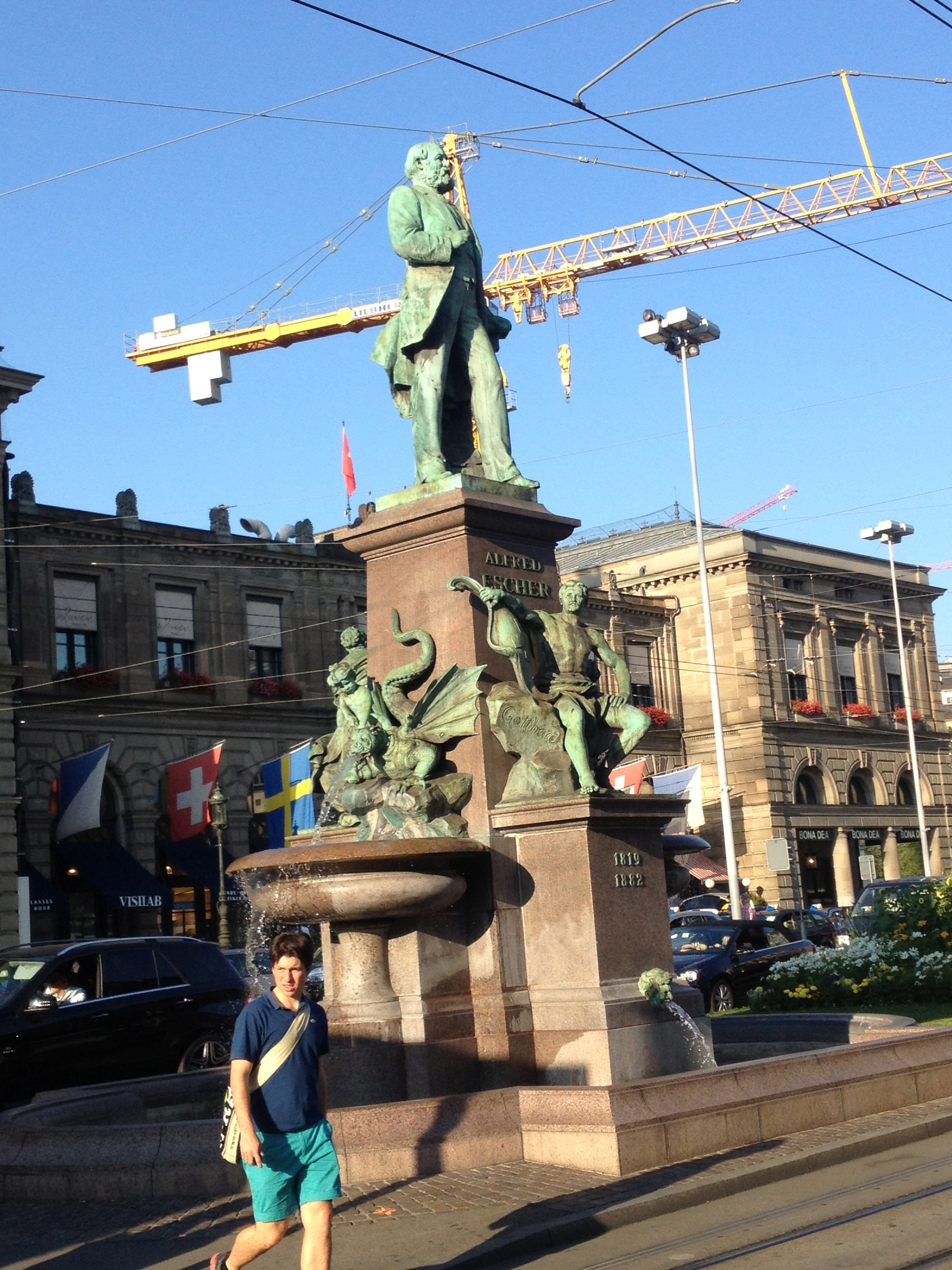
Statue of Richard Kissling, a Swiss sculptor, outside the train station.

Statue of Richard Kissling, a Swiss sculptor, outside the train station.

We hopped onto one of the numerous trams that made up Zürich’s impressive public transport system. The system is comprised of trains, overground trams, buses, electric buses, a cable car and regular ferries across Lake Zürich, and the system was so comprehensive that I couldn’t imagine why anyone would bother driving anywhere in the city, when public transport could literally take you everywhere. As we travelled through the city centre, Umer pointed out various attractions that I should come back and visit and photograph later, when I wasn’t carrying my large bag. Umer wouldn’t be able to return with me, though. The following morning Umer had to fly out of Switzerland for a work trip. However, he’d agreed to let me stay at his place for one more night without him, since he lived with his parents who would be home for that time. I had had another host lined up for that next night, but they had cancelled on me last minute. Umer also gave me a very serious warning about tickets on public transport. “If you don’t have a valid ticket, its an on-the-spot 100 franc fine. If you don’t have it on you, police accompany you to an ATM so you can get it, and if  you can’t pay it then they put you in gaol.” He told me a couple of horror stories about previous Couchsurfers of his who had been hit with the whopping fine, and even though I had been happy to risk it several times while travelling on the U-Bahn in Berlin, I decided the risk probably wasn’t worth 100 francs, and definitely not worth spending time in a Swiss gaol. Luckily, Umer had brought along his dad’s monthly public transport pass for me to use, so I didn’t have to buy a ticket that afternoon.

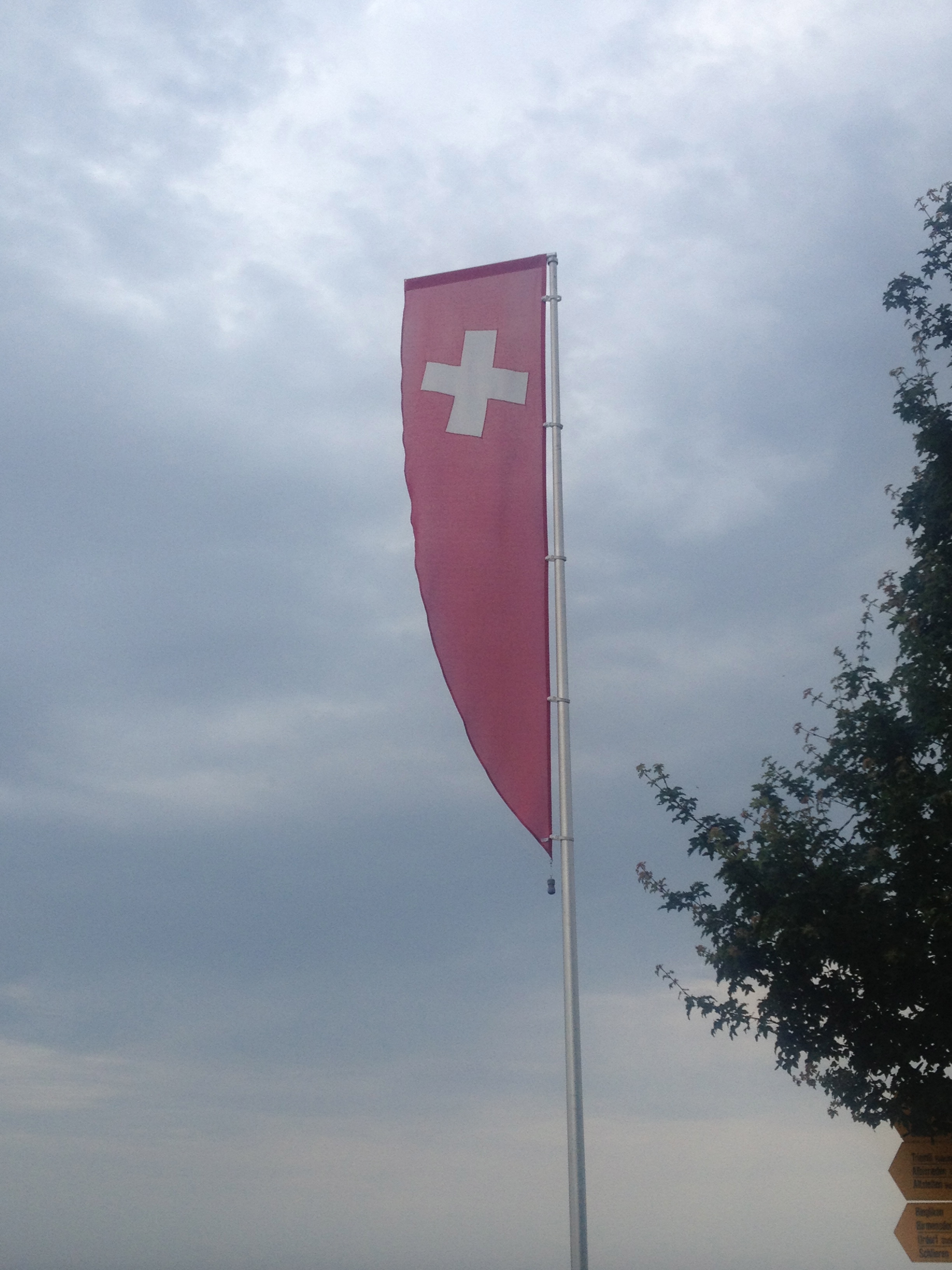
The Swiss flag (although this one isn't in the traditional square shape).

The Swiss flag (although this one isn’t in the traditional square shape).

***

Umer was a fantastic guide, even from the confines of the train, teaching me random bits and pieces about the history of Switzerland, and other interesting facts. After I confessed to him that I originally thought that Zürich was the capital of Switzerland, not Bern, he told me that the city only serves as the capital for international purposes, and that most of the regions within the country are pretty autonomous. “Switzerland really is all about being neutral,” he elaborated. “None of the other cities really have sovereignty over any other – it’s all quite self-sufficient. It’s also one of the few countries that has a square shaped flag, and not a rectangle. The equal sides represent equality in all parts, and that idea of remaining neutral.” Who knew there could be so much history behind a flag? We also got off and had a wander through the downtown area, and passed the Limmat River, which flows out of Lake Zürich. “The water quality in the river is so high that it’s practically drinking quality. It’s mostly freshly melted ice from out of the Alps, so it’s so clean,” Umer said as we strolled by the water that was a bright shade of blue. “We don’t really have beaches around here, but in the summer time you can always find people swimming in the river and hanging out by the bars along the waters edge.” I made a note of it, since my good luck streak with the European summer weather was forecast to continue.

But our stops along the way were all really brief. “I’ll let you take your time with the sightseeing when you come back tomorrow,” Umer said. “For now, I want to show you one of my favourite things in Zürich that you probably wouldn’t see as an ordinary backpacker.” And so we eventually arrived that Thermalbad & Spa Zürich, a thermal bath and spa house whose design still held remnants of the ancient Irish-Roman bathhouse that had once stood in its place. “I love coming here”, Umer told me. “Just wait until you get inside.” We paid, entered, and got changed into our swimwear before entering the complex. The whole place felt like a Buddhist temple in that it was extremely calm and relaxing, but when you looked up the roof was old and arching domes made of ancient bricks and stones. We relaxed in the warm bubbling water, which was apparently drawn straight from natural springs that existed under Zürich, and was full of revitalising and rejuvenating minerals. It was actually the perfect relaxing experience after the long, exhausting day of train travel. There was also a mediation pool, where you could lie face up in a shallow body of water, and when you put your ears in the water you could hear soft, tranquil music playing. The whole place had quite a mystical feel about it.

However, the best was yet to come, Umer assured me. Once we were done on the lower levels, we got into a lift that took us up to the top floor. We stepped out of the lift and straight down into a staircase that led into the bubbling water, and rounded a corner and passed through a plastic curtain… which led us out onto a rooftop spa, with panoramic views of the city. The sun was slowing setting, hanging between the mountains, and the view was absolutely breathtaking. “You should see it in the winter when its snowing, it’s pretty amazing,” Umer said, and I could only imagine that the juxtaposition of temperatures would be rather incredible. So we sat up there on the rooftop spa as twilight sank over Zürich, sharing Couchsurfing stories and telling him all about my travels, much like I would have done with any new host, but in a quite a unique setting. Umer was right – it was a pretty special place, and once again I was grateful that Couchsurfing had been able to introduce me to some experiences that I would had never have had without it. Afterwards we headed back to Umer’s house, where his mother made us some dinner and then I promptly crashed, feeling incredibly relaxed after my time in the spa that had felt like something out of a dream.

I wasn't able to take one, so I stole this photo from the Internet - but I couldn't not include a picture of the amazing rooftop spa and the view that it offered.

I wasn’t able to take one, so I stole this photo from the Internet – but I couldn’t not include a picture of the amazing rooftop spa and the view that it offered. Image courtesy of: http://www.somestepsaway.com

Recovery: From the city to the sea

I watched the Italian countryside whizz past me as the train carried me away from Rome. Eventually the train tracks became parallel with the seaside, and I gazed out into the distance over the Mediterranean. In one short trip I was going from coast to coast in Italy, from the capital city of Rome to the tiny port town of Ancona. “Ancona?” Valerio had asked me with a very confused expression, when I had informed him of my next destination. “Nobody… I mean nobody, goes to Ancona. Pass through maybe, but… well, there’s nothing there!” Ancona was a regular port for ferries that routinly carried passengers from the east coast of Italy to Croatia and Greece. It hadn’t exactly been on my high priority list of places to see, but while I had been searching desperately for a place to stay in Rome via Couchsurfing, I had received a message from Ike.

The interesting thing about Couchsurfing is that you can send requests to potential hosts, but you can also publicly post your travel itinerary so that hosts in areas where you are planning to travel are able to find you and invite you to stay with them. The majority of people who I have spoken to about this assured me that that was way too creepy for them, and that they wouldn’t just accept offers from random people they didn’t know, but my journey so far had showed me that taking a chance on the generosity of strangers can sometimes have the most rewarding results. I had been looking for other places to stay in while travelling Italy, but so far all my other searches had been unsuccessful. Meanwhile, Ike had sent me a message saying he had noticed I was travelling through Europe, and that if I ever made it to Ancona he would be happy to host me. We had stayed in correspondence during my frantic search for hosts in Rome and my breakdown in Madrid, and from what I could gather he seemed to be a nice and rather genuine guy. So when I arrived in Rome and had to make plans for my next upcoming destination, I agreed to visit Ike in his sunny little corner of Italy. Four days later, and I was stepping off the train into the blistering afternoon sun, where he was waiting to pick me up.

Ike was a fun and outgoing guy with a cheeky sense of humour, and just like when I had met Stefan – who had also stayed with Ike – we got on well straight away. I knew I had made the right decision in coming here – better to spend a couple of days in a town you’d never heard of with a fun stranger than wander around a well known city by yourself. I’d done plenty of that in Rome, so during my time in Ancona I was determined to do absolutely no sightseeing. I needed a break from all that. When we got back to his place, Ike showed me a map of the area and a bunch of information pamphlets about things to see and do. “There’s a short historical walk through the main centre,” he said, pointing at the map to a spot in the centre of town – Ike lived a little further up one of the many rolling hills that surrounded the port, about a 10 minute drive from the train station. “Stefan was very into that kind of thing, but I’m not sure what you want to do while you’re here.” I told Ike that I would be happy to find a spot on the beach and just chill out, so he gave me a few options for the nearby beaches that I could try, most of which were pretty easily accessible by bus. “I’d love to come with you if I had the time, but unfortunately I’ve got to work.” Ike even had to go back to work that afternoon, so he left me at his place to do some laundry and get some rest. When he got home, Ike cooked dinner and we had a night of great conversation over a bottle of wine. We talked about travelling, our Couchsurfing experiences, and he even taught me a couple of phrases in Italian. It was a fun and carefree evening, and I was already very pleased with my decision to stop by Ancona and take some time out in this Italian hideaway.

***

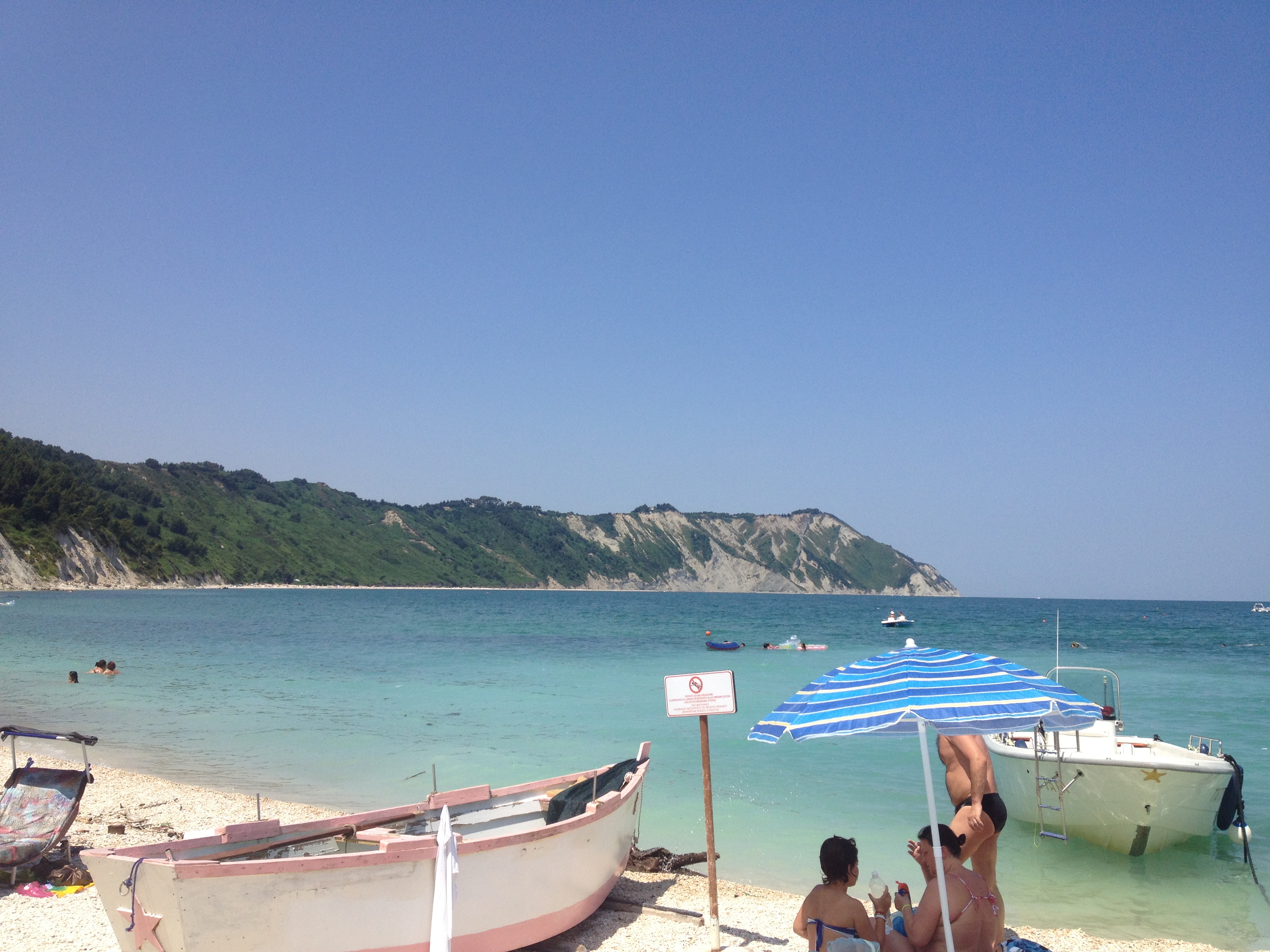
The next day Ike had to go to work again, so after a bit of a sleep in and a lazy morning, I caught a bus down the hill to the city centre and then transferred to another bus that would take me to the nearby beach of Portonovo. The bus was crowded with lots children and teenagers, and it was only then that I realised it was the height of summer and that school was probably out, and everyone in town would be heading for the beach. It also took a little longer to get there than I had anticipated – I was on the bus for over half an hour, going up and down the twisting and winding hills of the outskirts of Ancona before we finally arrived at Portonovo. I wandered through some of the shrubbery around the bus stop and down through a small woodland area before emerging onto the beach. The area had a handful of restaurants and other overpriced-looking places where you could hire beach chairs, but I bypassed all that and went straight to the waters edge.

There, I faced a problem that I hadn’t really faced since I’d been in Thailand – I was alone on a beach with a backpack containing valuables such as my phone and wallet, and I had no way of properly securing them. Even if I was to put a lock on my bag, there was nothing stoping someone from simply running away with it. The beach was fairly crowded, but not so much that I wouldn’t be able to see my things if I left them in plain sight from the water, and it was too hot to not go swimming. In the end I just had to take a chance and leave my backpack while I went into the water. I never swam too far from where I’d left it, but I was a little more relaxed than I had been on the beach at Ao Nang. And it was worth it – with the hot sun beating down on the crowds of beach goers, the cool blue water felt absolutely amazing to dive into. When I’d had enough of that, I crawled back onto the beach, lathered myself in sunscreen, and laid down to soak up some rays. I think it was something I’d first noticed lying in the park in Christiana during my time in Copenhagen, but the sun in Europe just doesn’t seem to be as strong as it does down in Australia. Obviously Italy has a lot stronger sunshine than Denmark – Ike told me he regularly uses 50+ SPF sunscreen – but compared to the sun in Australia it felt like a casual warm day. I was very conscious of my sunscreen use though, which allowed me to relax enough to actually doze off into a state of semi-sleep more than a couple of times. It was the perfect temperature, and I stayed there on the beach for as long as I dared before I thought there really was a chance of me getting significantly burnt.

The refreshing blue waters of Portonovo Beach.

The refreshing blue waters of Portonovo Beach.

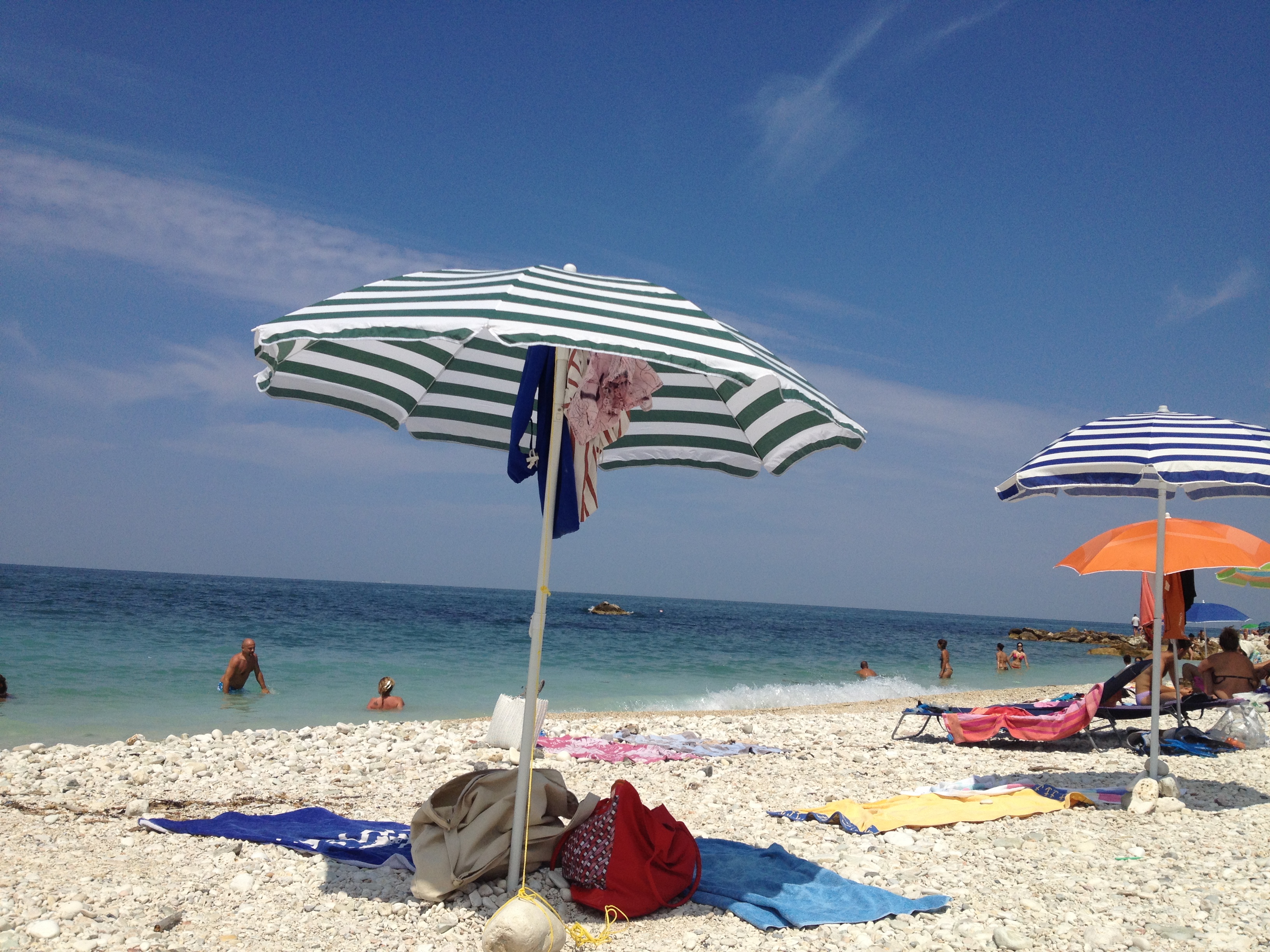
Lots of people set up camp for a day on the beach in the gorgeous sunshine.

Lots of people set up camp for a day on the beach in the gorgeous sunshine.

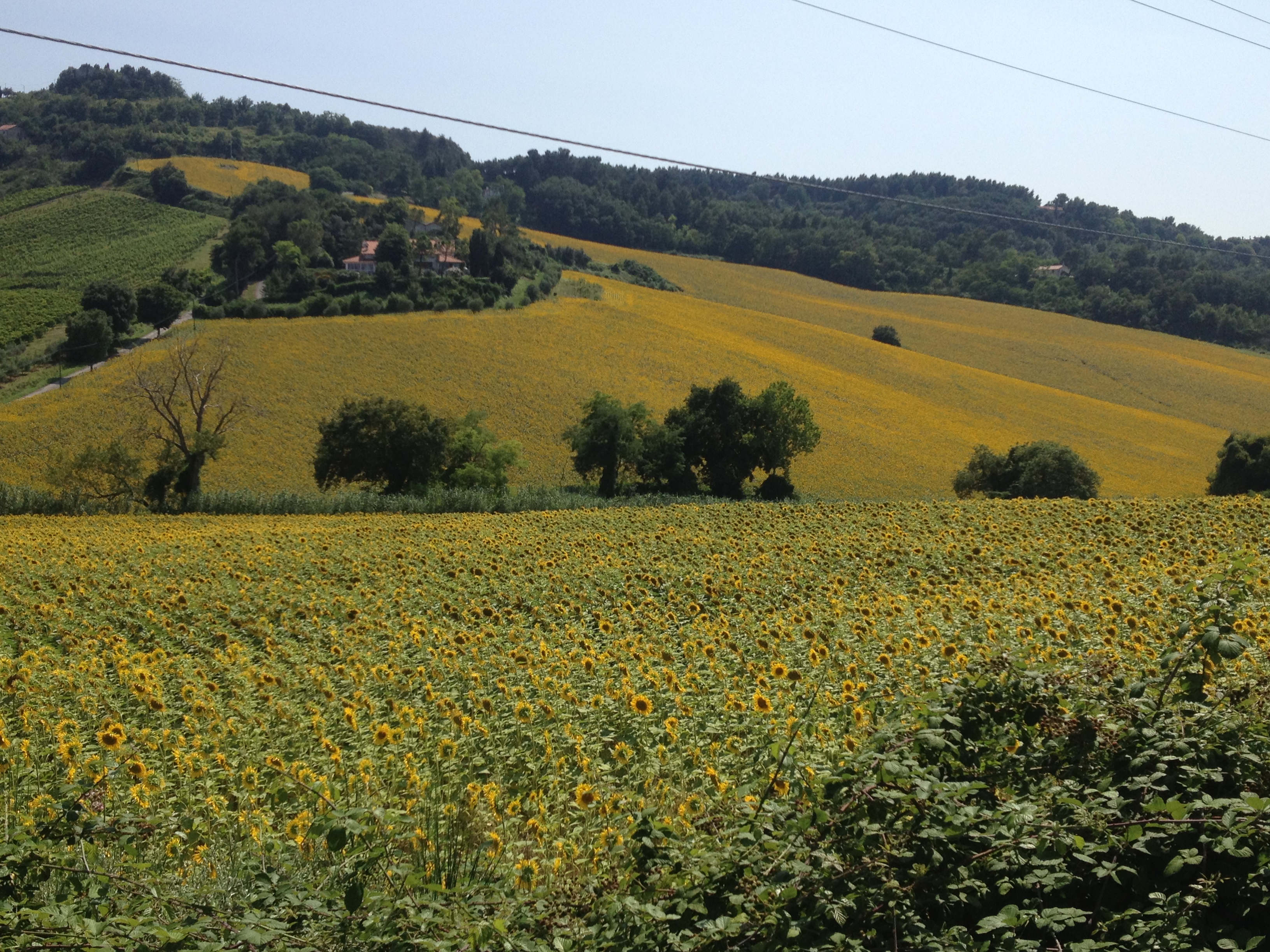
I took one final dip in the ocean before heading back to the bus stop, and indulging in some amazing Italian gelato while I waited for the bus. When the bus finally arrived, slowly making its way down the hill from the highway, I hopped on board, thinking it would take me back to the centre of Ancona. I was surprised to find that its final stop was simply at the top of the hill. “Last stop – everyone off,” the bus driver called out to me. It was definitely up there in my travel nightmare scenarios – being forced off the bus but having absolutely no idea where I was or how I was going to get back. However, when I hopped off the bus I was momentarily distracted by the field of sunflowers that spread out in front of me in the paddock beside the road. I took the opportunity to take a few photos, and just sit back and marvel at the Italian countryside and the picture perfect landscape I had laid my eyes on.

The sunflower fields just next to the bus stop by the beach.

The sunflower fields just next to the bus stop by the beach.

But then it was back to panicking. Another bus with the right number came along, so I hopped on. It took me… back down to the beach. What the Hell was going on? I decided to swallow my pride, realising I needed help, and approached the bus driver, crossing my fingers and praying he spoke some English. I explained where I wanted to go, and he knew enough to understand and give me a reply: “Ahh – next bus!” I sighed, knowing it was about as much help as I was going to get, and stepped off the bus. It wasn’t too long before the next bus came trundling down the hill, and when it finally did I was relieved to feel it make the turn onto the main road that led back to Ancona. I had given up trying to understand how public transport timetables – or indeed, any kind of timed service – operated in Italy. I’m not one for generalising stereotypes, but I can honestly say that chronic lateness was something that I experienced in pretty much all public services in Italy. Countries like Italy and Spain are currently suffering from unbelievably high levels of youth unemployment, but I can’t help but wonder if the people who were actually employed were doing any more work than the people who weren’t.

***

That evening was my second and final night staying in Ancona, so when Ike got back from work we decided to go for a little drive to see some of the other parts around the area that I hadn’t been able to see by myself. We headed south down the coast, admiring the countryside in the dying daylight. At the small town of Sirolo, we stopped the car and got out to watch the sunset behind one of the cliffs. It was nice to be outside of the huge cities for a change, and to experience some very natural beauty such as this. I took a few photos before we continued on to the next small town of Numana. There we got out and walked around the town. It was a little more tourist-orientated than the centre port of Ancona had been, and the streets were quite well preserved in an older, historical style, with uneven tiling and cobblestones lining the streets. We walked down to the docks and looked out over the water as twilight settled in. It wasn’t quite as prominent as the white nights in St Petersburg, but even in southern Europe it still took a very long time for nighttime to actually become dark – often there was still a lot of natural light and visibility as late as 10pm. It was a strange phenomenon that I was only now getting used to.

Overlooking the beach at Sirolo at sunset.

Overlooking the beach at Sirolo at sunset.

The ocean view from our vantage point near Sirolo.

The ocean view from our vantage point near Sirolo.

Overlooking the town of Numana.

Overlooking the town of Numana.

Ocean views as dusk settles over the province of Ancona.

Ocean views as dusk settles over the province of Ancona.

After wandering through the old, steep streets, we headed back to the car and went home. I didn’t ask, but in a small town like Ancona I assumed that there wasn’t much of a nightlife scene, gay or otherwise. Even if there was, I don’t think I would have bothered going. My time in Ancona had been all about relaxing and taking the down time that I had been unable to take in the past couple of weeks. I helped Ike make some dinner and we had some more wine before retiring to bed. He was leaving for a work trip the following day, and I had several trains to catch. But I’d had a fun and memorable few days with Ike in Ancona. He’d told me that it was often just a passing through town for so many people, and that people rarely discovered the little gems of beauty it contained. At that moment, I was eternally grateful that I’d decided to travel the way I was travelling: solo, using Couchsurfing, and meeting all kinds of interesting locals along the way. It assured me that not only was I having an amazing once in a lifetime trip, but that I was seeing parts of the world that many other travels might breeze over without a second glance.

Friends, Romans, Countrymen

After a day of extremely touristic activities at the Vatican, I was looking forward to doing something a little different on Saturday night. When I first arrived in Rome, Valerio had told me about something called the ‘Gay Village’, an annual event that was held in Rome. I shouldn’t have been surprised – after being to three different gay pride festivals during my time in Europe so far, I had to conclude that it was simply the season for pride all over the continent. “The gay scene isn’t as big here in Rome as it is in other cities or countries,” Valerio had informed me. “We’re so close to the Vatican, so there’s lot of influence from the Catholic church… It’s not repressed, exactly, but it’s just very… subdued.” Valerio went on to inform me that rather than having one weekend full of pride festivities and a parade, there was this event called the Gay Village which ran for weeks during the middle of summer. Valerio hadn’t been yet this year, so I told him I’d happily join him. He also had another Couchsurfer who arrived that Saturday evening, and American from New York named Steve. Steve himself wasn’t gay, but he had no plans and was keen to come along, so the three of us got into Valerio’s car and went off to investigate whatever Rome had thrown together as part of their pride celebrations.

After driving though dark roads in areas that seemed almost rural, we emerged at what appeared to be a festival ground. That’s what Gay Village seemed to be – a big festival village, with food stands, games and rides, performances, bars and a huge dance floor. We met up with a few of Valerio’s friends once we’d lined up to pay and gotten inside, and after a quick wander around to see some of the sideshow attractions, we inevitably ended up by the bar and on the dance floor. I was still fairly exhausted, so I only had a couple of drinks for fear of passing out right there if I overloaded myself with booze, and the group of us danced among the huge, seething, sweaty crowd. Oddly enough, the person who seemed to be having more fun than anyone was Steve – I’ve always found that straight people are usually rather impressed by the way the gays can throw a party. We danced and danced until the ice in our plastic drink cups had all but melted and keeping my eyes open became a little too much of a struggle. It was fairly late by then, and we’d seen the best of the performances, so we said goodbye to Valerio’s friends and headed back to the car to drive home.

The pumping crowd in the Gay Village.

The pumping crowd in the Gay Village.

The lights turning up over the dance floor.

The lights turning up over the dance floor.

On the drive home, I questioned Valerio about something I’d noticed throughout the night. “So did you not drink tonight because you were driving, or do you just normally not drink anyway?” Not that long ago I wouldn’t have even thought to consider that second option, but meeting Ralf at Berghain had definitely shone a light on that perspective for me.
“No, I don’t drink alcohol,” Valerio said rather simply. “I don’t really like the way it affects me – I don’t really like being drunk.” For a man of such small stature, I could only imagine that it wouldn’t take much to get him heavily intoxicated – something of a foreign concept for me. Now, I’m not a complete idiot – I know there are plenty of people in the world who don’t drink for the sole purpose of getting drunk. I guess that binge-drinking behaviour is mostly the kind of thing I’d been experiencing back home, but I was surprised that find that there were people who actually liked going out to nightclubs to dance and party while not even drinking the smallest amount of alcohol. It was a pleasant change, because for the first time in my life I didn’t feel like I needed to drink as much as I could in order to catch up and keep up with the rate at which all my fellow companions were drinking. Being outside of it for the first time, it was made painfully clear just how problematic and potentially dangerous Australia’s drinking culture can sometimes be. Not that I’m condemning or praising any culture either way – it was just some food for thought on the quiet drive home.
“Well, either way, thanks for driving us tonight. That was definitely a side of Rome we wouldn’t have seen without you.”

***

The next day I slept in. I know, I know – there is so much to do in Rome, how could I possibly waste an entire morning just sleeping? But I was exhausted, and I had reached a low point in the cycle of motions you move through when travelling. Some days you’re so full of energy and feel like you can do anything and literally get out there to take on the world. Other days, things catch up to you a little bit, and you have to remember you’re only human. It was another new perspective I had to consider – on a two week holiday you can cram every day full of activities and sleep it off when you get home, if you so desire. When you’re on the road for nine months, you really do need to be a little more self-conscious and give your body time to relax and recover. It was something I’d neglected over the past few weeks, and I’d paid for it when it culminated in the form of a small breakdown.

Steve had gone off for a day full of sightseeing, but I awoke very late in the morning to hang out with Valerio for a while. The most peculiar and interesting thing about Valerio was his obsession with Madonna. His living room was crammed with memorabilia that spanned back through the years of her career, from CDs and DVDs to posters to books to official tour merchandise, much of which had been signed by the Queen of Pop herself. Normally I might have found such an affinity with one artist slightly creepy, but when Valerio got talking about Madonna, there was such passion and vindication in his voice that it was almost a little inspiring. The decades long career, the different themes and styles in her music, the shocking and controversial material in some of her discography, and the way she’d adapted to achieve longevity in her musical career – but the end of our discussion, Valerio had me wanting to go and purchase all the Madonna albums to discover it all for myself. There was definitely a look of disapproval when I mentioned that I only had two Madonna songs on my iPod – I decided it was best not to mention my Lady Gaga inspired tattoo. We had a good afternoon though, sitting in our pyjamas and drinking tea while he showed me some of his favourite scenes from her MDNA tour – which he assured me would never make it to Australia. “She’ll never go to Australia,” he said rather simply. “She always announces it, but she’ll always cancel. Her tour is too elaborate and expensive. The cost of getting it down there would be more than she could ever make back from an Australian tour.” At that moment, arguing about the worlds various pop divas when I was still in my pyjamas at noon, I felt more at home than I had in a long while.

***

However, I did have other plans for the afternoon. A couple of days ago I had received a message from my next arranged Couchsurfing host – a man by the name of Ike, who lived in Ancona, on the eastern coast of Italy. We had been exchanging messages to arrange my stay since I’d been in Madrid.
“Robert, how are you? Are you still in Rome? I’ve just had a Couchsurfer named Stefan stay with me. He’s a lovely guy, he’s gay too, and he’s heading to Rome now. I’m not sure if he knows anyone – if you have a chance you guys might like to catch up?”
It wasn’t really a lot to go on, so I can’t tell you exactly why I bothered following through – but I got in touch with Stefan, and after a few miscommunications we planned to meet on the Sunday afternoon near the Colosseum, one of the last sights I had left to visit.

From the moment our conversation began, neither of us were at a loss of words. Stefan was from Austria and was currently travelling through Europe as well. We talked about our travels, or lives back home, friends and studying and working. We seemed to have so much in common, and before long we found ourselves discussing things like our hopes and dreams for the future, the things that inspired us and the things that terrified us, things we were doing, and the things we really wanted to be doing. Stefan spoke several languages and had been working as a translator for some time – he’d been a conscientious objector to the compulsory military service in Austria and had instead spent the time working on peace efforts and treaties in Japan. “But I’m also an artist,” Stefan had confessed to me. “I do sculpting… for me, that’s my real passion.” I asked him why he didn’t do that – why he didn’t pursue the dream that meant so much to him. He struggled to answer.
“I feel a similar way, I guess, but about music,” I told him. “I write and play music, and God, there isn’t much else I love in the world more than that. But to actually pursue it further? To really do it? I guess… I’m a little scared.”
“Scared of what?”
“I guess… of failure. What if  you gave it all you had, 100% give it your all, but you’re still not good enough? It’s just a cut-throat world out there…”
“Well, I’m scared too. But not of failure.” We were sitting on a park bench, staring out over the broad Colosseum in front of us. “But of losing that dream. What if you do make it, but it’s not all you dreamed it to be? That dream keeps me alive some days. If I made it that far, only to learn I’ve been wrong along…” He didn’t need to finish his sentence.

Posing with the Colosseum from where Stefan and I had our long afternoon conversation.

Posing with the Colosseum from where Stefan and I had our long afternoon conversation.

It was a strangely profound moment to have with someone that I had just met, and a tragedy that we probably wouldn’t be meeting again for a long time. I’d wanted to stay and talk more – I felt like I could have talked to Stefan until the end of time itself and still not gotten bored. But my time in Rome was fast coming to an end, and I wouldn’t forgive myself if I didn’t catch even just a glimpse of the Roman Forum and the inside of the Colosseum. We had already talked for much longer than I had anticipated, and I only had about an hour and a half to get down and see those final attractions before closing time. But the structures had stood there for thousands of years, so I could always return another time if necessary – the Forum wasn’t going anywhere in a hurry. And if I’d made such a point on seeing every last speck of historical tourism Rome had to offer, I would never have met up with and made a new friend in Stefan. It was a brief yet memorable moment, and I’m eternally grateful that it happened.

***

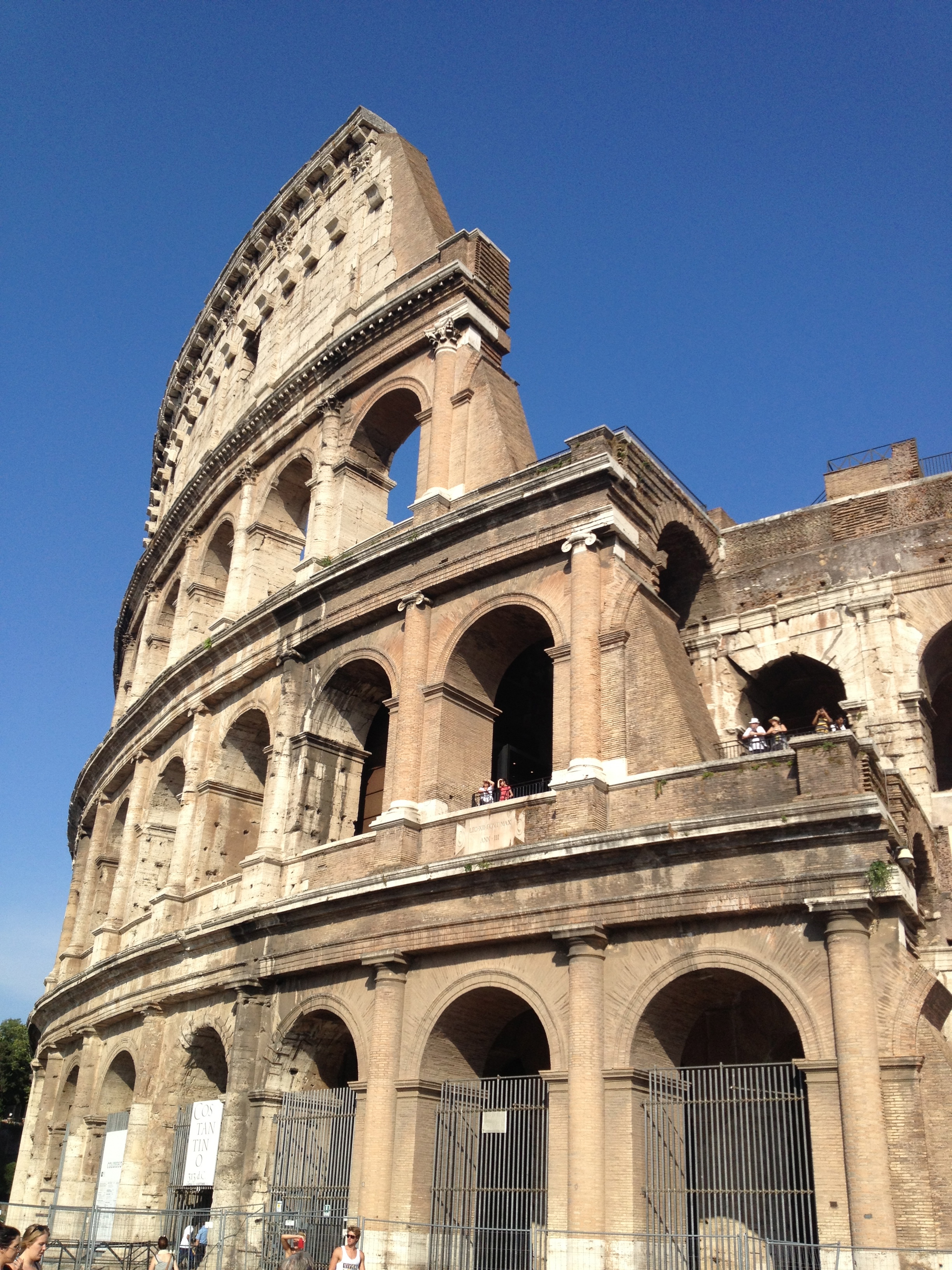
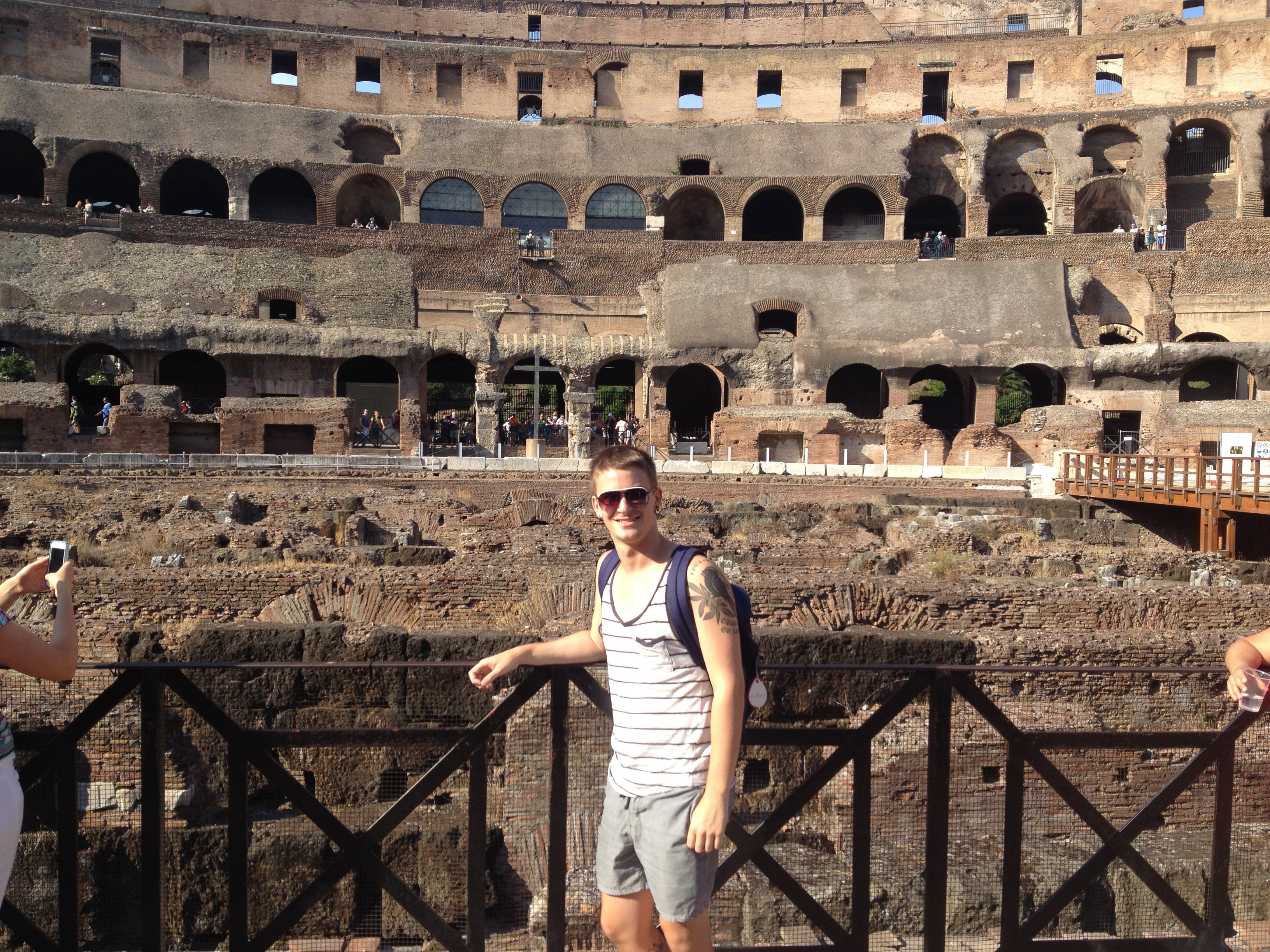
Fortune was favouring me that afternoon, because I somehow managed to breeze through the swift-moving line for the Colosseum and get in an out in what was probably a record speed. I didn’t climb to the upper tiers for the view down on the main arena, but standing at the bottom and looking up and the walls of relics towering over me was enough to give me a few shivers. The main stage was overrun and off limits to tourists, but I spared a moment for the countless men who would have died there centuries ago.

The Colosseum close up.

The Colosseum close up.

Inside the arena of the mighty Colosseum.

Inside the arena of the mighty Colosseum.

Inside the Colosseum.

Inside the Colosseum.

Arco di Costantino right beside the Colosseum.

Arco di Costantino right beside the Colosseum.

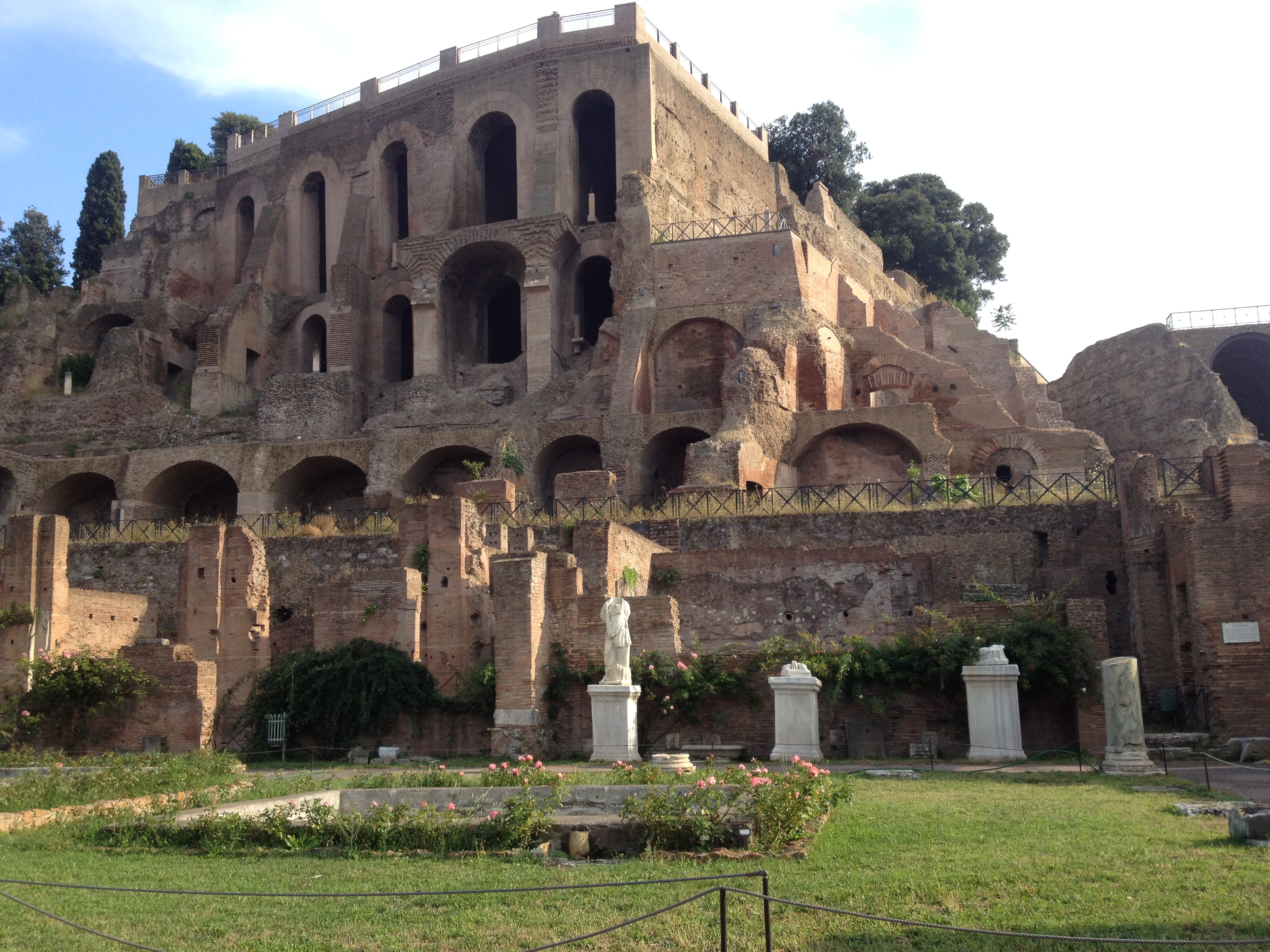
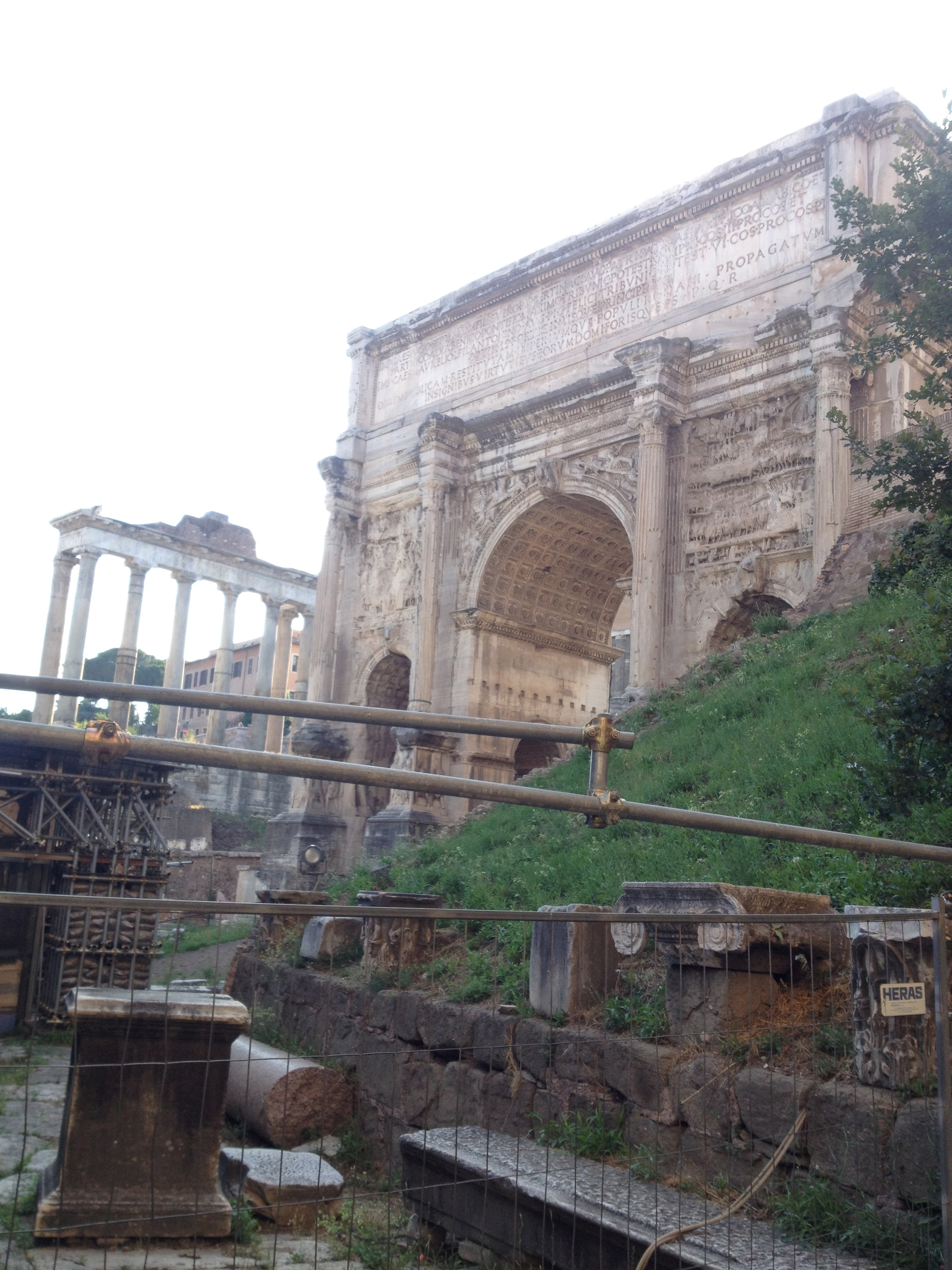
The Roman Forum was a little bit overwhelming. After finally finding the entrance, I entered the grounds and wandered through the ruins, using my Lonely Planet book to roughly guide me through the highlights – there was only an hour left until the Forum closed. I didn’t rush through it too quickly though, but instead appreciated the sights that I did get to see. In the end I think I saw a great deal of the ruins, but Valerio was mildly horrified that I hadn’t spent more than hour there. Still, it was a beautiful afternoon as I watched the dying light fall across the Forum, and the furthest part of the ruins up near Palatine Hill offered a pretty remarkable view of the area.

Some of the first sights I saw upon setting foot in the Roman Forum.

Some of the first sights I saw upon setting foot in the Roman Forum.

Ancient ruins.

Ancient ruins.

Ruins in the Forum. There were far too many for me to keep track and remember them all.

Ruins in the Forum. There were far too many for me to keep track and remember them all.

Monument inside the Forum.

Monument inside the Forum.

Unfortunately some parts of the Forum were under repair while I was visiting.

Unfortunately some parts of the Forum were under repair while I was visiting.

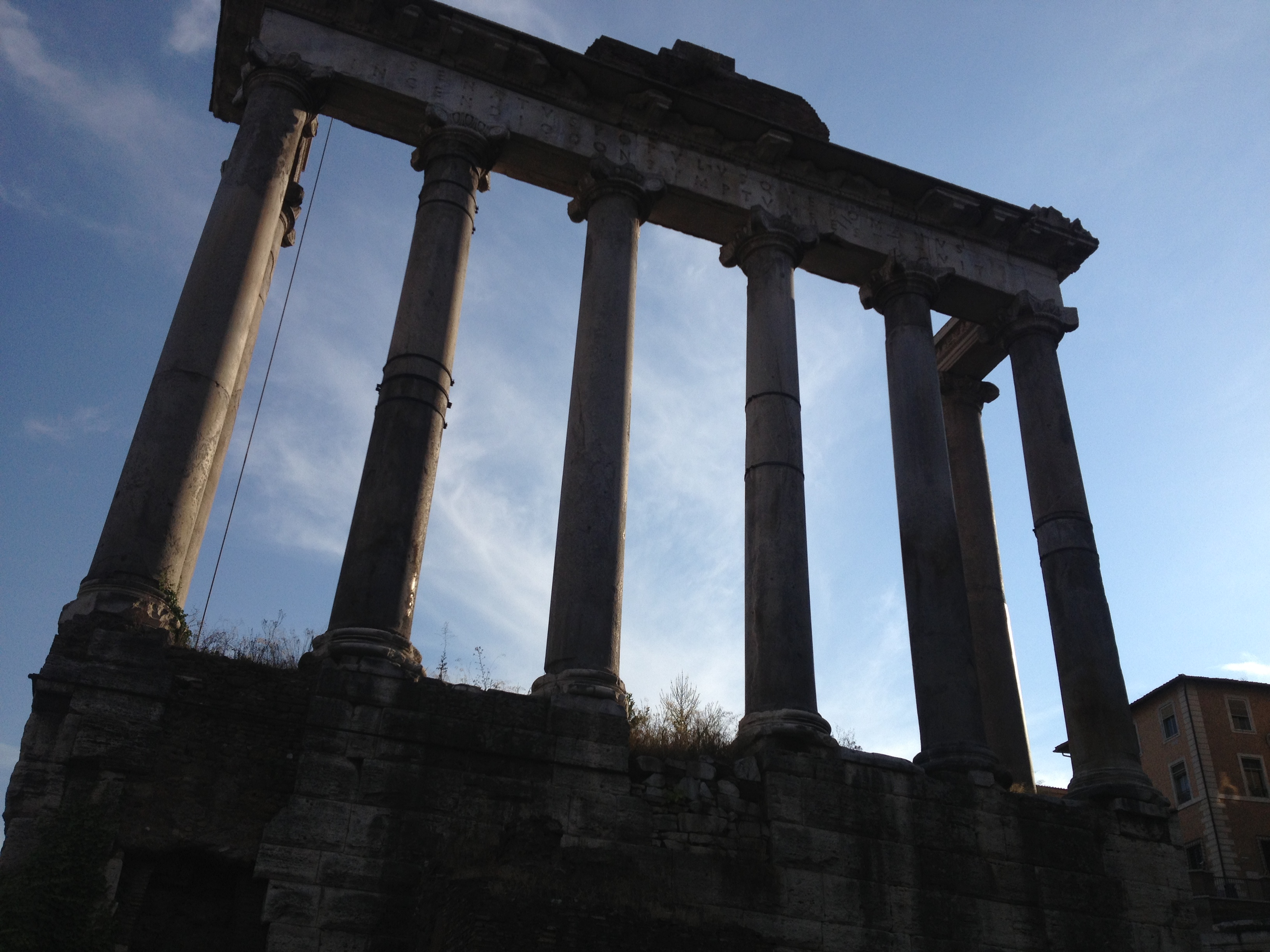
Tempio di Saturno - the Temple of Saturn.

Tempio di Saturno – the Temple of Saturn.

More ruins in the Forum.

More ruins in the Forum.

A fountain in the upper reaches of the Forum on Palatine Hill.

A fountain in the upper reaches of the Forum on Palatine Hill.

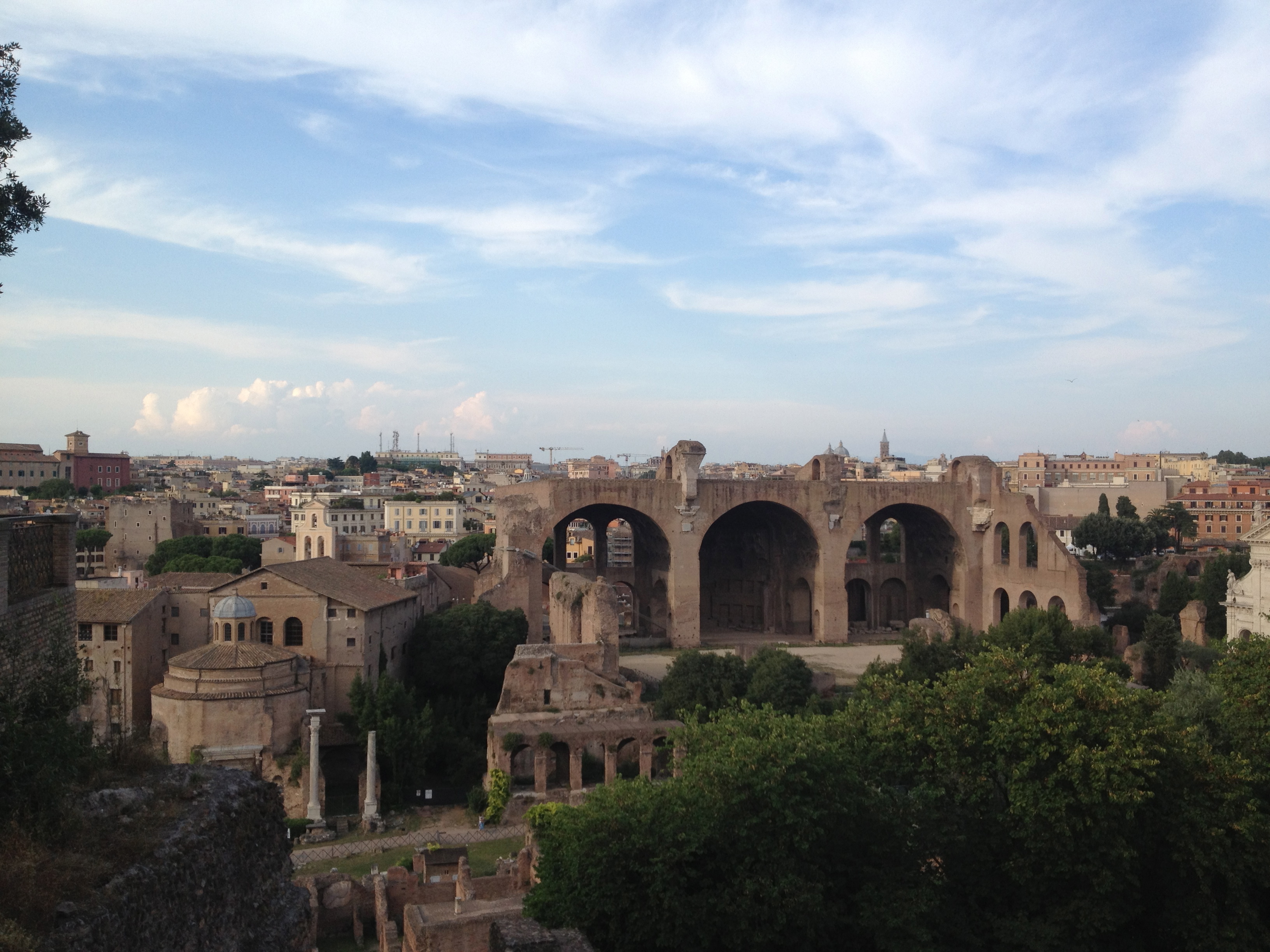
View from the top of the surrounding area and of the Forum itself.

View from the top of the surrounding area and of the Forum itself.

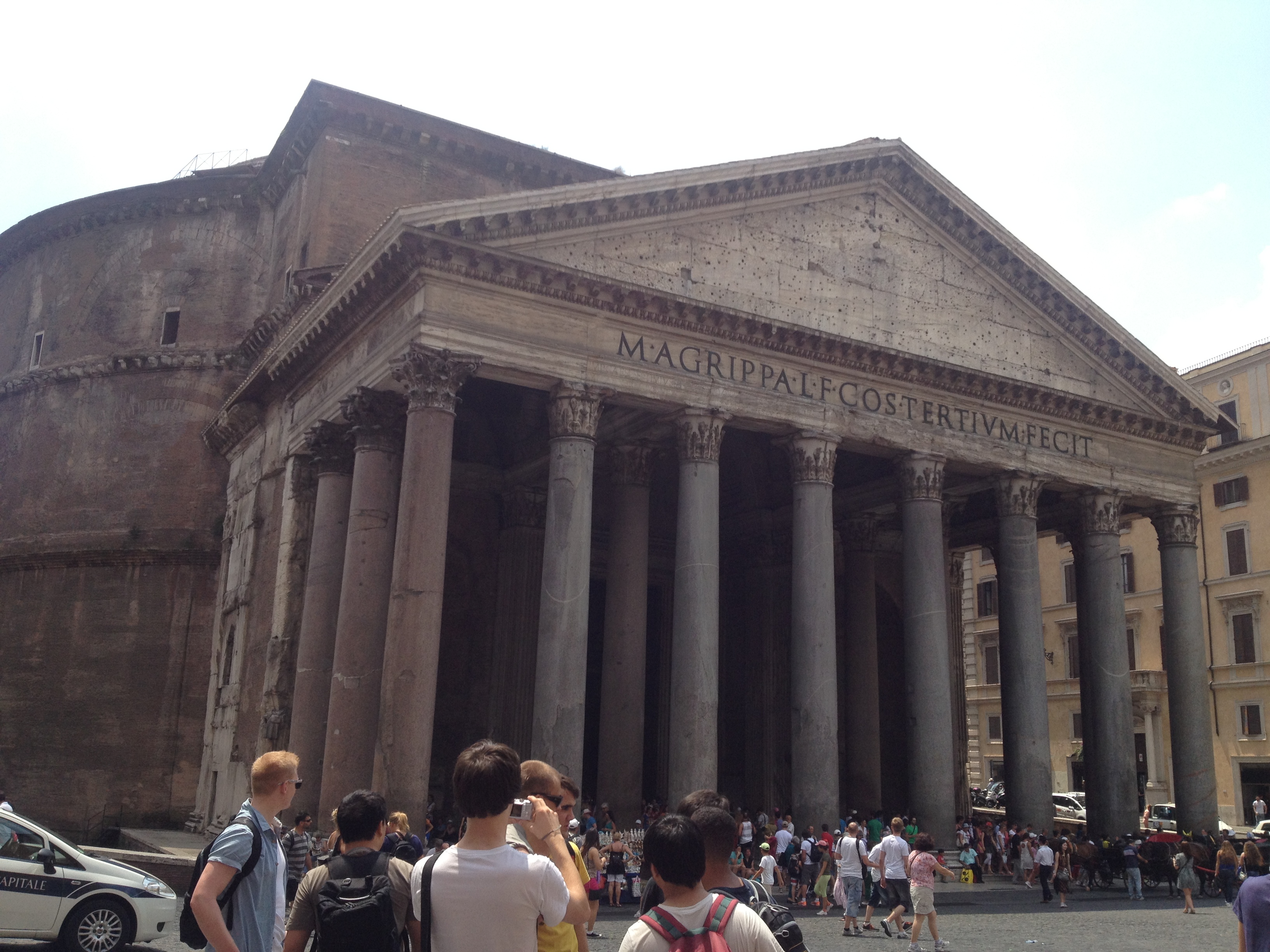
Afterwards I met Valerio back near the Colosseum, and we wandered through the streets as dusk sank over the city. Valerio told me that there are over 900 churches in the city of Rome, and he himself had managed to visit a few hundred of them during his time living there. We walked past the National Monument for Victor Emmanuel II, and ended up back in central Rome. The area looked quite different at night, as we wandered past the Pantheon, through Piazza Navona, and ended up near Trevi Fountain, where we were due to meet up with Steve.

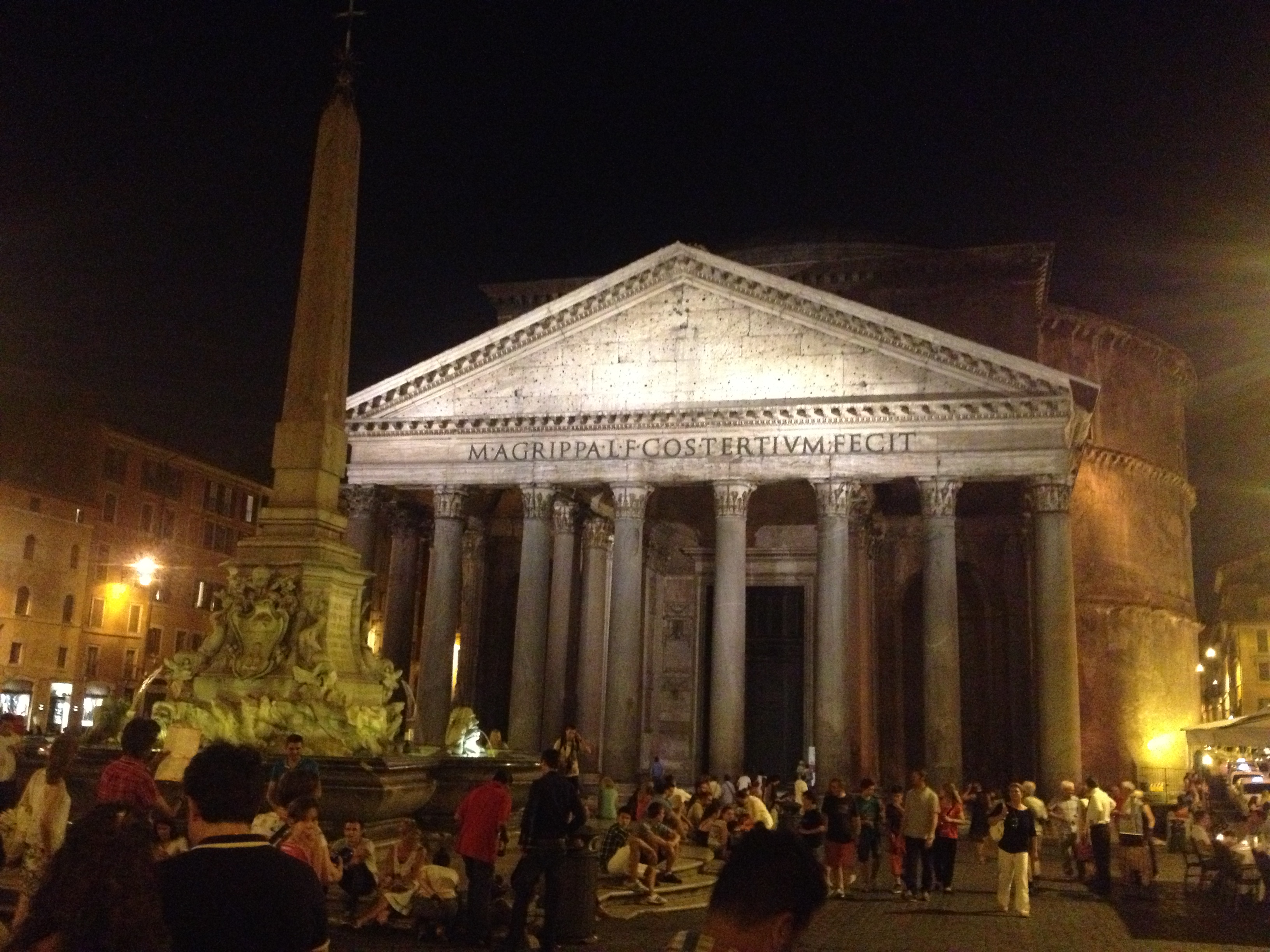
The illuminated Pantheon at night.

The illuminated Pantheon at night.

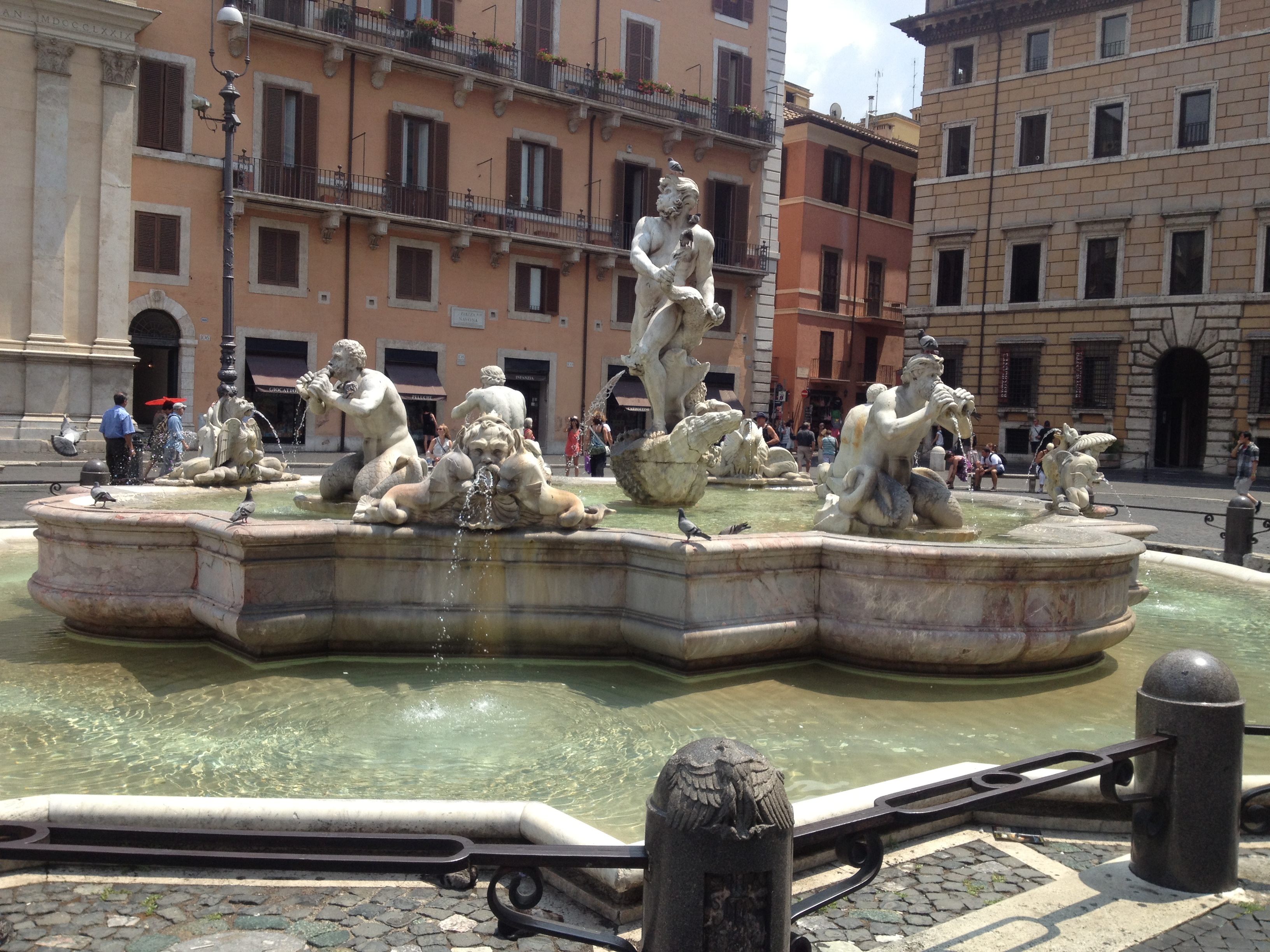
Fontana dei Quattro Fiumi - Fountain of the Four Rivers -  at night.

Fontana dei Quattro Fiumi – Fountain of the Four Rivers – at night.

“Did you throw a coin into the fountain?” Valerio asked me as we watched the hordes of tourists struggle to get their picture taken with the fountain in the background.
“Nah, it was too crowded when I was here,” I replied pretty casually. But Valerio turned to me with a look of horror.
“What?! No, you must throw a coin into the fountain, or you will never again return to Rome!” That was one superstition that I hadn’t heard of, and I just laughed. But Valerio seemed insistent, so I went down the fountain to appease him, tossing 20 euro cents over my shoulder, and getting another picture with the fountain, remarkably without anyone else in the crowd creeping into the shot. Later, I would read in my guide book that an average of €3000 is thrown into Trevi Fountain everyday – I guess that’s one superstition that a lot of people take pretty seriously.

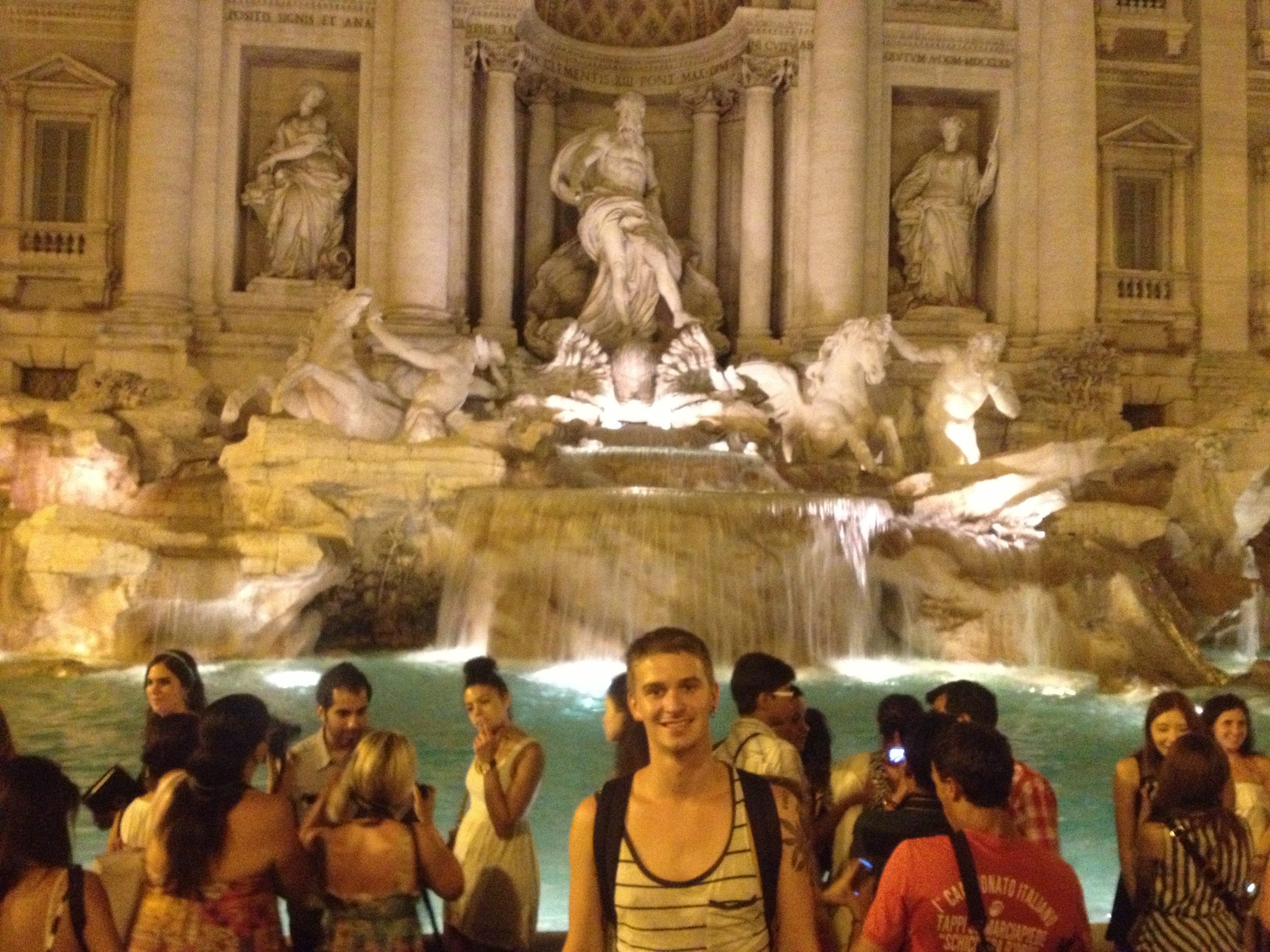
Just before braving the crowds to throw my coin into Trevi Fountain.

Just before braving the crowds to throw my coin into Trevi Fountain.

Valerio managed to capture a shot of me and the fountain without the hordes of tourists around me.

Valerio managed to capture a shot of me and the fountain without the hordes of tourists around me.

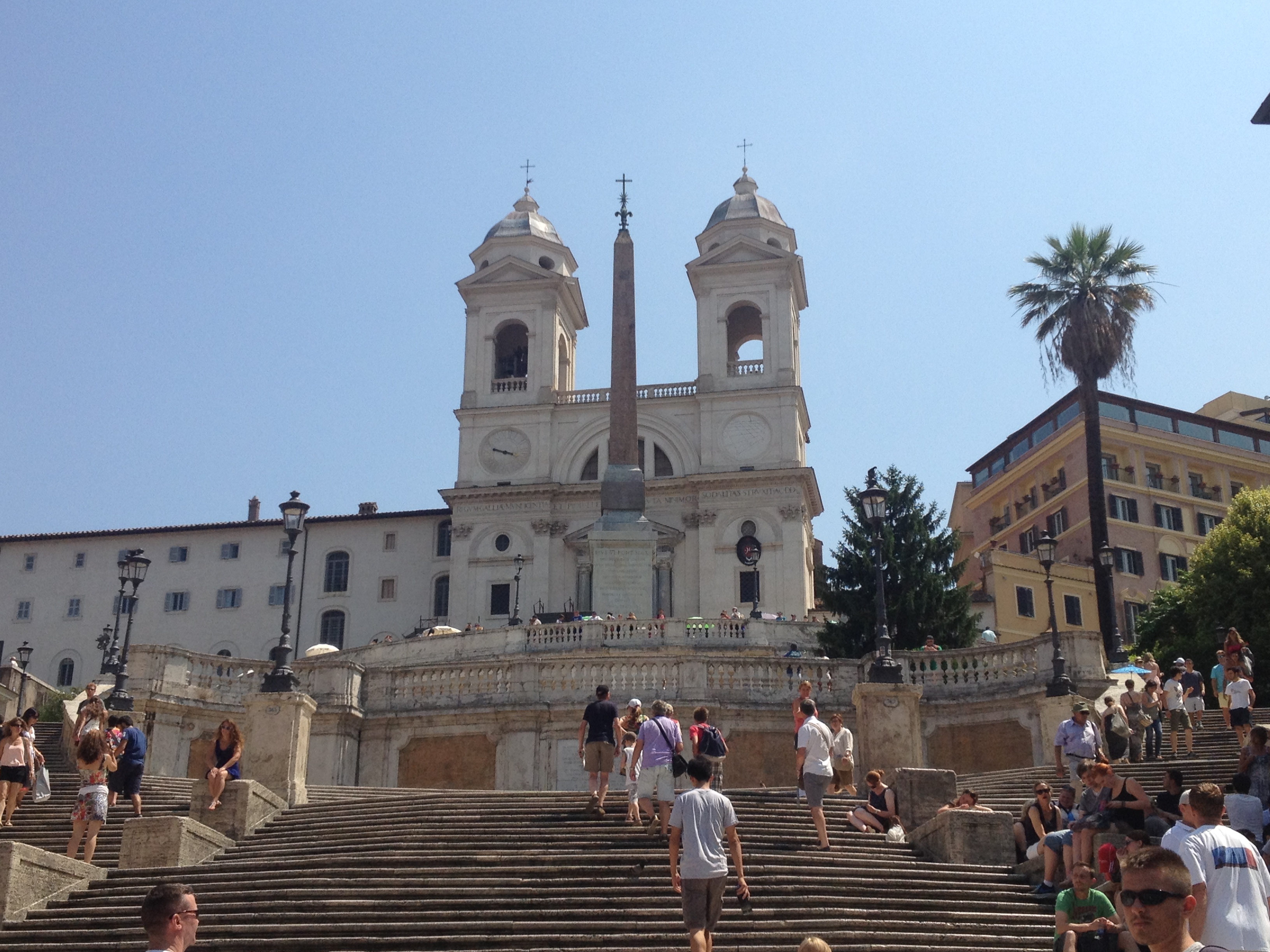
We finally caught up with Steve, and we went for a wander to the Piazza di Spagna and the Spanish Steps, which were even more crowded than the afternoon I had first visited them. The whole city seemed to have a different vibe at night, and the three of us sat at the top of the steps and just looked out over the crowd of people, enjoying the warm, humid air. That was my last night in Rome, and I have to say it was a rather enjoyable one. I’d made some new good friends, and after the few days of sightseeing, it had been great to just wander around with someone as chilled out and relaxed as Valerio and, if you will, do as Romans do.

View of the Spanish Steps from the bottom...

View of the Spanish Steps from the bottom…

... and from the top.

… and from the top.

***

The next morning Valerio dropped me off at the metro station so that I could make it to my train out of Rome in time. He bid me goodbye and wished me good luck on my travels. I thanked him for his hospitality and his generosity, and with a wink I reminded him that I threw that coin into Trevi Fountain, “So I’m sure I’ll be back to visit you again.”

Losing My Religion

Day Two of Selma’s itinerary started off with another sight that was deemed one of Rome’s “must see” attractions: The Vatican City. The further along I got on this itinerary, the more I realised that there are just so many things to see in Rome, and that I would have probably wasted a whole heap of time had I not had the good fortune of Selma’s advice. Still, the Vatican was something I was almost in two minds about. “The Vatican? Won’t you, like, burst into flames or something when you step inside?”, my best friend Jesse had said during a Skype conversation while I was getting ready to head out. I just laughed and shrugged. I hadn’t let my homosexuality or my distaste for organised religion stop me from entering any of the other churches throughout Europe so far, so why should I treat the Vatican any differently. By that reasoning St Peter’s Basilica was – to me, at least – just another church.

The Vatican is located slightly north-west of central Rome, and Valerio’s place was in the south-east, so it took even longer to get there than it had taken to get into the centre yesterday. Selma’s instructions had advised I wake up early to visit the Vatican, presumably to avoid the queues, but unless it is absolutely essential, I have discovered I am just not a morning person. Especially not for the Pope. So the sun was high and bright as I stepped out of the metro system and into the streets, where I immediately could find my way to the Vatican by simply following the flocks of people. There were lots of people holding signs advertising guided tours, hollering at passers-by with things like “You going to the museum? Vatican Museum is not this way, you want want guided tour, aye?” Every now and then I would see people stop and talk to them, and I wondered if any of them realised how ripped off they were probably going to get. “Long lines for the museum, but not with guided tour!” Maybe I was wrong though – I never bothered to investigate them further. I dodged the assumed tourists traps as I blended into the throng of the crowd.

The centre of the Vatican City.

The centre of the Vatican City.

There were lines to get into the main church – there was absolutely no way around that. Entry to St Peter’s Basilica is free, so there wasn’t really any reason not to go in, once you realised the lines moved at quite a constant and steady pace. I couldn’t have been in line for more than 20 minutes before I was through the security check and on my way in. Some of the other tourists around me, however, were not so lucky. Like many holy sights that I had visited in places like Bangkok and Angkor Wat, respectful attire was compulsory for entry into the largest Catholic church in the world, and I had done my research. As I approached the front of the line, I pulled out the pair of jeans that I had stuffed into my backpack and pulled them on over my short, immodest shorts. I’d been sure to wear a t-shirt with decent length sleeves, so once I had covered up I was given the green light by security. The women behind me in their sandals, summer dresses and light gauze shawls weren’t so lucky.

The first thing I noticed when I was finally within the compound was, lo and behold, another line. It was a line to climb the steps to the basilica’s atrium, a dome that supposedly offered views of the Vatican and the surrounding area. I stood in line for a short while before I realised a sign that read “Exact fare only” (it cost €5 to walk the stairs or €7 to take the lift). I checked my wallet – all I had was a €50 note. I deliberated in the line for a little while, but in the end I decided that it wouldn’t be worth the wait to be turned down for not having the correct change, and even if that didn’t matter, I wasn’t sure the view itself would be worth even more waiting. So instead I slipped out of the line and entered into the main chamber of the church.

The Michelangelo Dome inside St Peter's Basilica.

The Michelangelo Dome inside St Peter’s Basilica.

One of the many statues inside St Peter's Basilica. Unfortunately, I am unable to recall it's name.

One of the many statues inside St Peter’s Basilica. Unfortunately, I am unable to recall it’s name.

I have to admit that my musings in the morning before my arrival at the Vatican had been a little bit off – I had seen a lot of churches so far, but this place was impressive. I wandered around the hollow space aimlessly for some time, just staring at the walls and the ceilings and the masterpiece artworks that adorned them. It was almost similar to the interior of the Hermitage in St Petersburg, with gold plating and lavish trimmings, but as I admired all the beauty, I couldn’t help but think that it was all so over the top, and question whether or not it was necessary for a church to be so intricately decorated. Although these places were built in a completely different time period, almost a completely different world, and I suppose institutions such as the Catholic church would have had enough power that they could have commissioned anything to happen, not just a masterpiece by Michelangelo. Which isn’t really any more of a comforting thought. I had been able to admire almost all the other churches I’d visited during my travels simply as holy places of worship, where people found solace in their faith, even if I did not. But there was something else, something more than the interior design within St Peter’s Basilica that made me a little uncomfortable, somehow reminding me of all the things that I really did have against religious institutions such as this one. I couldn’t put my finger on it, but all my previous attempts at finding some kind of enlightenment came to naught as of that day, and I fell back into a phase of religious disillusion.

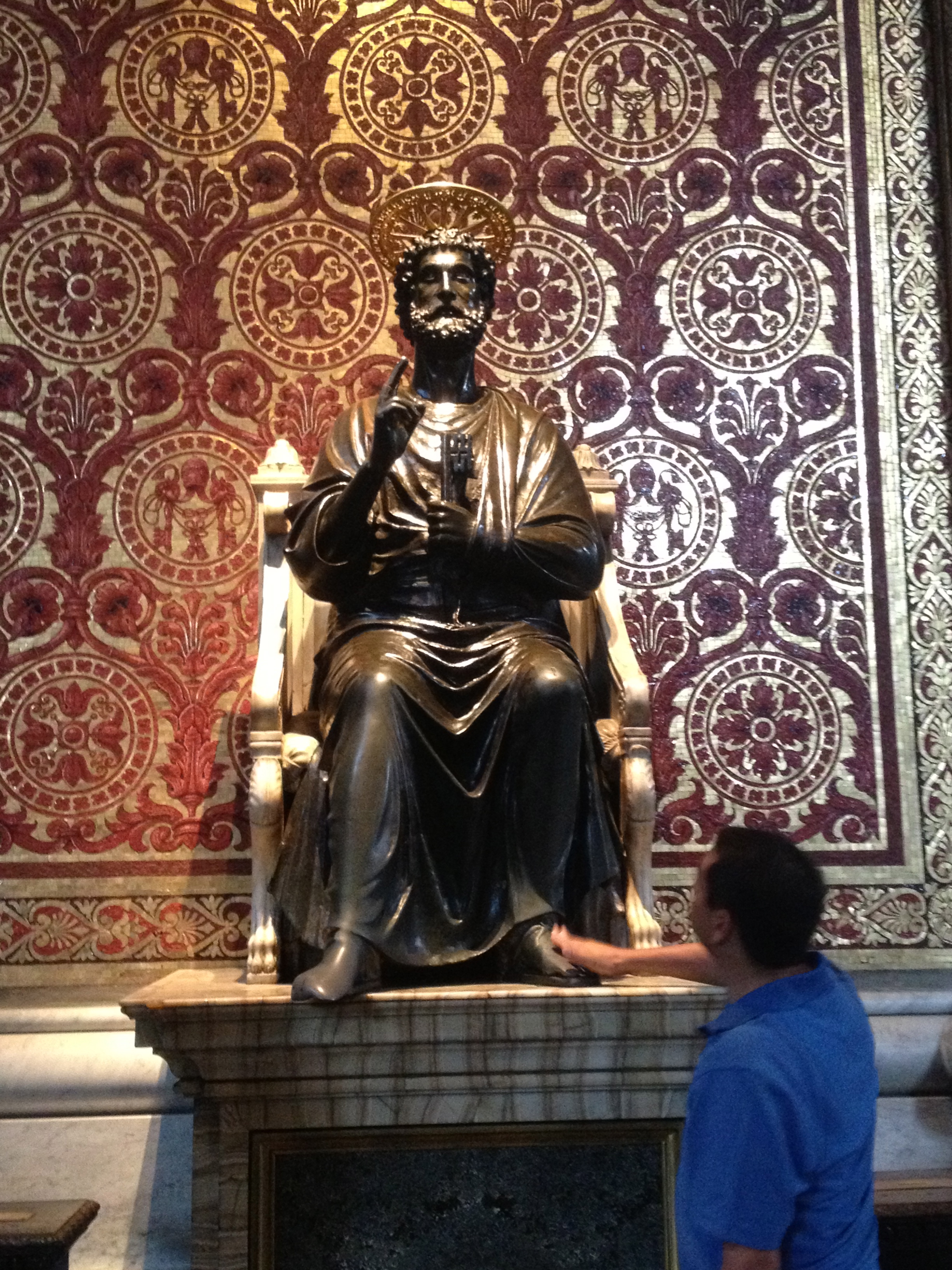
The statue of St Peter with his worn worn down foot.

The statue of St Peter with his worn worn down foot.

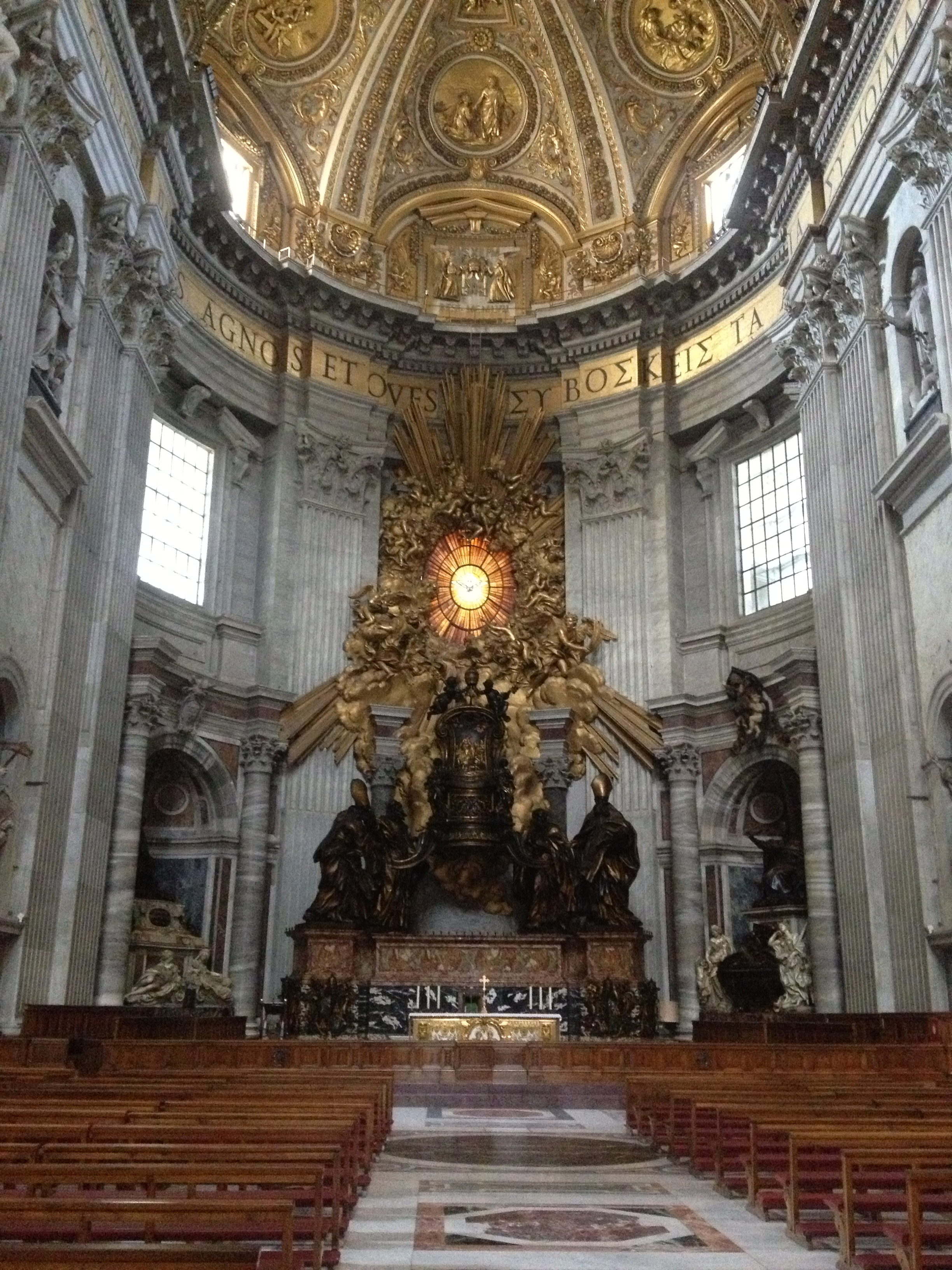
The main alter in the church, featuring the Apse Cathedra (the chair of St Peter) and the Apse Gloria (the stained glass window).

The main alter in the church, featuring the Apse Cathedra (the chair of St Peter) and the Apse Gloria (the stained glass window).

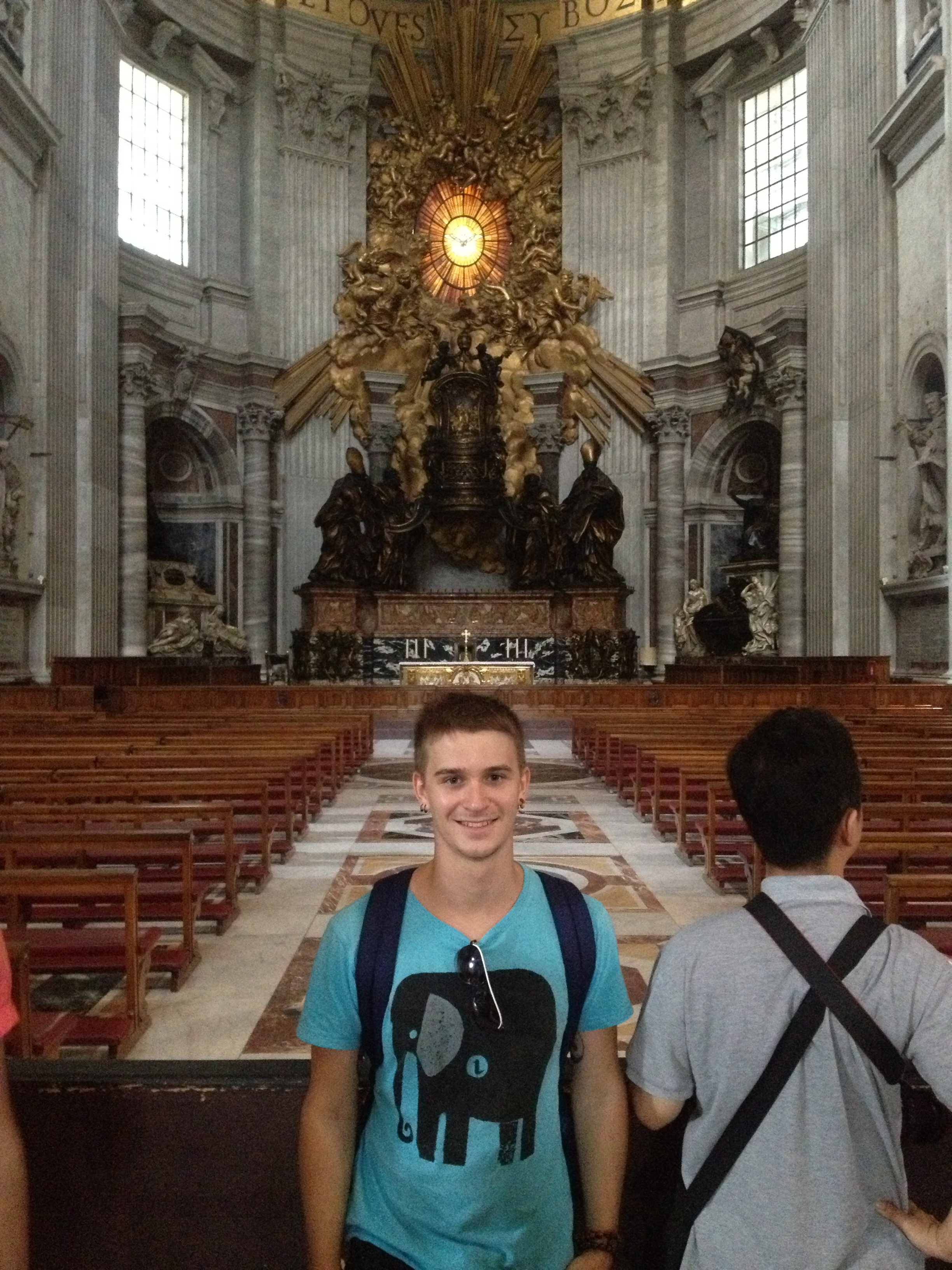
Personal reflection aside, the basilica is still rather wondrous to behold. A highlight is the statue of St Peter, whose toes on this right foot have been worn down to a smooth nub after centuries of pilgrims touching and kissing his foot while they pray to the saint. As I was taking a photo of the main alter in the church, I was tapped on the shoulder. I turned around to see a couple, a man a woman, extending their camera out to me and pointing at the alter. Figuring that they wanted me to take a picture for them, but also guessing that they didn’t speak English or Italian, I just smiled and nodded. I took the camera and snapped a few shots before handing it back to them, and then motioning for them to take a few for me in return. “спасибо,” (or phonetically ‘spasiba’) the man mumbled to me in a deep voice as we parted ways. I got momentarily excited, and went to say “You’re welcome”, until I realised that ‘thank you’ was pretty much the extent of all the Russian that I knew. After I had finished looking around and taking a few pictures, I exited St Peter’s Basilica through the underground crypts, where former Popes are laid to rest. It was a solemn route in which photography was not allowed, so after I left I snapped a few last pictures out the front in St Peter’s Square.

Having my photo taken with the main alter by the surly Russian couple. Also annoyingly photo-bombed.

Having my photo taken with the main alter by the surly Russian couple. Also annoyingly photo-bombed.

This rebel worshipper decided to touch the other foot instead of the traditional one. St Peter's left foot still have distinguishable toes.

This rebel worshipper decided to touch the other foot instead of the traditional one. St Peter’s left foot still have distinguishable toes.

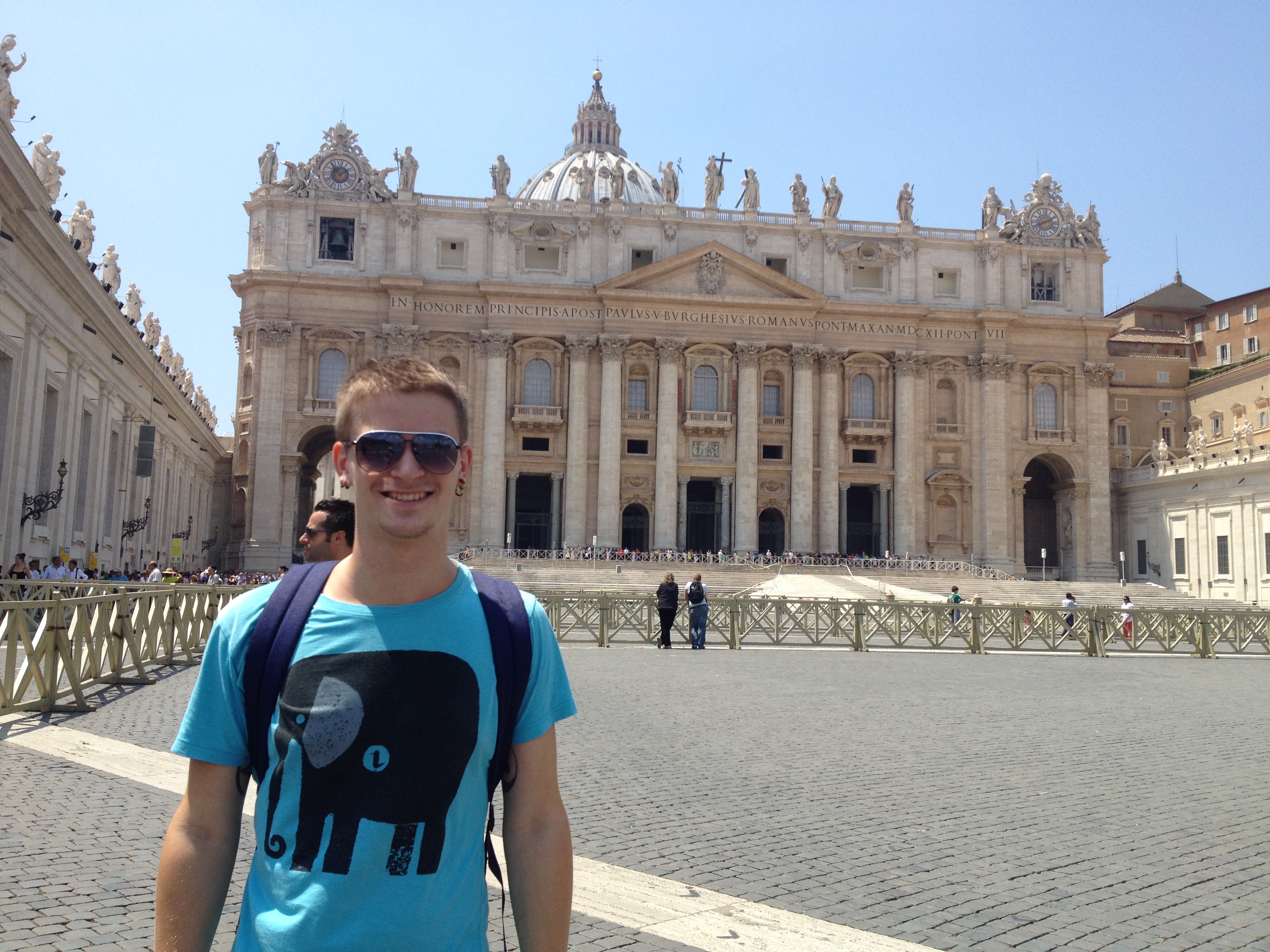
Outside St Peter's Basilica.

Outside St Peter’s Basilica.

Outside the church in St Peter's Square.

Outside the church in St Peter’s Square.

***

The next stop of the day was the other major feature of the Vatican – the Vatican Museums. Now I’m not a huge art buff, but I’m no snub either, so I wanted to take my time and at least see some of the highlights – according to Lonely Planet you would need a couple of hours for that alone. I followed the crowds exiting the basilica and found my way to the museums. I instantly knew that I had made the right decision in forgoing the expensive tourist trap guided tours of the Vatican Museums – what appeared to be a long waiting line to get in was actually just a steady stream of people moving into the building. I never actually stood still once while I was ‘waiting’, and I was in and away in no time.

The collection of artworks in the Vatican is quite remarkable though. Every room is crammed with as many works of art as possible, from the most minuscule and seemingly insignificant to the most amazing of masterpieces. There were sculptures, statues, paintings, portraits, walls and ceilings decorated with the most extravagance: it just went on and on. I won’t even attempt to describe or explain everything I saw, but I did take a few photos of some of my favourite pieces.

The Vatican statue of Neptune.

The Vatican statue of Neptune.

The famous statue titled "Laocoön and His Sons", which depicts them being strangled by a snake.

The famous statue titled “Laocoön and His Sons”, which depicts them being strangled by a snake.

A collection of various sculptures on display.

A collection of various sculptures on display.

The Belvedere Torso.

The Belvedere Torso.

One of the roof paintings in the halls of the Vatican. Unfortunately they're not so easily marked, thus not easily identifiable.

One of the roof paintings in the halls of the Vatican. Unfortunately they’re not so easily marked, thus not easily identifiable.

The statue of Hermanubis, a god who was a combination of Hermes in Greek mythology and Anubis in Egyptian mythology.

The statue of Hermanubis, a god who was a combination of Hermes in Greek mythology and Anubis in Egyptian mythology.

A mummy in the Egyptian wing on the museum.

A mummy in the Egyptian wing on the museum.

The sarcophagus of St Helen.

The sarcophagus of St Helen.

Another ceiling painting in the Vatican.

Another ceiling painting in the Vatican.

I followed the signs and directions for the most brief tour of the museums, which as expected still took a couple of hours. But no matter how you go about it, the final stop on any tour of the Vatican Museums inevitably has to be the Sistine Chapel. Photographs are forbidden in the main chamber, and rightly so. I’ve previously expressed similar sentiments that being unable to take a photo of a place, such as inside the temples of the Emerald Buddha in Bangkok, make the place a little more special and sacred, and you really have to be there to see it. Of course, you can see the highlights of the chapel with a quick Google search, but there is so much more to the room than Genesis. The chapel itself would have been quite a chilling and moving sight to behold, if it weren’t for the fact that the rule of silence was so heavily policed. Don’t get me wrong, I think that requiring to be silent in places like the Sistine Chapel is totally acceptable – it’s still a holy place and I’m sure there’d be dozens of Catholics around the place casting prayers up to Heaven as they gaze around in awe. But the effect of that silence, and indeed the point of requiring it, seems a little defeated by the “ATTENTION! SILENCE PLEASE! NO PHOTOGRAPHY!” boomed out over a very loud speaker system in 6 different languages every thirty seconds. It’s a little hard to be impressed while standing in the midst of a famous work of art when you feel like you’re being ordered around like a herd of cattle.

One of the halls leading up to the Sistine Chapel.

One of the halls leading up to the Sistine Chapel.

The famous Spiral Staircase that leads to the exit of the Vatican Museum.

The famous Spiral Staircase that leads to the exit of the Vatican Museum.

Although, it’s disappointing to admit that more than half the tourists in the room were behaving like cattle. I left the museum after that, and the Vatican as a whole, feeling not exactly underwhelmed by what I had experienced, and not necessarily disappointed. I just felt a little confused. Like, was there something I wasn’t getting? I appreciated these places as world renowned and works of art, but I just felt like I was missing something that made it all really seem that worth it. Maybe it was the disillusionment I felt in St Peter’s Basilica, or maybe I was just suffering from museum fatigue, or was just tired of an itinerary that was starting to feel like a season of  “Europe’s Next Top Cathedral”. I was glad that I had seen what I had seen, but I decided after my visit to the Vatican that I was going to terminate the rigid itinerary that Selma had provided me with. There were still a couple of major sights I legitimately wanted to see, but I think my trip to the Vatican marked the day that I had officially grown tired of museums, churches, and every other typical tourist attraction.

Rome Wasn’t Built in a Day

After a decent nights sleep at Valerio’s house, I woke up feeling remarkably refreshed and ready to take on Rome. I had been told by almost everyone who had visited Rome that the city was enormous, and that if you didn’t have a plan of attack you could easily waste all your valuable sightseeing time trying to find your way around the maze of combined modern and ancient history. Lucky for me, I had met Selma in Barcelona, who had seemed more excited than I was at the fact that I was going to Rome. We had exchanged contact details, and at some point during my stay in Madrid she had sent me a huge message that had included a list of all the famous sights, monuments and neighbourhoods, as well as a detailed itinerary of how to make the most of all these things and visit as many as possible in the three days that I had to explore Rome. I felt a mix of overwhelming gratitude and guilt – I hoped she had already had this itinerary written down and had just forwarded it on to me, because what I got had been so much more than I had expected when I’d asked for “a few tips”. Nevertheless, she had saved me a great deal of planning when it came to all that touristic stuff that I’d never really been any good at.

As convenient as getting to Valerio’s house from the airport had been, getting from Valerio’s house to central Rome was somewhat more of a challenge. I had to get a bus to the closest metro station, and then from there catch the metro into the heart of the city. The whole trip should have only taken me half an hour if the public transport ran on time, but I was about to learn very quickly that literally nothing in Italy runs on time. So it took a little longer. Given the size of the city, I was also surprised that Rome only had two metro lines that ran diagonally across the city and intersected only once or twice in the middle. Cities like Moscow, Berlin, Paris, Madrid and even Barcelona all had upwards of around fifteen metro lines, so it was puzzling as to why Rome was so far behind. Valerio would later tell me that the city was working on a third line. It’s completion was scheduled for approximately somewhere in the next several years – Rome wasn’t built in a day, I guess?

When I finally reached central Rome, my first stop was Piazza del Popolo, a large public square with a huge obelisk towering over the tourists crossing the plaza. From there I following Selma’s directions and climbed the stairs up to Pincio Hill. The top of the hill was a beautiful and quite peaceful garden, a stark contrast to the hustle and bustle of the lower streets of Rome that I had been in so far. It was also a spot that afforded excellent panoramic views of Rome, so I stopped to take a couple of photos before wandering through the greenery. I followed the edge of Pincio Hill until I rather unwittingly walked down the next attraction, Scalinata della Trinità dei Monti: the Spanish Steps. It wasn’t until I reached the bottom and arrived at Piazza di Spagna, thought to be the most famous square in Rome, that I turned around and took in my surroundings. The square is a common rest stop for tourists wandering the city, so it was quite crowded, and at the top of the steps sat the French church Chiesa della Trinità dei Monti.

The obelisk in Piazza del Popolo.

The obelisk in Piazza del Popolo.

The view of Piazza del Popolo from the top of Pincio Hill.

The view of Piazza del Popolo from the top of Pincio Hill.

View of Rome from the top of Pincio Hill.

View of Rome from the top of Pincio Hill.

The garden on top of Pincio Hill.

The garden on top of Pincio Hill.

At the foot of the Spanish Steps I came across my first Roman fountain, the Barcaccia, sculpted in 1627 in the style of a sinking boat. Valerio had told me that the water in all of the fountains around Rome was safe to drink. I hadn’t understood at the time, but I would soon learn that similar fountains were scattered all around the city, and thirsty tourists and locals alike could be seen stealing a sip from the flowing water, or filling up their water bottles. The water all comes from clean underground springs and is completely safe to drink as it pours out of the fountain. It was a cute little feature of the city, and particularly convenient given how hot it was that day, and all the walking I still had left to do. From Piazza di Spagna I walked down Via dei Condotti, the posh shopping strip of Rome that was lined with expensive designer and luxury brands. It was an amusing juxtaposition, to see such expensive and modern designer brands in the shop fronts that were situated in some of the oldest streets in the world. Though the entire city of Rome was full of such contrasts – modern stores that were built a few months ago stood side by side in the street with structures that had been standing in place for over 3000 years. For someone who comes from a country as young as Australia, it was a strange concept to fathom.

The Spanish Steps and the church at the top, as seen from Piazza di Spagna.

The Spanish Steps and the church at the top, as seen from Piazza di Spagna.

The Barcaccia fountain at Piazza di Spagna.

The Barcaccia fountain at Piazza di Spagna.

At the end of that street came the Trevi Fountain, one of the more well-known and more highly anticipated sights of Rome. The crowds around the fountain were unbelievable – it was almost impossible to get a photo without someone else being the photo. I actually saw a couple of fights break out between groups who were trying to take photos while other groups were getting in the way. It was actually quite frightening, and at that point I decided I wasn’t going to stay in any areas heavily populated by tourists for any longer than necessary. It was at that point that I broke away from Selma’s itinerary, although not entirely intentionally. I thought I was following her directions to another plaza, but after a while I emerged into a clearing to behold the Pantheon, another instantly recognisable sight. The 2000-year-old temple is now a church, and one of the best preserved monuments in Rome. It was beautiful, both inside and out, and the dome in the roof that is considered to be the ancient Romans greatest architectural achievement allowed a cylinder of sunlight to pour in from the sky. It was a little eerie, but also gave a rather holy feel to the aesthetic of the huge old room. I wandered around the inner chambers and admired some of the artworks and decorations before taking leave back out into the midday sun.

Trevi Fountain.

Trevi Fountain.

In front of (or as close as I could get to) Trevi Fountain.

In front of (or as close as I could get to) Trevi Fountain.

The Pantheon.

The Pantheon.

Alter inside the Pantheon.

Alter inside the Pantheon.

Sunlight pouring through the dome in the roof of the Pantheon.

Sunlight pouring through the dome in the roof of the Pantheon.

A few short streets later and I found myself at Piazza Navona, a long plaza that is home to several fountains, the most famous of which is Fontana dei Quattro Fiumi, the Fountain of Four Rivers. The plaza was full on tourists, but it also seemed to be a popular place for buskers, street performers, artists drawing both realistic sketches and caricatures, and peddlers selling all kinds of souvenirs and trinkets. It reminded me a lot of some of the heavily touristic areas in Paris, and I stayed for long enough to observe some of the interesting things going on, and take a few photos of course, before heading off and moving on.

The Fountain of the Four Rivers, the centrepoint of Piazza Navona.

The Fountain of the Four Rivers, the centrepoint of Piazza Navona.

The Neptune Fountain in Piazza Navona.

The Neptune Fountain in Piazza Navona.

La Fontana del Moro, the Moor Fountain, in Piazza Navona.

La Fontana del Moro, the Moor Fountain, in Piazza Navona.

There were a few other things on Selma’s itinerary for the first day, but they were more missable things such as places to eat or where to get some good gelato. I would have followed through and investigated, but by that point I was completely exhausted. My body still hadn’t fully recovered from the breakdown in Madrid, so I ended up grabbing some quick take away food before heading back to Valerio’s to rest and recover for the remainder of the afternoon. I know, it seems sacrilegious in a city and country known for some amazing cuisine, but the last thing I felt like doing was sitting down at an overpriced tourist restaurant by myself. However, I did swing by the Termini train station on my way home, so that I could book my tickets out of Rome for a few days time. On my way there I passed a building which I later learned to be Monumento Nazionale a Vittorio Emanuele II, the Alter of the Fatherland, the National Monument for Victor Emmanuel II, which had also been on Selma’s itinerary. It’s a controversial monument that was built in honour of the first king of unified Italy, and also holds the home of Italy’s Tomb of the Unknown Soldier and the accompanying eternal flame.

The National Monument for Victor Emmanuel II.

The National Monument for Victor Emmanuel II.

After waiting an hour to be served and book my train tickets (again, this is Italy, so no surprise there), I took the metro and the bus back home to Valerio’s. Considering I was far from my peak physical condition, I felt I had done a decent job of sightseeing for the day. Rome wasn’t built in a day, and you certainly can’t see it in one either, so I had a quiet and early night, making sure I got plenty of sleep to continue the exploring tomorrow.

Rome Without a Home

I know that it sounds slightly ridiculous, but one of the contributing factors to my little emotional breakdown at the end of my stay in Madrid was the anxiety I had about boarding my very first Ryanair flight. With the exception of one ferry, I had made the journey from Beijing to Madrid entirely by trains, and for the first time in a couple of months I was accosted with the issues of baggage dimensions and maximum weight limits. Ryanair are known for their absolute rigidness with these rules and, being a budget airline, their limits aren’t exactly generous. I had a 15kg weight limit for my checked bag – which was already an added cost on the price of the ticket – and I was allowed to take one piece of carry on luggage that was within the dimensions of 55cm x 40cm x 20cm. Which would have been fine it weren’t for the fact that I had another carry on item – my little blue ukulele – that I had simply been clipping onto the outside of my backpack. I had a sinking feeling in my stomach when I realised I wouldn’t be able to do that this time, but also that it seemed very unlikely that I would going to fit the ukulele into either of my bags.

I figured the little instrument would get tossed around and far too damaged if I put it in my checked luggage, so I went about attempting to fit it inside by small backpack. The top was sticking out between the zippers, and it also meant I’d had to shift some things from the smaller backpack to the bigger one, bringing its gross weight ever closer to the already quite low maximum. I sat on the floor of the dorm with my belongings scattered over my bed, playing Tetris with them as I tried to fit them around the awkwardly shaped ukulele I now had to cater for.
“Do you think that’s within the required dimensions?” I asked Rachel. She wasn’t much help there, being unfamiliar with the metric system, but she attempted to calm my anxieties.
“They’re a pain in the ass, those airlines, but the trick is to be confident, if you ask me. They may not even make you measure it if you walk in feeling confident enough that you don’t need to prove it.” It made a bit of sense, I guess, but the top of the ukulele sticking out through the backpack was keeping my fear in check. It would cost €60 to check it in separately as a musical instrument, and I’d only paid $35 for it in Australia. I mean, worst case scenario was that I made it to the gate but would have to leave the ukulele behind. But still, it had made it this far, and if it came to that then I’d be sad to see it go.

***

The other thing that was causing me a fair bit of stress was that I had no idea where I was going to stay once I got to Rome. Every single hostel I found through online searches were completely booked out, save one that had a sole night available on the evening I arrived. I booked it out of desperation, not sure how I was going to travel the 15km from Ciampino Airport to the city centre at around 11:00pm when I finally arrived. I had sent dozens of Couchsurfing requests, and even posted a message on a public group asking if there was anyone I could meet up with, even if they didn’t have a place for me to stay. None of my efforts proved fruitful. It was all getting a little desperate – it got to the point where I was calculating the hire charges for luggage lockers in the train terminal Stazione Termini, and just going homeless for a new days, turning tricks in some gay bars in order to find a bed for the night. Part of me thought that was kind of exciting, like a really crazy adventure, but most of me thought it was completely insane, and frantically returned to the search for somewhere to actually call home while in Rome.

Come the day of my departure, I wasn’t doing too good. When it grew late enough in the afternoon, I gathered my belongings and trekked it over the metro station. The closest station had been conveniently closed, so I had to walk a lot further in the hot Madrid afternoon sun to finally get to a working station. I hopped on the metro and rode it out to the airport, which would prove to be another confusing game of back and forth through the terminal, getting things stamped and finding the right gates and being told to go to the wrong place by person after person after person. By now I considered myself a pretty capable and experienced traveller, and I don’t normally have too many problems with airports, so maybe it was just the stress and exhaustion of the past few days, but this terminal of Madrid airport was a real kicker. Before checking in my bag, I literally stripped down in the middle of the terminal so that I could change and pull out my heavier items of clothing like my jeans, hoodie and thick leather belt, which I could wear on the plane and thus make my luggage a little bit lighter. It was almost 40°C that day, so I looked like a bit of a crazy person as I layered up, but I told myself it would only be for a few hours, and that it was probably going to be colder on the plane anyway. You can imagine my sheer relief when I put my bag down on the conveyor belt and the scale read “15.00”. Exactly 15kg. It felt like I’d just witnessed a miracle.

But my luck turnaround didn’t stop there. As I sat down to some hideously overpriced airport food and checked into the limited airport wifi, I was shocked to see a message from a Couchsurfing host in Rome. He had replied to the public message I had sent out, to anyone in Rome who would listen. “Hey Robert, do you still need a place to stay in Rome? Maybe I can help? Valerio”. I quickly messaged him back with my phone number, as well as the brief overview of the logistical disaster that I had found myself in. His response was more than I could have hoped for – he lived right near the airport I was landing in and offered to pick me up when my plane arrived. I thanked him profusely until I used up all my free wifi.

The last obstacle to overcome was the carry on bag. “Be cool, be cool,” I repeated to myself under my breath. “Confidence. Confidence.” I had my backpack on, stuffed with all my worldly possessions that exceeded 15kg, including the little ukulele peeking out past the zippers. However, there had been no restrictions on extra articles of clothing you were allowed to bring on the plane, so I had my hoodie draped over my shoulders and over my backpack, attempting to cover any irregularities that may have otherwise stuck out like a sore thumb – and it worked! After having my boarding pass checked I was waved through onto the plane without so much as a second glance. For all the things that had gone wrong and caused me so much anxiety before this flight, everything was turning out remarkably well.

***

The flight was smooth sailing, and we touched down in Rome at about 11:00pm, with Ryanair sounding their little victory ditty over the PA system to signify they’d had another on-time arrival. Valerio was waiting for me in the terminal when I emerged from baggage claim. He was a tiny man, probably just shy of five feet tall, but he was very sweet and very generous. He offered to drive me into the city where I had the hostel booked for one night. “If you had gotten a taxi, they would have charged you way more than they should have, because you’re a tourist. They assume you don’t know any better.” Which would have been right. “Watch out for things like that.” But when his home was literally a five minute drive from the airport, I said “Screw the hostel!” and decided to stay at Valerio’s that night. 12 hours ago I had been a panicking mess, with no idea where I was going, what I was doing, or how I was going to survive the next three days in Rome. Now, I had a shower to freshen up in (though Valerio apologies that the hot water wasn’t working, a cold shower was particularly refreshing in the Mediterranean heat), a spare bed to sleep in, and a new friend who was essentially my pint-sized saviour. I still smile to myself every now and then when I think about it, filled with equal parts of gratitude and wonder that things always just seem to sort themselves out in the end.

Bathroom Breakdown

The hostel that I stayed in during my time in Madrid would end up being the last one I stayed in for quite a while, but it was also one of the most fun and sociable hostels that I stayed in during my entire journey. The open layout and the party atmosphere meant that it was incredibly easy to strike up a conversation with whoever happened to walk into your dorm room. After my night out at Studio 54, I stumbled into the hostel with just enough time for a quick power nap before my check-out time. However, it was Monday morning, and the flight to Rome I had booked while I was in Barcelona didn’t fly out until Wednesday evening. I had two more nights left in Madrid, and since I hadn’t found anyone who had been able to put me up for those final nights, I had to try and book into the hostel again.

“We do have some room,” the guy working at reception said to me, “but…” There’s always a ‘but’. “You’re going to have to switch rooms. The bed you’re in now has been assigned to someone else.” I have no idea how their booking system works, or why they put particular people where, because I ended up moving from a full four bed dorm to an empty one, but I was way too tired and hungover to care. It actually worked out perfectly – I just dragged everything down the hall, down one flight of stairs, and into my new empty room, where I spent most of the day having a prolonged and much needed siesta. Later that evening, I was graced with the presence of some new roommates. Rachel was a girl around my age from Missouri, and she collapsed onto one of the bunks in an exhausted heap as soon as she arrived. She’d been travelling with her brothers and cousin, and now Rachel and her cousin Talon were in Madrid after being at the Running of the Bulls festival in Pamplona. We got chatting straight away, as she unpacked the mess that was her backpack and began sorting out all her things. I have to say, despite the reputation that American travellers have as the typical “stupid American tourists”, they were ultimately some of the nicest and friendliest people that I met during my time in hostels. Rachel and her traveling family crew had been all over Europe via train as well, so we shared stories and experiences and before long it felt like I was catching up with an old friend. She was exhausted at that point, but we made plans to meet up later for a drink at the hostel bar.

***

I headed out to have some tapas for dinner, and drink a small bottle of wine that was served not with a wine glass, but a large shooter glass… okay then. Very confused, I took my shots of red wine while I contemplated what my next move was going to be. I had my flights to Rome booked for the following evening, but absolutely no idea what I was going to do when I got there. During my down time over the last few days, I have been frantically searching for Couchsurfing hosts in Rome. It was high season in Europe at that moment, and I had made the horrifying discovery that almost all of the hostels and accommodation within my price range were completely booked out. It was exactly like my arrival on that Friday night in Hamburg, except this time I had sufficient time to search for alternatives on Couchsurfing. I wrote over a dozen long, personalised requests to hosts from all over Rome, but I only ever received replies from about a quarter of the people I contacted, and none of them were able to host me while I was in town. It seemed a little strange, given the size of the city, and by Tuesday evening I was stifling the rising panic inside myself.

Tiny bottle of wine with a glass that is probably highly appropriate to Spanish culture.

Tiny bottle of wine with a glass that is probably highly appropriate to Spanish culture.

After a few deep breaths and a final shot of shiraz, I headed back to the hostel to meet Rachel and Talon for a beer. I found them on the rooftop with a pitcher of beer, and the warm evening air was giving way to a cool change that blew through the balcony. They were sitting with a pair of brothers, also around our age and also American, and the five of us sat around chatting, only moving to take cover under the large cloth shade umbrellas when a brief but heavy downpour of summer rain bucketed down on us. After a couple of pitchers of beer, Talon decided that he wanted churros, the traditional Spanish doughnuts, and so we headed out into the streets, the smell of rain on the hot asphalt filling the air. We got a dozen churros and a bottle of chocolate dipping sauce to go, and walked on up to Puerta del Sol, where we saw crowds of locals and tourists alike, hanging out in the square doing tricks on their skateboards, or playing instruments and busking for money. We sat by the edge of the fountain and watched the world go by. It was there, relaxing in the plaza with my new friends, that I didn’t feel so bad about the way I’d spent my time in Madrid. I had done minimal sightseeing – there hadn’t been any major sight or particular attraction that I had wanted to see, and I had passed up every opportunity to visit museums. But I had been partying like crazy – for me, Madrid was a city that you do, not a city that you see. I had spent almost my whole time in the streets amongst the people and the nightlife, and as I reflected on my stay in Madrid, I was incredibly satisfied with the experience I had had, and my time spent in the city. I’d made friends, both locals and other travellers, and I had done things that no admission price could have bought me.

***

I had fun in Madrid, but my time spent there also took its toll on me. In my attempt to make up for the failed nights out in Barcelona, I had managed to go out drinking and partying every night for over a week straight. That, combined with the unanticipated lack of Couchsurfing hosts and the spending on accommodation in the last few cities, threw my budget a little out of whack, but the biggest blow the week of partying in Spain had dealt me was to my health. A week of excessive alcohol consumption, lack of sleep and very little nutritious food left me feeling like something of a train wreck come Wednesday morning. It was a combination of a summer cold and mild malnutrition, coupled with the stress and anxiety that it was now less than 24 hours until I was due to land in Rome and I had absolutely no idea where I would be going after that. I had secured a single night in hostel in town, which was a long way from the airport I would be arriving in at approximately 11pm. I had to check out of my hostel room in Madrid at 10am when my body was telling me “Lie the Hell down, you exhausted idiot!”, so there I found myself, sitting alone on a sofa in the common room of the hostel, searching desperately through Couchsurfing profiles, scared and alone.

I’m not really proud of what happened next, but I’m going to tell you, because it was actually somewhat of a milestone in my journey. I had a bit of a breakdown. I went into the  bathrooms, locked myself in a cubicle, sat down, and cried. Not just cried – I sobbed, balling my eyes out into my palms and wiping my nose on my sleeve, to little avail given that I was already pretty physically sick on top of being an emotional mess. And I can’t exactly put my finger on what it was that cracked me – sure, there had been a couple of disappointments and a few close calls and rather scary or stressful incidents, but for the most part my journey had been an incredible experience that was overwhelmingly positive and fun. I suppose I could put it down to the deterioration of my current personal situation – if something in the outside world of my surroundings goes wrong, it’s not difficult to come up with a plan or solution or something else to fix it. But as soon as my body began to be the thing that was going wrong… Sometimes we’re not as tough as we think.

I also felt a bit lonely, which seems a little paradoxical. Physically, there were always people around, and aside from sleeping I very rarely had time to myself – and in the hostel environment, sometimes not even then. But it was the familiarity of close friends that I was starting to miss. Meeting new people every day was an amazing experience, and it’s always fun to get to know people and start fresh with that kind of thing, but there are days when things begin to catch up to you, and all you want is that friend who knows exactly what you’re thinking without you having to say it, knows exactly what’s wrong without having to ask it, and knows how to make you feel better by seemingly doing nothing at all. Ever since leaving Ralf behind in Berlin, this trip had been a crazy whirlwind of faces coming and going – and I guess somehow it all became a little too much. I wouldn’t exactly  say I was homesick – Hell, I knew I was doing a lot more fun and exciting things here than I thought I was ever going to do back home – but I was definitely tired, and in dire need of some of the more homely comforts that are hard to come by while on the road.

Sometimes I think everyone just needs a good cry. Whether the matter is trivial or life-altering, sometimes things just upset us, and the straw that breaks the camels back is enough to burst open the waterworks too. People might think it’s a sign of weakness, but afterwards you sometimes feel significantly better. I sat there for a little while after the heart of the breakdown, sniffling and wiping the tears from my cheeks, but in the end I got to the realisation that no one was going to come looking for me. No one was going to notice I was missing from the common room and ask if I was okay. I’d seen no sign of Rachel or Talon that morning, but to be honest I was glad that they didn’t see me post-cubicle breakdown: it wasn’t a pretty sight. I was on my own. But now, as the emotional storm was clearing, being alone wasn’t such a scary thing. It was a challenge. I’d been accosted by a shady monk in Thailand, I had survived motorcycle accidents in Cambodia, I’d had money scammed right out from under my nose in China, and I survived as an openly homosexual man in Russia without getting arrested, or worse. I’d made it through a lot worse: was I going to let a mere week of partying be my undoing? Not a chance in Hell!

With new resolve to take better care of my body and an optimism that I would overcome whatever obstacles my travels had in store for me, I emerged from that cubicle a better man. I could have easily left out this chapter of my journey when telling this story, but I think it’s important for anyone who is thinking of travelling, to let them know it’s not always a walk in the park. It’s not always a holiday or a vacation. Sometimes things go bad and it really sucks and at that very moment you really wish you weren’t there, that you were back home, or some place else a little more comfortable. And that’s okay. Because thats why we – or why I, at least – choose to travel this way. It pushes you to your very limits and faces you with challenges where you really have no choice but to overcome them. My little emotional breakdown was a milestone in that it taught me the true value of character building that comes with extensive travelling. And I wouldn’t have had it any other way.