Sacred Sunrise: Angkor Wat

The streets of Siem Reap were almost deserted – it could have been a ghost town if it weren’t for the few other tuk tuks and the occasional motorbike that puttered along on the road beside us. I rubbed the sleep from my eyes as dawn unfolded around the small Cambodian town – as I’ve mentioned before, early mornings and I make strange bedfellows, and I have no clear recollection of the last time I was getting out of bed at dawn. I peered through the thin light around us, and watched as the streets fell away to be replaced by dense woodlands and rainforest. I was on my way to the temples of Angkor Wat, to see what is regarded by many as one of the most beautiful sunrises in the world.

***

Yet my Angkor Wat experience had started the previous afternoon. After crawling off my overnight bus from Sihanoukville, I stumbled into a tuk tuk and asked to be taken to a cheap hostel. After being shown the dingy and humid dorm rooms, I caved in to the sales pitch of the hostel owners and checked into a private room – after the weekend I’d had, a comfortable bed, a private bathroom and a place to wash my underwear proved to be irresistible. Treat yourself, I told myself, and collapsed onto the bed to the catch up on the sleep that I had not managed to acquire during my overnight transit. I’d managed to strike an arrangement with my tuk tuk driver to be my guide through the major temples of Angkor Wat, so he told me he would come back this afternoon to take me up there to see the sunset. Unfortunately, he’d failed to mention that to be allowed inside any of the sacred buildings, you need to have the standard respectful clothing. In other words, attire that covers your shoulders and knees. I should have known better – it’s been the same with all the temples and palaces that I’ve visited throughout South East Asia. But my momentary lapse in judgement allowed me to rock up to the temple that is famous for its view of the sunset, only to be advised I wouldn’t be allowed to climb to the top due to the singlet I was wearing. I kicked myself for not realising this before I set out from the hotel, and then took a few photos of the view that I could see.

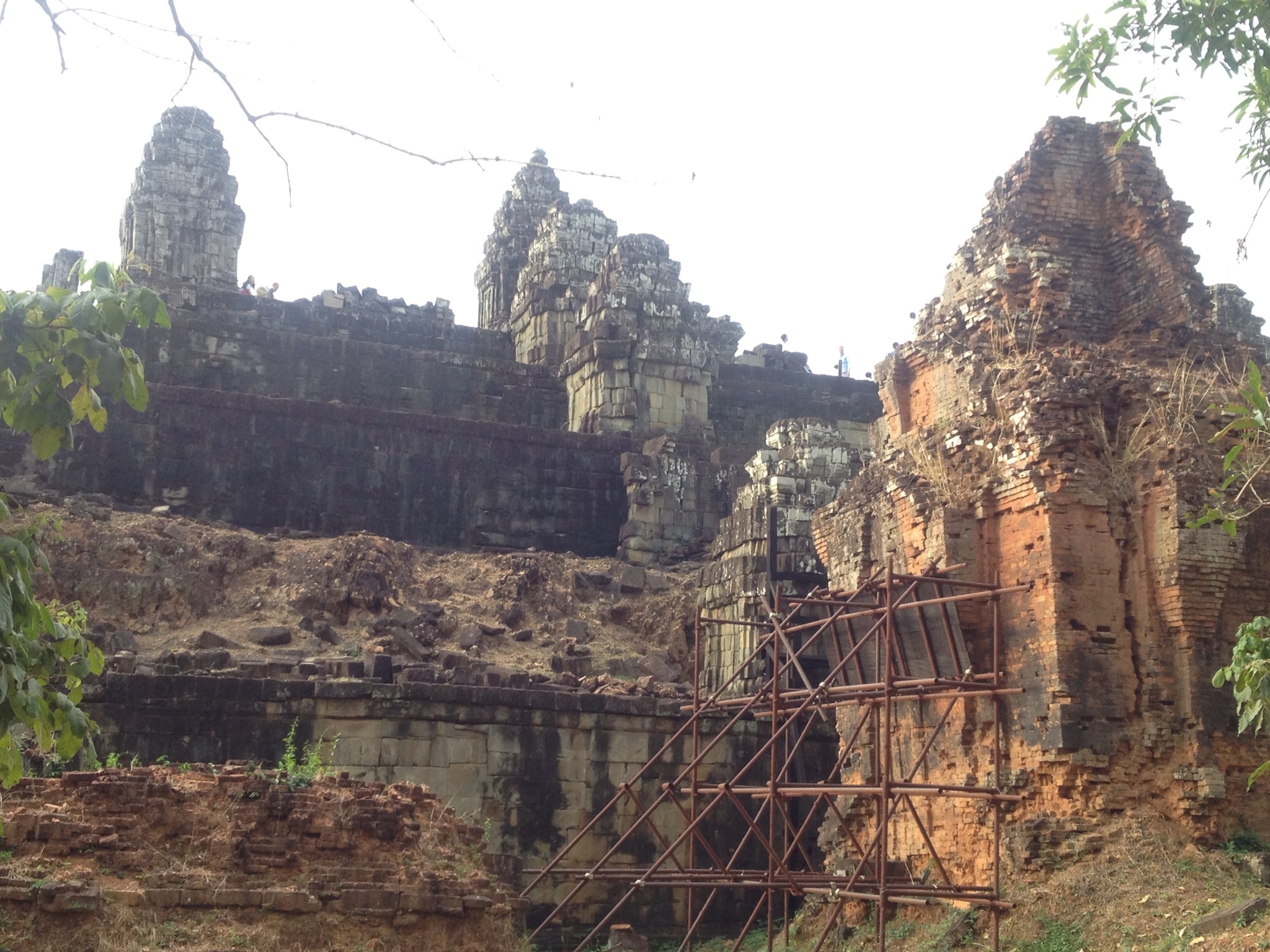
The ruin which has a beautiful view of the sunset, which I was not able to enter.

The ruin which has a beautiful view of the sunset, which I was not able to enter.

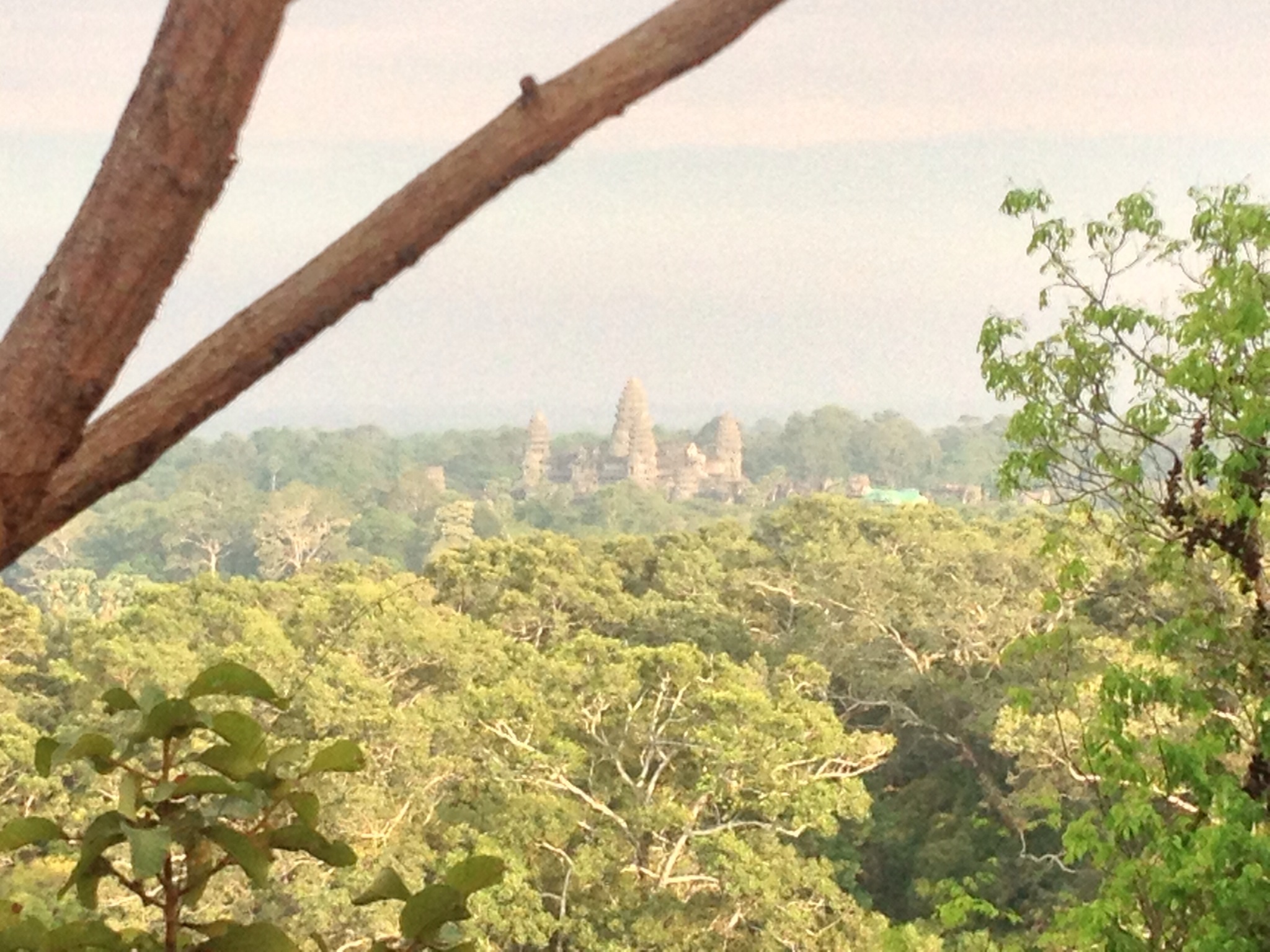
View of Angkor Wat from the base of the sunset ruins.

View of Angkor Wat from the base of the sunset ruins.

I was about to ask to go back to Siem Reap, but my tuk tuk driver said that I’d still be able to walk across the bridge that crossed the moat that surrounds the main Angkor Wat temple, all the way up to the main gate, so I decided to make the most of the sunset and check it out. The temple is really quite a fascinating structure, and it looked beautiful bathed in the light of the setting sun. I wandered up to see now far I would be allowed in. However, what I didn’t realise is that the temples technically close at five o’clock, and at this point it was almost six. Despite there being lots of people around, there were no guards or staff checking for tickets. As a result, my wandering found me quite deep inside some of the main chambers before I realised that I was well within the areas that required one to be ‘respectfully dressed’. But I’d come this far, and I couldn’t pass up the opportunity to take a few photos of the temple when it wasn’t completely flooded with tourists. I took a few photos of the mystical place, made a silent apology through prayer to anyone I may have offended, and quickly scampered out of the temple and back to my tuk tuk.

Angkor Wat in the light of the sunset.

Angkor Wat in the light of the sunset.

Inside the main Angkor Wat temples.

Inside the main Angkor Wat temples.

One of the entrances into the main temple.

One of the entrances into the main temple.

***

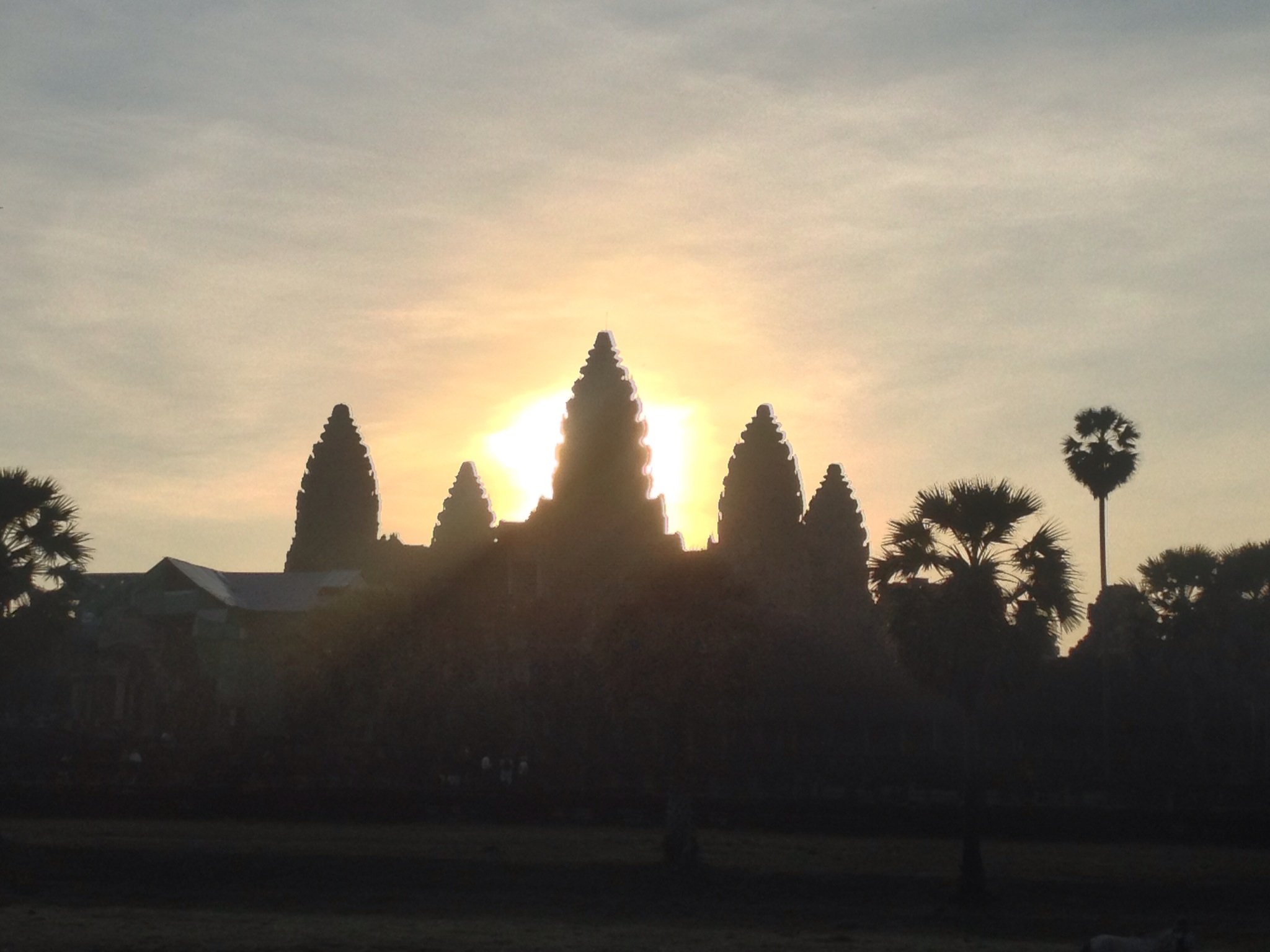
Flash forward to the next morning, and I am stepping out of the same tuk tuk in the same location, into a throng of people who are all making their way across the moat into Angkor Wat. Like cattle we plodded through the gates and into the inner compound, where there were already hundreds of people claiming their positions and setting up their cameras, keenly anticipating the rising sun. I found my own spot amongst the crowd and readied my camera for the moment the sun broke from behind the horizon and cast the temple into a silhouette. It was clear to see why the sunrise was such a popular event – the reflection in the pool within the grounds was simply stunning, and the temple took on an even greater air of majesty with sun burning brightly in the background. However, I couldn’t help but feel as though the experience was detracted somewhat by the extreme presence of tourism. It felt as though this structure, originally built as a famous and majestic Hindu palace, has been reduced to a holiday snap, a postcard, or simply just another checked box on a list of things to do in South East Asia. While I was still able to admire the view, the sense of mysticism and spirituality that I had while exploring the inner chambers yesterday had been successfully drained by the amount of photo taking going on around me.

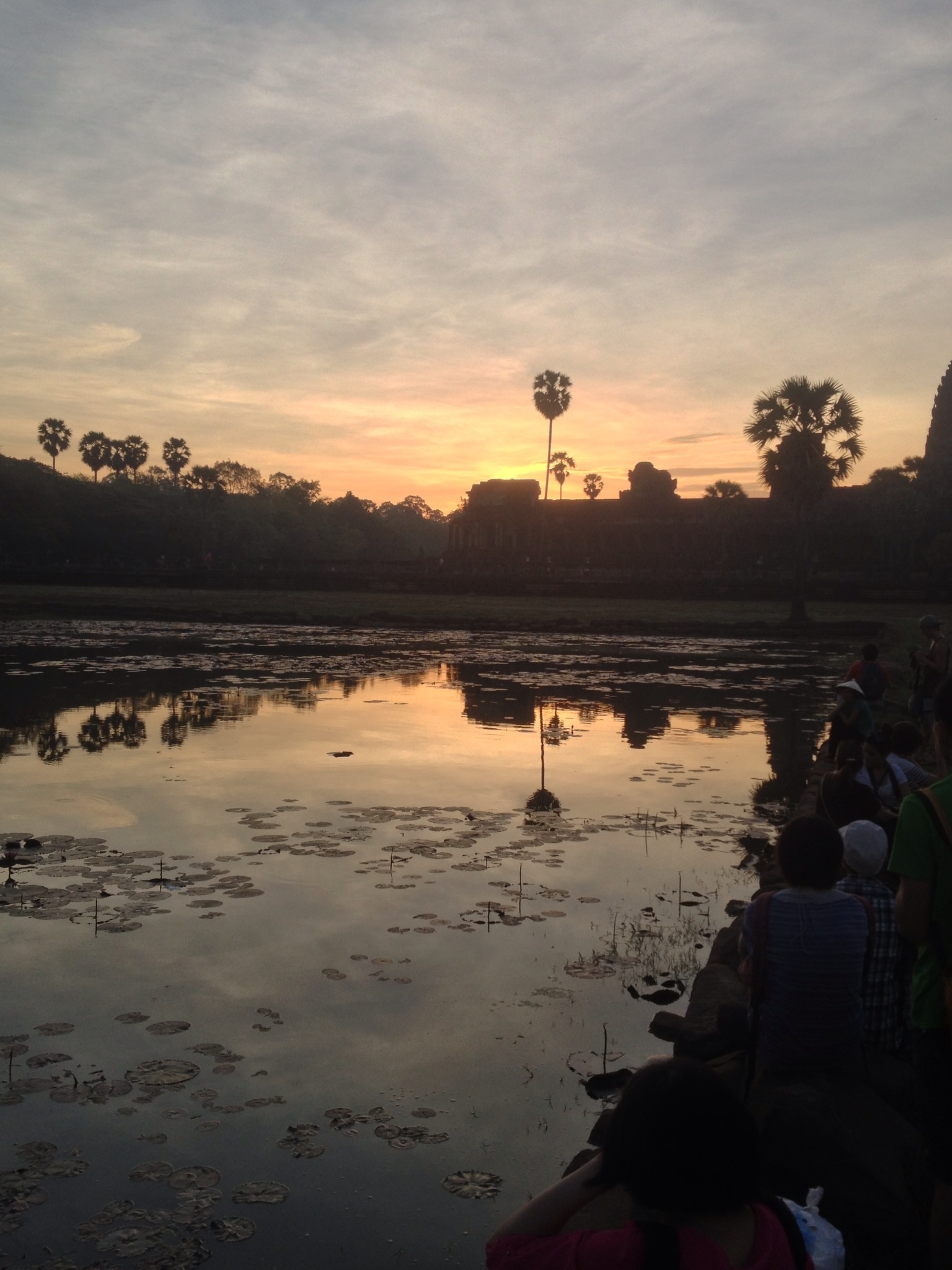
Reflection of the sunrise on the Angkor Wat pool.

Reflection of the sunrise on the Angkor Wat pool.

The throng of tourists crowding around the pool in anticipation.

The throng of tourists crowding around the pool in anticipation.

Sunrise over Angkor Wat.

Sunrise over Angkor Wat.

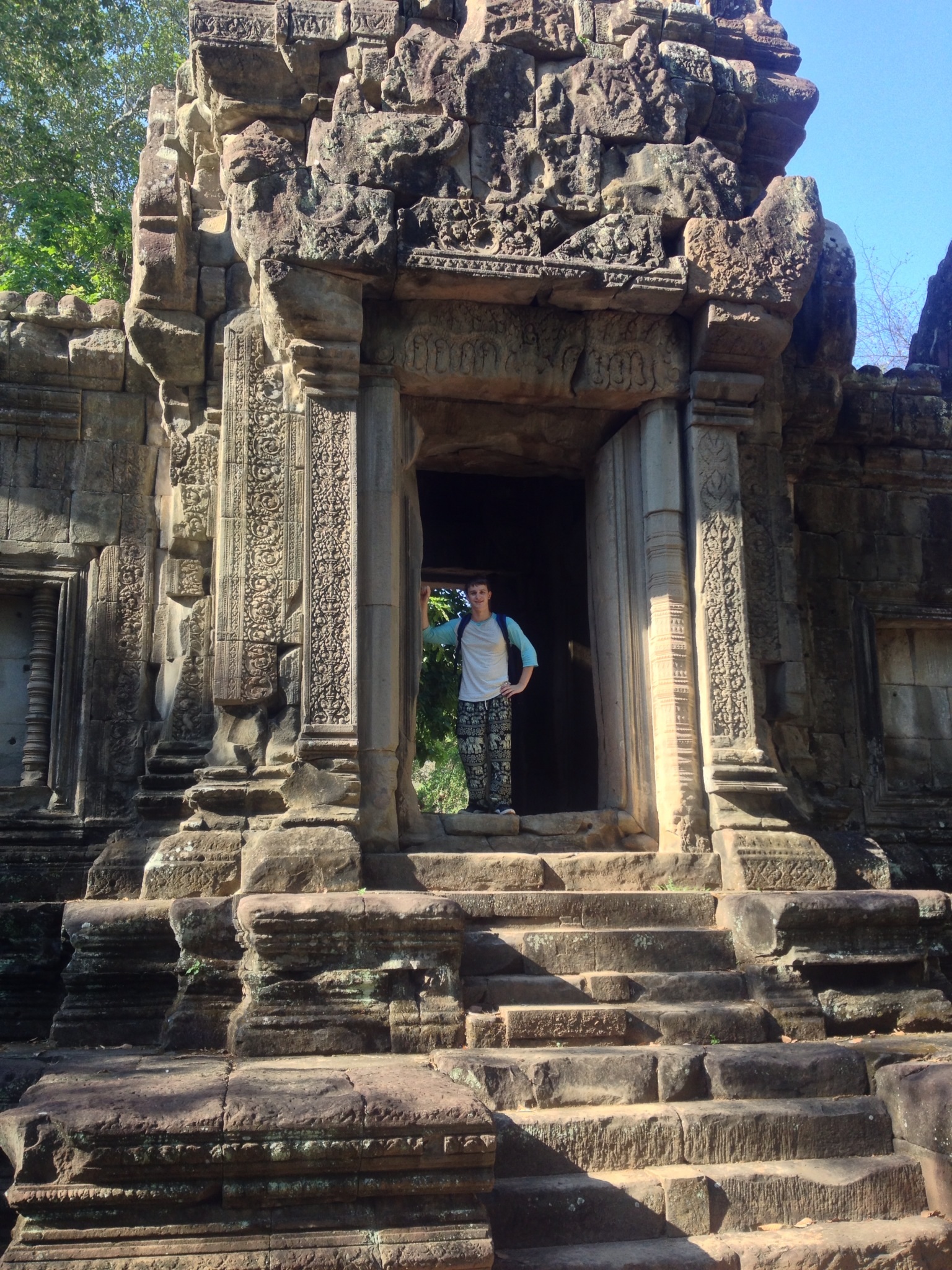
Standing in one of the entrances to the inner chambers.

Standing in one of the entrances to the inner chambers.

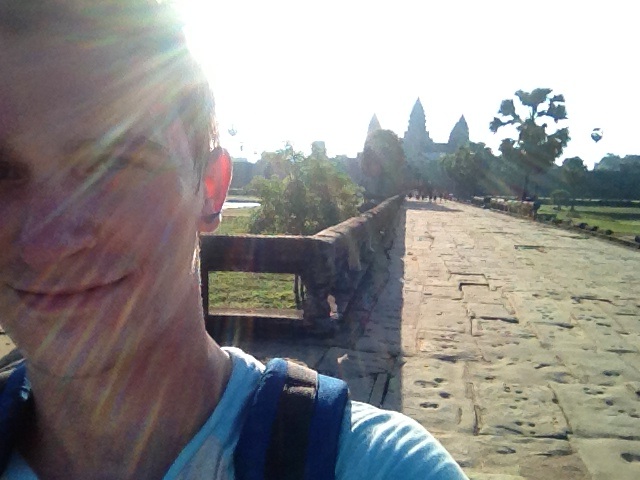
Sunrise selfies at Angkor Wat.

Sunrise selfies at Angkor Wat.

***

However, Angkor Wat is only one temple in what is actually a huge collection of relics and ruins scattered throughout a huge area. The entrance into the domain of these temples is about four kilometres from the town of Siem Reap, and once you pass the main temple you reach Angkor Thom, four times the size of Angkor Wat and not so much a temple as it is an ancient enclosed city, full of its own collection of ruined temples, the largest and most impressive of which is Bayon. My tuk tuk driver dropped me off there, and allowed me to explore the smaller ruins spread out within the walls of Angkor Thom. It was here, wandering through the rainforest and getting lost inside the deserted temples, that I really felt the awe and wonder that comes with the history behind these epic structures. While Angkor Wat was originally built as a Hindu palace, Bayon and the rest of Angkor Thom were Buddhist monuments. I still struggle to get my head around the specifics of the history, a tale riddled with kings, conversions and a host of sects within the two religions, even after a later visit to the Angkor National Museum, but for the moment I was happy to just wander through and explore the ancient wonderland.

Bayon temple inside Angkor Thom.

Bayon temple inside Angkor Thom.

Inside one of the smaller ruins.

Inside one of the smaller ruins.

A building colloquially known at the Elephant Temple.

A building colloquially known at the Elephant Temple.

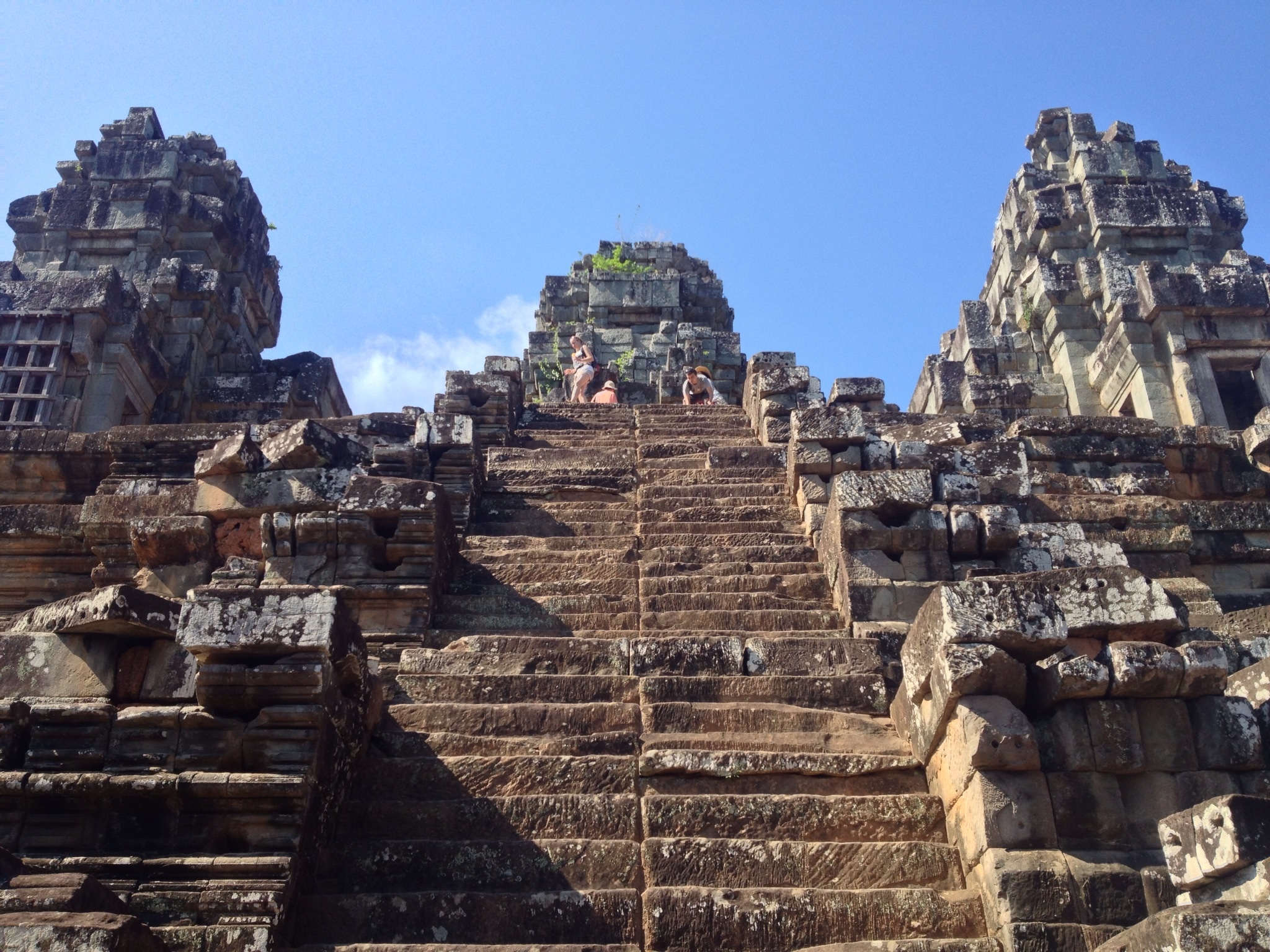
The steep steps of Ta Keo.

The steep steps of Ta Keo.

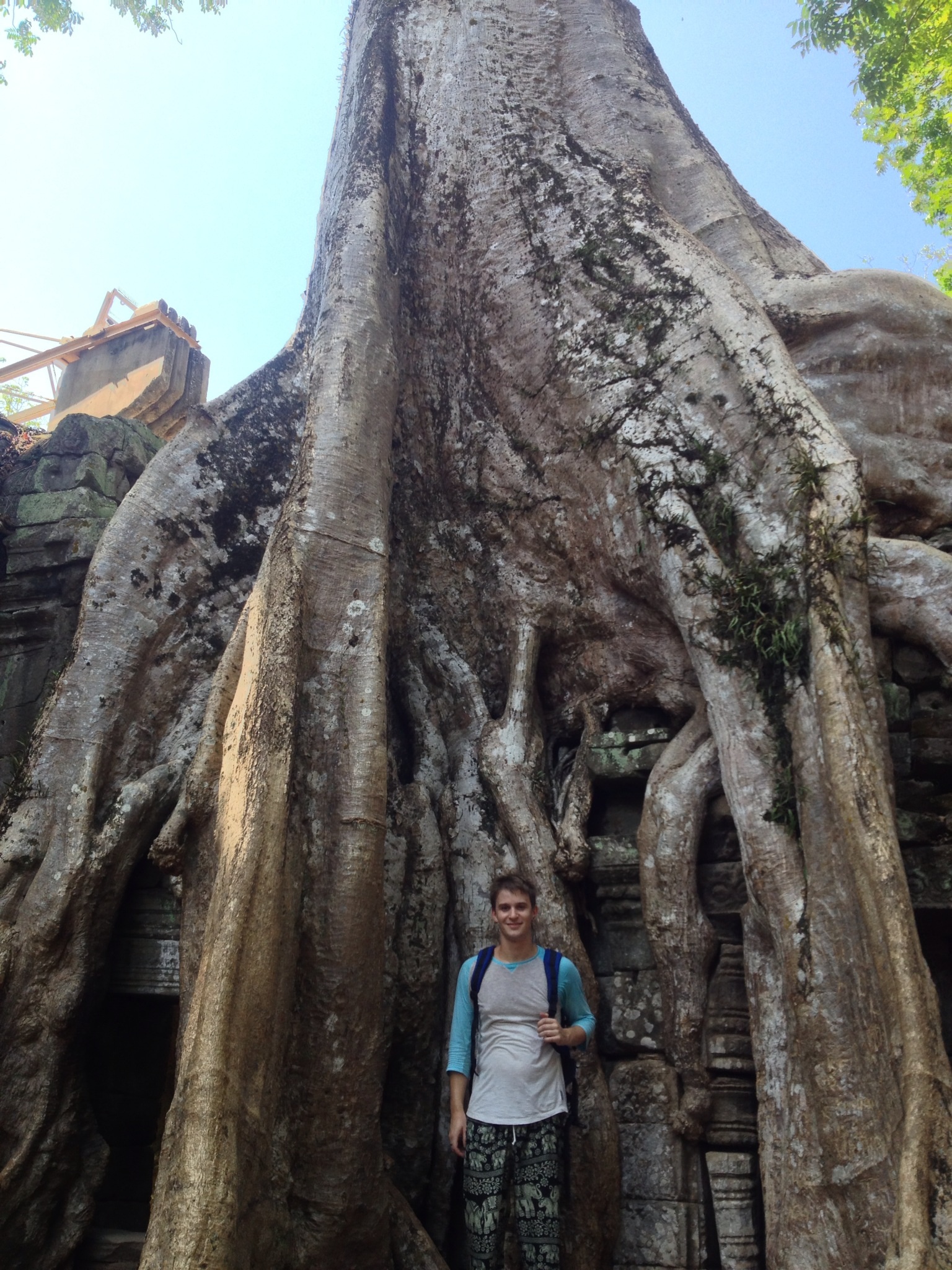
Part of the temple featured in Tomb Raider.

Part of the temple featured in Tomb Raider.

Myself with the 'Tomb Raider tree'.

Myself with the ‘Tomb Raider tree’.

***

My tuk tuk taxied me between the rest of the temple highlights, including an unfinished temple called Ta Keo, which lacked the detail of some of the other temples but whose steep staircases provided me with my daily exercise, and a dilapidated compound which I believe was called Ta Prohm, which contained several areas that were the location for the filming of Tomb Raider. Many of the temples were in poor condition, with parts of them closed off to the public due to reconstructions that were underway, but they were nevertheless an impressive sight. I was told by my mother that most people allow three days to see the temples. In Bangkok, Brendon had said one day was enough to see the best bits, unless you were truly mad about temples. In the end it wasn’t even midday before I decided to wrap things up at Angkor Wat. Between my afternoon visit, and having been awake since before sunrise, I had grown exhausted, and I also felt like I had seen quite a lot of what the area had to offer. Of course, there were more temples, but as my time in South East Asia was drawing to a close, I decided I had seen enough temples in the past six weeks.

Having said that, the temples of Angkor Wat really are something entirely different and special. It might have been checking off another box on the list of things to do in South East Asia, but it was definitely more than that. It’s an ancient and marvellous wonder, and one of the few things in this part of the world that could unquestionably be classified as a must see.

***

NB: While I tried my best to learn the history of the temples that I visited, it was long and complicated, and I can’t guarantee that everything I’ve said is correct, especially regarding what these temples were used for in previous ancient cultures. For more reliable facts on these things, please continue your research elsewhere

Leave It To The Locals

After traveling for over a month, I was beginning to feel pretty confident with my abilities in navigating new cities with a simple map and the unearthed Boy Scout skills from my childhood. The day before I had been driven from place to place in a motorbike tuk tuk, feeling relatively posh with my own little carriage to be chauffeured around in. During the evening of my second night in Phnom Penh, I had a brief encounter with another guy staying in my dorm, who had told me that he and a few other people had rented their own motorbikes and driven themselves around the city. Back in Ho Chi Minh City when my Couchsurfing host had offered me the controls of the vehicle, I had, rather sensibly, declined the offer. However, I’d seen quite a few people at my hostel in Saigon rent and even buy motorbikes, using it as a cheaper form of travel as well as a way to see more of the countryside. I had told them they were crazy, but one of the Americans had assured me that the traffic out there was nowhere near as crazy as in the city itself.

It never really crossed my mind again until it was mentioned to me in Phnom Penh. I’d seen the roads and the traffic, and it didn’t seem quite as busy as the hustle and bustle of Bangkok or Saigon. I told myself that I should be making the most of the unique experiences on offer here, and so far I’d been all about pushing my boundaries and challenging myself. With that in mind, I set off down the road to rent myself a motorbike, oblivious to the fact that my stay in Phnom Penh was about to get even more harrowing than a trip to the Killing Fields.

***

In retrospect, it was a terrible decision. As my mother reminded me when I emailed her after the fact, “You can barely ride a push bike, Bob!” Yet I was taken over by some kind of invincibility complex that most young adult males get after a six pack of beers (though it should be noted that I made this brilliant decision completely sober). The fact I’d never really ridden a motorbike didn’t occur to me as a potential problem – how hard could it be? It was only when they showed me the bike and demonstrated how to change the gears did the sheer unfamiliarity of this vehicle truly hit home. My blank, uncomprehending expression must have given me away, because one of the men suddenly shouted, “Ahh! Automatic! You need automatic?”. Honestly, I’d had no idea there were automatic and manual motorbikes until that very moment, but I figured I was going to have a hell of an easier time on an automatic one, so I agreed enthusiastically and waited for him to bring around another bike. After a brief overview of the controls, they handed me a helmet and the keys, and away I went.

I puttered along through the small streets, using the same cautious method that I employed for crossing the roads as a pedestrian, before turning onto a main road and zooming along with the rest of the traffic. It was a similar thrill to riding on the back of a motorcycle taxi, except this time there was a certain element of fear, given that I was the one who was actually driving. But I was doing pretty well so far. I was heading towards Phnom Wat, a large temple located in the north of the city, surrounded by lots of traffic. I managed to park the bike next to Phnom Wat, which was situated in the middle of a huge roundabout. I wandered over to the temple and had a brief look inside. It is still a very active place of worship, so I didn’t stay too long so as not to disturb the prayers inside. Besides, I was keen to get back on the motorbike and do some more exploring.

The temple of Phnom Wat, my first and only stop of the day.

The temple of Phnom Wat, my first and only stop of the day.

***

And shortly after that is when it all went wrong. My destination was to be the Russian Markets, which are supposed to be a unique and interesting corner of the city. I’d checked my map and memorised a rough route through the main roads, but I’d only been driving for a few minutes before I came up to the next roundabout. I needed to turn left, but as I followed the roads, I realised I was veering right, and there didn’t appear to be any way to change my course. Was I not as far as I thought I was? Was I taking a wrong turn? Could I still turn left from where the road was taking me? All these perplexing questions bombarded me at once, and the fact that they drive on the right side of the road rather than the left didn’t help my heightening confusion – although the very limited road rules at all hadn’t laid the best foundation for building confidence. In the end, I hesitated for just a moment, but that was all it took. I came tumbling off the motorbike and skidding across the road.

It all seemed so slow and surreal at first. I thought for sure that I was dead. I’d heard the horror stories, the idiot tourists who thought they knew what they were doing when they set out onto the roads and ended up becoming another statistic. I could hear my mothers “I told you so” screeching through the back of my mind. But as soon as I was down, I was jumping up again and scrambling off the road. The way I’d fell meant I’d skidded out of the roundabout towards the edge of the road, rather than deeper into the oncoming traffic. Anyone behind me just swerved around me and continued on their way, as though nothing had happened, or as though that kind of thing happened every day – though for all I knew, such accidents were a common occurrence.

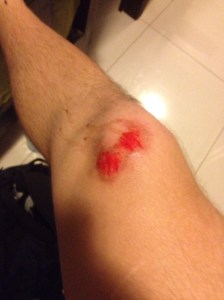
A few of the motorbike taxi drivers on the edge of the road rushed over to my aid, pulling the bike up and helping me wheel it to the edge of the road. I checked my arms and legs to find myself, remarkably, almost unscathed. The only exception was a shallow, bloody graze on my right knee, though I was so full of adrenaline at the time that I barely noticed. I cleaned myself up as best I could, and the local men checked to make sure the bike wasn’t damaged. Thankfully, other than a few mild scratches on the paint, which could have very well been there before I took my little tumble, it was fine. I thanked the men for their help, though they didn’t understand English, so they simply watched me curiously, probably trying to figure out the exact same thing as me – what the hell was I going to do now?

There was nothing else I could do. In my shaken and unsettled state, I mounted the bike and took a few deep breaths. I assessed the roads and where I was going, and then revved the engine and took off again into the traffic. With my confidence shattered from the fall, it was one of the most terrifying decisions of my life, but I didn’t really have any other option. I could have called the rental company, but I didn’t want to risk having to pay for any damages if I confessed to crashing the bike. I couldn’t ask anyone for a lift, since I was the one who had the vehicle. Though it screamed of the illogical and was beyond all common sense, I managed to get back on my bike and continue driving around the city.

***

It was horrific. With the exception of the crash itself, I had never felt so scared as I did navigating the streets of Phnom Penh by motorbike. For some ridiculous reason that I still can’t explain, I decided to travel further from where I was staying, perhaps in the hopes I would regain confidence and learn from my mistake. I didn’t. Every turn, corner or crossing filled me with terror. I had several extremely close calls with both other motorbikes and cars. In the haze of my terror I think I actually even made it to the Russian Markets but by that point, shopping for whatever trinkets they sold there was the last thing in my mind. It was on the return trip that I became not only frightened, but lost. I remember stopping at a petrol station, staring out into the peak hour afternoon traffic, and wondering how the hell I was going to make it back to my hostel alive.

Thankfully, the gash on me knee was the only real injury I sustained during the ordeal.

Thankfully, the gash on me knee was the only real injury I sustained during the ordeal.

After a lot of slow puttering down busy streets and long waits at corners to make sure there was absolutely no chance of being caught by other traffic, I finally made it back to the hostel. I’d been following the setting sun to make sure I was going in the right direction, and using what little I did remember of the streets from my drive through the city yesterday. It had been another long and exhausting day, and as soon as I parked the bike I showered, tended to my wound, and put my leg up by the pool whilst nursing several scotch and Cokes to calm my nerves. Needless to say, I had learnt my lesson. The traffic might not seem dangerous when experienced locals weave their way in and out of cracks and crevices of the gridlock, but it’s still a death trap for anyone who doesn’t know what they’re doing.

I promised my mother I would stay away from motorbikes altogether, but that’s literally impossible in most parts of Cambodia, so from now on I’ll just leave the driving to the locals.

Confessions Part 2: My date with a Cambodian girl

On my first night in Phnom Penh, a thunderstorm ravaged the sky and the heavens opened up to release a torrential downpour of which I hadn’t seen the likes of since I was in Singapore. I took a seat in the common room of the hostel and watched the storm roll through the sky. The common room was more of an open terrace area, with a bar, pool, and snooker table. As I sat watching the storm, one of the Cambodian girls who worked at the hostel approached me and introduced herself, before asking if I wanted to play a game of pool with her. I told her that I wasn’t very good, but she just laughed and said it didn’t matter. Her name was Sana, and throughout the course of our few games she even gave me a few pointers and tips, so that I began to be not quite as bad as I had been at the beginning of the evening. However, I had a big day of sightseeing ahead of me the next day, so after a few games I said goodnight to Sana and went to bed.

The next evening Sana was off duty, and after she finished she asked if I wanted to join her at a local bar down the road to play some more pool. They had cheap jugs of beer, she told me, so I got dressed and we headed down to continue my education in playing pool, and sink some balls and beers. A few more of her friends turned up, coming and going and having a beer or two here and there, and before long I realised that we’d been there for a couple of hours, and had polished off several jugs of beer. It was at this point that Sana mentioned something about going dancing. After a few more probing questions, I gathered that Sana was talking about going to a nightclub later. Sure, I thought, why the hell not?

I’m not sure if something got lost in translation, or whether I was just oblivious to the signs, but to me the whole thing still seemed totally innocent at this point – a few beers and a drunken dance with a new friend. We went back to the hostel, because Sana said that I needed to get changed, and that she had “a nice dress to go dancing in” that she wanted to put on. Figuring we would be going to some of the nicer places in the area, and not just the street side beer gardens, I switched my singlet and thongs for a collared shirt and enclosed shoes. After I got changed, she told me that we had to go back to her house first, so she could change into her dress. I didn’t know why she couldn’t just change at the hostel too, but at this point I had relinquished any control over the direction that the evening was taking. So as I stood at the top of the stairs while Sana chattered to her mother and sisters from inside another room, who occasionally peeked through the ajar door to get a better look at me, I came to the realisation that I had unwittingly let this scenario become, for all intents and purposes, a date.

The first bar we went to was called Heart of Darkness, which only had a handful of patrons, most of whom were nursing beers and playing pool. As we sat down on one of the couches, Sana scooted right over next to me so that our knees were touching, and that was when alarm bells really started to go off in my head. So naturally, I asked what she wanted to drink. “Whatever you’re having, you’re the boss.” As I ordered two margaritas, I also realised that this time the shoe was on the other foot for me – as the man in this situation, it looked like I would be paying for this date. I still had no idea how it had happened, or how I was supposed to get out of it. Sana became even more flirty and a little bit tactile, getting closer so our knees where pushed together. Despite my best attempts to shuffle into a less suggestive position, I had to face the fact that my inaction or disinterest in the situation were not going to get the message across. So that was when I grew some balls and finally said what I thought everyone should have already been thinking.

“Hey, I need to say something. And I probably should have said it ages ago, and sorry that I didn’t… But you should probably know that I’m gay.” I didn’t feel the immediate change in atmosphere that I was expecting, and for a moment of horror I thought she hadn’t heard me, and that I would have to repeat the awkward confession again. But after a moment, Sana half-heatedly mumbled something, barely audible over the music. “Whatever you want to do, that’s cool. Whatever you do, that’s okay.” It was a better reaction than I had expected, though it wasn’t a hundred percent clear that she had understood what I had said. I tried to keep the positives coming by assuring her that I still wanted to dance, so we changed venues to another club called Pontoon, which had a few more people who were up and dancing. That still didn’t help the mood though, and I ended up buying her another drink, just because I felt so bad. We did dance for a little bit, but the mood had officially taken a nose dive since I dropped my bombshell, and in the end she was feeling drunk enough for me to walk her home. I did that, thanked her for the evening, and gave her a hug before retiring back to the hostel.

***

Coming out is a very peculiar thing. Most of the time we think that once we’ve done it – made that big step towards being openly homosexual – we’re out of the closet and that’s that. I still remember the little thrill I had after confiding in many of my close friends, one by one, and the relief that came with releasing another fragment of that burden. But once it’s done, you never really expect to have those nerve-wracking experiences, uncertain of how people will react or how you’ll be received. I had a pretty gay life back at home – I worked in a gay owned business, I went out to gay bars every weekend, most of my friends were either gay men or fag hags. I also took a lot of gender studies classes at university. I never made a huge point about disclosing my sexuality, but I was just used to people assuming I was gay based on a lot of the facets of my life. Either that, or it just comes up in conversation when meeting new people. I mention it in passing, or add it into part of a story to provide some context, but I never had to flat out say it just for the sake of saying it.

But when I was so removed from my old life, and thrust into a position that was blatantly assuming my heterosexuality, I really struggled to stay true to my identity as a gay man. Coming out the first time is hard, but having to do it again can be just as difficult. It feels as though you’re in a constant backslide, with a constant need to reaffirm your identity and save yourself from falling back into the script of normativity. Especially in South East Asia, where even the legalities of homosexuality still seem a little blurry, you never know how people are going to react. Maybe Cambodian girls just have really bad gaydars: in Sihanoukville I had another hostel worker girl doing splits by the pool for me in her bikini, and begging me to buy her a beer. It was uncomfortable, and there was no real way to stop the suggestive advances without making some kind of proclamation that would only result in more awkwardness for everyone.

And that really does suck. I hate feeling uncomfortable just for being myself. And I hate to think that I probably made Sana quite uncomfortable too. She was a lovely girl and I wouldn’t wish what I put her through upon anyone. Having said that, I don’t think what happened was entirely my fault. It was just a failure to communicate my feelings on something that Sana herself was being very clear about. In my journey so far, I’ve learnt a lot about myself, done some things I never thought I’d do, grown as a man, and ultimately, I’ve changed. There’s nothing wrong with that, but amongst all the change I need to stay true to myself, and not let go of the fundamental things that make me who I am.

First Impressions: Phnom Penh

I was a little nervous as I climbed off the boat and onto the dock at Phnom Penh. I wasn’t sure what to expect from Cambodia. I was under the impression that it was a relatively poor country, but so far on my tour through South East Asian countries I’d been surprised by the diversity of living conditions and levels of development within single cities, let alone entire nations. Phnom Penh is the capital city of Cambodia, but in the back of my mind I was quite certain it wasn’t going to be anything like Bangkok or Ho Chi Minh City, and most definitely not like Singapore. And I wasn’t wrong.

It’s hard to describe. It wasn’t a city in the way that Bangkok was a city, it with networks of public transport and numerous towering skyscrapers.There was certainly some parts of the city that were more built up and developed, with busy roads and crazy traffic, but there were also smaller streets with a slightly suburban feeling, though not without busy roads and crazy traffic. As I would later learn during my stay in Phnom Penn, while most of the time the locals make it seem like a fine tuned art from, driving in pretty much any major South East Asian city is a perilous affair.

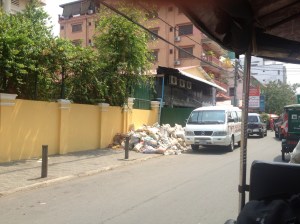
View of the street from my tuk tuk to the hostel.

View of the street from my tuk tuk to the hostel.

Ultimately, what made Phnom Penh different was the not-so-seamless integration of tourist attractions, middle class living, and extreme street poverty. In Bangkok, the city is almost separated into layers like a rainforest, with the wealth in the canopy descending down to the poverty on the forest floor, and Saigon has a tourist-focused centre which sprawls outward to the more authentic and local experience. From what I could gather, there was no method to the madness with was the design of Phnom Penh. The official currency is the Khmer riel, although US dollars are so widely accepted that menus and price lists of everything are shown in dollars, and even the ATM machines dispense dollars rather than riel. The use of the dollar, however, meant that I found Cambodia a little more expensive than Vietnam. I’m no economist so I can’t even try to explain the way it works, but that’s just a little something that did surprise me.

***

I decided to spend my first day in Phnom Penh seeing all the major tourist attractions, so I enlisted the help of a tuk tuk driver who would take me from place to place and wait for me while I visited each destination. We came to an agreement, though only after several minutes of myself insisting that I did not want to visit the shooting range and fire a bazooka. The driver seemed disappointed, but nevertheless took me around for my day tour of the city. The first stop was the Grand Palace, the home of the current king of Cambodia which doubles as a beautiful tourist attraction. As I wandered through the various temples and buildings that the public was allowed to visit, I noticed that a lot of the architecture was similar to the Grand Palace in Bangkok. They even had murals on the inner surface of the walls that surrounded the silver pagoda – named for its floors of solid silver – which depicted the same epic poem from Hindu religion. However, unlike the murals in Bangkok, these ones were not so maintained, and there was fadedpaints and cracks in the walls, and the whole thing had more of an ancient wonder appeal to it, rather than the glittering magnificence of the palace in Bangkok. There was also an Emerald Buddha in the silver pagoda, and like the one in Bangkok, it was actually made of jade, and I wondered how many more trends there could have been between two such temples in completely different countries.

The silver pagoda.

The silver pagoda.

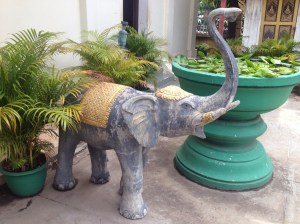
Elephant statue near the old elephant stables.

Elephant statue near the old elephant stables.

Nagas are mythical serpents that frequently appear in this holy South East Asian architecture.

Nagas are mythical serpents that frequently appear in this holy South East Asian architecture.

In front of the main temple.

In front of the main temple.

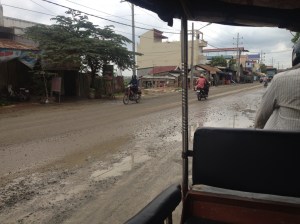
After the palace was the Killing Fields, which was about a half an hour drive out of town. The trip there was an experience in itself, as it had rained heavily the night before, and some of the dirt roads had turned to mud and were littered with puddles and pot holes. We had definitely reached the outer limits of the city, and there were no pubs, hostels our other tourist attractions. “Definitely not in Kansas anymore”, I muttered to myself, watching the mud fly and cursing myself for not wearing ruby slippers – or at least more appropriate footwear.

The muddy trek out to the Killing Fields.

The muddy trek out to the Killing Fields.

The fields themselves weren’t so muddy though, so my canvas slip-ons would live to see another day. The 3 million Cambodians who were brought here by the Khmer Rouge during the rise of Communism, however, did not. As I entered the complex and purchased my ticket, I found myself surrounded by the group of Americans who I had met the day before on the boat from Chau Doc to Phnom Penh. I had a quick chat with Mike, one of the guys I’d spoken to at length during the boat ride, discussing how our first nights in the city had gone down. They were just on their way out as I was arriving, so when it came time for us to part ways again, Mike looked around gloomily and said, “Well, I’d tell you to enjoy… but that’s not really the right word for this place. But go and soak it in, it’s pretty intense.” He bid me farewell, along with the rest of the group, and I set off to see the fields.

Mike has been spot on when he had described the place as intense. It was such a harrowing experience, to walk through the site and learn of the atrocious acts of genocide that occurred here, all because the victims didn’t want to subscribe to the Khmer Rouge Communist regime. It’s a little frightening to realise how unknown these tragic events are on an international level, with I myself only truly learning about the history of this genocide for the first time. Even worse is that it happened just over 30 years ago – worse that we still don’t know more about it, and even worse that these kind of things were still happening in such recent history. There is a real emphasis in this place on remembering the tragedies and the stories, so that future generations will learn, and not make the same mistakes of the past.

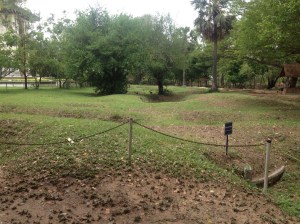
Depressions in the earth that used to be mass graves for the genocide victims.

Depressions in the earth that used to be mass graves for the genocide victims.

Broken and shattered skulls of victims, now housed in a memorial shrine.

Broken and shattered skulls of victims, now housed in a memorial shrine.

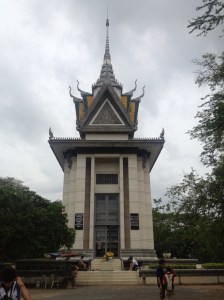
The monument that holds layer upon layer of the skulls and bones of the genocide victims.

The monument that holds layer upon layer of the skulls and bones of the genocide victims.

There is also a torture museum back in the city of Phnom Penh, but after spending so long at the Killing Fields I was feeling quite exhausted, both emotionally and physically, so I spent a short while looking around the school-turned-prison and house of torture. It was the place where many people were tortured, interrogated, and made to sign false confessions before being sent to the Killing Fields to be thrown into a mass grave. In the end it was too much for me, and I ended up heading back to the hostel to debrief myself.

***

My time in Phnom Penh provided me with a handful of peculiar tales that deserve posts of their own, but one thing that defined my time in the city in general was the acquisition of a new friend, Laura. On my second night in the Phnom Penh hostel, I stumbled into the dorm after a few beers – in order to change my outfit before going out again – to discover that someone new had checked into the hostel. She was sitting down on the bunk next to mine, unpacking her things, so I said hello and gave her a smile as I rummaged through my bag. Rather than the passing “Hey” mumbled under herbreath before returning to what she was doing, something not uncommon in these situations, this woman was very receptive to my greeting. We briefly introduced ourselves and had a quick chat before I had to head out again. It was nice to have met and got along with someone so quickly and so easily, though the fact that I had been drunk, and thus prone to random babbling at strangers, wasn’t lost on me.

I saw Laura again the next day, and we properly introduced ourselves and had a bit of a chat. She was a backpacker from Newcastle in England, and had been travelling around South East Asia for a few months now, in the similar unplanned method that I had been employing. She was also travelling alone, and so while we spent our days separately, doing our own sight seeing at our own paces, each night we would catch up for a few drinks, sharing our stories and experiences of both Cambodia and the greater region of South East Asia, and one night we even hit up the night club across the road from the hostel, which had been surprisingly busy for a Wednesday night.

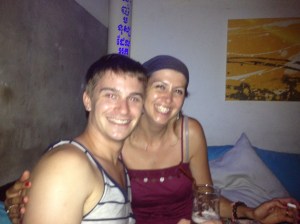
Laura and I sharing a drink.

Laura and I sharing a drink.

On my last night in Phnom Penh, we had gone to a nearby restaurant that was run by disadvantaged youth and street children who were receiving training in hospitality, and was also known for serving some interesting foods that were considered Cambodian specialities. I have to admit, I was a little nervous at first, but I found the crispy fried tarantulas to be delicious! The legs were my favourite bit, tasting like crispy fries with chicken salt. The thorax was also nice and crunchy, but the abdomen was a little chewy for my liking, though still tasted fine.

Fried tarantulas are actually quite tasty!

Fried tarantulas are actually quite tasty!

***

Further into my travels through Cambodia, I met people who had not spent any time in Phnom Penh. After a girl had insisted that she couldn’t visit the Killing Fields because she knew she could not handle it emotionally, I had to agree with her assertion that she hasn’t missed much by simply passing through. Yet I feel as though I definitely grew as a person during my time in Phnom Penh. I was faced with quite a few challenges that I doubt I would have come across many other places in the world (which will appear in forthcoming blogs). So in the end I’m glad I made it a destination on my travels – it definitely ranks up high with the rest of my memorable cities.

Getting to Know You: Miss Saigon

My first impression of Ho Chi Minh City was that it seemed like a baby version of Bangkok. It has the backpacker district with the flashing lights and street hawkers, it has the numerous food carts selling a variety of local cuisines, and it has a lot of busy traffic. However, it’s almost as if the vehicles are in baby form, with the motorcycles being to cars what tadpoles are to frogs, and the motorcycles are everywhere. I know I’ve said it before, but literally everywhere – they put the gangs of Central Coast NSW to shame. So the city may feel a little smaller than Bangkok, but in no way does that make it feel any less busy, at least in District 1 in the central part of the city.

So. Many. Motorbikes.

So. Many. Motorbikes.

Vietnamese flag out the front of the Ho Chi Minh City Museum.

Vietnamese flag out the front of the Ho Chi Minh City Museum.

There is also a confusing aspect in that this city has two names – something that puzzled me to no end in the early stages of planning my side-step detour to Vietnam. Pretty much all the native locals call it Saigon, even a lot of the travel agencies do too. Ho Chi Minh City, taken from the name of the Vietnamese leader during the wartime period, is the name used by the government and officials and anyone else of relative importance. As a traveller, I don’t really have a preference, and will use both interchangeably throughout this blog, just to keep y’all on your toes.

***

My first few full days in Saigon were spent doing some sight seeing. I decided to tackle the city on foot – after letting my guard down and being scammed into paying an exorbitant amount of money for a brief ride in a cyclo, which is basically a bike with an oversized basket for passengers, I became a little mistrusting of all the locals who approached me, offering rides on their various street vehicles. I also found myself slightly terrified of the traffic, although I quickly learnt that in Saigon, being a pedestrian is just as hazardous as being behind the wheel of a car or on a motorbike. Which is not necessarily saying that it’s risky – you simply need to really keep your wits about you at all times… although, it is risky. I’ve had a number of extremely close encounters where my attention lapsed for just a moment, and I came this close to being far too acquainted with the front end of a motorbike. Look both ways, amnd look all four ways at intersections. Sometimes it’s easier to just slowly wander out onto the road and let the bikes move around you. This is particularly terrifying though and by no means safe – sometimes I just got impatient waiting for a legitimate gap in traffic.

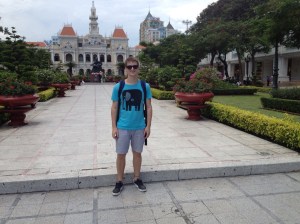
Outside the Ho Chi Minh City People's Council People's Committee Building .

Outside the Ho Chi Minh City People’s Council People’s Committee Building .

French-designed Cathedral in the city centre.

French-designed Cathedral in the city centre.

Reunification Palace.

Reunification Palace.

Another thing Ho Chi Minh City seems to have a lot of is museums. As well as the War Remnants Museum, I visited the Fine Arts Museum and the Museum of Ho Chi Minh City. I took some refuge from the bustling city outside to observe some of the paintings and sculptures in the Fine Arts Museum, almost all of which are created by Vietnamese artists. I’m no art critic, and I don’t know the first thing about techniques or designs or any of the fine details when it comes to the fine arts, but the museum did have a huge variety of works on display, much of which represented lots of aspects of Vietnamese culture. As I wandered through the halls, I noticed that many of the paintings depicted soldiers and other wartime themes. Despite being beautiful works, that saddened me a little bit, and I was beginning to understand just how much the war has affected the mindset of so many local people here, and had branded their cultural history with a very distinct and conspicuous mark. It was a mark of remembrance and mourning, but also hope for the future.

Then I came across a piece called ‘Agent Orange’, where the oil painting had been textured so that it recreated the horrific deformities of the victims of the harsh poison, to a point where the art was almost three dimensional, and the suffering reached out from within canvas to force you to feel the emotions it depicted. I both loved and hated the painting, because it was so confronting, and because it filled me with the similar feelings I felt at the War Remnants Museum. I took a few photos, which I think I probably was not supposed to do, so I won’t upload them. I also feel like these works are best experienced in their true medium, and not from within a computer screen.

The other museum was also interesting, learning about the history of the the city. I don’t really care to regurgitate everything I read though, so make sure you check it out if you’re ever in Saigon. The building did, however, have a nice view.

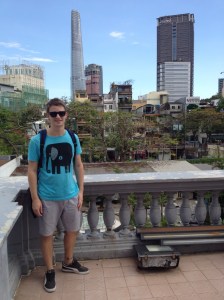
View of city from the Ho Chi Minh City Museum.

View of city from the Ho Chi Minh City Museum.

***

My first evening in the hostel was when I began to experience the tourist nightlife. As people began slowly arriving home from their days activities and trawling into the dorm room, one of the guys made an open invitation to anyone who was interested in joining him and a few other guys in getting some dinner. Having no plans and nothing to lose, I tagged along and found myself with four guys, respectively originating from Germany, Wales, America and New Zealand, and a Hungarian girl. Our small international party set out looking for cheap street food. I’d always been a bit of a fan on Vietnamese food back home, so it was kind of a novel thrill to sit on a tiny plastic chair on the side of the road, like all the local people did in District 1, and eat my pho noodle soup. After that we were joined by two Argentinians and headed to a bar to drink some beer. I say “bar”, but in reality it was a little hole-in-the-wall joint with tiny plastic chairs (and slightly bigger plastic chairs that were used as tables) littering the footpath out front, sprawling out onto the road when it got busy enough. Later in the week, when I explained this scene to a New Zealander expat now residing in Ho Chi Minh City, he merely chuckled and said, “Yep, we call that a bar here.”

However, what the place lacked in bells and whistles, it made up with value for money. Draught beer was 7000 Vietnamese dong per glass. That converts into approximately 35 Australian cents. It seemed criminal to drink anything else when you could drink for so ridiculously cheap, and not for the first time on this trip I found myself succumbing to peer pressure and going in for a round of beers, only to be surprised that I actually quite enjoyed the taste of it. I didn’t love it, but for a few quiet drinks on a Tuesday night it doesn’t get much better than three beers for a buck.

The weekend was a different story though – I met a bunch of Australians who had been in Vietnam for the last month or so for work, and they took me out to some of the nearby nightclubs. The bars were a little more sophisticated then plastic stools on the pavement, and the drinks were more than 35c, but they were still exponentially cheaper than back home and the cocktails were lethal. Two Long Island Ice Teas later and I have to confess that I couldn’t tell you much about the difference between the clubs in Saigon and the clubs back home. Except that in one of them I ran into a Tasmanian couple casually smoking a hukka, and I’m pretty sure the flavour was “blue”. And security guards loved to pose for photos, something I have never seen in Australia.

In an e-mail to my father about my trip down to Krabi, I had mentioned how good it had been to get out of the city for a while and see the rest of the country. His response triggered something in me that I’d never really considered before: “Yes, cities tend to all feel the same after a while. It’s best to get out and see the real country”. While I could see comparable differences in each city I had visited, I promised myself that I would make my best effort to see a little more than just the major cities in each country went to, wherever I could.

Because at the end of the night, whether its beer or spirits, Sydney or Saigon, hangovers are generally all the same too.

Happy New Year! Songkran Water Festival

The end of my time in Thailand was rapidly approaching. It had only been three weeks since I first departed from Sydney, yet already I had experienced so much, seen some incredible things, and met some amazing new people. Yet there was one final event I was to attend in my final weekend in Bangkok – the Theravada Buddhist New Year festival celebrations, better known by its traditional name, Songkran.

Songkran is celebrated throughout South East Asia in Thailand, Myanmar, Cambodia and Laos. It’s traditional origins as a water festival come from a practice where the younger generation pours water on the hands and feet of the older generations, symbolic of a recognition of the knowledge and wisdom of their elders, and as a sign of respect. While I’m sure these traditional values are still upheld, the modern translation of Songkran is a huge water fight, where major roads in the city are closed off and people flood into the streets with hoses, buckets, water pistols and super soakers, and anybody on the streets becomes fair game for a hearty drenching. All throughout my time in Bangkok, people would repeatedly ask me, “Wait, when are you leaving? Are you gonna be here for Songkran?” Truth be told, the timing was a complete coincidence, but my flight out of Thailand was to be on the Monday after this wet and wild long weekend. As the weeks passed by I saw many of the corner shops stocking up and selling small waterproof pouches for money and valuables, and water guns of virtually every shape and size, and I began to think I was underestimating the significance of this festival.

“The whole city basically turns into a mosh pit”, Brendon had told me. “The Saturday afternoon of Songkran, this road will just be completely full of people. You’ll barely be able to move.” We were in a taxi going down Silom Road, and I peered out the window. The traffic was a blurry rush of taxis and tuk-tuks, cars and buses, the blaring of horns all around us. This was a major road in this area of Bangkok, and it was then that it really hit me that Songkran meant business.

***

As fate would have it, Silom Road was to be the destination of my very first Songkran. Nervous, excited, and not knowing what to expect, I set out with Rathana and his friends and caught the BTS to Sala Daeng. When we exited the platform and descended the steps down to Silom, I realised that Brendon’s description had not been an exaggeration in the slightest.

Silom Road packed with people celebrating Songkran.

Silom Road packed with people celebrating Songkran.

The road was packed. In place of the regular traffic was a steady flow of humans, almost like herds of cattle, being pushed along the street by the momentum of the crowd. Every man, woman and child was armed with a water pistol of some description. As we merged into the congregation, I could already feel the splashes of water coming from basically every direction. It was basically a free for all – I shot a random passerby with my super soaker, and he immediately whirled around and returned fire. But it was the normal thing to do – people were expecting to get wet, so no one seemed to get upset or annoyed. I’d been a little terrified at the though of entering such a massive crowd in a relatively unfamiliar city, but the whole vibe of the festival was one of complete, unabashed fun, indulging in the simple pleasures of a mass water fight in the streets. Even when I was copping a water pistol to the face, nothing could wipe the enormous, goofy grin off my face.

Except for maybe the flour. The were lots of people running around with buckets of (what I hope was) flour mixed with water, painting the faces of passers by with their hands. While I’m not afraid of getting a little dirty, some of the attackers weren’t as gentle with their application of the white paste, and a couple of times I got a stinging eyeful of floury finger. After that, I viciously defended my face, giving anyone who approached me with a bucket of flour a heaving dousing to the face from my super soaker.

We took to the streets with our own arsenal of water guns.

We took to the streets with our own arsenal of water guns.

The streets were wild. At various points there were what appeared to be fire trucks, or at least huge tanks of water with huge hoses attached. They rained down on the streets, and everyone cheered and screamed as we all got absolutely drenched. On the sides of the streets, people were selling more water guns, bottles of water for refills, beer and food, but their were joining in with the drenching just as much as the rest of the soggy mass of people.

We moved up and down through the packed street a couple of times before taking a turn down Silom Soi 4 – because obviously the gays really know how to throw a party. As we walked down the narrow street, people in the bars on either side assaulted us with an onslaught on water. We ran through, screaming and laughing, attempting to squirt them back. We ran into more of Rathana’s friends, and soon we were part of the mobs of people squirting water at the passers by, and engaging in water warfare with the groups on the other side of the street. While the only water refills available out on Silom Road came from bottles that we had to buy, the bars at Soi 4 had big buckets for us to refill our water guns, so the water fights continued long into the afternoon.

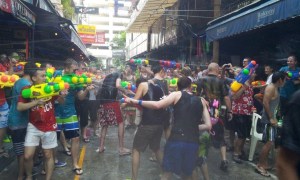
The water fights were raging in Silom Soi 4.

The water fights were raging in Silom Soi 4.

At one point there was a lull in the madness, and a parade emerged from the throng of people. Boys, and a few girls, in matching outfits and shiny black thigh-high high heeled boots marched down the strip, and they were showered with lots of cheering and even more water.

The parade marching down the drenched Soi 4.

The parade marching down the drenched Soi 4.

But after the procession passed, it was back to the water fight. As the sun begin to go down, some of us decided to leave Silom, go get dry and celebrate with dinner somewhere else. We ran back through the torrential rains that were the water guns of Soi 4 and back out onto the main road. If I’d thought that the streets were packed when I first arrived in the early afternoon, I really got the shock of my life on our return trip back to the BTS station. Earlier, we’d been able to move with relative ease in the mass of people, as long as we followed the flow of the crowd. However, now the flow of people had practically come to a standstill. Moving in either direction was difficult, and numerous times we found ourselves trapped, surrounded by either people who were going the wrong way, or walls, carts, and other stationary obstacles. There was a mild hysteria brewing in some of the crowd, as we were forced to move in the wrong directions, or simply stand still in a crush of people while waiting for the chance to move at all.

As the day progressed the crowd of people only grew bigger and bigger.

As the day progressed the crowd of people only grew bigger and bigger.

Deaths at these kind of festivals aren’t unheard of – tourists that got trapped in the wrong place at the wrong time, and other travelling horror stories. Luckily we all made it out alive, only slightly traumatised, and I commented to my companions that despite being an absolute logistical nightmare, the vibe and mood within the crowd of people never strayed from that of lighthearted fun and enjoyment. Had a similar thing happened at an Australian event, I have no doubt there would have been aggressive vibes, pushing and shoving, and inevitably break outs of violence and fights. So despite being packed into such a throng of people, and there not being any security guards or crowd control to speak of, I never at any point really felt unsafe.

***

Songkran traditionally lasts the whole weekend, but I needed to spend the Sunday getting my things together and finalising plans for my next destination. But I was also exhausted from the celebrating that I did do – the water festival was unlike anything I’ve ever seen before, and it’s always pretty amazing to see how another culture reinterprets historical events in their own fun modern ways. I had so much fun in my first Songkran, and somehow I have a feeling it’s not going to be my last.

Life’s a Beach

While Bangkok may be a glistening gem of a city, full of flashing lights, broken streets and chaotic, life-threatening traffic, the country of Thailand is home to a huge range of other travel destinations, particularly the beaches and islands that are scattered all around the Andaman Sea and the Gulf of Thailand. My time spent in this mega city had been incredibly eye-opening, but once again that travelling itch was gnawing in the back of my mind, and I felt like I’d been stationary for too long. I needed to keep moving – to keep travelling – and so I decided to make the most of my time left in Thailand by making my way south to explore some of the coastal delights that the country has to offer. After a quick search through locations and hostels, I set my destination as the small coastal town of Krabi.

***

Sticking to my commitment to travel as cheaply as possible – and to also get the most “experience” out of my journeys, I booked a ticket on the overnight train from Bangkok. It was a 12 hour journey from there to a town called Surat Thani, from where I would travel via bus for a few more hours before finally reaching Krabi. Including delays and waiting time, it took me about 17 hours before I finally set foot in the hostel – a long time considering Krabi has an airport which is a one hour flight from Bangkok, but it was also remarkably cheaper. Getting the train also felt like an adventure itself – the staff working on board came down the aisles and set up the beds, and an hour into the journey I was curled up in my own private bunk, watching the countryside pass by under the cover of night. It was actually kind of fun – I felt a little bit like a child again, hiding in a cubby house or a fort made out of pillows. I admit that it may not have been the best sleep of my life, but it was adequate, and the option had the advantage of covering both transport and accommodation for the night, killing two birds with one stone. The morning of my arrival in Surat Thani was a confusing wild goose chase, with buses and vans taking me from place to place until I finally arrived at the hostel in Krabi. It was a little unnerving when you weren’t 100% sure where you were going, but sometimes you really have no choice but to go along with it and pray whoever is taking you wherever just knows where they’re going.

I soon learnt that I should probably put a bit more effort into my research in the future, as I made a startling discovery upon arriving in Krabi – the town itself doesn’t actually have any beaches. I was a little put out – gone were my fantasies of strolling down to the beach, with nothing but a towel and my ukulele, and strumming little ditties among the backdrop of paradise. But I hadn’t come through 17 hours of transit to sit and feel sorry for myself. After showering and changing out of my soiled traveling clothes, I enquired with the hostel staff and learnt of a “local bus” that could take me straight to one of the nearby beaches. So away I went, in the back of what was essentially a ute with a roofed cage mounted in the tray. I rode for about 20 minutes before we turned onto a long strip of road that ran parallel to a long beach called Ao Nang. I alighted and made my way down to the sand.

It was early afternoon at this point, and I was faced with another problem that I hadn’t properly considered – low tide. The beaches in Thailand are particularly shallow, so when the tide goes out, it really goes out. I probably had to walk about half a kilometre before the water was even above my thighs. Since the water is so shallow, it also stays very warm. As I crouched down in the shallows to fully submerge my body, it felt more like I was taking a sandy, saltwater bath than a dip in the ocean. It was still quite pleasant, but not exactly the refreshing dip I had been expecting, or that I really needed in the sticky Thai humidity. Nevertheless, I was glad to be out of the city and washing away the rest of my worldly cares on a beach somewhere.

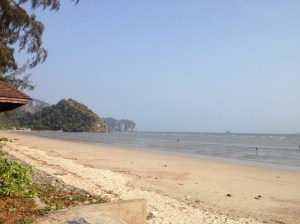
Ao Nang beach

Ao Nang beach

I had been told by a few travellers that he beaches down in this part of Thailand were some of the most beautiful in the world, with clear waters and pristine white sand. Yet as a made my trek through the waves breaking around my ankles and back go the shore to walk along the beach, I was quite shocked at what a found. All along the sand and in the wash along the shoreline, the beach was polluted with all kinds of litter. T-shirts wrapped in pieces of driftwood, lost shoes, beer bottles and other shards of broken glass, beer cans, plastic bags, water pistols and other toys – after closer inspection the sand along the beach resembled somewhat of a dumping ground. “Untouched” was a word I had heard used to describe these so-called pristine beaches. Maybe Ao Nag was an exception, or maybe that person hadn’t visited this area in a long time, but as the sun set on the otherwise beautiful seaside setting, I couldn’t help but feel slightly disappointed in what I’d found. I climbed aboard the local bus and headed back to the hostel, making a determined promise to myself to continue my search for the pristine beaches tomorrow.

***

My trip to Krabi also marked the first time that I would be staying in a hostel. I’d heard some horror stories about stolen possessions and other traveling nightmares, so I wasn’t sure what to expect. After showering and changing I ran into a couple of guys in my room and introduced myself. We sat around chatting for a while – Jens was a traveller from Sweden and Sam was from London – and we ended up going down to the local night markets for some cheap Thai food dinner. Back in hostel room, we got chatting to a Moroccan traveller, a girl named Sarah. The four of us, complete strangers until that evening, made an unlikely group of friends, yet we ended up chilling out on one of the hostels balconies, drinking and smoking and just talking about our lives. It was at that moment that I really felt like a traveller – just an individual in a collection of wanderers, making our way through the world, whose paths intertwined for that one night, for that brief moment in time.

The quiet streets of Krabi Town at night

The quiet streets of Krabi Town at night

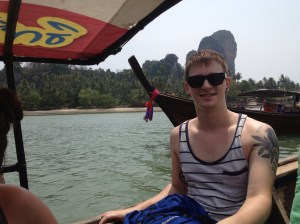
The next day, after trading tips among the hostel dorm room, Sarah, Sam and myself decided to catch a boat to a beach called Rai Leh. A pair of Norwegian girls had promised us beautiful beaches there, and I figured we could trust the word of someone who had visited the area just days before. And we were not disappointed – as the boat cruised in to anchor just off the beach, even the towering sheer limestone cliffs that filled the scenery around us were breathtaking. Sam said it looked like something out of Jurassic Park, and as a fan of the movie I most definitely agreed. This place was simultaneously beautiful, soothing, and awe-inspiring – this is what tropical paradise was supposed to look like. Rai Leh was a strip of land that had two beaches, with the eastern side acting as more of a port for the various boats bringing people in, so we made our way over to the western side which had been a little more developed for the tourist population. There were lots of bars and resorts just beyond the edge of the sand, so we had a few drinks before making our way into the water.

On the boat pulling into East Rai Leh.

On the boat pulling into East Rai Leh.

I soon discovered that the shallow beach at Ao Nang wasn’t a one-off thing. The water at West Rai Leh was a similar depth to begin with, and I had to walk out a long way before the water even came up to my chest. But when it did, the water became much cooler, and it was lovely swimming around, diving under the waves, and then kicking back and marvelling at the sweeping scenery that surrounded the beach. While the water wasn’t as deep as I would have preferred in a beach – or probably more accurately, what I was used to – it was definitely the visuals of the location that made it so appealing. The sand and water was also a lot clearer than Ao Nang, so I was satisfied to have finally founded these fabled, pristine beaches.

On the stunning shores of West Rai Leh.

On the stunning shores of West Rai Leh.

I also learnt a few travelling tips from Sarah that day. As we boarded the boat to take us to Rai Leh, she had brought along her large rucksack, while Sam and I only had our smaller backpacks. “You must never book more than one night in a hostel,” she said to us in a thick French accent, when we asked her why she had checked out and brought all her gear with her. “You never know where you might end up, or where you might want to stay. Krabi Town has no beaches! I do not want to spend another night there.” She had been travelling around the Thai islands for months now, and she had definitely mastered the tricks of the trade. And she was right, of course. When we got to Rai Leh, she sniffed out some budget accommodation – a mattress on the floor of a bamboo hut on the east side – and checked in straight away. “The beaches… This is where I want to be.” Sam and I still had our beds booked back at the hostel, so when it came time to get the last boat back to Krabi, as the sun set behind the clouds and turned the sky a glowing pink, we bid Sarah goodbye and good luck in her new home for the night.

The sun turning the sky a beautiful shade of pink on the boat ride home.

The sun turning the sky a beautiful shade of pink on the boat ride home.

***

My original plan had been to leave the next day, but I felt like my time in the beaches had come to a premature end. So after sniffing around some of the tourist information centres in the street, I booked a full day SCUBA diving tour for the following day, and secured my room at the hostel for one more night. I hit the hay early that night, to rise for an 8am pick up, in a car that took me back Ao Nang beach. From there, a boat took the group – the dive instructor and a pair of stern looking European men who spoke very little, and when they did, it was rarely in English – about 40 minutes out into the sea. We geared up, and soon we were descending into the deep blue.

I had completed my Open Water SCUBA Diving course when I was only 12 years old, on a family holiday in the Maldives. I had been diving periodically since then, but it had been about 4 or 5 years since my last dive. So I was a little nervous, but as I flipped over the edge of the bloat and plunged below the surface, it all came flooding back to me – unfortunately, like the sea water into my mask. But other than that, it was like riding a bike – some things you just never forget.

The first dive reached a depth of about sixteen metres. The visibility wasn’t the greatest, which meant the distance you could see through the water was limited, but it wasn’t awful, and we were still able to see all the marine life that was just teeming in the water around us. Schools of fish that looked like walls in front of us parted as we swam in their direction, and our guide pointed out some other less obvious creatures, such as sea horses clinging to the coral, or small stingrays that would gently hover above the surface, and then take off once we got too close. It really was like another world down there on the ocean floor, and I realised just how much I loved and missed SCUBA diving, as I marvelled at the marine alien world. I made a promise to myself at that very moment that I would make more time for diving in my life, and later went on to scope potential diving destinations on the rest of my year long world tour.

After the first dive, we had a break in which I was able to do some snorkelling. This far out to sea, the water was clear and cool, and an absolute dream to swim through. The boat was anchored to a small limestone island jutting out from the sea, and as I swam around the perimeter I discovered a cuttlefish nestling in the safety of the rocks. The second dive was going to be in a cave – something I was a little nervous about, knowing some of the potential dangers. Armed with flashlights, we descending a second time, not just into the deep blue sea, but through the mouth of a cave below the limestone island, and into a black abyss. I experienced a strange sense of vertigo in the darkness of the cave. The ground can be rushing up to meet you one moment, and the next you’re bumping your head on the roof. It found it difficult to maintain a stable neutral buoyancy at the best of times, so trying to do so with no real idea of where I was proved a little stressful. I made a point of not losing sight of our guide though, not only because I knew he wouldn’t be lost, but also because he was pointing out some of the marine life with his torch. We saw a couple of nurse sharks, a few more stingrays and seahorses, plenty more fish, and a strange creature that looked like an octopus but had far too many legs, so I can only assume it was either a type of cave dwelling squid or jellyfish.

The island above the cave, and the surrounding blue water.

The island above the cave, and the surrounding blue water.

As I followed our guide in what appeared to be in upward direction, we moved through a small grotto before coming to a halt. When he shone his light at the walls around us, I saw about 5 or 6 lobsters at several points, all curiously climbing out of their hiding holes to get a better look at us. It was odd to see a lobster in the wild – the closest I’d ever really come was seeing them was in tanks at Chinese restaurants. We continued up through the grotto when, to my surprise, I broke the surface of the water. I pulled off my mask to look around to discover we’d found ourselves in a little pocket of air inside the cave, completely closed off from the outside world – the only way in was the way we’d come, through the sea. Sunlight was coming through from somewhere below, so the caves entrance wasn’t too far off, and the water lapped the edges of the rocks so that the cavern echoed around us. The light and the sounds and the serenity of the whole place made it strangely beautiful, despite being quite visually uninteresting. I’d been unable to bring my camera and so couldn’t photograph the cavern, but similar to the temple of the Emerald Buddha in Bangkok, being unable to take a photo made the experience feel that much more special – a little personal memory that was mine to keep and treasure.

(NB: I did take a few photos with my underwater camera while I was snorkelling, but until I have access to a computer with an SD card reader I’ll be unable to upload them.)

After we made our way back to the boat and then back to the shore, clouds began rolling in over the ocean and eventually a downpour of rain was released upon Krabi Town. The driver who took me back to my hostel said it was a good thing, and that it hadn’t rained there in about a month. I spent the rest of the evening with Jens, Sam, and a couple of other British guys, who introduced me to some of the local beers, the most notable being Chang. I’m not usually a big beer drinker. Maybe it’s because it was just cheaper and easier, or maybe it was the peer pressure of hanging out with four straight guys – I guess we’ll never know – but the local beer was much easier for me to stomach than any of the brews I’d tried back home in Sydney. Chang was supposed to be particularly potent though – and the next morning, after about 5 or 6 drinks and a round of beer pong, I can vouch for that supposition.

Changover.

Changover.

Getting out of bed with one of my highest ranking hangovers ever – dubbed a “Changover” by the boys – and getting out of the hostel by 11am check out time was not an easy task. The rest of my day was spent navigating various modes of transport in an attempt to get back to Bangkok. It took just as long as it did to get there, although since the overnight trains were all booked out due to the upcoming Songkran holiday, I had to catch a bus for the 12 hour stint of the journey. Overland travel can be long and tedious like that, but I eventually made it home to Bangkok in one very tired and worn out piece.

***

My trip to Krabi marked an important step for me on my gap year world tour. It was the first time I’d really gone out on my own for more than just a day. Finding a place to stay that wasn’t a friends house, organising and booking transport merely hours before it actually leaves for the destination, and making friends with the fellow travellers around me were all things that I’d been very keen to do since I’d set out on my journey. I was only heading back to Bangkok to celebrate Songkran and gather my things before heading off to Vietnam, an entire country where I truly don’t know anyone. I’d had a blast in my short time at Krabi, so now I was more excited than ever to travel to more new places and really live the life of a world wanderer.

Boys Boys Boys

Everyone told me that, while I was in Thailand, I had to go to a ping pong show. While I didn’t have a burning desire to see any vaginas, let alone tiny plastic balls popping out of them, I must admit I probably would have gone along for the sake of my curiosity. However, as fate would have it, the opportunity arose for me to attend what I can only really summarise as the “gay version” of a ping pong show: a live gay sex show. Not one to turn down the offer for such a unique experience, I went along with a group of people – all of whom wish to remain anonymous (I can’t imagine why?) – to witness what was sure to be an interesting performance, to say the least.

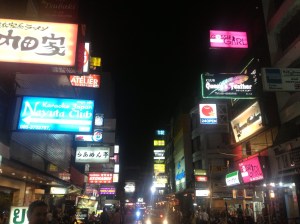
Neon signs of the red light district of Bangkok.

Neon signs of the red light district of Bangkok.

I don’t know what I’d had in mind, but I was a little surprised when I walked into the bar. It felt like a pretty normal club, although all the seats were in fixed rows facing towards the stage. Oh, and there was a rotation of slender Thai boys in their underwear moving slowing around the stage. They had numbered pins attached to the minimal clothing that they were wearing, so if you saw a boy you liked you could pick him out by number, by him a drink, chat to him and, if you so desired, take him home – it was basically a prostitute sushi train. The boys would smile at us occasionally, and I often found myself blushing and looking away to break the eye contact, not wanting to give any of them the wrong idea. I had come for to satisfy my curiosity with the show, but I was definitely not about to delve any further into the world of sex tourism. I felt some mixed emotions, watching the guys walk around the stage. I didn’t want to come in and impose my Western sympathy on a culture I didn’t fully understand, but I wondered how these guys had come to be in these situations, doing these kinds of things for, and with, complete strangers.

Then the actual show started. The stage cleared as the lights dimmed, and then slowly faded up to a guy sitting on a chair, centre stage, with a cowboy hat cocked over his face. I couldn’t help but laugh at the cliché, but as the music started up, and the strippers various garments of clothing came off, I couldn’t help but giggle like a little school girl, a combination of the several drinks I’d already consumed with the novelty of seeing my first ever live male strip show. Of course, I’d seen these kind of situations in films (no, not those films), and even though they’re weirdly similar… Well to be honest I don’t know exactly what I was expecting. I guess it looked like I was enjoying it so much – I won’t lie, I wasn’t hating it or anything – because the next thing I know the stripper is down on the seat in front of me, his crotch thrusting into my face, miming a pulling motion along his side seams.

My first reaction was mortified embarrassment, throwing my hands over my face, yet laughing hysterically at the situation. When I realised he wasn’t going anywhere, I reached up to where his short shorts were gyrating and pulled the front forward. I didn’t really think about it as I did it, but in retrospect I’m glad that he was wearing a G-string under those shorts, or I might have really copped a face full of surprise. Instead, I just continued my unabashed laughter – I don’t know if that was considered rude, but I guess it’s means I was being entertained one way or another – and threw the Velcro tear-away pants back onto the stage.

The stripped was just an appetiser – now began the real show. Again, I’m not sure what I was really expecting, but I had not envisioned any S&M displays when I walked through the doors of this bar. Two guys emerged from behind the stage curtain: one was naked except for a face mask, leash and collar, and the second was also completely naked, wielding a spanking paddle and furiously striking the first guy across the buttocks. Previously, I’ve had the pleasure of selling such kinky wares for a living, so I was familiar with their uses and purpose, but this was the first time I’d ever actually seen them in action. And despite all my theoretical knowledge of these practices, seeing them in the flesh was quite shocking. I jumped and squirmed a lot, letting out a gasp or shriek every now and then, but I was barely heard above the music.

The rest of the show was… well, I wouldn’t call it tame, but it shifted from the S&M theme and into something less frightening. One by one boys would come out on stage, completely naked and penises fully erect, and go through a similar display process from the beginning of the show, except now everything was on display. Some of them were also wearing condoms, which seemed strange because as far as I could see no one was having sex yet. That didn’t stop my from giggling in amusement – I felt like an annoying hens night in the middle of a gay bar, but I couldn’t keep a straight face as most of them came forward and bared all for us, shaking their manhoods in our general direction.

There were a few other acts – a transsexual doing a geisha-styled number, with a kimono just short enough for her member to poke beneath the folds of the gown, and a dance routine that actually involved little nudity and was surprising elegant and graceful – before the grand finale of the whole show. It almost snuck up on me by surprise – though it looked as though they were about to recreate a frat boy hazing scene, so I don’t really know why it surprised me. I was expecting some more S&M displays, maybe another kinky slap-around, when suddenly – BAM! There it was. I was watching a four man gang bang, live in the flesh. I could go into more detail, but I feel like I’ve already pushed the limits of graphic detail in this recount. All I will say is this: mid-intercourse handstands. It happened. It only lasted a few minutes though, and as soon as it had snuck up on me, the show was over.

The whole experience was bizarre. Not as bizarre as being molested by a Buddhist monk, but still very bizarre. I can’t say it’s something I’d ever do again, let alone the kind of thing I would visit on a regular basis, but I’m glad I saw it before leaving Bangkok. Besides, is a trip to Thailand really complete without a little bit of casual sex tourism?

Culture Lesson in Review: “Normal” Love

My first weekend in Bangkok felt like a throwback to my previous lifestyle in Sydney – you can take the boy from the party, but you can’t take the party from the boy.

Silom Soi 4 on a Saturday night.

Silom Soi 4 on a Saturday night.

Earlier in the week, Rathana had put me in touch with a few of his friends in Bangkok, and they had agreed to take me out and show me around while he was still in San Francisco. After dinner, and several jugs of margaritas, I found myself back at Silom Soi 4, though it was a Saturday night this time so the street was a little busier than last time I’d been there. The four guys I was with were all good friends, a couple of them having known each other for nearly as long as I’ve been alive, but they were fantastic company and welcomed me warmly into the group. Conversation was flowing fast and freely, and it usually does between such good friends, and I was privy to some hilarious, provocative, and thoughtful conversations. One in particular that I want to reflect on was a topic that was sparked when we spotted a peculiar couple on the other side of the street. One half of the couple was a young Thai boy with pretty, delicate features – I’m terrible with guessing, ages but I’d say somewhere in his mid- to late-twenties at the most. The other man was older… much, much older. I’m no stranger to age gaps in my relationships, but even I have to confess to feeling a little uncomfortable watching these two canoodle on the balcony of the bar.

Some cheeky remarks were made about the couple couple, and the discussion about such pairings being a common occurrence in the area turned to questions of why they occur in the first place. One of our group, who has only just recently moved to Bangkok himself, suggested that some of the younger local boys were almost driven to those types of relationships due to poverty, while the older Caucasian gentlemen use their wealth to effectively buy affection. In response to that suggestion, one of the guys – who we shall call ‘Anna’ – made a point that I personally had never really considered.

“The definition of love in their culture is very different from our Western ideas of what love is supposed to be. For them, love is about taking care of someone, or them taking care of you. I wouldn’t say that they’re driven to these relationships, or even that they’re being coerced, or that these men take advantage of them. It’s just how their culture defines love – they’re in love. Who are we to come in with our Western ideas about love and tell them what they have isn’t normal?”

I paraphrase, of course, but the idea really stuck with me. Even in a Western setting, I’ve had people question the integrity of my relationships with a number of previous boyfriends, whether it be due to ages or otherwise. And the more I thought about it, the more I agreed with Anna. As two consenting adults, these two men have a relationship. Are they in love? Who can say? We didn’t ask them –  I know plenty of people in our own Western society who are in loveless relationships, but seeming a little more “normal” helps them avoid much scrutiny at all. The idea that love means different things in different cultures was intriguing, and while I’m sure there’s a multitude of complexities regarding love and relationships in Thai culture that I have little to no idea about, I think the discussion reaffirmed a value in me that I’d temporarily forgotten – love doesn’t play by any set rules, and there’s no such thing as a “normal” relationship. That particular age gap may have given me the heebie-jeebies, but hey, if they’d said that they were in love, then that would have been good enough for me.

Dancing in a cage in a Bangkok club - don't ask me which one, because I can't for the life of me remember.

Dancing in a cage in a Bangkok club – don’t ask me which one, because I can’t for the life of me remember.

My period of deep reflection on such complex emotional processes didn’t last long, though. A few more margaritas later and I was ready to hit the dancefloor. I think that’s what I like about a good gay bar – you can be millions of miles away in a foreign city, surrounded by people that you’ve never met and probably never will, but when you’re shaking your stuff on a crowded dancefloor to a Britney Spears remix, it’s always going to feel like home.

Monkey Business

After the reawakening of my travel bug on the back of a motorcycle, I noticed myself growing slightly restless with the fact that I had been in the same city for over a week now. I’d been all around Bangkok, seeing the sights, tasting the flavours, and soaking up the smells, and while it truly is a huge city and simply impossible to see and do everything, I felt like a wanted to venture out and do some more exploring. At the suggestion of a friend who had traveled through Thailand before, I decided to take a day trip to the small town of Lop Buri, about two and a half hours north of Bangkok via train. Lop Buri, I had been told, was rather famous for its large population of monkeys that inhabit some of the old nearby temples. It might have seemed rather novel, but after spending to much time in the city I was interested in checking out a town that had been partially overrun by the native wildlife. The day turned out to be quite an eventful adventure, though not for the reasons I was expecting…

***

To make the most of my day in Lop Buri, I caught the 7:00 train. To allow ample time for getting ready, getting to the train station, buying my ticket and finding the platform, I crawled out of bed at 5:30 – the earliest I have gotten up for as long as I can remember. Navigating Hua Lamphong Railway Station turned out to be surprisingly easy though, and before long the train was pulling out of the platform and traveling north. It was a slow start, with the train stopping at several smaller stations in the Bangkok area, and a couple of times just stopping, seemingly in the middle of nowhere for no reason. But as the train kicked off again, I realised that the train tracks frequently crossed the streets roads, and I could only assume that we had been waiting for the barriers to come down and stop traffic so that the train could proceed. The further we traveled, the less frequent our stops became, and soon enough I was racing through the Thai countryside, wind in my hair from the open window and a smile across my face. It really was a great way to see more of the country than just flying from city to city, though I have to admit to nodding off into a micro-sleep every now and then – early morning starts have never agreed with me.
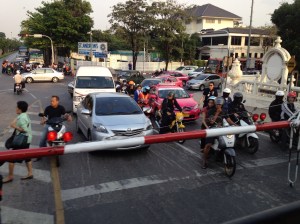
Traffic waiting at the crossing while the train passes.

Traffic waiting at the crossing while the train passes.

Thai countryside.

Thai countryside.

Lop Buri train station.

Lop Buri train station.

Due to some of the stops we’d made the train was running about 40 minutes late. I kept a cautious eye out for signs as we pulled into every station, slightly anxious about missing my stop, but it was about 10:20 when the train finally rolled into Lop Buri, so I jumped off and wandered out in to the town in search for monkeys. The sun was high in the sky now, and I wandered the streets for close to an hour, just observing the scenes and the environment, appreciating just how different it really was from the big cities like Bangkok. There were a couple of old relic temples, and I soon realised that these historic buildings were the towns biggest official tourist attraction. However, while I did find the temples intriguing to behold, I had come to Lop Buri for the monkeys, and so far I had not seen any. I told myself that I had a whole day, and that I simply mustn’t have been looking in the right places. I stopped walking and gazed out into the streets around me, and then looked down to the pavement… to see a monkey, casually leaning against a telephone poll and eyeing me with a look of disinterest.

My first monkey sighting of the day.

My first monkey sighting of the day.

It was as though I had stumbled upon them seemingly out of nowhere – one moment I was searching the streets desperately, the next minute there was a throng of them sitting on the footpath ahead of me. Someone had thrown some food on the ground – from what I could see it appeared to be a huge batch of hard-boiled eggs, though they smelt kind of rotten. Or maybe that was just the smell of the monkeys, I couldn’t say for sure. All I know is that the monkeys are scampering around to pick up every last bit of food. Some of them were fighting, some of them were mating, some were climbing up buildings and poles, shrieking wildly, while others sat about casually plucking scraps off the floor. I approached with caution to get a closer look, but they didn’t seem to pay me the slightest bit of attention as they hastily went about cleaning the food off the pavement.
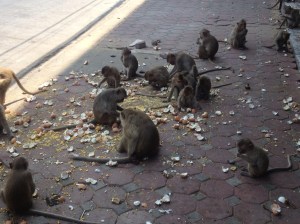
Monkeys eating their feast off the pavement.

Monkeys eating their feast off the pavement.

Monkeys literally took over this street, passing between the gaps of this seemingly abandoned building.

Monkeys literally took over this street, passing between the gaps of this seemingly abandoned building.

Making themselves at home.

Making themselves at home.

That was when I noticed another old temple just down the road. As I carefully stepped my way through the crowd of lunching monkeys and approached the building, I realised that it was covered in monkeys. Some were running around on the grass and dirt that surrounded the temple, but there were more draped over the stone statues and steps, masses of limbs and fur all clambering up the concrete and into the shade that the building provided. Again, I was able to get right up close to the monkeys, and most of them simply looked at me with rather blank expressions – but I’m not sure if monkeys faces are really capable of showing emotion or if I was just reading far too into it. As I circled the temple, however, I encountered a bawdy collection of monkeys that were a little more feisty. It may have been something to do with the open packet of peanuts I’d left in my bag, who can say? But just when I thought that I was the monkey equivalent of a severely unfunny comedian, I felt a tiny pair of hands latch onto my shorts. I looked down to find a monkey crawling up my leg… and then turned my head to realise there was one on my shoulder too, and before I knew it there were about four monkeys hanging onto my various limbs. One was clinging onto my backpack, tugging at the at one of the tags on the outside of the bag, but thankfully none of them managed to unzip it.

Monkeys lounging around on the temple statue.
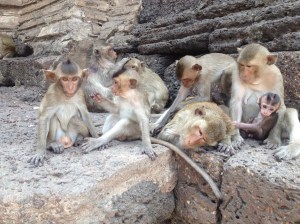
Monkeys lounging around on the temple statue.

I was able to get right up close to the monkeys, yet they paid me little attention, at first.

I was able to get right up close to the monkeys, yet they paid me little attention, at first.

At that point a local boy came running up to me, screaming and shouting. At first I thought that I was in some kind of trouble, but he began clapping his hands very close to my shoulders, and I quickly figured out that he had rushed to my aid and was scaring away the monkeys. I thanked him… and then awkwardly had to ask if he might take some photos of me, while the monkeys hung from my legs and shoulders. He obliged, so I edged back over towards the curious critters, and in no time at all they were all over me again, tugging at my clothes and calling out to each other. The local boy snapped a bunch of photos, then returned to my side to help scare the monkeys off again. I hung around the temple for a little while longer, though I kept a safer distance from the monkeys for fear that they might eventually figure out a way into my backpack. When I was done, I waved to the local boy and thanked him, and then continued on my way.

The monkeys didn't stay disinterested for long, though...

The monkeys didn’t stay disinterested for long, though…
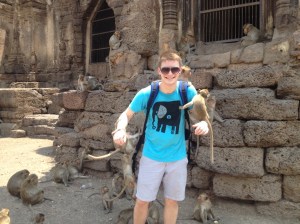
Good thing I've had rabies vaccinations, I guess?

Good thing I’ve had rabies vaccinations, I guess?
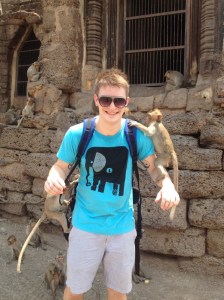
I still think they're kind of cute, if a little dirty.

I still think they’re kind of cute, if a little dirty.

The temple that is home to the obscene amount of monkeys in Lop Buri.

The temple that is home to the obscene amount of monkeys in Lop Buri.

***

It was just past noon, and as I wandered the streets I came to the slightly bleak realisation that, other than the monkeys and the temple ruins, this small country town didn’t have a lot to offer. While I did find it interesting, there’s only so long you can walk through the streets of a little country town and absorb all the cultural differences. The small town couldn’t have been more different from the big city hustle and bustle of Bangkok – in a way it reminded me more of some of the smaller towns in countryside Australia I had been to, except that the element of relative poverty was quite distinct. However, I had not properly visited the rest of the historic attractions, so I consulted the map that I had acquired at the monkey temple and made my way to some of the other sites.

There was one particularly large temple complex that I enjoyed walking through – the scenery looked like it could have been lifted from a Forest Temple in a Legend of Zelda video game, adding to a sense of adventure (for myself, at least). The grounds were huge and as you wandered inside you quickly lost sight of the main road – in some parts it felt as though you were actually lost in the jungle somewhere. It was a different kind of beauty than the Grand Palace, which was still fully functional and constantly had people attending to the paint and decorations to keep the complex looking beautiful and up to date, despite their ancient histories. These ruins had a completely different vibe – the stone was worn and broken, grass had overgrown all the floors, and many of the structures were in pieces. It was not completely abandoned – some on the inner chambers showed signs of recent visits, perhaps to pray or show respects, so it was as though these monuments had been allowed to age gracefully,  growing old and worn, rather than constantly revitalised to be kept new and pristine for all of eternity.

The old temples looked like places from adventure video games.
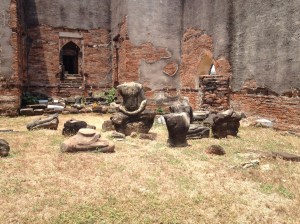
The old temples looked like places from adventure video games.

Decaying status inside the temple ruins.

Decaying status inside the temple ruins.

I spend a while reflecting on these juxtapositions, when suddenly I heard a voice call out. I turned to see a Buddhist monk walking slowly across the grass, smiling and waving. I had seen many monks during my time in Thailand, though most of them had seemed rather solemn and stern, keeping to themselves whenever I saw them riding the BTS through Bangkok. However, I had personally known a Buddhist nun back in Australia, so I wasn’t too concerned or nervous as the monk approached me. If truth be told, I felt a little special that a monk had stopped and taken the time to even pay me attention, although this time I was the only person in sight, rather than a face in the crowd on a busy Skytrain. We met face to face on the grass, and he spoke to me in what was limited, broken English.

“You alone?” he asked in a gentle voice that almost sounded like a quiet sigh.
“Me? Am I alone?” He nodded slowly, and I looked around, as though some friends may have materialised around me while he had been asking the question. “Ah… well, yes. I’m here by myself. So yeah, I guess I’m alone.”
The monk nodded and smiled. “Ah yes. Come and sit with me.” I didn’t really know how I was supposed to refuse a holy man in his own country, so I followed him to one of the temple ruins. He laid out a small orange cloth to sit on, though it was only big enough for himself, and then motioned at the ground beside him. As I sat, he asked me if I was thirsty. It was impossible to not be thirsty in the ridiculous midday heat, so I told him that I was. He had been carrying some plastic bags, and from within them he pulled out a large bottle of water, and a few smaller bottles of flavoured iced green tea. He offered me one of the teas, and filled up my small empty water with some of his own. They’d all been newly bought, still sealed, and I figured that monks would be known for their kindness and sharing. I knew enough about the teachings of Buddha that greed and material possessions weren’t something that meant a lot to them, so I graciously accepted his offer and drank the tea.

But you can imagine my surprise when, after some small talk about where I was from and what I was doing, heavily strained through the language barrier, the monk proceeded to pull out an iPhone.
“Can I take photo?” he asked me. I was taken aback – it certainly wasn’t the kind of encounter I’d been expected from a revered holy man – but I didn’t see the harm in it. I then asked if I could take a photo of him, thinking that it would make a nice picture to go with the story of how I met Buddhist monk in a tiny village in Thailand.
He smiled and nodded, but as I went to take the photo, he shook his head. “No, no. Of both of us.”
I was even more surprised by that – taking selfies with a monk? Though I wasn’t one to shy away from the unconventional, so I shuffled over so that we were sitting close enough, and leaned out my arm to take the picture. When I showed him afterwards, he gave a little giggle and pointed to our faces, side by side. “Black, and white!” he said through his mirth as he pointed at both of our faces, one by one. He’d told me was forty-nine years old, though I might have guessed older, and it was strange to see a grown man take such delight in the simple juxtaposition of skin tones. He even reached out to take my hand and examine the paleness of my skin, and held our arms together to see the difference. “Black and white,” he repeated with a grin.
“Ebony and ivory,” I chuckled, going along with joke, though I think the phrase was beyond the limits of his English.
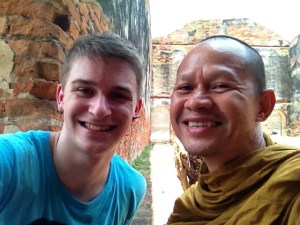
The first of (too) many photos I would end up taking with the monk.

The first of (too) many photos I would end up taking with the monk.

Later, Rathana would tell me that the monks were technically not even allowed to touch the lay people. If I had known that, alarm bells might have gone off inside my head a little bit sooner. Yet I put it down to a supposedly gentle nature of the monks, and I myself am somewhat of a tactile person, so I didn’t think much of the gesture. However, he had noticed my tattoos, and became very interested as I began pointing out all the spots where my body was adorning ink. He wanted to take photos. I just laughed and went along with it, although when I went to roll my sleeve up to show him the bird on my shoulder, he said “No, no”, and made a lifting motion to the bottom of my shirt. It seemed a bit odd, but I didn’t really mind, so I went along with his request and removed my t-shirt. He then asked me to stand up, and it wasn’t until I was standing shirtless in the middle of an old, abandoned temple while a Buddhist monk took photographs with me on his iPhone that I fully comprehended how bizarre, and definitely not normal, this situation was.

I put my shirt back on, but the monk wanted to take some more photos of the two of us. He wasn’t as good as taking the selfies so I offered to operate the iPhone camera. It wasn’t until he went to pose for a photo by kissing me on the cheek that I knew something was definitely wrong with this picture. Not wanting to simply grab my things and run at the first sign of weirdness, I instead tried to diffuse the situation by asking if he could take some photos of myself in front of some of the old temples. He agreed, and took a few photos of me in front of the various buildings, but as we sat down again it wasn’t long before he was wanting to take more photos. The bright sun combined with the shadows and shade we were sitting in made it quite difficult to get the lighting right within the photographs – I thought it seemed reasonable that he was simply trying to just get the perfect picture. Though after a while I began to grow tired of the whole ordeal. I had expected to perhaps discuss Buddhism, world peace, the meaning of life – something, or anything, that might have been considered somewhere closer to enlightening. Instead, I’d starred in a topless photo shoot and sat through mostly unintelligible conversations that were completely lost in translation.
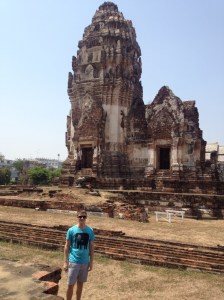
One of the other temples within the ruin complex.

One of the other temples within the ruin complex.

When I finally plucked up the courage to tell him that I had to return to the station and buy my ticket – a half-truth, but I wasn’t going to tell a monk I was leaving because I was bored and/or slightly weirded out by his company.
“Ahh,” he said with a sigh. “Wait, sit down a moment.” I had already put my backpack on, so I lightly eased myself down onto the step where he was sitting.
“It was very nice to meet you, thank you very much for the tea and the water,” I said to him, genuinely grateful for that part of our meeting.
“Ahh, goodbye,” he said in his high, airy voice, and outstretched his arms. A hug was a hug, so I thought nothing of it, and lightly leaned into the embrace.

At the most, I had been expecting a light cheek kiss, something appropriate for acquaintances who have just met. So this monk very much shocked me, not for the first time that afternoon, when he turned his head to try and kiss me on the lips. I was stunned – I had absolutely no idea what to do. I certainly didn’t want to kiss him, but in my mind I was still thinking ‘How do you say no to a freakin’ monk?!’
I just sat there, our faces touching for an awkward moment. Then I felt his tongue press against my tightly closed lips, and I knew that I had exceeded my daily limit of weirdness. I firmly pulled myself away from the monk, but I was still at a loss of words.
“No,” he said to me in that soft voice, which had made the jump from gentle to just plain creepy. “You kiss me for longer time. It’s been so long.”
“Ahh…” I just stared at him in disbelief. “No. No, I’m sorry. I have to go now.”
“Okay,” he said, his voice exhibiting that strange quality that made it sound like he was sighing. I was sufficiently creeped out, but as I hurried out of the temple to the main road, I actually spared a moment of sympathy for the man. He’d been a monk for seven years, and I couldn’t even imagine how lonely one would feel after that long.
Then I remembered that he had basically forced himself upon me. I scurried back to the train station and caught then afternoon train back to Bangkok, shuddering every time the moment replayed in my mind.
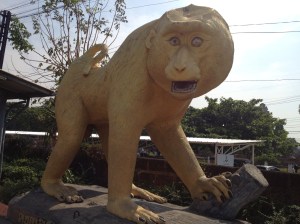
Statue at Lop Buri station - one of the only clues that suggest the town does actually have the population of monkeys that reside there.

Statue at Lop Buri station – one of the only clues that suggest the town does actually have the population of monkeys that reside there.

***

Over the weekend, I recounted my story to the group I had gone out with last week – Anna & Co., if you will. While they found my experience highly entertaining, none of them seemed that shocked.
“I wouldn’t be surprised if he wasn’t even a real monk”, one of the guys said, and suddenly the cynical worldview that my sociological background had gifted me with came flooding to the surface of my mind.
“Yeah, that’s true”, Anna had agreed. “Still, many of the monks don’t even choose to become them. Poor families that have too many sons often donate them to the monasteries.” I imagined being donated to a religious institution, and forced into a life of celibacy, and while for me that seemed like an awful punishment, my experience had left me a little shaken and unable to muster up any more sympathy for the monk. The discussion continued. “In a way it’s pretty similar to the sex scandals of the Catholic Churches and what not, although…” Anna looked towards me with a genuine look of sympathy. “Not to condone what he did to you at all, Robert, but I think we can all agree that we’d much rather them try with 21 year old men than with 10 year old boys!” I returned the smile, and we all had a bit of a laugh at my bizarre experience, while still recognising that perhaps such incidents aren’t as isolated within certain religions as one might first expect.

I don’t think I can say I was glad it happened – the way it turned out with the Buddhist monk was not a pleasant experience in the slightest. Still, it was definitely a unique story I would be able to tell of my travels for a long time – I mean, how many people can say they’ve been hit on by a monk?