Weird, Wonderful, Wasted: Exploring Berlin’s Gay Bars

“Robert, do you know what kind of car this is?” Dane said to me, his voice almost quivering with subtle excitement.
“Um… a really fancy one?” I was slightly off my face by that point in the evening, and hadn’t exactly retained my attention to detail.
“It’s a Mercedes,” Dane said as he stoked the impeccable leather seats. He had always had a thing for cars, so after a disappointing rejection from Berghain this seemed to be lifting his spirits. “There are so many taxis around here like this. How awesome is this?!” That’s right, the Mercedes we were in was a taxi, taking us away from the depths of east Berlin on a Sunday night. We had attempted to get into the notorious Berghain, but had been turned away on the grounds that we were too late, and the only people allowed back in were those who had stamps from previous admission.

The Berlin Wall during our late night trek out east.
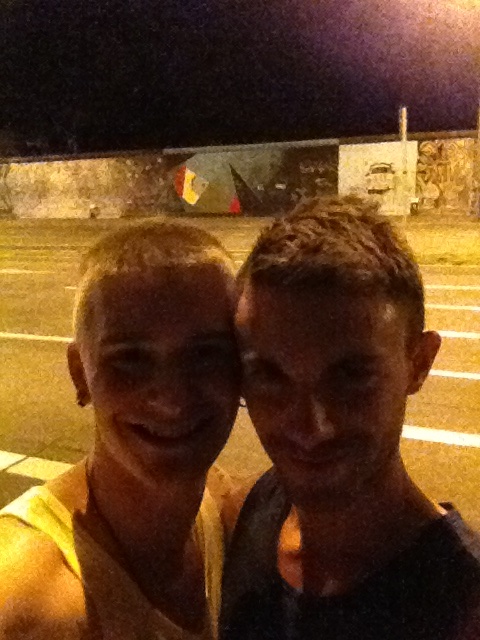
The Berlin Wall during our late night trek out east.

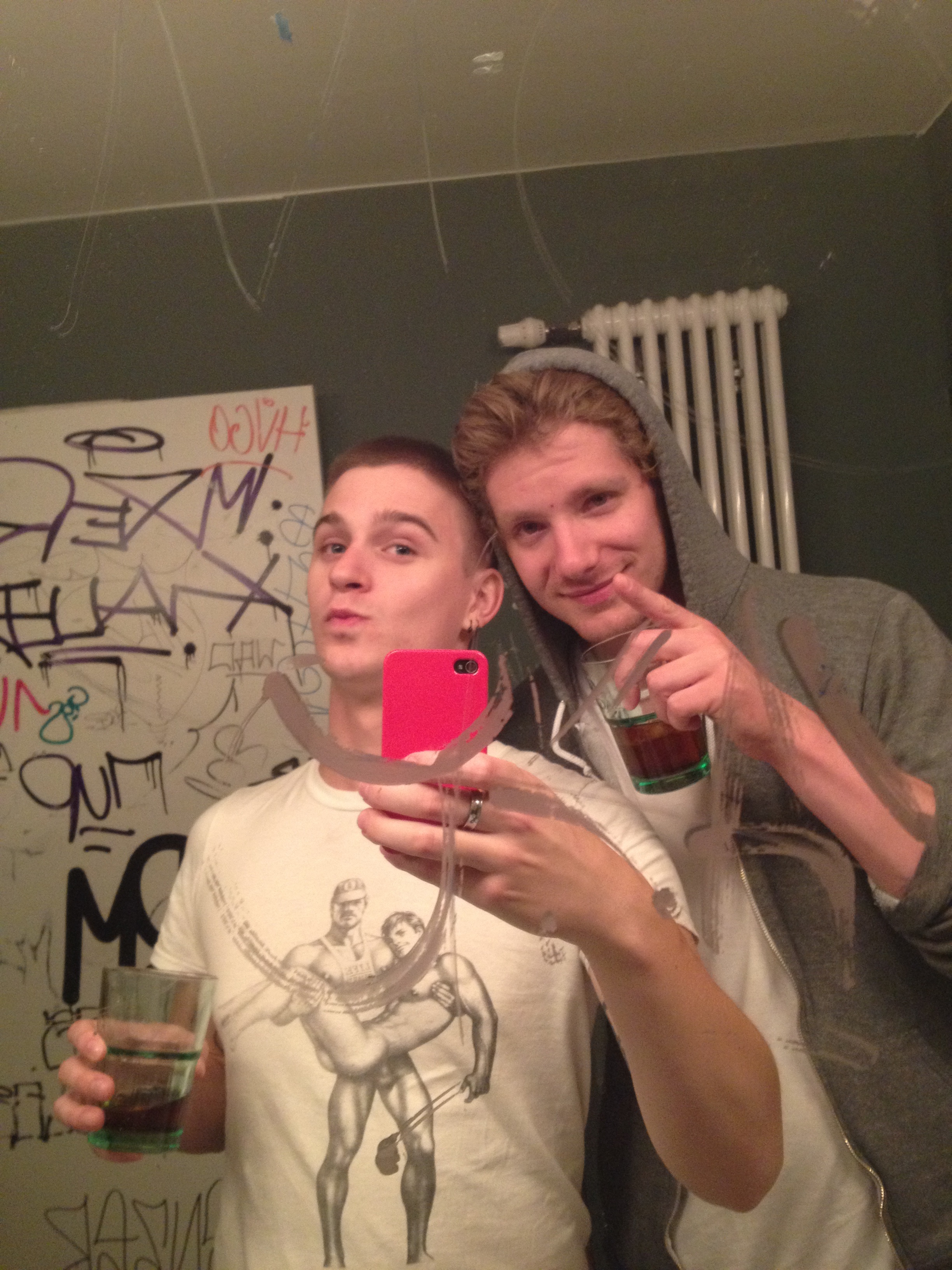
Pre-'not getting into Berghain' selfies with Dane.

Pre-‘not getting into Berghain’ selfies with Dane.

So now we were heading back to Motzstraße, the heart of the gay district where Dane was staying. It was the Sunday evening of my first weekend in Berlin, and after my failure of a Saturday night, we had decided we would have one last night on the town before Dane left Berlin. “Let’s just go back to Schöneburg and check out Toms,” Dane had said. “It’s this bar that’s kind of infamous for its dark rooms. Could be kind of interesting to check out, right?” Back in Australia most licensed venues are not allowed to be sex-on-premises venues (SOPV), so there was something of a novelty behind a bar that had rooms that were dedicated solely to meeting and having sexual relations with other patrons. When we finally arrived, we sat down in the upstairs bar area and got some beers. The atmosphere literally oozed of sex, but in a dirty, filthy way, rather then anything refined or classically ‘sexy’ – I suppose that’s a matter of perspective though, but this was far from a cabaret speakeasy or a ‘gentlemen’s club’. There were numerous television screens mounted on the walls – all of them were playing hardcore gay porn. Dane and I both giggled to ourselves at the surreality of it all, and we made eyes with guys as they passed by, though just as frequently dodged glances from those who weren’t our types. While I wouldn’t have minded going to a bar with more of a dance floor, or a setting that better enabled conversation, there was clearly only a few reasons most people came to Toms: cruising, picking up, and hooking up.

After downing a little more liquid courage, I turned to Dane. “Are you gonna go downstairs?” The entrance down into the darkroom looked like a looming cave in the corner of the bar.
“Only if you come with me,” he said.
“What, for moral support? Need someone to hold your hand?” I teased, but in all honesty I was just as curious to check out what really happened down there. I mean, I’ve seen the entire series of Queer As Folk, so I had a pretty good idea, but it’s still something that you really just have to see for yourself. Dane and I are pretty good friends, and weren’t too shy when it came to being naked in front of each other, so we turned out to be pretty good partners in crime when it came to exploring the dark rooms. We descended into the depths with a pact to look out for one another, and each managed to do our own thing while we were down there without ever really straying too far from each others sides. Dane was newly single, and I was… well, I don’t really have a reason, but it’s safe to say we were both a little adventurous when we were down there. But it was fun, albeit a little seedy, and an undeniably interesting experience which served as my introduction to Berlin gay bars.

***

Later on during the week, after Dane had moved on to the next destination in his trip, I decided I wanted to check out some more of the gay nightlife. I was given some advice about where to go by Donatella and Lola and some of the other housemates, but I didn’t have anyone to go with. It was a Thursday night, and I was planning to head to Schöneburg on the Friday night for the opening party of the Christopher Street Day pride weekend, so I wasn’t sure if I should head to the same place or try and find something in a different area. After striking up a few conversations with some guys on one of the various gay chat applications on my phone, I finally found someone who wasn’t looking for casual sex and was also planning to go out for some drinks later. His name was Micha, and it turned out he would be meeting a friend at a bar called Rauschgold, which happened to be less than a ten minute walk away from Donatella’s apartment. He said I was welcome to join them, so I got myself ready and headed out into was what becoming a stormy and rainy evening.

As I scurried inside out of the pouring rain, I was hit with a sensation that I can only describe as the love child of nostalgia and déjà vu. There’s something about visiting that kind of gay bar that can make you feel like you’re right at home, no matter what part of the world you’re in – if that’s the kind of bar you choose to frequent in your hometown, I suppose. It was essentially Kreuzburg’s version of Stonewall in Sydney – rainbow flags and a whole host of other sparkly decorations adorned the walls, the sound system was playing a combination of the latest pop hits and classic gay anthems, and there seemed to be at least one drag queen present at any given moment. Though when I arrived it wasn’t too busy, and I was able to spot Micha fairly easily. He was with a female friend of his, so I introduced myself to them both and sat with them over a couple of beers, but after a while Micha’s friend had to leave to get home to her teenage son.
“No, let’s not stay here,” Micha said when I went to order another beer. “It’s not going to get much better than this. Do you want to see some other better bars around here?” I was delighted that he had offered – locals always know the best places to go – so I took him up on the offer and we jumped in a cab to our next destination.

***

We found ourselves at a bar called Möbel Olfe. “It means furniture shop, in English,” Micha explained to me, “which is what it used to be before it became a bar.” Thursday was ‘gay night’, so other than it being crammed full with men and not a woman in sight, there was nothing overtly gay or camp about the place. There were bits of bare wall behind a broken façade and the drinks list was written on the tiled parts of the wall in a way that would be easily mistaken for graffiti at a passing glance. Then there were high stools and tables made of wood, and a slick wooden bar that was receiving a lot of attention. Throw in a crowd that was rather impeccably dressed, yet packed together like tinned sardines, and the unescapable veil of cigarette smoke that hung above us and the whole scene really just seemed like a mess of contradictions that actually came together to create a really cool bar. “This is a particularly trendy place, I guess.” Micha said as he returned to our table from the bar with our drinks. The room was packed – he literally had to squeeze his way through the tightly pressed crowd to get back to me, and even as we sat there, it was inevitable that we would be bumped and jostled by the stream of people navigating their way through the bar around us.

“Where else have you been in Berlin so far?” Micha asked me. I told him that I’d visited Toms last weekend, and the expression that came over his face informed me that the place indeed had a reputation – one that it had no doubt lived up to.
“I guess it’s an okay bar, if that’s your sort of thing,” he finally said.
“It was more just the novelty of the whole dark room thing,” I said with a shrug. “It’s not exactly the place you can go to have a conversation though.”
Micha let out a small laugh, and slowly shook his head, almost knowingly. “No… No, it’s definitely not.” He motioned around the bar we were in now. “This is a pretty typically Berlin place, though. Sometimes it can be full of… well, they’re called Nylons.”
“Nylons?”
“Yes. It stands for ‘New Yorkers and Londoners’. They’re people who come to Berlin for… Well, they’re people who are like…” Micha cleared his throat, and when he spoke again it was an airy, mocking voice that was quite clearly taking the piss. “I’m over here for six months, working on a project,” with an emphasised snooty tone on the final word. I let out a little giggle, but he continued to explain. “You know, so many people who come over from cities like London or New York, self-described creative types who think its so trendy and artistic to live in Berlin while working… on a project.” I laughed again, but Micha just shrugged his shoulders. “Ah, it’s not that bad. It’s just a more… shallow idea of what Berlin’s all about.” I’d spoken to a couple of locals now, about the kind of people who live here and the kind of people it attracts, so I guess I got where he was coming from. It made me want to avoid being a typical tourist more than ever, though I was glad my own city wasn’t included in the acronym. Though at this point I was yet to meet them, I would remember that conversation the following evening when I met Giles and the other London boys, and have a little chuckle to myself.

***

After a couple of drinks at Möbel Olfe, Micha and I headed out into the rain and around the corner to a third and final bar for the evening, a place called Roses. “It’s a very camp place”, he forewarned me as we approached the entrance. “The walls are… well, they’re… you’ll see.” As we stepped into the bar, I felt like I had been thrown into a funky Austin Powers movie with a gay twist. I understood what Micha had meant about the walls – they looked like an extension of the carpet, covered in long, thick pink fur. I had to resist the urge to stroke it, as though it was the matted mane of some visibly homosexual cat. But the rest of the club was just as eccentric – fairy lights, homoerotic art, quirky and chic furniture. The lights were dim and the room was almost hazy, yet the smell in the air suggested there wasn’t just tobacco being consumed in or around this venue. We sat down after getting our drinks, and I took a sip of mine. I instantly recoiled, making a face as I placed the drink on the table. “Oh my God… That drink is so strong!” That was a big call coming from someone like me, but it honestly felt like I was drinking 2 parts bourbon, 1 part Coke.
“Yeah,” Micha said as he took a careful sip from his own drink. “I’ve sometimes wondered whether they intentionally spike drinks in this place to make people party harder. I’ve have some crazy night after ending up at Roses.” A comforting thought.
“Well, at the very least they’ve spiked it with extra alcohol,” I said as I took another sip.

I wish I could add further details to some more of the conversations I had at Roses, because my vague and blurry memory tells they were quite humorous. I think I met another Australian, a girl who was with a gay friend of hers. Their personalities were somewhere between hipsters and divas, and I think I successfully managed to offend one or both of them by probably being a little too honest about what I thought of them. Then Micha and I also chatted to a Swedish girl who was barely 18-years-old and a complete drunken mess. It was her first time travelling and she just seemed so happy and excited about every single thing that was happening. Which would have been sweet, if it weren’t for the fact she could hardly stand up without resting the majority of her weight on us. Which meant she wasn’t going anywhere, and we were stuck with her emphatic, high-pitched, excited and incessant babbling. Micha left me at one point for a cigarette, and eventually the girl’s 19-year-old boyfriend came to help her, but it very much appeared to be the blind leading the blind as they stumbled out of the bar. When I made a trip to the bathrooms, I was stopped by an American guy. “Hey!” he called into my ear over the music, “I remember you from that other place!”
I stopped to enquire further – I won’t lie, I got a tiny little kick out of already being recognised. “Which one?”
“The… The furniture place,” he said through some mild drunken slurring.
“Möbel Olfe?! Yeah, I was just there with my friend!” I replied, probably also slurring my words due to our obscenely strong drinks.
“Do you know where we can get some…” The guy began to asked me, completely out of the blue. I stared at him expectantly, while he stared at me blankly. He was obviously about as wasted as I felt, probably more. “Do you know where we can get some stronger stuff?”
“The drinks here are so strong!” I exclaimed for the second time tonight.
“No, I mean like-”
Oh!” And right there, I momentarily felt like I was back at ARQ in Sydney, being hunted down by people who just assumed I was the type of guy who would be selling GHB. “Sorry, can’t help you buddy,” I said as I slipped away and continued on to the bathroom.

***

When we left Roses, feeling extremely more wasted than when we had arrived, Micha said he was ready to call it a night.
“Me too,” I agreed. “But first: I need food!” Micha just laughed, ushered us into a taxi, and directed us back towards Rauschgold – conveniently in the direction of where we both lived. Except we got out a little earlier at a place called Curry 36 – and so began what will probably be my life long addiction to currywurst. One of the few original recipes the province of Berlin has to offer to German cuisine, it is now definitely one of my favourites. It’s just a standard sausage cooked in curry spices, but served with ketchup, mayonnaise and a side of chips, it was exactly the kind of food I needed after a night of drinking. Dangerously, it was located just around the corner and down the road from Donatella’s apartment – this would definitely not be the only time I ate currywurst while I was in Berlin.

Currywurst -it tastes even better than it looks!

Currywurst -it tastes even better than it looks!

Micha and I with one of his friends.
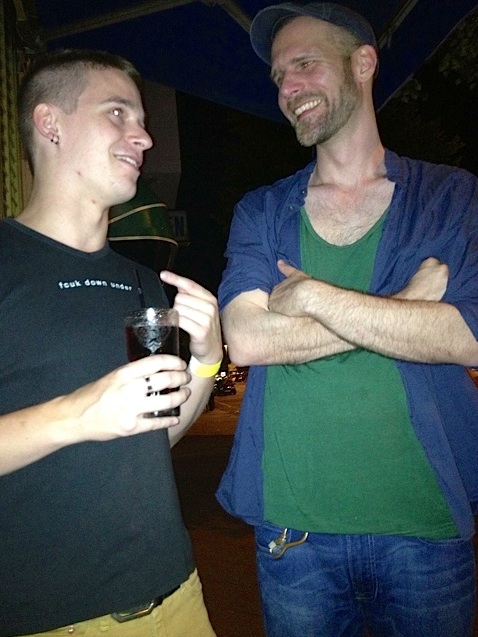
Micha and I with one of his friends.

Micha and I at his birthday party on Saturday.

Micha and I at his birthday party on Saturday.

After trying to call Eva – who had our shared key – to no avail, I eventually had to crash on the couch at Micha’s place. We walked back to his apartment as the 4:30am sun was rising, drunk and tired and ready to sleep. I was really happy that I’d decided to go and meet Micha – he was a nice and friendly guy who had voluntarily taken the time to show me the nightlife in his city. As it happened, it was actually his birthday that coming Saturday, and he said I was more than welcome to join him and his friends for the open bar tab he had planned at Rauschgold. Never one to shy away from free alcohol, I wandered on down after the Christopher Street Day parade on Saturday and got to know some of Micha’s friends. They were all lovely, but when they asked me where I’d been in Berlin so far and I mentioned going to the party at Goya on Friday, they all wore the same slightly pained expression.
“Why do you all make that face when I say that!” I exclaimed in my raised octave voice that creeps in after a few too many strong vodkas.
“It’s fine, it’s fine,” they would say. “It’s just very touristy. Have you been to Berghain yet? Now that’s a real Berlin experience.”
“Well, I am a tourist – cut me just a little slack!” I laughed. The talk of Berghain continued to intrigue me though. Micha had shown me a bunch of other clubs, but the elusive warehouse party had thus far evaded me. With intentions to leave after this weekend, I was running out of time, but it was one of the few places that I knew I had to visit…
Christopher Street Day: Gay Pride in Berlin

Up until now, most of my travelling through Europe had been sporadic and unplanned, never really knowing which city I was going to be in on any exact day, with only though vaguest idea of an itinerary. However, my plans for Berlin were different. Some prior research had told me that Berlin would be celebrating gay pride during the middle of June, and so I had based most of my rough plans around the desire to definitely be in Berlin during that time. Pride week was supposed to begin on the weekend I arrived and run right through until the end of the next weekend. If I followed all the strong suggestions to stay for at least a week, I would be in Berlin for most of the festive period. Berlin was supposed to be a pretty crazy city with a huge and diverse gay party scene in general, so it would be an understatement to say I was excited to see what the city had to offer at its flaming homosexual finest.

***

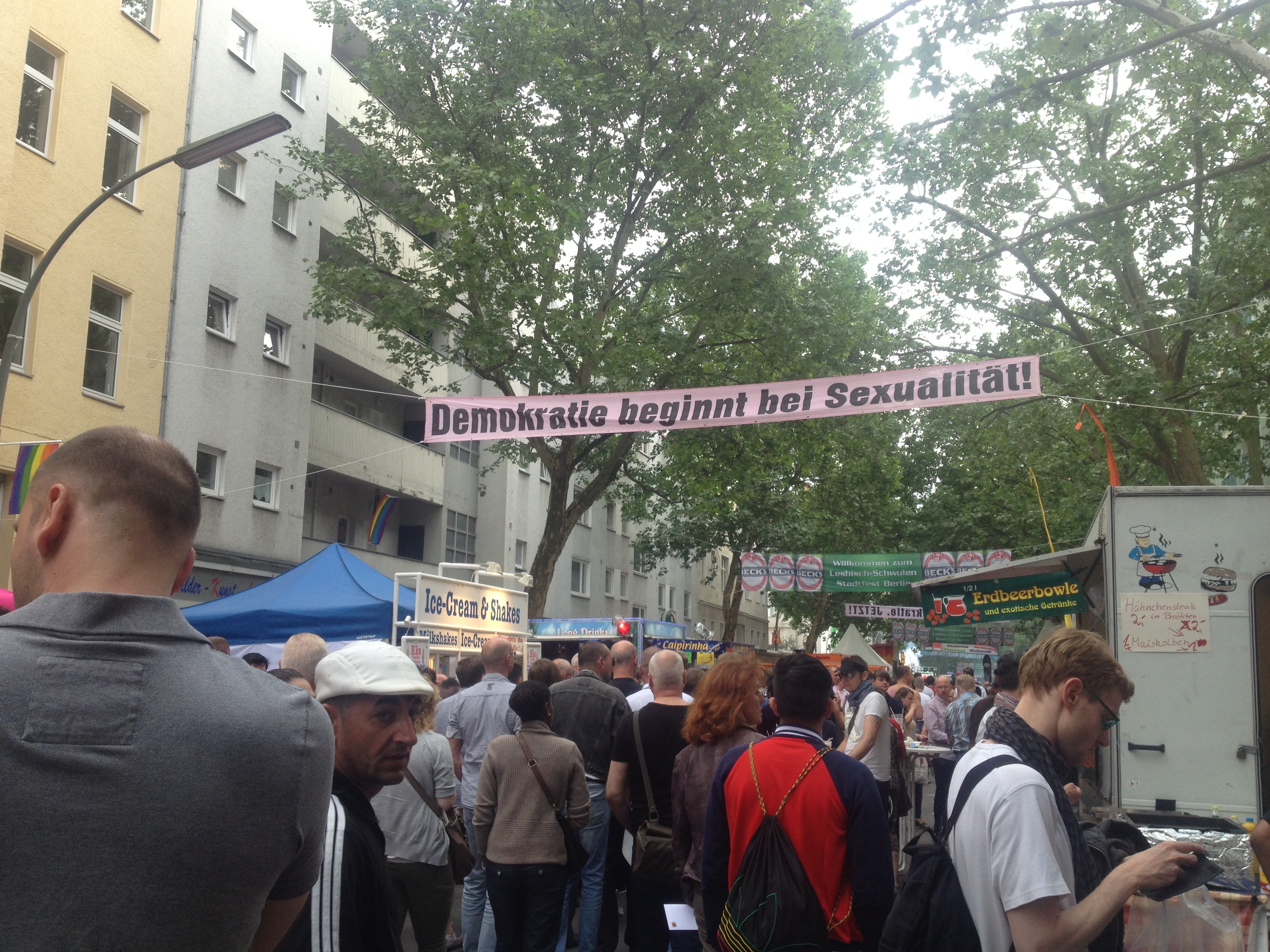
They say the world is a small place place. In an almost eerie coincidence, Dane – the very friend who had raved to me about Berlin just before my departure from Sydney – was in the German capital at the exact same time as I was. I’d seen his movements around Europe through his Facebook page, and couldn’t believe it when he to me the dates he was going to be in Berlin. We made plans to meet, and so on the Saturday afternoon after my crazy first night out, Dane picked me up in his hire car and we drove to Schöneburg, the ‘gay district’ out in west Berlin. The streets were packed – for all of my queer Sydney readers, it was a similar vibe to Fair Day during Mardi Gras season, kicking off the pride period. There were food stalls and restaurants and pop up bars selling beers and cocktails and all sorts of other fun things. One huge cultural difference I discovered in Germany is that it’s completely legal to drink alcohol on the street. I mused to Dane that if this were an event in Sydney it would be an absolute nightmare for licensing laws, and there would have to be so much strict control around the perimeter to make sure no alcohol was removed from the designated drinking zones. Germans have a reputation for being sticklers for rules, but I guess that doesn’t really mean anything when there’s no rule about it in the first place!

The streets of Schöneburg during pride.

The streets of Schöneburg during pride.

Oh, the people you see on the streets - standard Berlin.

Oh, the people you see on the streets – standard Berlin.

Dane and I wandered through the streets, soaking in the atmosphere, and occasionally stepping into some of the shops that lined the streets. Another thing I loved about Berlin was the sheer amount of crazy and kinky fetish shops that they had – it reminded me of home and the shop that I used to work in, except back there we were one of the only stores in the city to sell such quality kinky leather wares. Remembering all the names of places that Lola had listed for me the previous evening, we browsed through the stores and the huge ranges of leather jeans, harnesses, jock straps, butt plugs and… well, I’ll leave something to the imagination. The day kicked on into the evening and the partying in the street continued, though eventually Dane and I left, making plans to regroup later as he dropped me home. Unfortunately those plans never came into fruition – when I arrived back in Kreuzburg, I settled down for a quick power nap to recover from Friday night… only to wake up again at 12:40am, feeling like I’d been hit by a train. I wandered out into the kitchen, which was big enough to double as a lounge and chill out area, where a bunch of people were scattered around the floor, drinking and smoking and listening to music. Someone was on ‘something’, quietly laughing to himself on the floor. Someone else had done a huge bulk order McDonalds run, so I sat down, devoured a quarter pounder and then, after realising I hadn’t heard from Dane at all, decided to call it a night and headed back to bed.
***

If there’s one thing that all gay pride celebrations have in common, other than scores of drunken queers, it’s a full blown, glitter and rainbows pride parade. “According to one of my friends, Christopher Street Day is actually this weekend,” Donatella had informed me on the Monday after my first weekend in Berlin. “I thought it was later, but if it is this weekend then you should definitely stay for another weekend. It will be pretty crazy.” Already the words of Ruth and Lola were creeping into the back of my mind – was I ever going to leave Berlin?

Sadly, Dane’s travel plans meant that he couldn’t stay for the following weekend, so when the weekend finally rolled around after my week of being fairly touristic, it became my mission to find new friends to celebrate pride with. I’d been keeping an eye on the official events online, and so on Friday night I headed out to Schöneburg by myself with the intention of hitting the opening party at a nightclub called Goya. I arrived relatively early though, so instead of heading inside straight away, I wandered up Motzstraße to see if there were any other bars that were busy. I was only half successful – there were plenty of people around, but none of them were in the bars. Since the weather had been particularly warm lately, and drinking of the street is completely legal, throngs of gay men were gathered around outside the bars, on the footpath and the side of the road, talking amongst themselves while clutching their bottles of beers. It was a pretty cool set up, but unfortunately made mingling a little hard, since everyone already broken off into their own seemingly impenetrable groups.

As I was wondering what to do, I was approached by a group of four guys. “Hi there,” one of them said to me in a charming, distinctively British accent. “We were just wondering if you knew of any good bars around here to get a drink?”
I was a little taken aback. “Umm… I actually don’t.” I pointed to the crowd across the street and said, “That kinda looks like the place to be, though. I don’t really know any specific bars.”
“Yeah, but…” A second British man, clearly already a little tipsy, leaned in closer to perform an exaggerated whisper in my ear. “We’re interested in a slightly… slightly…” He glanced back at the crowd.
“Younger?” I offered.
“Less… bear-ish crowd,” he finished with a giggle. His assessment of the crowd wasn’t wrong – while the four in front of me all seemed the be in their mid-twenties, the group across the street contained a high proportion of broad shoulders, silver hair and scruffy, salt and pepper beards.
“Wait a second,” the first guy cocked his head a little as he considered me a little more closely. “You’re not German?” Ever since I’d arrived in Berlin, I’d constantly had people mistaking me for a local German and asking me for directions. I blamed the particularly butch haircut that I’d gotten in Groningen, but I didn’t really mind too much – I’d studied enough maps that half the time I could actually tell the enquirers where they had to go.
“Nah, I’m Australian,” I replied.
“Oh, nice!… And you’re here by yourself?”
“Yep.”
“Well, we’re looking for a place to have some drinks before going to the opening party later, but you’re welcome to join us if you like. I’m Giles,” he introduced himself. I went to shake his hand, but he was a bit of an eccentric character and insisted on cheek kisses, before acquainting me with the rest of the group of friends. They were a bunch of guys from London who had flown over for the weekend. The idea of flying to Berlin for the weekend blew my mind at first, but I realised that the city couldn’t be more than a few hours away from London via plane.

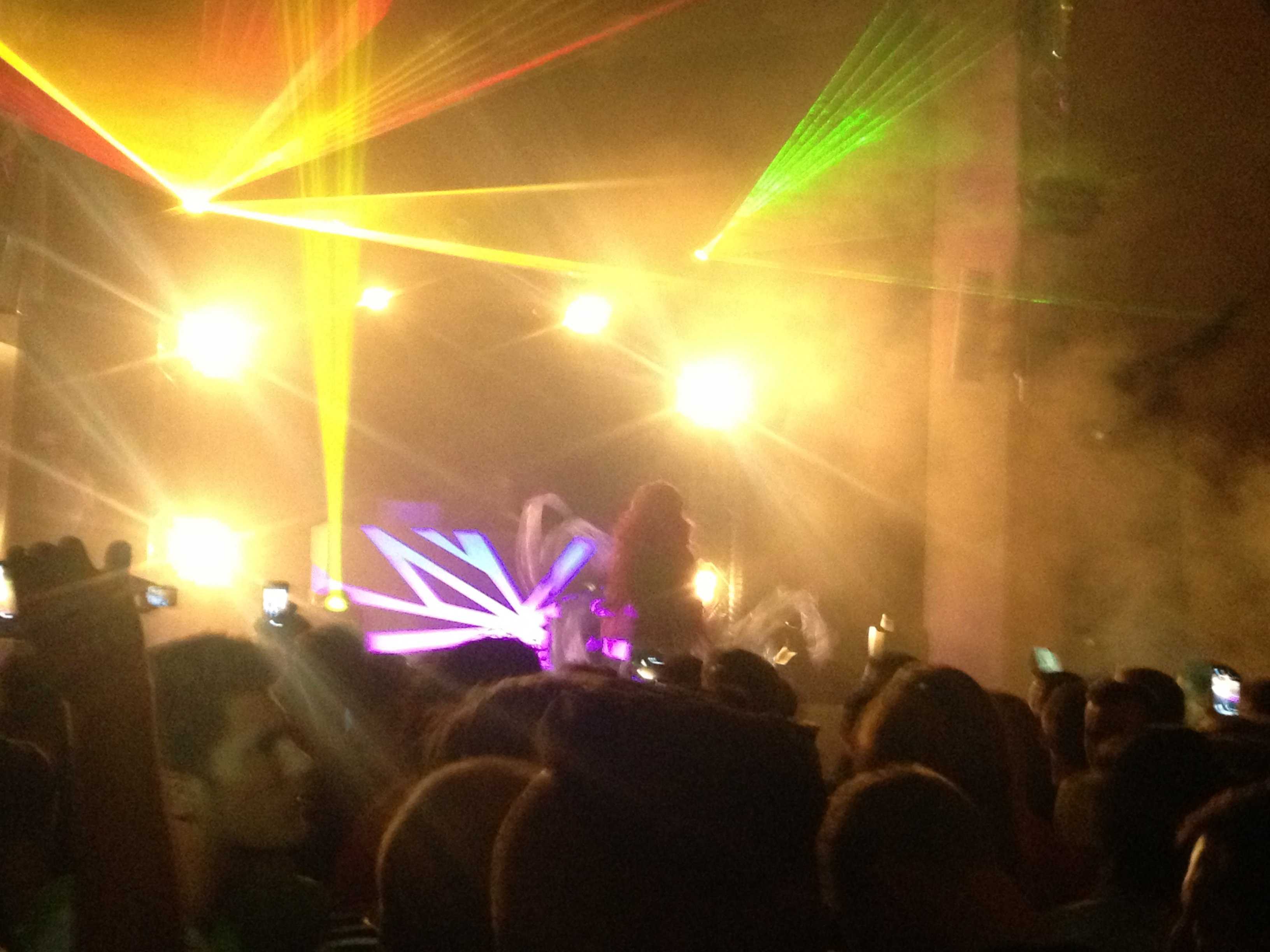
So I tagged along with Giles and the Londoners for the evening, eventually just grabbing some beers from a convenience store before heading back to Goya. The venue was huge and elaborate, with towering domed roofs and chandeliers that sent the laser lights scattering, and curved marble staircases that led up to a vast dance floor. The crowd was full of gorgeous men, but from the ones that I spoke to and interacted with, I quickly realised that a large percentage of the crowd were foreigners like myself and the London lads. It was very drunken and slightly messy night, but I remember encountering very few, if any, German men. There were drag shows and pop music and smoke machines and overpriced drinks – I had a great night partying with my new friends, but reflecting on the night in the morning, I decided that it had been in its own way, for all intents and purposes, a bit of a tourist trap.

The evenings entertainment at the party at Goya.

The evenings entertainment at the party at Goya.

***

Though as a mentioned earlier, for every spectacular pride party, there must be an equally fabulous pride parade. Christopher Street Day is essentially the German version of Mardi Gras, except it doesn’t just happen once a year – apparently an event by the same name happens in cities all over Germany at various times of the year. A perpetual pride of sorts, I suppose, and completely befitting of the the Germans, in my opinion. Despite making new friends the night before, I didn’t end up making plans to attend the parade with them. That didn’t stop me though, and when I emerged out of Nollendorfplatz station onto the main strip on Motzstraße I found the streets busy and bustling with people. Some were on-lookers, wide-eyed and curious. Others were selling water and beer and food and drinks and all sorts of goods, but most of the crowd was decked out in full blown costumes, whether it was leather daddies and their ass-less chaps, drag queens in their finest frocks and wigs, or gym bunnies that had seemingly been dipped in pots of glitter. I had arrived just in time to see the passing parade, so I walked down the road a little bit to find a spot with a good view to stand and watch the parade.

Leather pride marchers.

Leather pride marchers.

One of the numerous party bus floats.

One of the numerous party bus floats.

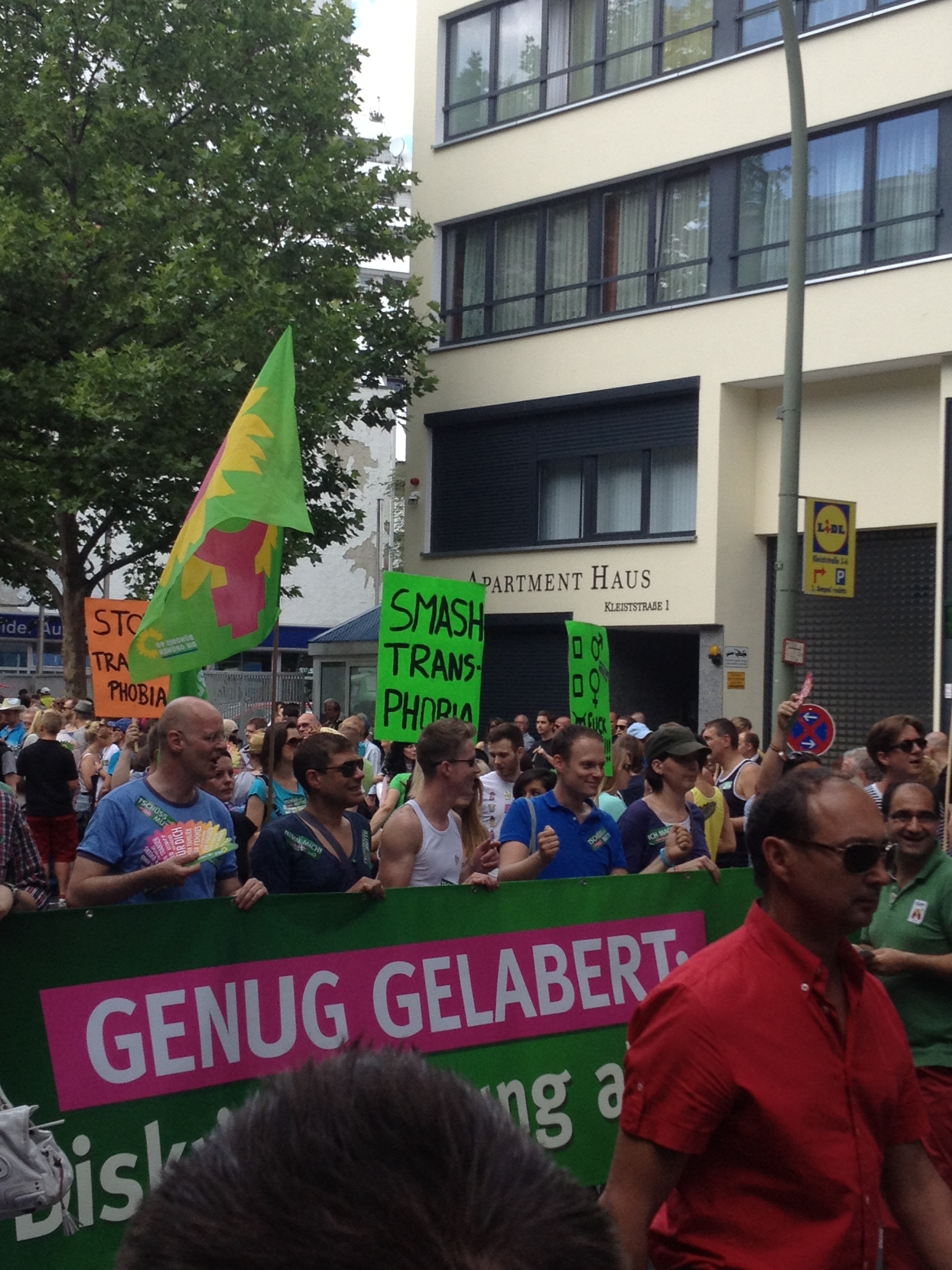
Anti-transphobia marchers.

Anti-transphobia marchers.

More kinky leather men.

More kinky leather men.

One key difference I observed in the Christopher Street Day parade was that everything was just so casual and relaxed, while still operating and functioning in an efficient German manner. Once again, drinking was a non-issue, and marchers in the parade blatantly clutched bottles of wine and cans of beer as they strutted their stuff down the street, whether it was on foot or on one of the many floats. It threw me back to the comparison I made between the crowds in Thailand during the crazy
Songkran water festival, and crowds at Australian events. While in that example I felt as though an Australian event would have grown quickly out of hand and potentially violent, I feel as though had Australians been given the ability to freely drink in the streets, we’d have a lot more problems of misconduct than the Germans were having. Another key difference in this pride parade was the ability to participate. I was feeling slightly hungover from the previous evening, so I chose to remain a spectator from the sidelines, but there were no fences or barriers between the sidewalk and the road – anyone could step off the curb and join the masses in their dancing and partying, strutting and posing, actively taking part of the pride parade. It was worlds away from the organisation and red tape that goes into the planning of Mardi Gras back home, where no one is allowed to pass over those barriers once the parade has started. The German way seemed so much more open and liberated, which is exactly what you would expect from a pride parade, though I can’t help but think that given the same privileges, Australians would still somehow manage to make a mess of the whole thing. Maybe I’m just disillusioned after several years of seeing more intoxicated bogans roaming the streets of Sydney during Mardi Gras season than actual queer people.

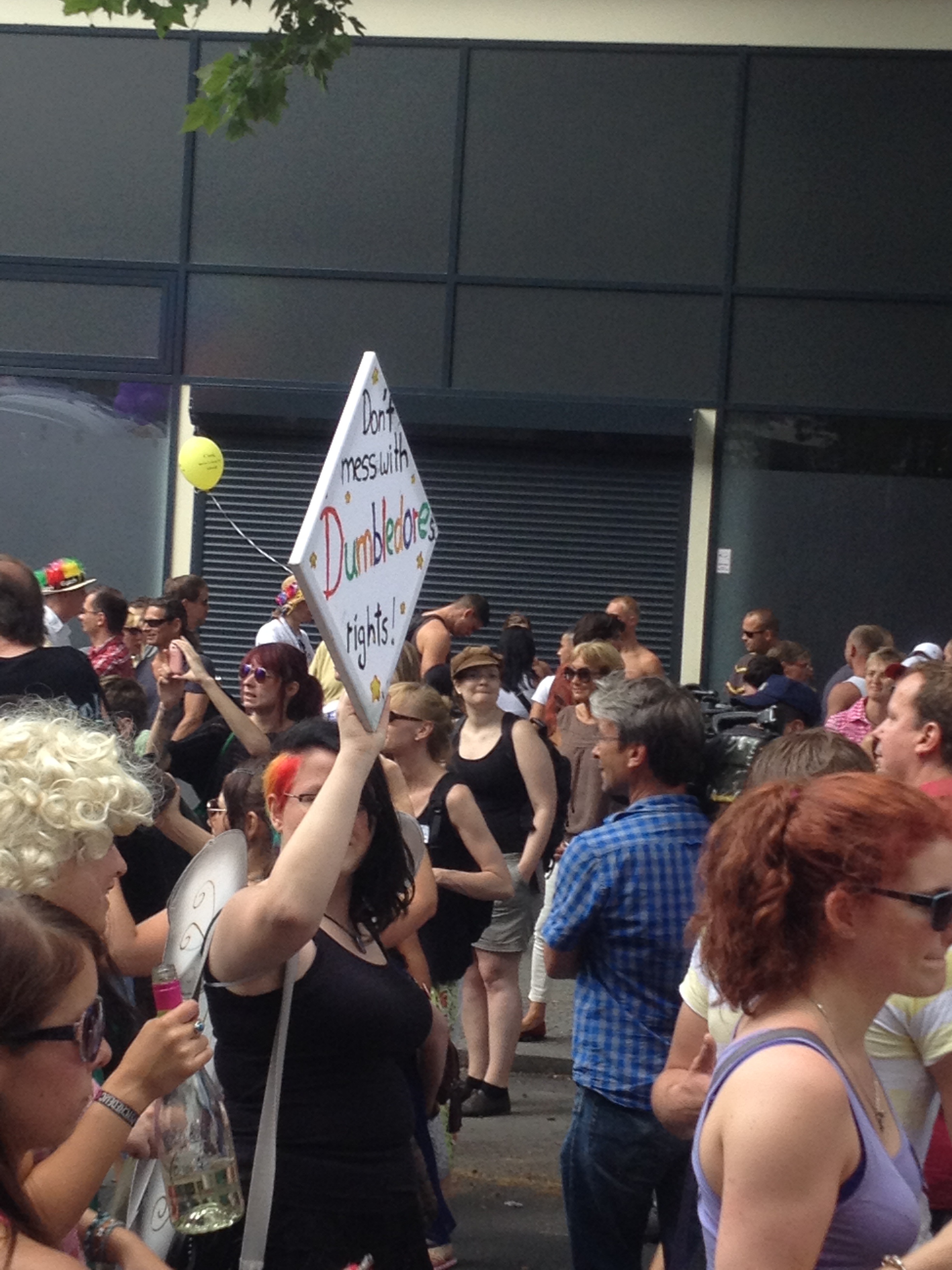
Probably my favourite sign of the day.

Probably my favourite sign of the day.

Definitely my favourite drag queen.

Definitely my favourite drag queen.

Drag queen with fierce bra and shoes.

Drag queen with fierce bra and shoes.

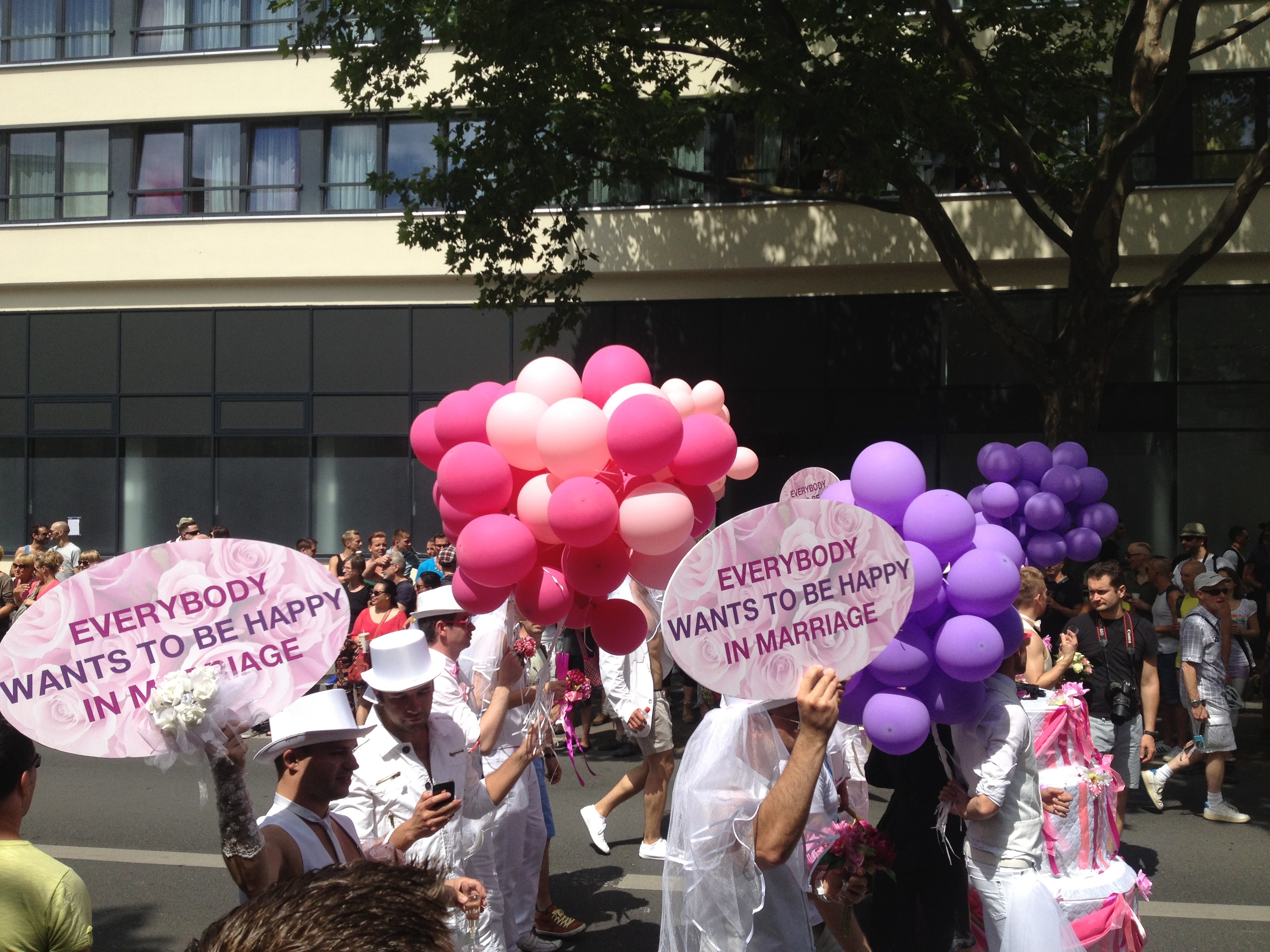
Germans marchig for marriage equality.

Germans marchig for marriage equality.

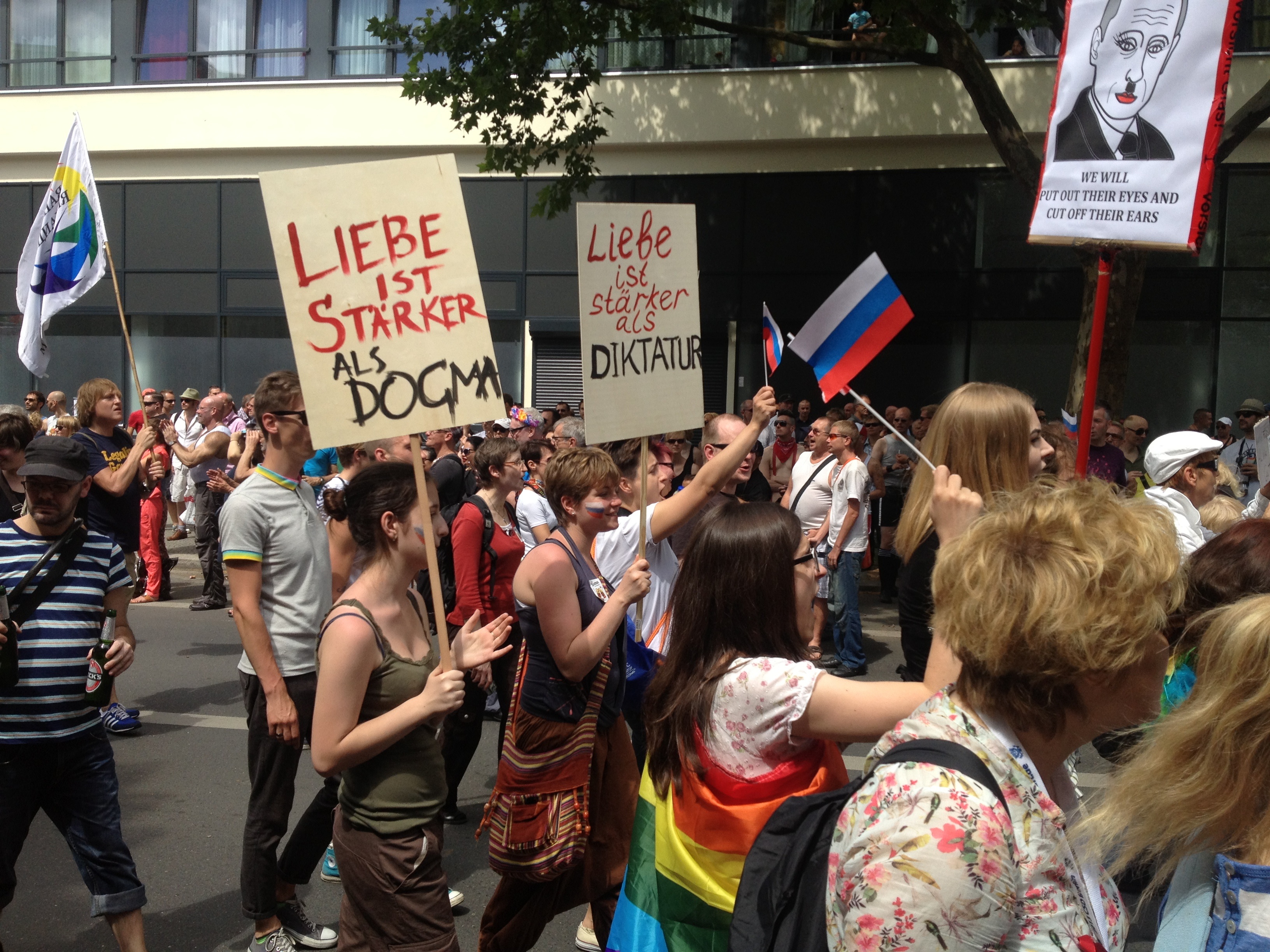
But is wasn’t just the organisational set up of Christopher Street Day that impressed me – the participants really did put on a show. There were gay pride groups for men in leather, lesbian mothers, transgender and intersex people, drag queens of every shape and size, queer students, campaigners for marriage equality, and many other queer community organisations and businesses – my personal favourite was definitely Dildo King. Everyone was dressed in amazing costumes, and music was blaring out of all the trucks that carried the floats. Free stickers and giveaways were being handed out and thrown from floats, and it was impossible to wipe away the smile that was plastered across my face. As a citizen of a country that doesn’t yet recognise marriage equality, I was really pleased to see that people in countries that do recognise it still continue to be proud and fight for the rights of their international queer brothers and sisters. Because up here in Europe, there is a situation that is far more dire than the right to a same-sex wedding.

The beginning of the Russian marchers.

The beginning of the Russian marchers.

Queer. Russian. Proud.

Queer. Russian. Proud.

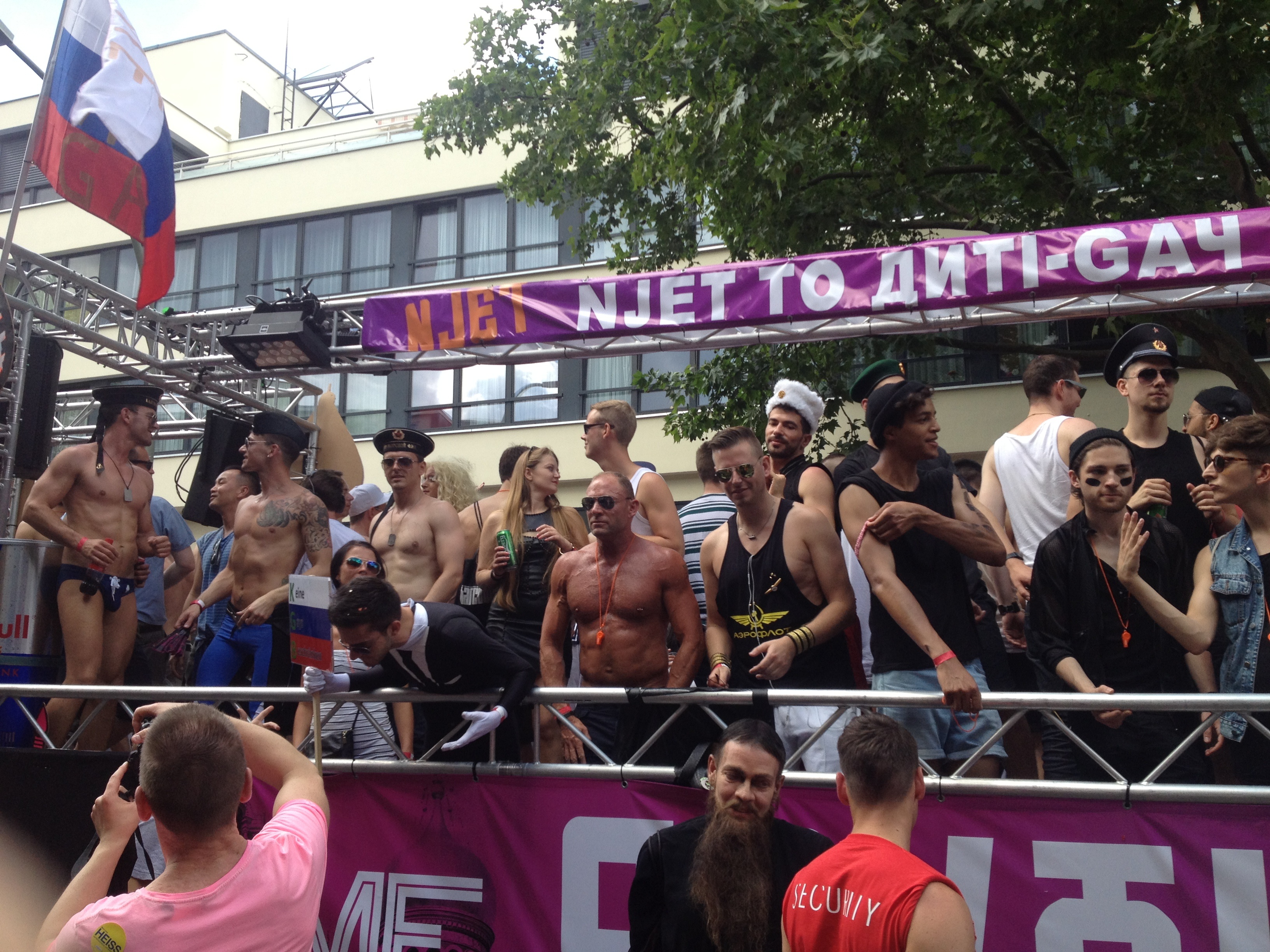
Russian float - proud and naked.

Russian float – proud and naked.

The only thing they're guilty of is being so cute.

The only thing they’re guilty of is being so cute.

There were several groups of Russian marchers who genuinely brought a tear to my eye. Whether they were dressed plainly and carrying slogans and banners, or fierce drag queens strutting down that street with their hearts on their sleeves for the world to see, my heart simultaneously swelled with pride and broke just a little, for these people who had been turned into exiles and criminals in their own country, to their point where this kind of march would have them thrown into jail or beaten to pulp, perhaps even both. ‘Dark days in the white nights’, read one of the placards being waved over the weave a Russian drag queen whose pissed off expression should have frightened anyone into giving her equal rights. ‘#putinmyass’ was another popular slogan that was being waved around. I screamed and cheered with the crowd around me as these brave souls marched down the street in front of us. Between then and the time of writing, the situation in Russia has only gotten worse. More than ever I reflect upon my visit to the Sachsenhausen concentration camp, and how the laws being laid down by President Putin are becoming frightfully similar to a Nazi Germany that the world saw during World War II. It’s terrifying, and my heart goes out to our brothers and sisters in Russia who are being faced with such terrible conditions. But there at the Christopher Street Day parade, I was assured on one thing – the world isn’t watching on silently this time, and these atrocities aren’t going unnoticed. It’s almost a little ironic that these displays of pride are now happening in Germany, but it’s up to us, and the people with the freedom to be proud of who we are, to stand up and protest against the Russian authorities, Putin, and the oncoming homosexual Holocaust.

The Geometry of Genocide: Triangles and Tales from a Concentration Camp

While I was trying my best to avoid the typical tourist scenes and experience the more authentic culture of Berlin, there is one historical aspect of the city that is simply impossible to ignore. So on Wednesday I set off on the S-Bahn heading north to the Sachsenhausen Memorial Museum, located on the site of one of the “model” concentration camps where prisoners were taken in WWII. It was located approximately an hour north of central Berlin, and it took me even longer after getting lost in the surrounding suburban streets, but the trip was worth it – ‘enjoyable’ isn’t exactly a word use can use to describe a visit to an old concentration camp, but it’s definitely a moving experience that you come away from with more of an appreciation of your life, and of life in general.

The cute little suburban German streets I wandered through while getting lost on my way to the museum.

The cute little suburban German streets I wandered through while getting lost on my way to the museum.

***

The entrance to the Sachsenhausen Memorial Museum.

The entrance to the Sachsenhausen Memorial Museum.

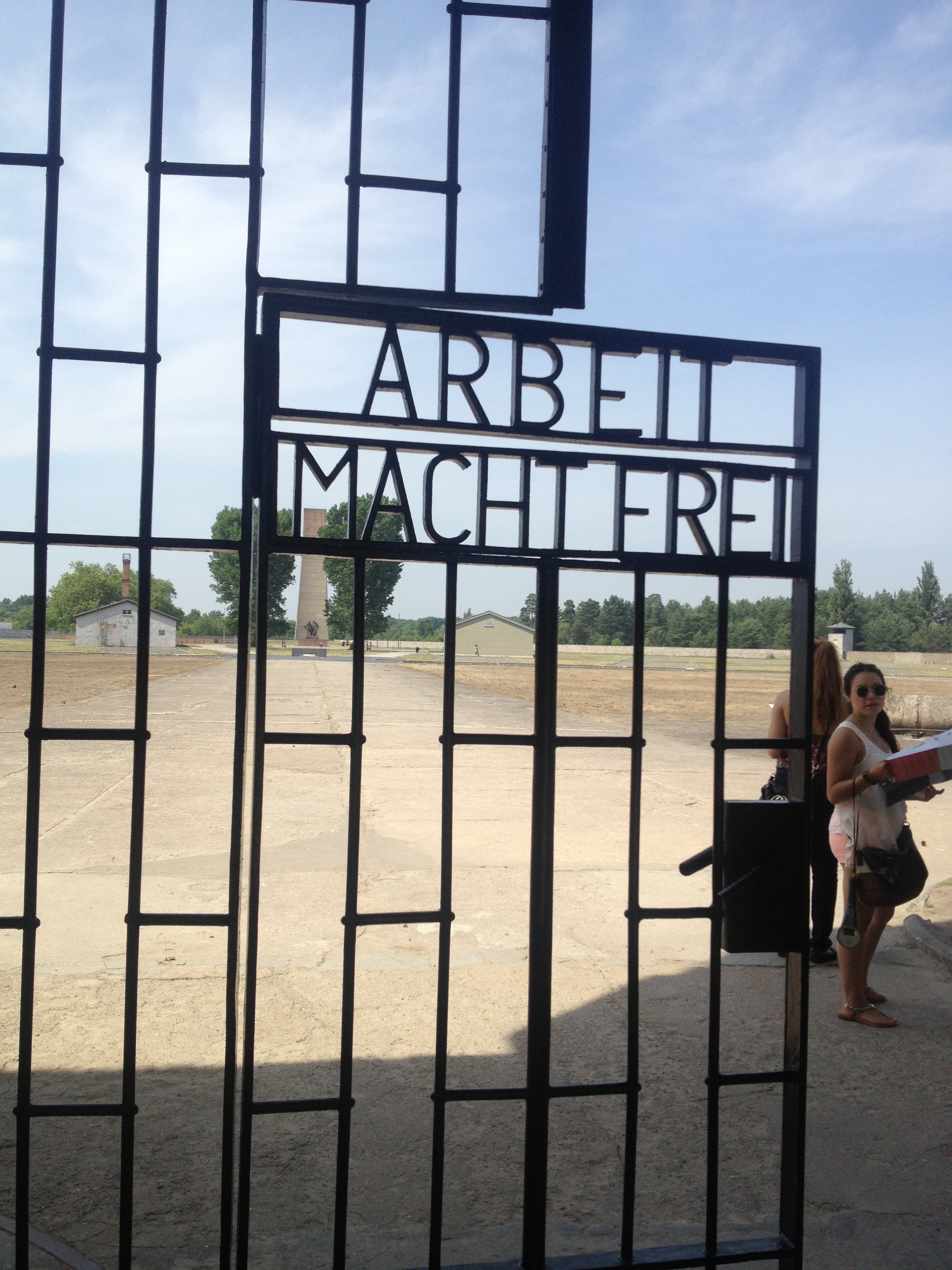
When I visited the Killing Fields near Phnom Penh in Cambodia, Laura had described the place as “harrowing”. I still feel like it’s the best fitting adjective to describe a visit to a location tainted with a grim history of mass genocide. While the Killing Fields were particularly morbid, with broken skulls and bones depicting the barbarity of the Khmer Rouge clearly visible in their monuments, Sachsenhausen Memorial Museum was a little more refined as a tourist attraction. After passing through the main entrance and picking up an audio guide, and listened to the history of the camp as I wandered down the same path that hundreds of thousands of prisoners were brought down during the Second World War. As I waled through the wrought iron gates, I noticed there were words – a slogan, or a motto – worked into the metal: Arbeit Macht Frei. Translated into English it reads ‘work will set you free’, something that is hard to mistake as anything other than cruel irony given how things ended up for most of the prisoners who walked through these gates. In the courtyard I sat and listened on the audio guide to testimonies of people who had been hit, kicked and beaten when they were down, right at this very spot. It was almost too overwhelming to listen to, and I moved on before hearing them all, already feeling a little depressed as the scenes were visualised by my imagination.

Main gate through which prisoners were escorted.

Main gate through which prisoners were escorted.

Metal inscription on the main gate.

Metal inscription on the main gate.

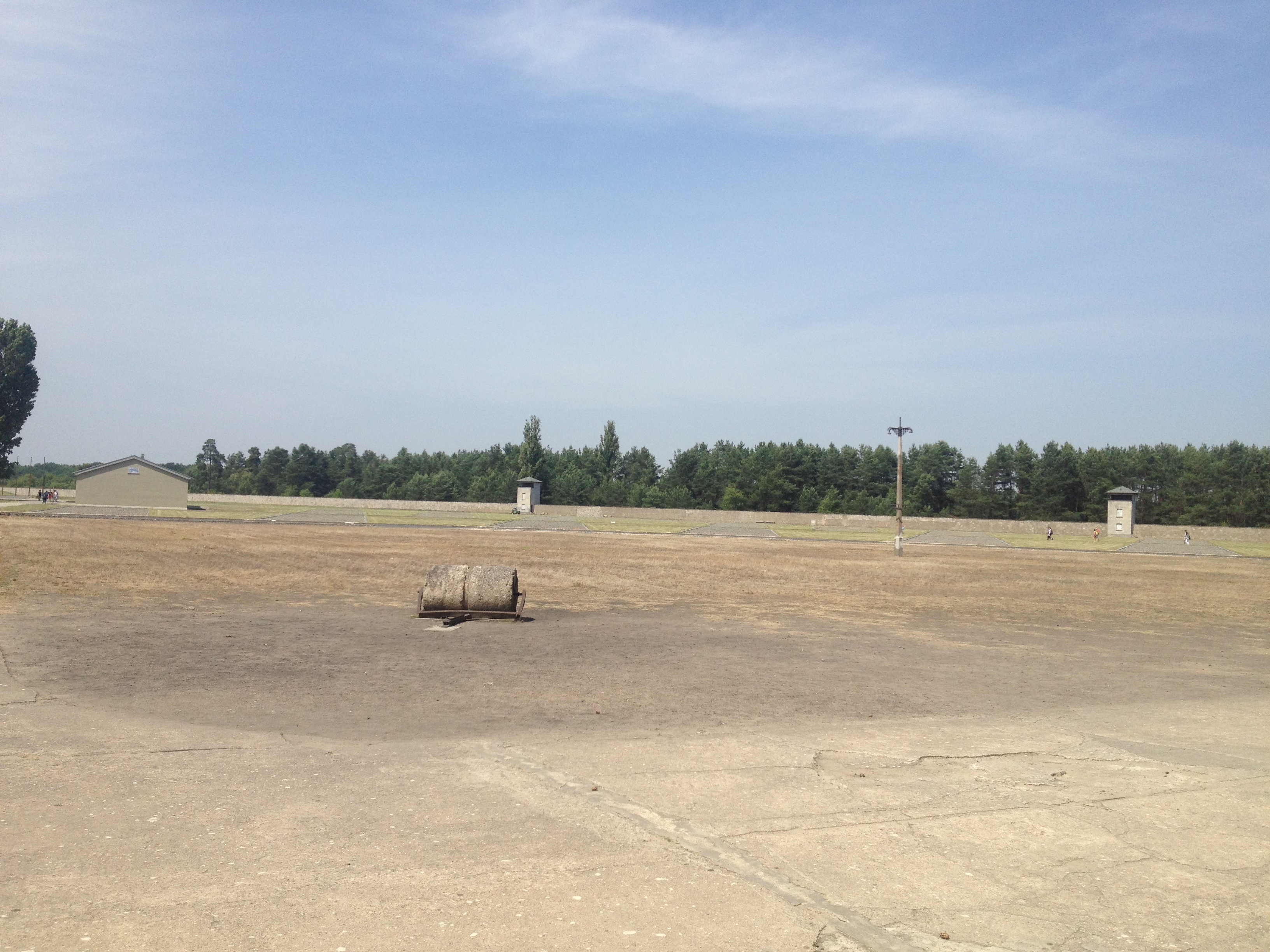
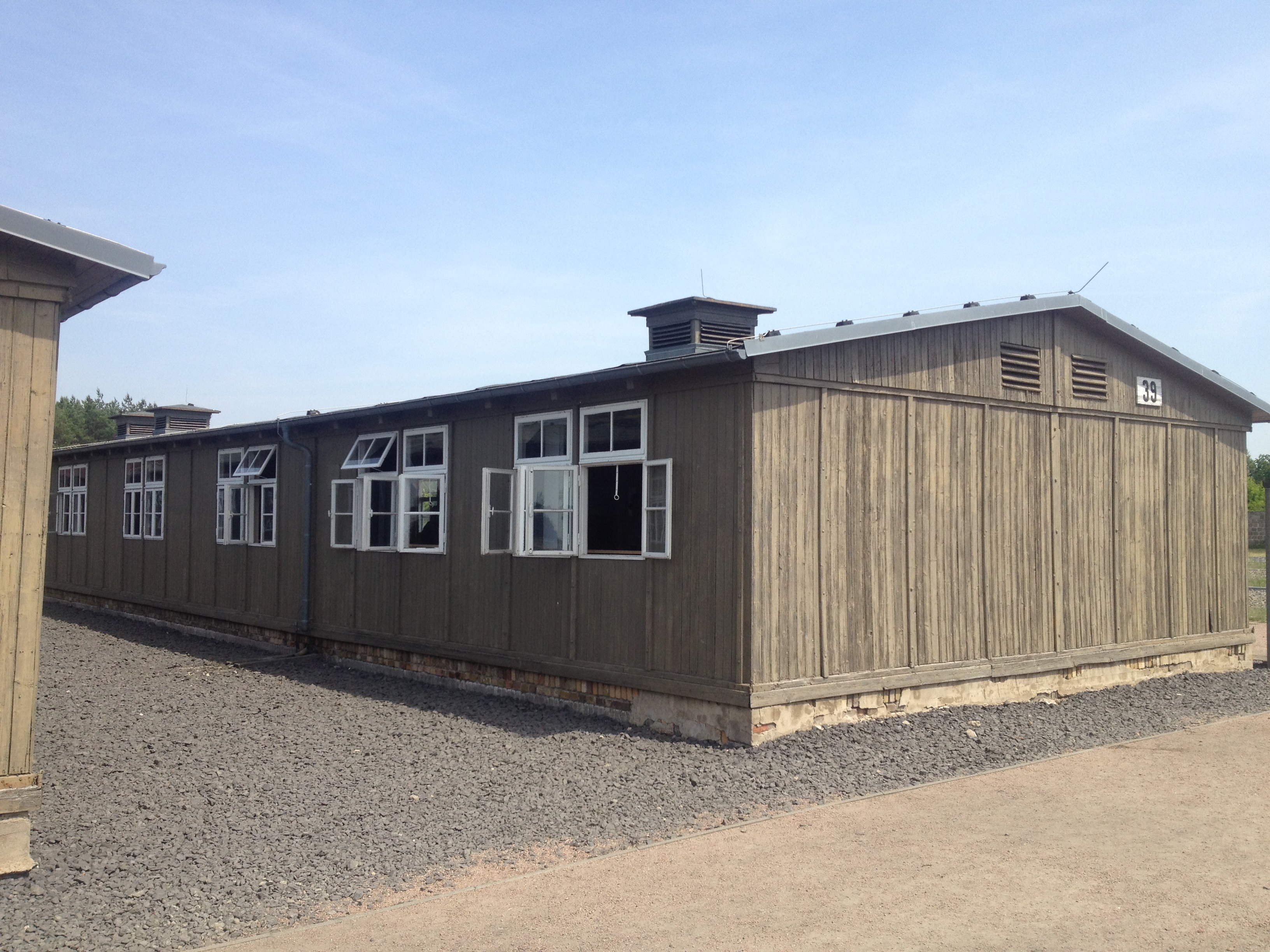
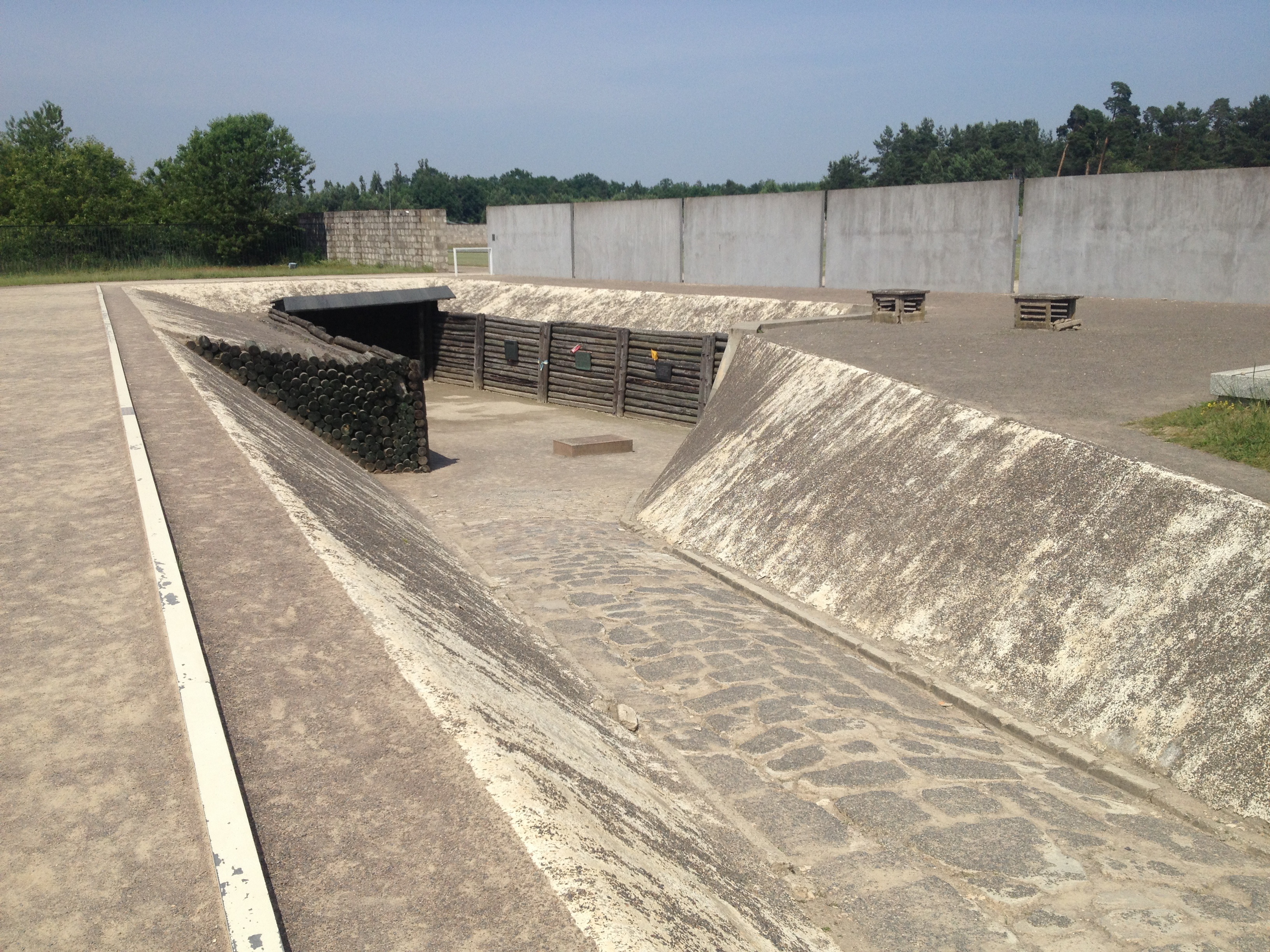
This concentration camp was opened in 1936 as a model design for other camps, although it ended up being much more than just an example – Sachsenhausen become a fully functioning concentration camp and prison. The architecture was designed to symbolise the subjugation of prisoners and the absolute power of the Nazi regime – the triangular design was built in a way that meant while in the grounds, prisoners were unable to escape the gaze of the guards in the watchtowers. Most of the barracks that were the prisoners quarters have been levelled, so now the area has an even eerier feeling, with so much open space between yourself and the watchtowers. There’s obviously no armed guards in there these days, but it still managed to recreate that sense of vulnerability the prisoners must have felt. Other features of the camps design included a security system which included a ‘death strip’: an electrified pathway and fence that took the lives of prisoners who made fleeting attempts to escape. Some of the barracks remain standing and have been converted into museums, showing the daily lives and conditions of the camps prisoners with a little more tangible depth, and you could also see the site of the gallows in the middle of the main triangle, where troublesome prisoners were routinely executed in front of large assemblies in order to create and example for the remaining prisoners.

The grounds of the camp are now vast and desolate.

The grounds of the camp are now vast and desolate.

Part of the security system at Sachsenhausen.

Part of the security system at Sachsenhausen.

The barracks that do remain have been transformed into smaller museums.

The barracks that do remain have been transformed into smaller museums.

Barracks 38 is one of the few that remain standing.

Barracks 38 is one of the few that remain standing.

The Execution Trench - the morbid name is self-explanatory.

The Execution Trench – the morbid name is self-explanatory.

In a building that used to be a garage for Nazi vehicles, there was now a museum that showed the history of the camp, and had numerous artefacts on display. Included in these was one of the uniforms that the prisoners were required to wear – the pink triangle sewn into the shoulder indicating that this particular prisoners crime was being a homosexual. The Nazis imprisoned anyone who disturbed their regime, whether they were political opponents, or those who were deemed by the National Socialist ideology as racially or biologically inferior, and were later joined in 1939 by captives from countries which Nazi Germany moved to occupy, such as Austria and Poland. Though historically famous for the persecution of people who were Jewish, the Nazi regime would happily have beaten me senseless and locked me up to starve simply because of my homosexuality – this uniform, now sitting behind a glass cabinet looking as innocent as a pair of striped pyjamas, was a chilling reminder of that. More than 200,000 people were imprisoned in the Sachsenhausen Concentration Camp between 1936 and 1945, with tens of thousands of them dying from starvation, disease, forced labour, malnutrition, and brutal, systematic murders. It’s a lot to take in as you stand upon the scene of these crimes, especially considering this is just one camp, where only a fraction of the atrocities committed during the war were committed.

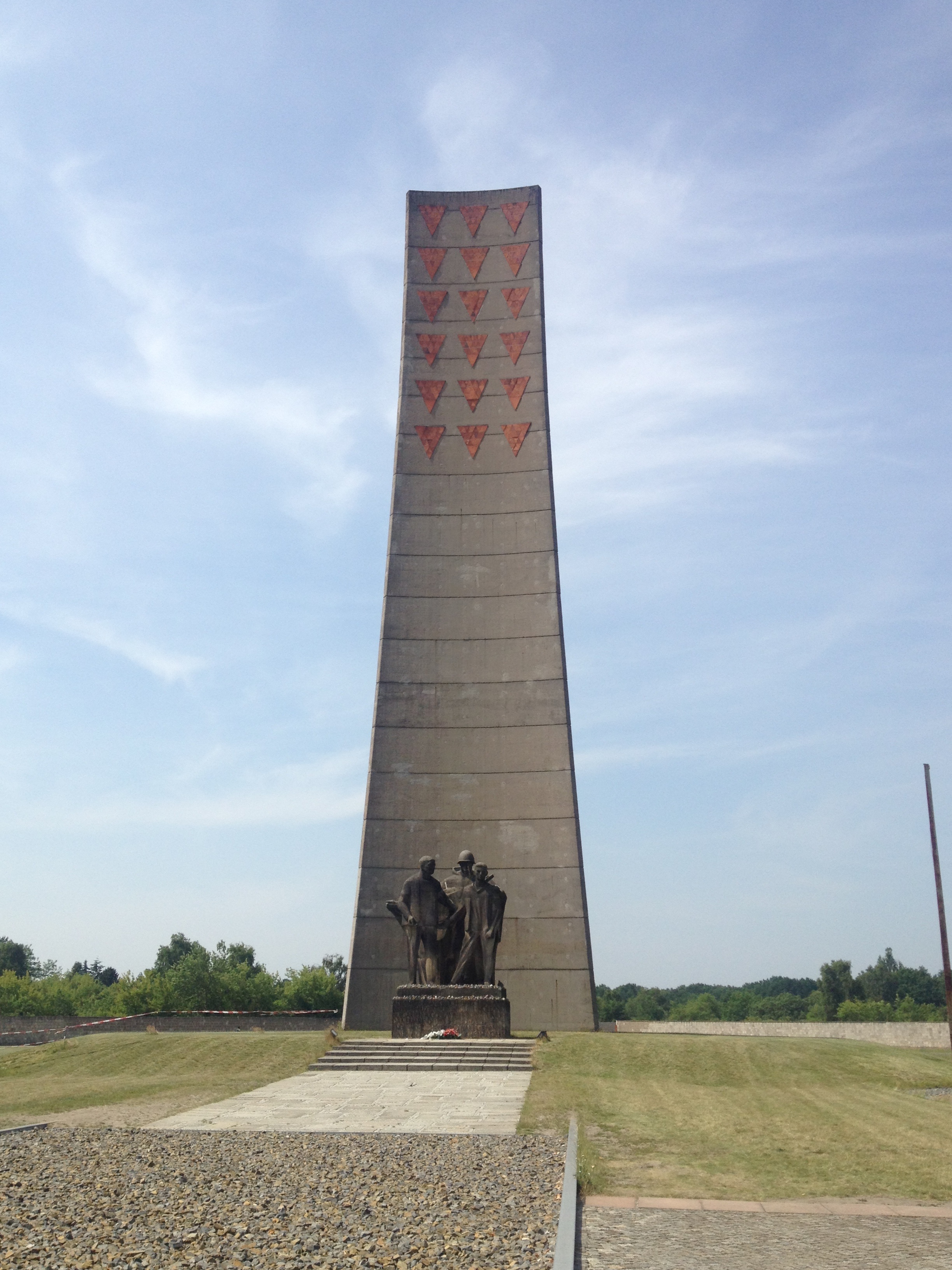
The memorial obelisk.

The memorial obelisk.

The pink triangle resonated with me strongly during the time I was at the Sachsenhausen Memorial Museum, but weeks later, at the time of writing, it’s truly terrible to realise that some parts of the world are still stuck in some of these barbaric ideologies. I’m referring, of course, to the horrific state of affairs for LGBT people in Russia. The newer, even harsher homophobic anti-propaganda laws came into place after I left Germany, but right now it’s something that I can’t just ignore. Having been to Russia and met a couple of very lovely gay men, it absolutely breaks my heart to see what is going on over there, to think that they might be suffering.
In the middle of then main triangle at Sachsenhausen, there now stands a forty metre high obelisk adorned with 18 red triangles – the symbol the Nazis gave to political prisoners – on each side, the number representing each of the European nations where prisoners at the camp came from. It’s a monument of memorial, but right now all it makes me think of is the European nations that are in such close proximity with Russia, and hoping that something might be able to be done before the persecution reaches a level of homosexual Holocaust. I never had the intention of using this blog to voice political opinions, but that was just one thing that I couldn’t let slide.

***

It had been a long hot day wandering around Sachsenhausen, and I was sweating profusely by the time I’d walked back to the station in the afternoon heat. “It’s not a heat wave”, Ruth would later tell me, fending off the claims of some other Berliners. “Thirty degrees is a normal summer day for Berlin – winter just lasted so long that most people forget about it, and are just shocked when it’s actually hot!” Nevertheless, even for an Australian I was feeling the heat. On the train home, I messaged Eva to find out what she was up to – the two of us had been sharing a key, since there weren’t enough for both of us to have one. She would be going out before I got home, but Simon would be around for a little while longer. When I was back into the heart if Berlin, I got a phone call from Simon.
“Hey, where are you?”
“I’m nearly home… Do you need to leave now?”
“Well, sort of… I’m going to the pool to meet Ruth, I was gonna ask if you wanted to come?”
Swimming sounded exactly like what I needed. Donatella had had to head out of town today for some work commitments in Munich, so she wouldn’t be joining us, but Simon said he’d grab my swim shorts and towel and pick me up from the U-Bahn station I was at.

What I didn’t realise – either because he didn’t say so or I didn’t listen – was that he was not picking me up in his car, but on his motorbike. A surge of panic ran through me – I hadn’t been on a motorbike since the horrific afternoon in Phnom Penh, and I still bore the mental and physical scars. However, I had to reassure myself that I’d since ridden quad bikes in Siberia and navigated the bicycle traffic of Copenhagen, and had come out unscathed, and I also wouldn’t even be driving this time. It would be just like catching the motorbike taxis in Bangkok, and so I put on the spare helmet, climbed on behind Simon, and we took off onto the roads of Berlin. We passed a few other bikies done up in their full leather gear, which I guess was to be expected in Berlin, and whizzed our way through the traffic until we finally reached the pool.

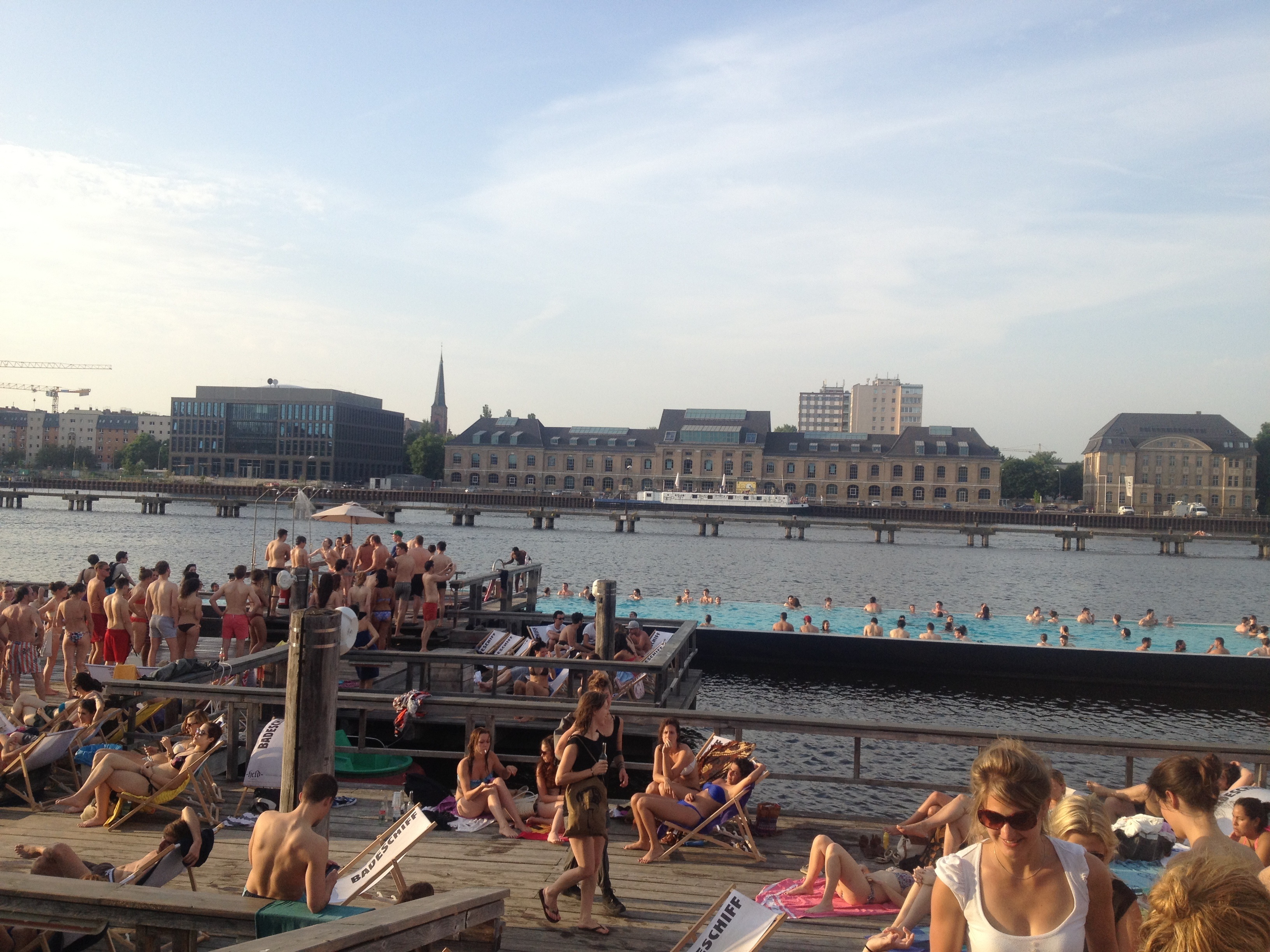
The place rented deck chairs from Simons vodka company, so we got to skip the queue and also got in for free. The place was really cool – the water in the Spree River and the adjoining canals is not something you’d ever want to go swimming in, so this place had designed a way around the problem. There was a large pool that was built on the river. The ground all around the edge was covered in sand so it felt as though you were really at a beach, and then off the wooden jetty the swimming pool itself sat just off the edge of the river. Of course, given that today was an extremely hot day for Germany, there was a long line to actually get in the pool. After finishing a beer from the beach cafes inside the complex, Simon and I joined the queue to go for a swim. After the long day I’d had walking around the old concentration camp in the hot sun and learning about all the horrors of history, it was definitely worth the wait – the swim was exactly what I needed. And so the end to an otherwise slightly depressing day was spent cooling off, kicking back and putting my feet up with my new Berliner friends.

The riverside pool where I ended my day.

The riverside pool where I ended my day.

From Tourist to Traveller: Berlin Sightseeing

After an exhausting weekend that nearly destroyed me, I decided to take some time out of the crazy Berlin party scene and do a couple of touristy things. Of course, I needed at least a full day just to receiver from the messed up sleeping patterns and diet that consisted almost solely of booze and currywurst. But on Tuesday, when I finally felt human again, I set off in the morning to do a self-guided Trip Advisor walking tour of Mitte, the central district of Berlin, also known as the Government Quarter.

But before I begin that recount, I need to do my obligatory rant, or rave, on the public transport situation for a new city. And I have to say, notwithstanding the train delays on my journey to actually get into Berlin, I am in love with their local train services. There are two kinds: the S-Bahn, which runs above ground and are actually integrated into the national rail system, and the U-Bahn, the underground trains that are essentially the German version of a metro. Trains on all lines come frequently at regular intervals, and between these two highly integrated networks, it’s possible to get almost anywhere in Berlin with relative ease, although there are so many different lines and interchanges that it can be a little difficult to wrap your head around at first. The only real issue I had with the U-Bahn and S-Bahn was the price of a ticket: €2.80 for a single trip seemed a little steep in my opinion, but then I guess I had still be paying student fares in Sydney right up until I left – welcome to the real world, kid. Although there’s one tip I can offer that you won’t read in any Lonely Planet book – there’s no barriers at the stations for which you need a ticket to pass through, and checking for tickets on board the train is very infrequent. Now I’m definitely not condoning fare evasion, but… there a few short trips I make where I felt it was worth the gamble. So for a system that is well-established, efficient, and if you can’t get away with it, free, Berlin public transport gets a general tick of approval.

***

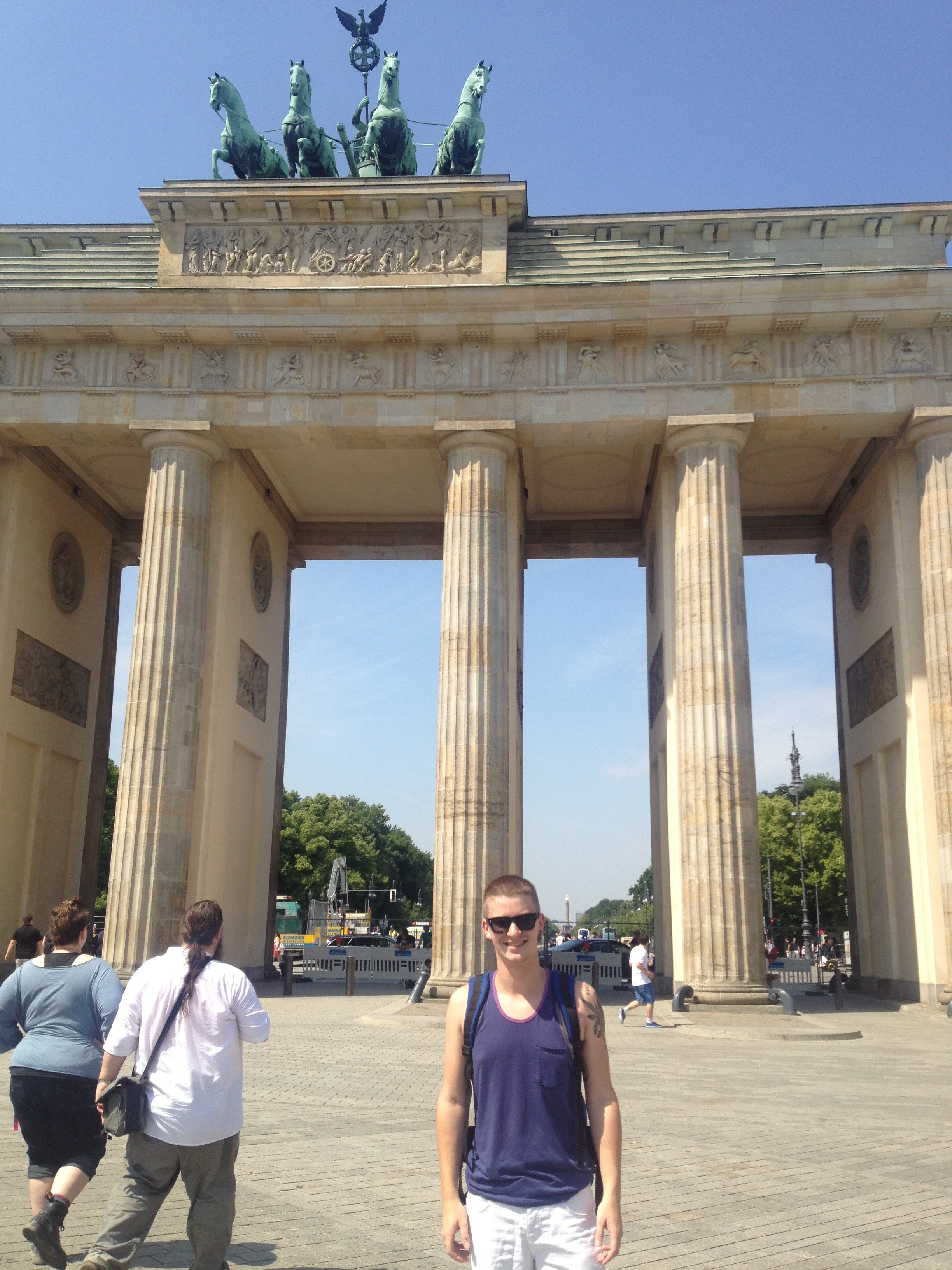
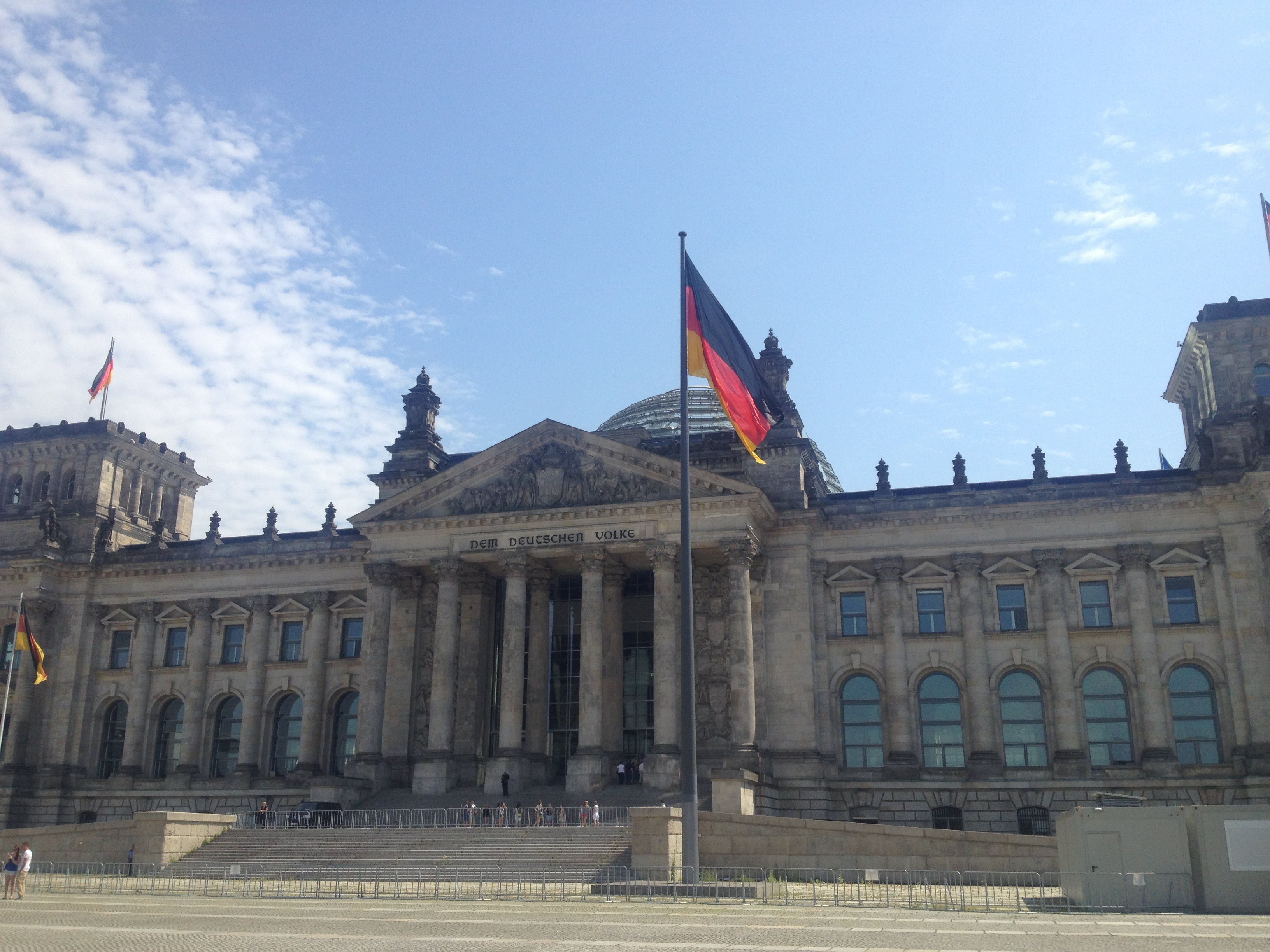
The first stop on my walking tour was the Brandenburg Gate. The most famous of all the east-west crossings of the Berlin Wall, it’s a symbol of the division that once ran through the city, though during my time in Berlin I’d learn that while the wall came down in 1989, distinctions and differences between East and West Berlin are not unrecognisable. Visually, the gate is probably the most iconic feature of Berlin, so I posed for a photo before continuing through. The time I was in Berlin also coincided with a visit from the US president Barack Obama, and so Pariser Platz, the square in front of the Brandenburg Gate, was full of security guards and scaffolding, as some type of arena seating was erected in the clearing. I passed through the arches of the gate from east to west to find the Tiergarten stretched out before me, and turned right to head towards the Reichstag, the German parliamentary building. According to my Lonely Planet guide book, there was a popular and impressive view of central Berlin from the glass dome ceiling of the Reichstag, and that it was free to go and see. What the guide book failed to tell me was that you needed to make a booking prior to your visit in order to secure your spot on the viewing platform. Slightly disgruntled but not really that bothered, I left the bustling tourists to their lining up and headed back towards the Tiergarten.

Gate

The Brandenburg Gate, with just a suggestion of scaffolding.

In front of the Brandenburg Gate.

In front of the Brandenburg Gate.

The Reichstag, the parliamentary building which I unfortunately didn't get to enter.

The Reichstag, the parliamentary building which I unfortunately didn’t get to enter.

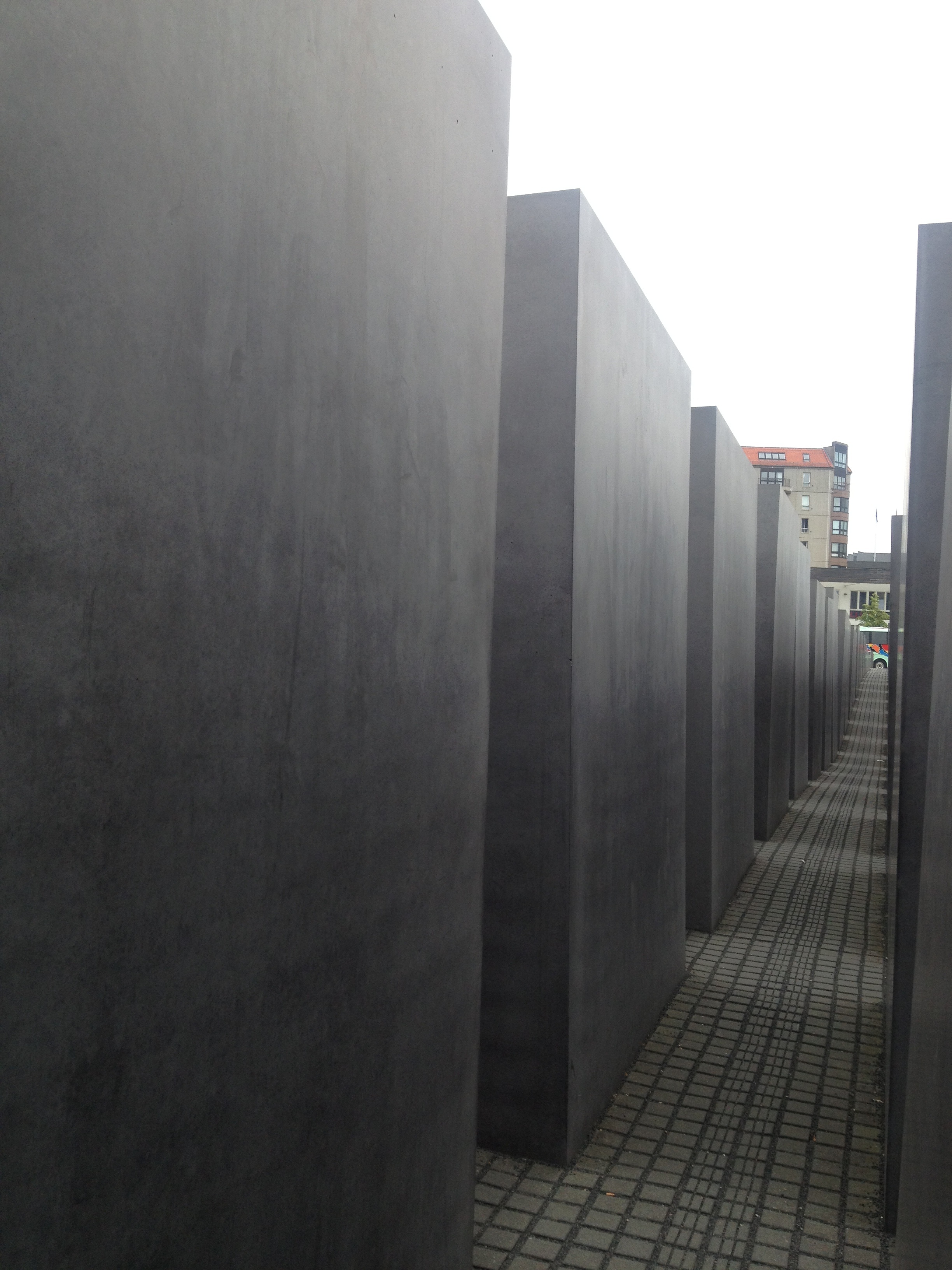
The Tiergarten is a huge expanse of greenery right in the centre of Berlin. I don’t know much about it historically, other than it being the name of a Rufus Wainwright song, but it was beautiful place to stroll through a park and lose yourself in the gardens. I made an arching route in and out of the Tiergarten, admiring some statues along the way, before emerging at the haunting piece of artwork that is the Holocaust Memorial. The memorial is a collection of 2711 pillars, all evenly spaced apart across 19,000 square metres, and which appear to be of a roughly similar height. However, as you walk into the grid you begin an unexpected descent, and discover that the ground is uneven and awash with hills. When you enter the grid, the pillars come up to your knees. After a few moments, they’re towering above you, and the only thing you can see in all for directions are long corridors created by the towering monoliths, and the occasional other person who crosses your path along the way. As I emerged from the memorial, I took a seat for a moment and reflected on the reason it was there, and who all the pillars represented: the victims of the Holocaust. Each one was the same essential structure, a homogenous collective, yet each pillar was also individual in its unique height. I’m not sure if that’s the actual rationale behind the memorial, but it struck me as somewhat symbolic. Afterwards I took a photo with the memorial, as a tourist souvenir – only afterwards was I told about a website that makes fun of men who use such photos taken at the memorial as their profile pictures on online dating sites – there happens to be quite a lot of them! That was a little embarrassing, but I just made sure to never upload the picture to my Grindr profile.

Lion statue in the Tiergarten.

Lion statue in the Tiergarten.

Holocaust Memorial: view from above...

Holocaust Memorial: view from above…

... and the view from below.

… and the view from below.

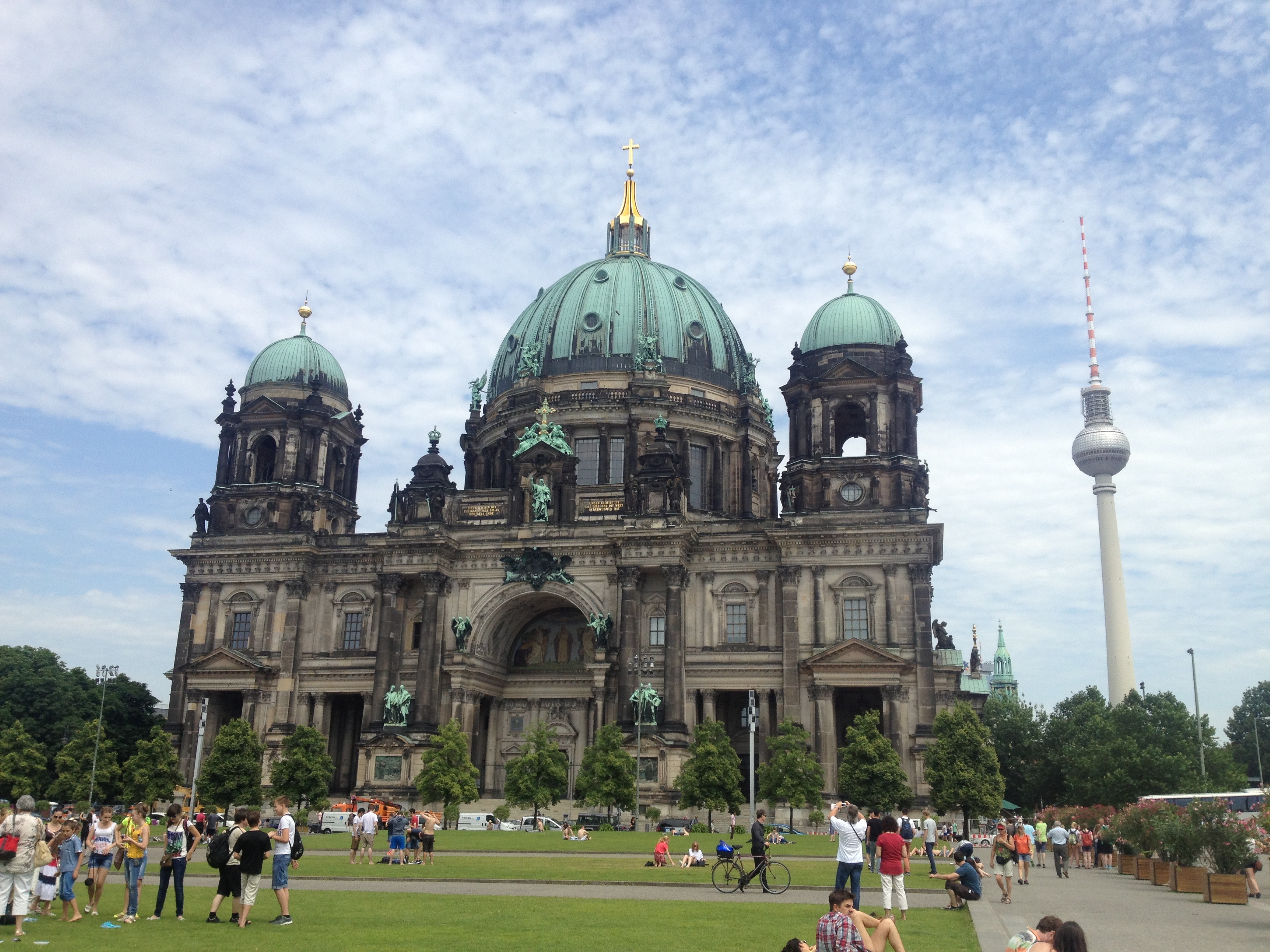
After the memorial I headed back east and eventually reached Museums Island, a block of land that is surrounded by canals, so technically an “island”, and is home to a cluster of art museums. I had a wander around, admiring some of the beautiful buildings, but decided I wasn’t really in the mood for museums. I continued along the path, looking at a few churches and stopping for a photo with the Karl Marx stature – the sociologist in me just couldn’t resist. Eventually I arrived at Alexanderplatz and the TV Tower. It’s not a particularly pretty building, but it is tall, so I went inside and took the elevator to the top. The TV Tower is one of the few sky scrapers in Berlin, and by far the tallest building, so it provided a complete panoramic view of the city, although it was so high up that so many of the sights were minuscule and almost unrecognisable – even the Brandenburg Gate looked no higher than a couple of centimetres from up there. There was a fancy rotating restaurant at the top of the tower, but I decided to save my euros and eat at Hackescher Markt, a nearby market down on the ground. I think there might have been more of the Trip Advisor tour, but the day had involved a lot of walking and I’d found myself rather exhausted. For something that’s isn’t really extremely exciting, sightseeing can be exhausting. I finished my lunch and jumped on the U-Bahn to head back home.

Berliner Dom, the cathedral on Museums Island.

Berliner Dom, the cathedral on Museums Island.

The Karl Marx statue.

The Karl Marx statue.

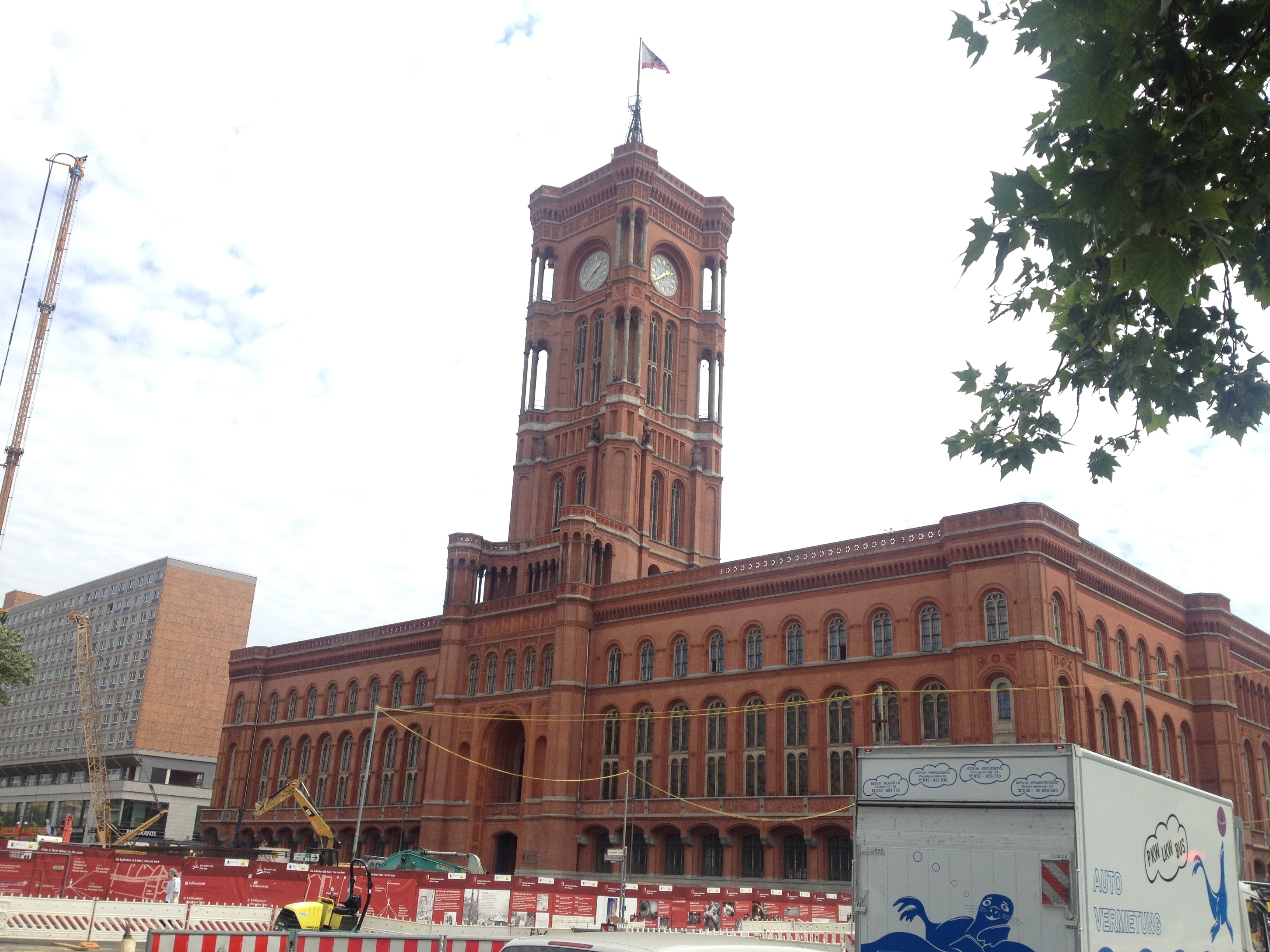
The Rotes Rathaus, or Red Town Hall, near Alexanderplatz.

The Rotes Rathaus, or Red Town Hall, near Alexanderplatz.

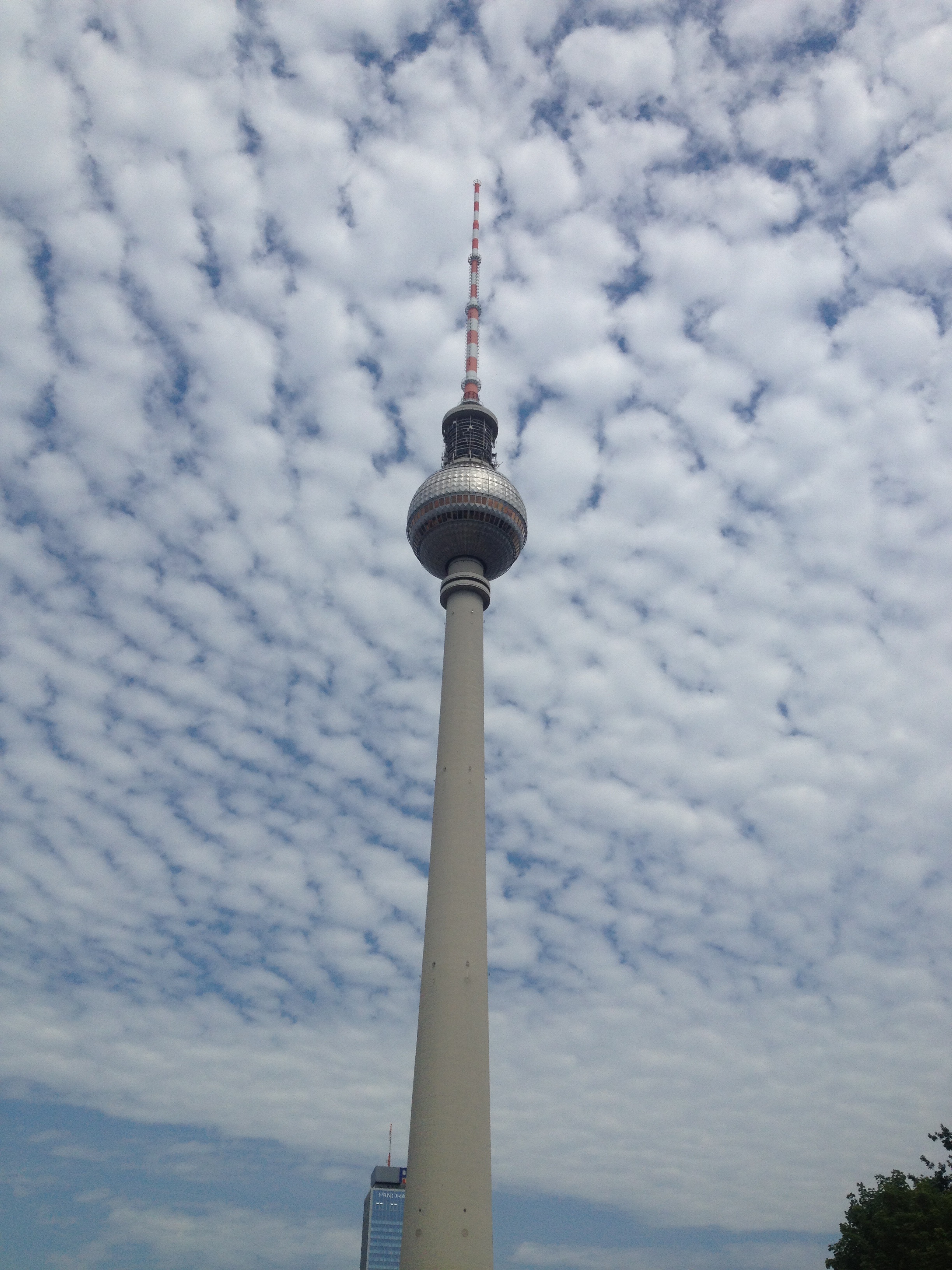
TV Tower.

TV Tower.

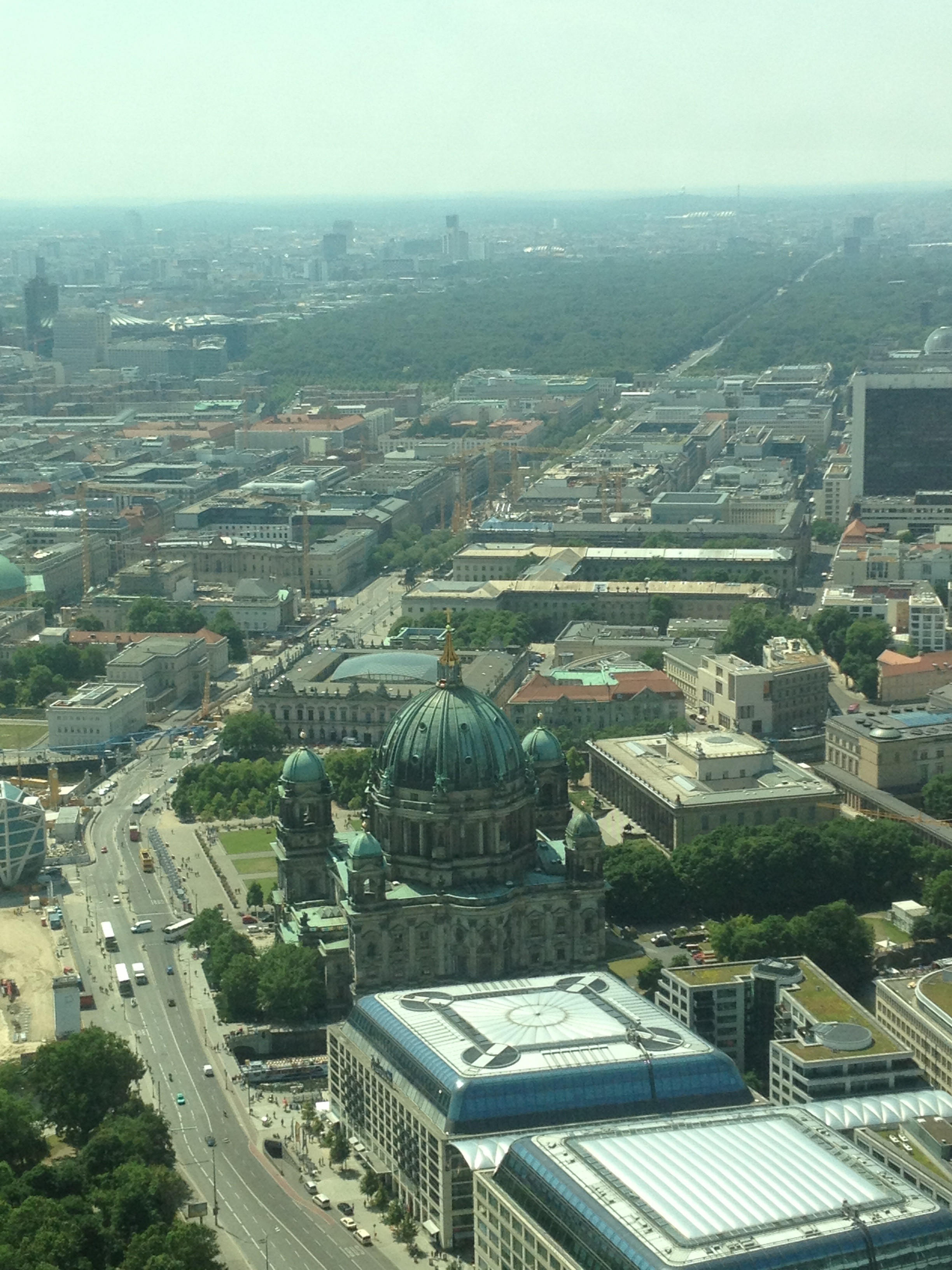
View of Berlin at the top of TV Tower, from the Tiergarten to Museums Island - essentially, what I'd just walked.

View of Berlin at the top of TV Tower, from the Tiergarten to Museums Island – essentially, what I’d just walked.

***

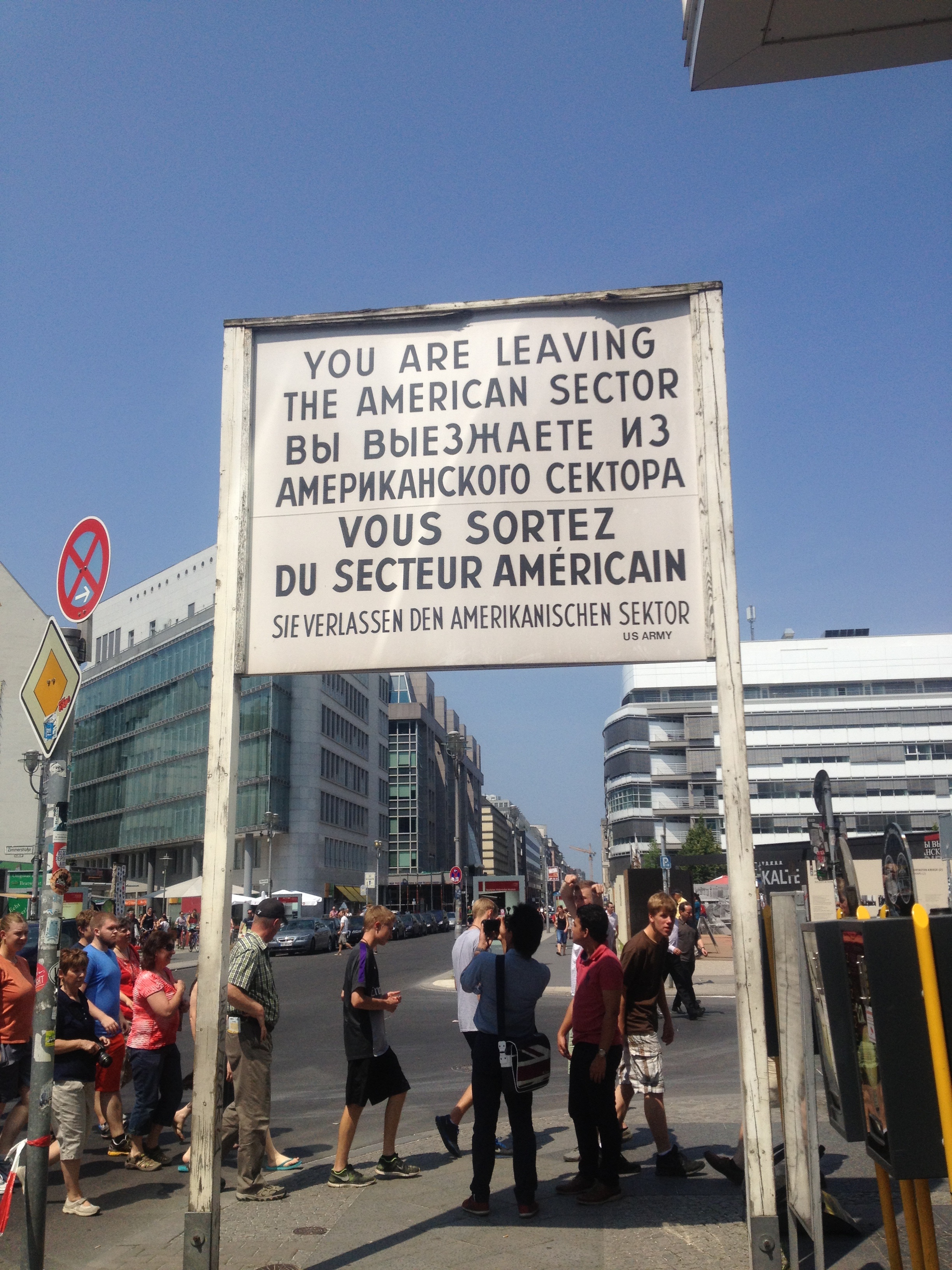
The only other touristy sightseeing I did during the week was a few days later when I visited Checkpoint Charlie, where you can still see the sign that “You are now leaving the American sector”, a remnant from the days of the war. However, with the men in uniform trying to sell you pictures with them, it’s all a little gimmicky and so full of tourists that I could only bring myself to stay for a short time. I would have visited the Jewish museum, but the weather had gotten so hot over the past few days I could bring myself to walk the rest of the way. It was there at Checkpoint Charlie, though, that I reached something of a turning point within myself: I made the conscious decision that I wanted to be a traveller, not just a tourist. I didn’t want to just check off the list of sights listed in the guidebook and take photos in front of the famous monuments – I wanted to experience what the city was really like, meet the locals and see things from their perspective, and see what Berlin was for them. Being a tourist can be exhausting, with the weird pressures you can feel from people to “do everything” and go to all the “must see” sights. For me, being a traveller is all about doing whatever you wanted to do, and going places that you actually want to be. I’d seen some of the wild and crazy sides of Berlin, and if was looking for more of that, I definitely wasn’t going to find it in a Lonely Planet book.

Checkpoint Charlie.

Checkpoint Charlie.

Welcome to the Jungle: Beginning Berlin

After another full day of travelling from Groningen, with brief changeovers in Leer and Hannover, I finally arrived in Berlin. It wasn’t without a delay of over an hour – central and eastern Germany had recently experienced a bit of flooding, which had caused lots of problems for the trains – but not even that could quell my excitement. “Spend at least a week in Berlin”, my friend Dane had told me on one of my last nights in Sydney. “We had a very tight schedule when we went. We were only there for a few days, and it was definitely not enough.” He’d let out a sigh and stared past me reminiscently, eyes glazed over with memories. “You’re gonna have such an amazing time. And the men! They’re going to eat you up, Robert.” Dane was just one of many of my friends who had expressed such sentiments about Berlin, so I was brimming with anticipation as I stepped onto the platform at Berlin Hauptbahnhof.

I was picked up at the main station by Donatella, an old family friend from Australia who, apart from a brief reunion in Sydney back in January, I hadn’t seen in at least ten years. We’d got on rather well at our most recent meeting though, and I was excited to meet up with her again here in Berlin, where she now lived. “You should stay with Donatella when you’re in Berlin,” her father had told me last year when I was telling him of my travel plans. “She’s queen of the clubs over there, she’ll look out for you and make sure you see everything you want to see.” I’d taken it easy during my week in Groningen, partly in anticipation of a crazy weekend with Donatella. And I was in no way disappointed – though I don’t think there was anything that could have prepared me for what Berlin was about to throw at me…

***

I threw my bags into the car as I greeted Donatella, and was briefly introduced to her friend and housemate Simon, who was driving, and then headed back to the apartment. It was an old style building with large towering walls, and huge rooms that seemed too big for their inhabitants, given that half the rooms only seemed half full with furnishings. “I think there’s like… five people who live here? Maybe six? I don’t know, anyway, here’s your bed.” Donatella had warned me that I wouldn’t have a room to myself – which, after all the hostels and train cabins, I assured her was no problem – so I was introduced to Eva, a Kiwi girl who had been living in Melbourne for a few years and had now just relocated to Berlin, who I was sharing a room with. “Everyone else will be back later after work, except some of the boys who are away for the weekend.” Donatella was a little quirky but very laid back – I’d only been in the city for a matter of hours but I could tell why she enjoyed living in Berlin.

Before I’d arrived in Berlin, Donatella had also issued me a slight warning. “Just so you know… Things can sometimes get a little crazy around here. Like, not all the time and not that often, but there’s always the all-nights and crazy benders where people are up for three days straight. But only ever on weekends – everyone still has jobs, so you know… It’s slightly normal.” Bring it on, was all I had to say. I was no stranger to partying, and if even Donatella was telling me that it was crazy, I could be sure it was a force to be reckoned with.

After settling in and having something to eat, I was introduced to more people as they arrived at the house. Firstly there was Ruth. “Ruth is an original Berliner – born and raised,” Donatella had informed me. “You don’t find too many of them still living here anymore.” Berlin was a city with a very cosmopolitan vibe, thanks to the artists and creative types that came from all over the country, as well as all over the globe, to be a part of what was becoming one of the big places to be within Europe. Ruth worked as a burlesque dancer – of course she did, this was Berlin – and it was during my conversation with her that I discovered why I’d had such trouble trying to find a place to stay in Hamburg the previous weekend. “Yeah, there was a big biker convention. All the leather men were there, Reeperbahn would have been very busy,” she had said. “It’s a shame you didn’t get to see Hamburg, it’s a really fun city,” though after that she shrugged her shoulders. “But hey, you’re in Berlin now,” Ruth said with a smile. It was that very logic that had drawn me straight here rather than attempting another stopover in Hamburg – I’d heard the stories and I just couldn’t wait any longer to discover them for myself.

The last person I met at the apartment that evening was actually an ex-housemate, a woman named Lola. She was also a burlesque dancer – never mind that she was older than my mother though, because she looked amazing! She arrived looking like a pin up girl who had just stepped out of a sailors shoulder tattoo, complete with her waist cinched into a corset. “You said you worked in a fetish store, right?” Donatella asked me. “Lola will be able to tell you all the places like that around here.” And she was delighted to – she rattled off the named of retailers, bars and saunas faster than I could have ever hoped to remember them after a few vodka tonics, though in retrospect I think I checked most of the boxes she listed during my time in Berlin.

Eva had already headed out to meet some other friends, and Donatella had taken leave of our company for a short while – to study, or nap, or something, I’m not sure – so I was left to converse with these three crazy Berlin personalities I had just met. “So where else have you been? What are your travel plans?” Simon asked me as he ashed a cigarette into the tray on the table. I retraced my travel steps, right back to Singapore, and then outlined the rest of my intended itinerary – the plan was to continue further into Eastern Europe: Czech Republic, Slovakia and Hungary. “Yes, you have to go to Budapest!” Simon had exclaimed. “I’ve got a friend who lives there. She is crazy, I swear will get you wasted every night! But definitely let me know when you’re going so I can set you up.” I was excited to already be making connections.
“And how long are you staying in Berlin?” Ruth had asked, almost ominously. He question hung in the air while I had to consider my answer – after all, Dane had told me at least a week.
“Well… I’m not sure yet. I don’t have any set plans, so it’s flexible… I’m thinking at least a week.”
All three of them shared a rather knowing laugh, and Lola reached over to put a hand on my knee and looked at me with a grin. “Oh darling, that’s what they all say. You’re never going to leave.”

***

When it came to the weekend, there really had been no exaggeration – it was wild. At close to midnight I headed out with Simon and Donatella to a bar and club called Prince Charles. Donatella knew someone, so we didn’t wait in line. Once we were in, the night progressed into a blur of drinks and people and music and making friends in bathrooms, the memory of which only exists through photographs. Eventually the sun began to rise as I sat around the courtyard telling straight men how attractive I thought they were – and then getting overly excited at the simple fact that they didn’t care, and were completely indifferent to my homosexuality. “That’s so Berlin!” I remember telling one of them. “If I was pulling this shit in Sydney I’d probably be dying in a gutter somewhere.”

Making friends.

Making friends.

Eventually Donatella rounded me up and we headed home – with at least 6 other people from the club who I’m not sure anyone had even known before that night. I’d heard of the after party culture in New York, but I figured that anything was possible in Berlin. Because of the early sunrise, it was actually quite bright and well into the morning by the time we fell out of the taxis outside Donatella’s building. I might have had a few more drinks, I don’t remember. The only clear recollection I have is sitting on the floor of the bathroom with some guy I’d never met, trying to have some deep conversation while he asked me to explain all of my tattoos. At that moment, whatever buzz I was feeling died. I looked around the bathroom with… well, not sober eyes. But you know what I mean. “Ugh,” I groaned as I pulled myself off the floor. “Sorry dude, but I didn’t even know you. And I live here, so I’m going to bed.” I stumbled out of the bathroom, into mine and Eva’s room – she was no where to be seen – and crashed on my mattress on the floor.

I woke up at noon. My new friend from the bathroom was lying comfortably on the kitchen floor. Half the people who’d come back from the club with us were gone. They’d been replaced by people who I didn’t recognise, who seemed to be only meeting the permanent occupants of the house for the first time too. I have no idea where they came from, but I just rolled with it. There was a boy and girl, around my age, and I spoke to them for a while.
“You mean you’re not drunk anymore?” the guy had said when I’d recounted my night to him. “How the hell are you still dealing with us right now.” I honestly wasn’t sure if I was dealing with them, but for someone who’d been awake for 36 hours this guy was actually able to hold together a coherent conversation.
“How do you do it?” I’d asked.
“Do what?”
“These benders! People stay awake for, what, three days straight?”
“Oh,” he laughed. “Drugs.” I guess it was obvious, but I hadn’t expected him to put it so simply. We spoke a lot more though, and while I can’t recall his name or anything else about him, he seemed like an alright guy. Like Ruth, he was a born and raised Berliner – it was like discovering an endangered species.

“Berlin needs more people like you, man. Your travels, man, you’ve seen the world! You know what it’s about, what makes Berlin such a great and crazy place. Right now it’s filling up with too many just… Germans!” I laughed at that. “No, but seriously. You should stay in Berlin! It’s an international city, full of people like you from all over the world! Berlin needs you.” At the time, his words seemed like cute drunken ramblings, but by the end of my time in Berlin they would feel like a foreshadowing, the beginnings of a very persuasive argument this city was going to lay on me.