Getting Cultured: St Petersburg and the Hermitage

After what had been a surprisingly good sleep, on what was without a doubt the best train we had been on throughout our entire journey, we woke up to a miserable-looking overcast day in St Petersburg. I was still excited though – partly because St Petersburg was supposed to be a beautiful city, but also because our tour was coming to an end. While I had made a handful of new friends who I had absolutely loved travelling with, I was itching to break out on my own again and enjoy the free and spontaneous style of travelling that I had done in South-East Asia. It was a little funny to reflect on the fact that two weeks ago, I had been yearning for the exact opposite – a little bit of structure, and someone to tell me where I was going and what I was doing. I guess it’s all about mixing it up and trying to find a balance, as well as learning the style of travelling that suits me as an individual. I think I’ve already learnt a lot about myself in that regard, though I do have quite a while to keep discovering.

We met Vladimir, our St Petersburg guide, at the train station, and there was a conversation between Maria and Vladimir that seemed slightly awkward but was entertaining to watch, though none of us could understand what they were saying. Within the first half hour, after dropping our bags at the hostel – actual check-in to our rooms wasn’t until 3pm – and meeting at a nearby coffee shop for breakfast, it was already clear that Vladimir was a very orderly and structured person. He knew the facts about his city: the main sights to see, how to get there, and when they were open – a welcome change from the Kremlin fiasco. It would have been interesting to know what Vladimir had made of Maria’s impromptu excursion to St Petersburg, but he wasn’t one for a great deal of chit-chat, so we never really got a chance to ask him. Another thing we weren’t quite expecting was for Maria to tag along with the group – she’d said she had a friend to visit, but we would later find out that that friend was busy on the day we arrived, and Maria ended up booking a night into the hostel with us. Her spontaneous holiday just kept growing and growing, and while some of the others in the group thought it was a little weird that she had come along for the ride, I just found it simultaneously awesome and hilarious.

***

We had arrived in St Petersburg on Sunday, and our Trans-Siberian tour officially finished on Tuesday. A lot of people were scheduled to leave on that morning, but Vladimir had advised us that the the Hermitage, the famous art museum of St Petersburg, was closed on Monday.
“Well then, looks like I know what I’m doing today,” Tim had said in the coffee shop where we’d had our briefing. “I won’t have another chance to do it, and it’s of the things that I really want to see here.” Alyson had shared similar sentiments, and while there were other ideas among the rest of our party, the familiar grouping of Alyson, Tim, Kaylah and myself all decided to hit the Hermitage that afternoon. While I was actually staying in St Petersburg for two extra days after the tour was over, I could see myself getting particularly lax after the others were gone, so I decided to do the typical tourist things while I was still with my companions, and save the city exploring for when I was flying solo again.

But first we set out as a group to have a tour of the main streets of St Petersburg. Vladimir showed us the way through some smaller streets around our hostel, taking us past a cathedral called the Church of the Saviour on Spilled Blood. It takes the morbid name from the location on which it was built – the site of the assassination of Alexander II in 1881 – but the style is an obvious homage to St Basil’s cathedral in Moscow. The Church of the Saviour on Spilled Blood seemed slightly bigger though, and while I did return on a later, sunnier day to take a picture of the building, as a group we never actually went inside. We continued walking along the streets – stopping at a small souvenir market were I bought a small Russian style pocket watch – until we hit the famed Nevsky Prospekt, a street that in itself was considered an essential St Petersburg experience. A wide and bustling street, it stretches through the southern bank of the city and is home to a number of landmarks, such as the Kazan Cathedral.

Outside the Church on the Spilled Blood of the Saviour, on a less overcast day.

Outside the Church on the Spilled Blood of the Saviour, on a less overcast day.

The Kazan Cathedral - I struggled to get a shot of the building in its entirety, it was so wide.

The Kazan Cathedral – I struggled to get a shot of the building in its entirety, it was so wide.

However, we had arrived in St Petersburg in a supposedly exciting time. It was the city’s 310th birthday, and a major section of Nevsky Prospekt had been closed for some kind of parade. The streets were lined with people jumping up and down to get a glimpse, climbing up staircases and buildings to peer over the amassing throng. I myself climbed up onto a concrete ledge to get a better view, but at the time there was nothing more than a group of cheerleaders doing what appeared to be a poorly rehearsed and actually quite boring routine. I could hear marching bands in the distance, so I figured the entertainment was going to pick up a little, but Vladimir had told us that the lines to get into the Hermitage could be painfully long if you wait too long into the afternoon, so those of us who intended to visit set off up the street, making plans to meet up with the rest of the group for a late lunch.

***

My grandmother had been constantly reminding me to visit the Hermitage, wishing she could have been there herself, so this one is for you, Nana! The main façade of the building, which had originally been used as a Winter Palace, was covered in scaffolding and construction materials, which seemed like a bit of a shame – especially since almost every major attraction I’d visited on this tour was undergoing some kind of reconstruction – but I wasn’t too worried, as it was what was inside the State Hermitage that interested me the most.
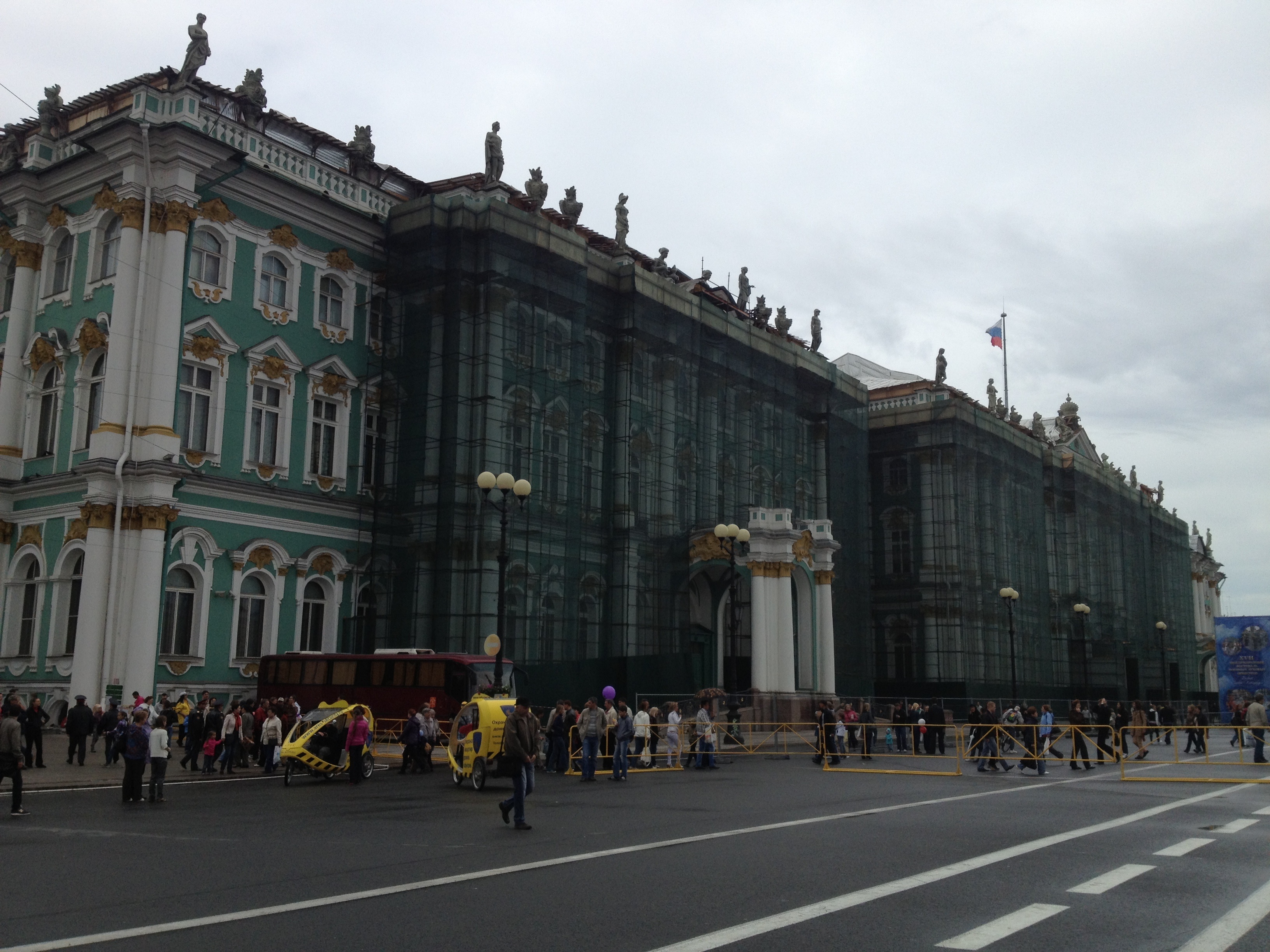
Outside the Hermitage.

Outside the Hermitage.

It did not disappoint. From the moment you enter the building, you feel as though you haven’t just visited a museum to view the works of art, but rather you’ve actually stepped into one yourself. The walls and ceilings were decorated with the most lavish and extravagant gold trimmings, and the images of gods and men were carved out of marble and extending their limbs into the cavernous rooms. I spent the first five or ten minutes with my eyes pointed upwards and my mouth agape with wonder, so much that stumbled up a few of the stairs. Alyson had wanted to go off and see the museum at her own pace, and I would have been happy to do the same, though I found myself sticking with Kaylah and Tim for most of the time.

There are several floors in the museum, and it was easy to get lost. A couple of times we found ourselves wandering into dead end rooms, or trying to get into rooms that were unfortunately closed for renovations or refurbishing. We moved through room after room of paintings and sculptures, seeing everything from early European art of classical portraits and flawless scene depictions, to the ambiguous and abstract work of Picasso, to the ancient sculptures of characters and gods from Greek and Roman mythology. I’d like to think I have a little bit of culture in me, but I’ll be the first to admit I’m no art critic, and I certainly know I couldn’t do any better. I liked some of them more than others, but I discovered that I had a particular love for the sculptures. I’d always been quite interested in the mythology of those cultures, and there was just something more interesting about a 3D piece of art that you can literally consider from a number of angles.

There was a statue of a man with an eagle perched upon his shoulder, to which Kaylah had said, “Look Robert, it’s you in Mongolia!” After that, I think we may have been a little delirious, because wandered through the rooms laughing at the simple, unoriginal names – such as Portrait of a Young Man – and generally just making humorous observations about the artworks. We also looked at some interesting Asian art, and I recognised many representations of Buddha that I had seen throughout South-East Asia, and together we also recognised quite a number a traditional Chinese and Mongolian styles of artwork. That made me a feel a little cultured, to know that I had come halfway around the world, and recognising the different styles of artwork and culture that I had seen along the way.

Posing with the statue Kaylah considered my likeness, due to the eagle perched on its shoulder.

Posing with the statue Kaylah considered my likeness, due to the eagle perched on its shoulder.

We spent a few hours at the Hermitage, getting lost in its beautiful and dazzling halls, but in the end my feet grew so sore I could barely stand up. I hadn’t had a shower since our last morning in Moscow, so after the copious amounts of sweating I’d done on that afternoon combined with the overnight train, I could tell I was starting to get a little foul again, and I was ready to head to lunch and then onwards to showering at the hostel. It had been a good day at the Hermitage, but I think the greatest feat of our day was that there had been absolutely no lines to buy tickets or get inside. Despite Vladimir’s warning of waits that can be up to several hours, we walked straight in with such an ease that it almost felt suspicious. We put it down to the fact that the parade had taken up most of the city’s attention, and were thankful that we had decided to visit the museum when we did.
Much More Moscow: Kremlin and State Armoury

After our first failed attempt at visiting the Kremlin, seeing it became the primary objective on our second morning in Moscow. We rallied in the hostel common room bright and early, then made our way back into the city centre. But before that, we had some goodbyes to say. Rach and Marti would be leaving us this morning, and travelling down into Eastern Europe rather and continuing on to St Petersburg. The two girls had definitely been a dynamic presence within our group, and I think most of us were sad to see them go. We went around the group taking turns to hug them goodbye, with warm wishes for the future and promises to stay in touch.

***

Maria had advised us that the tickets to all the Kremlin attractions, including the State Armoury, can sell out rather quickly, so we kept that in mind when we were planning our day. We were so punctual in arriving to purchase our tickets for the Kremlin that I wouldn’t have been surprised if we were the first people there, but somehow there was already a line of tourists waiting outside the security check point out the front of the complex. We purchased our tickets, checked our bags into the holding room and joined the end of the queue. I remembered back to something Kostya had said at Lake Baikal: “Yeah, in Russia… Russians don’t really understand the concept of a queue.” That can be very frustrating, especially in big crowded queues like this one. People would elbow their way in wherever possible, but I think by the end of our stay in Russia we’d learned to play by their rules, and we found that our group – small in comparison to some of the larger tours – was flexible enough to slip in between other people and slither ahead in the “queue”, non-existent in the eyes of Russians.

The Kremlin is essentially a huge palace complex that has been the hub of political power in Russia since forever, pretty much, and is surrounded by high walls made of blood red brick. It was once the centre of the Russian Orthodox Church, but also the central office for the royalty and tsars as well as communist leaders and democratic presidents alike. The red bricks surprisingly have nothing to do with the name of Red Square, and are no suggestion to communism either. Later, Maria would inform me that in Russian, the word for red has dual meanings, and that it had actually been the word for beautiful long before it was ever affiliated with the colour. The more you know. The main features of the Kremlin, though, are the churches inside, some of which have been transformed into museums and exhibitions. Most are still very well maintained in their original condition, designs that appeared to be far more modern than the palaces I observed throughout Asia, though can easily be admired as whole pieces of art in their architecture and decoration. They all follow similar Russian Orthodox designs on the outside, but the insides are far more intricate. Most places required the purchase of a permit to take pictures, but I don’t think any photos can really do justice to these places – especially not the camera on my iPhone.

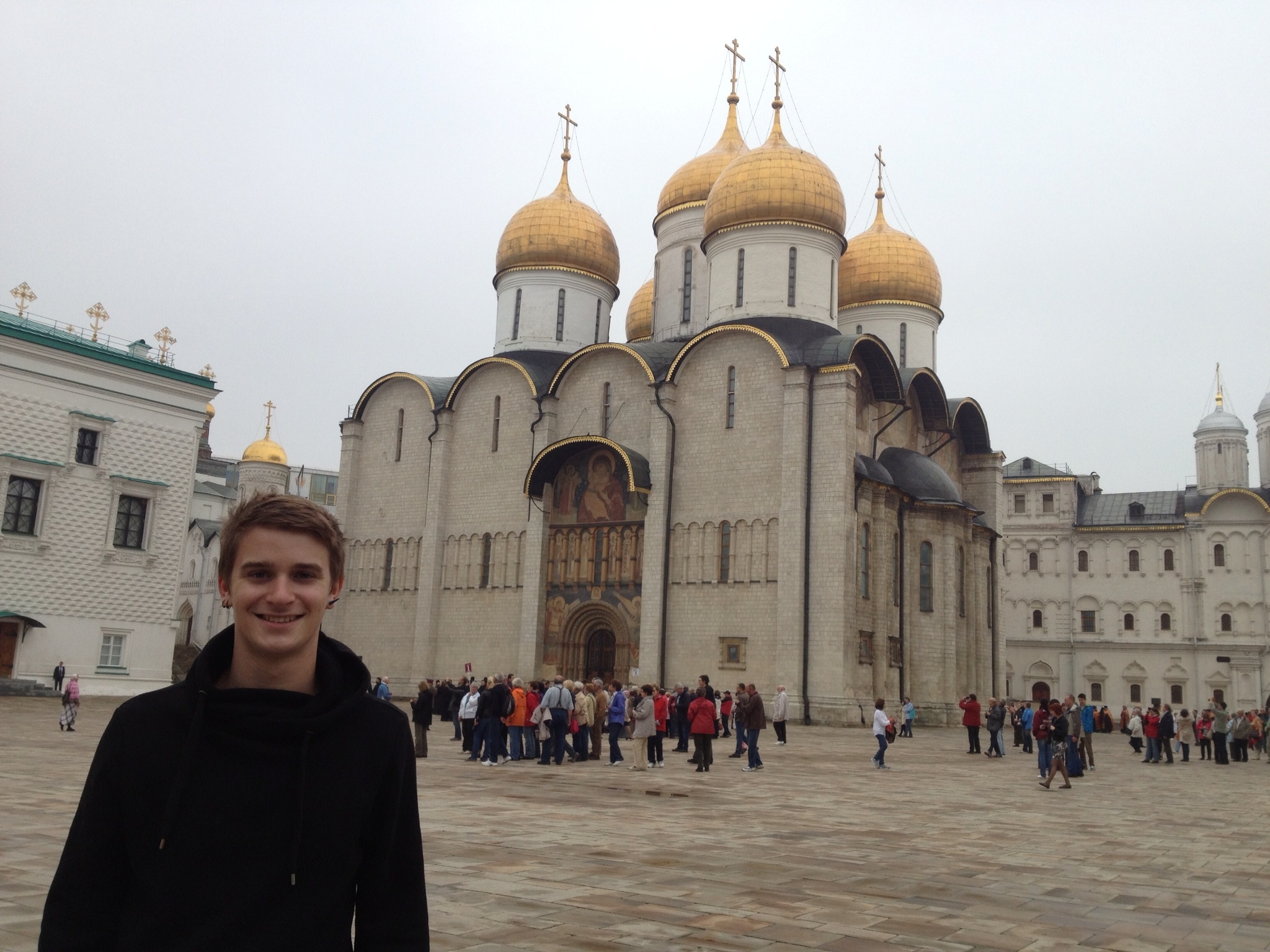
Outside the Assumtpion Cathedral in the Kremlin.

Outside the Assumtpion Cathedral in the Kremlin.

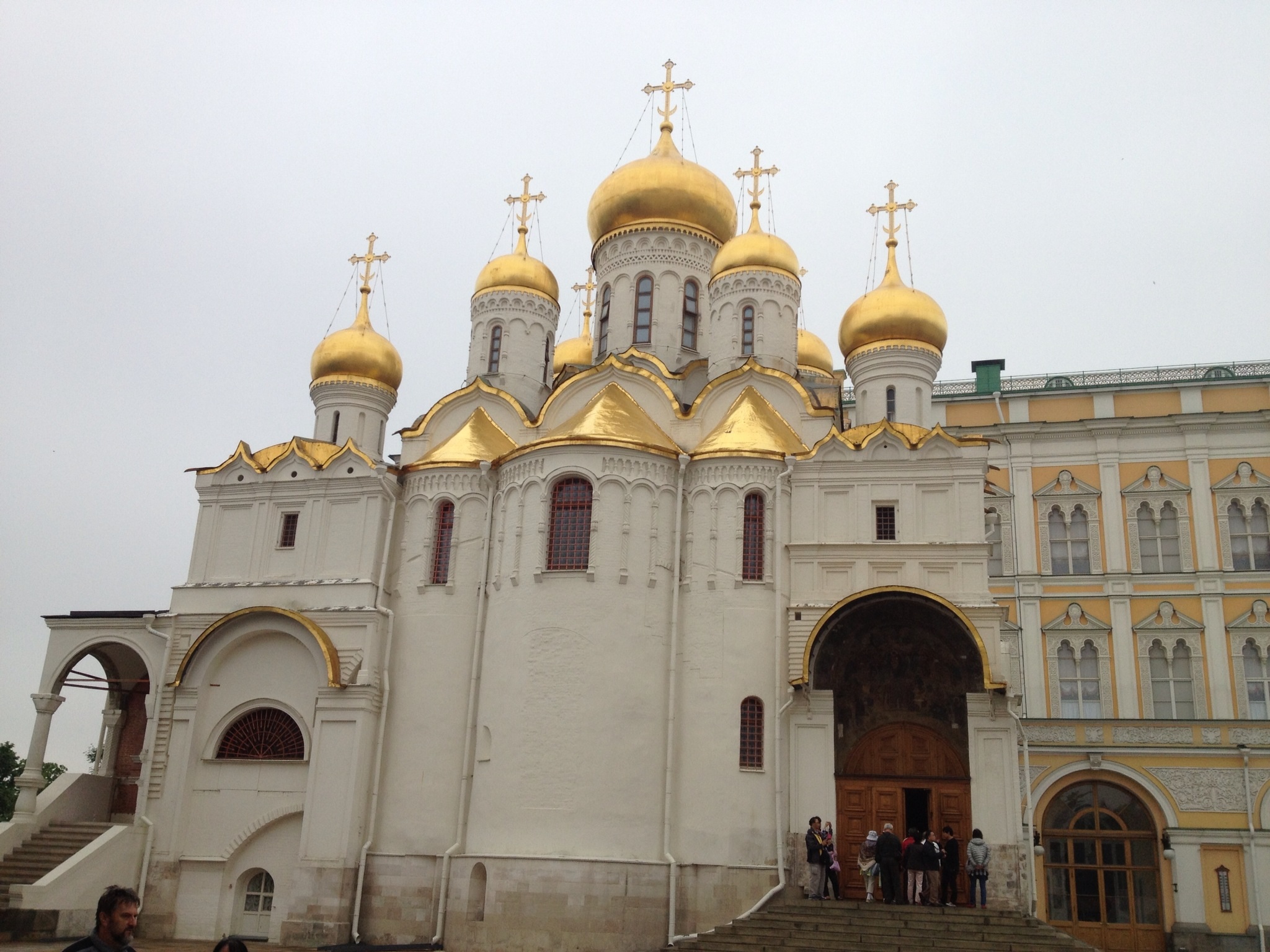
The Annunciation Cathedral.

The Annunciation Cathedral.

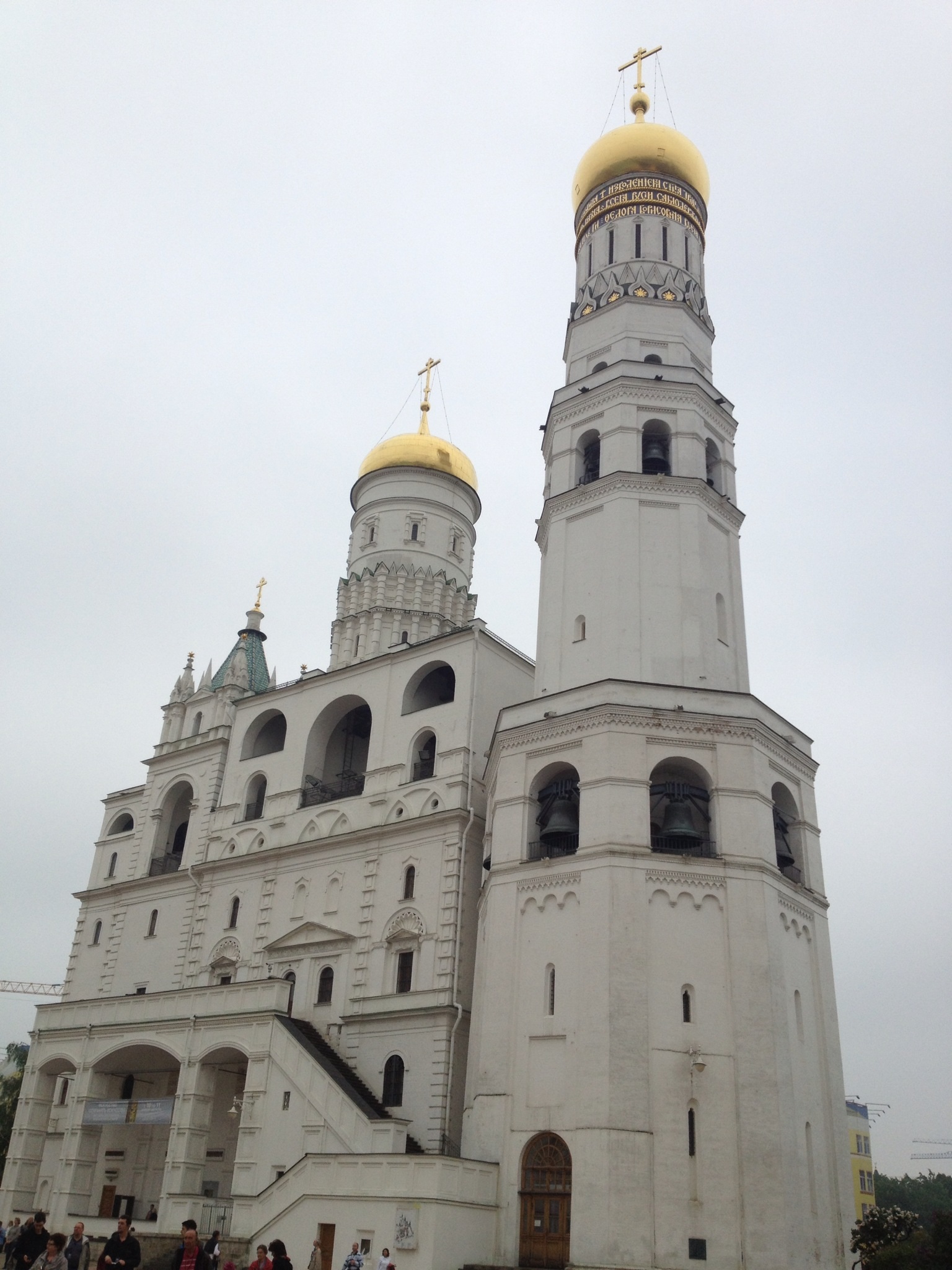
The Ivan the Great Bell-Tower Complex.

The Ivan the Great Bell-Tower Complex.

An old Tsar Bell, now on display in the grounds of the Kremlin.

An old Tsar Bell, now on display in the grounds of the Kremlin.

On this particular day, there appeared to be a lot going on inside the Kremlin. Once we were inside the main complex, we stumbled upon a huge congregation of priests who were all dressed up in their very formal robes. We asked Maria what was going on, but she confessed that she wasn’t a very religious person and so didn’t really know much about the occasion.
“Some angels have days, that are holy days that are assigned to them. I think today must be some angels day, and so they are praying and celebrating or something. I’m not sure which one though.” I still didn’t really understand, so I just settled for observing the crowd of devout men and watching them meander about the courtyards, looking rather excited as they chatted amongst themselves. We waited around for a little while, watching the men and listening to some of their singing while we waited for everyone to come outside of the final museum, before heading out of the Kremlin and back towards the ticket box.

The crowd of priests who were standing around in the grounds of the Kremlin.

The crowd of priests who were standing around in the grounds of the Kremlin.

I’m not really sure of the specifics or details of what happened next, since I had been taking a pretty passive role in decision making, happy to visit whatever sights had been deemed must-see. We took our time looking through the churches and various exhibitions, and Maria told us that we would be able to arrive at the ticket booths at 11:15am in order to get tickets to the session at noon. Maria had collected the groups money in order to buy all the tickets, but I came along with her because I was going to attempt to buy a student ticket with my ID – it was my university student card from last year, and I was well aware that it had expired, but the foreign people rarely noticed the expiry date and the savings, particularly for entrance to the Armoury, were worth at least attempting to score the discount. However, literally as we got to the front of the line, the woman selling tickets announced something in Russian over the a loudspeaker. I waited tensely beside Maria, who finally turned to me to translate. “She said that there are no tickets left for the Armoury, so…” She shrugged her shoulders. “I don’t know, I guess we should see what the others want to do.”

The others weren’t impressed. There was another session in a few hours, but I think most of the group had given up and decided we had wasted enough time trying to see these places, when it seemed like a constant uphill battle to even get into them. We ended up separating again after having some lunch, with some people going shopping, and others going for a longer, scenic walk back to the hostel. I returned to Red Square with Kaylah to take some photos, but after that I returned to the hostel via the metro to have a rest. I didn’t gotten a very good sleep the night before, and after talking to Tim yesterday we had decided we might like to go out for a few drinks and see some of the nightlife in Moscow. However, it rained rather heavily that night, which put a bit of a dampener on the mood. We went out to the Moscow Circus and had a beer before the show, but afterwards no one really seemed to be in a partying mood, so we called it a night and headed back to the hostel in the wet weather.

***

I was woken up the next morning by a knock on the door of my dorm. It was Kaylah.
“Tracy and Jenna and I are gonna head back to the Armoury. It’s early enough that we should definitely get tickets.” It was a struggle, but I rushed to ready and head out with them – inside the State Armoury is an opulent collection of treasures and artefacts that is considered one of the major attractions in Moscow, and even though I’d had another terrible nights sleep, I couldn’t justify sleeping in when I knew there was a group planning to head out that way one more time. “Okay, but we need to get back here before noon – we have to check out by then and I’ll have to get my stuff together.”

So off we went to the Armoury. I tried to purchase a student ticket, but unfortunately the woman working had been more attentive than the woman who sold us our tickets to the Kremlin, because she picked up on the expiry date – I still figured it was worth a try. But finally, after three days in Moscow and our numerous trips to this part of the city centre, we finally got into the Armoury. The collection of treasures inside was definitely worth it – all I could think of was how many millions of dollars these items would be worth. Goblets and plates and portraits and books and tea sets and dresses and weapons and – well, the list goes on, but everything was decorated with lavish jewels and pearls and I’m almost at a loss of words for how extravagant it was. It was the kind of extravagance that you only ever really saw in movies, and even then you knew they were most likely props that were worth only a fraction of the real thing. The diversity of the collection was also impressive. Jewelled sword handles and horse armour were in the room next to elegant pearl inlaid gowns, which were in between classical horse drawn carriages and a room full of velvet-lined thrones. We followed the directions of the audio guide tour, seeing the most important and interesting pieces in the collection and learning a bit about their histories.

While seeing the Armoury had been worth the rushed trip, it definitely made the rest of my morning a little more stressful. Firstly, as we walked down the stairs out of the exhibits, I dropped my audio guide. Despite having the safety strap around my wrist for the entire time we were in the museum, is was on the hard marble stairs that it slipped from my grip. It landed with a clatter, and I clutched at Kaylah’s arm when I saw that one of the buttons had lodged loose. I quickly scooped the handheld device up and shoved the button back into place, but the LED screen was starting a flicker, a sure sign that the machines life was about to expire. An endless stream of mumbled profanities escaped my mouth – we’d only needed to leave one form of ID as insurance when we’d collected the devices, but it was Jenna who had left her drivers licence with the desk.
“Just be cool, be cool Robert,” Kaylah had assured me. Once we got the desk, we placed our devices face down, showing the woman behind the counter their numbers, and she returned Jenna’s licence.
“Okay, be cool, stay cool, but go! Go! Go!” I’d whispered to the rest of the girls as we scurried out of the museum and back into the sunshine.

The second thing that made my morning just that bit more stressful was our returning time from the Armoury. I literally ran from the metro station back to the hostel, arriving at 11:58am. Perfect, I’d thought to myself, I literally only need two minutes to gather my things into my bag, I’ll be fine. Unfortunately, the hostel hadn’t been to sure I would arrive back in time, and I found my bag on the floor of the main hall with most of my possessions thrown into two big black garbage bags. Which, honestly, wouldn’t have been that bad. What actually sucked about this was that it wasn’t just my possessions – the bags was a mixture of my clothes and what may have been the possessions of one, or maybe two other guys from the room who weren’t part of our group. I felt kind of bag for that guy(s), because I’m not even positive they were supposed to be checking out, yet they’d had all their things scooped into a bag and thrown into the hall. I had to sit in the common room of the hostel and sort through all the bags to make sure I’d recovered all my things, while the rest of the group sat around waiting for me.
“I’m so sorry guys, sorry for holding us up,” I must have said a dozen times, but they all dismissed my apologies and said it was fine.
“We’ve got the entire day where we don’t have anywhere to be, so we’re not on a tight schedule, don’t worry.” I was glad they were being so nice about it, and as far as I could remember this was the first time I’d ever really had a problem or held the group up in any way, so they seemed fine with it.

Still, I had run all the way back to the hostel, and combined with the embarrassment of sorting though my bag and packing everything while the others patiently watched on, I found myself dripping with sweat. It was a warm, sunny day in Moscow, and I ended up mopping myself down with my towel and changing into a singlet and shorts. When I’d finally packed all my stuff up and put my pack in the storage room, we headed off as a group to get some lunch.
“Wow, Robert,” Don had said as we walked beside me, “You look like you’ve just had a shower or something.”
“Yes, Don, I’m a little sweaty,” I said, feeling a little testy and unable to hold back the sarcasm. “Thanks for pointing that out. I would rather have had a shower, but I’m actually just really sweaty. ” I think it’s safe to say that I wasn’t in a very good mood for the rest of the afternoon.

***

The Russian Market we visited in the afternoon.

The Russian Market we visited in the afternoon.

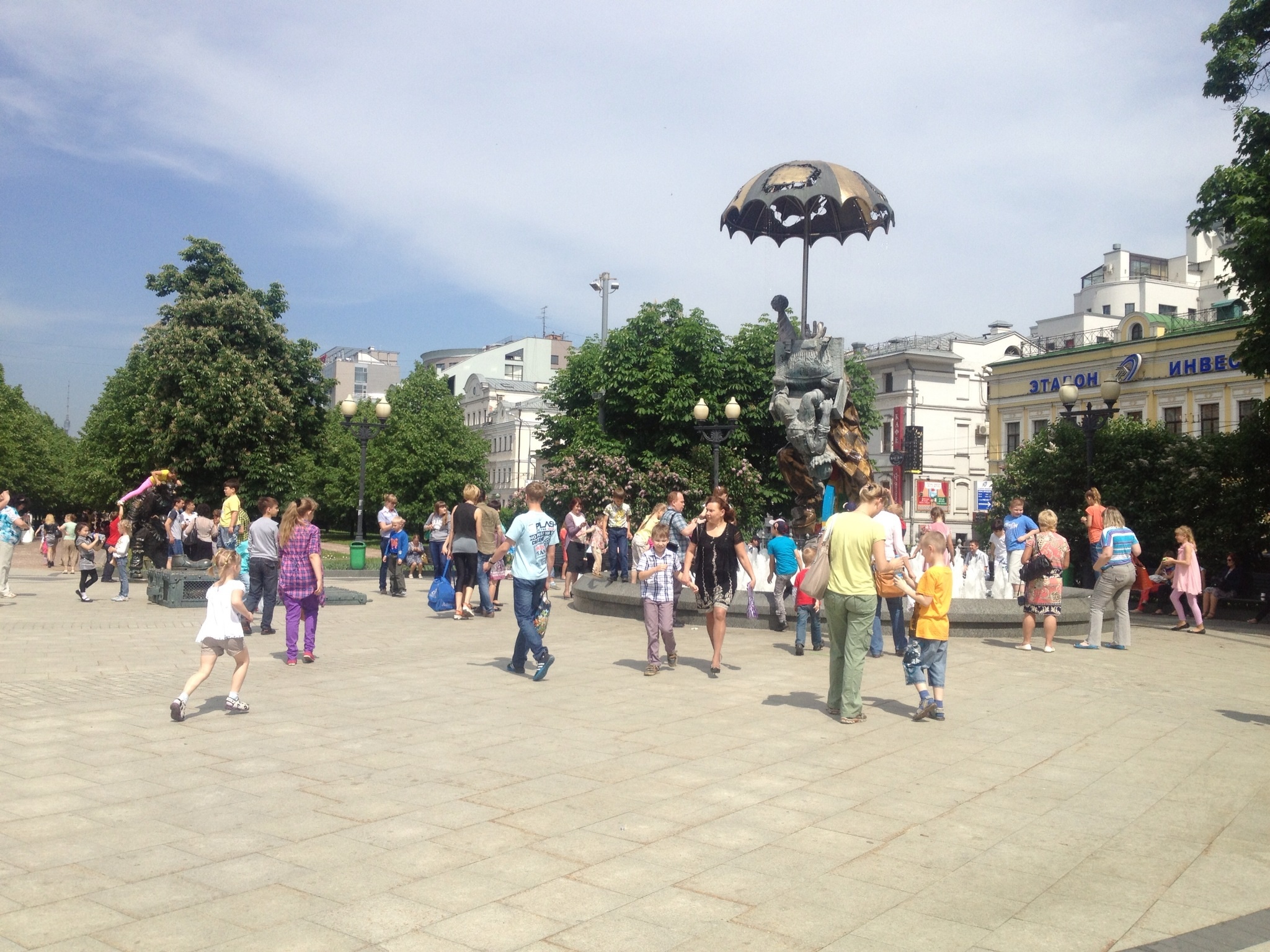
The park where we had lunch, watching the children frolic around in the warm weather.

The park where we had lunch, watching the children frolic around in the warm weather.

The rest of the day was spent as a group, hanging out in a park to eat some street food lunch, visiting a popular Russian market, and finding a few restaurants and bars to have a few drinks in and just hang out, enjoying each others company. I think the long train ride had really brought a lot of us together, but it was nice to hang out with each other in a different, relatively normal environment, although the absence of Rach and Marti was strangely noticeable. But after we whittled the afternoon away, Alyson and Tim and myself had a few more drinks at a pub just near the hostel, and eventually it was time to head to the train station to catch the midnight train to St Petersburg.

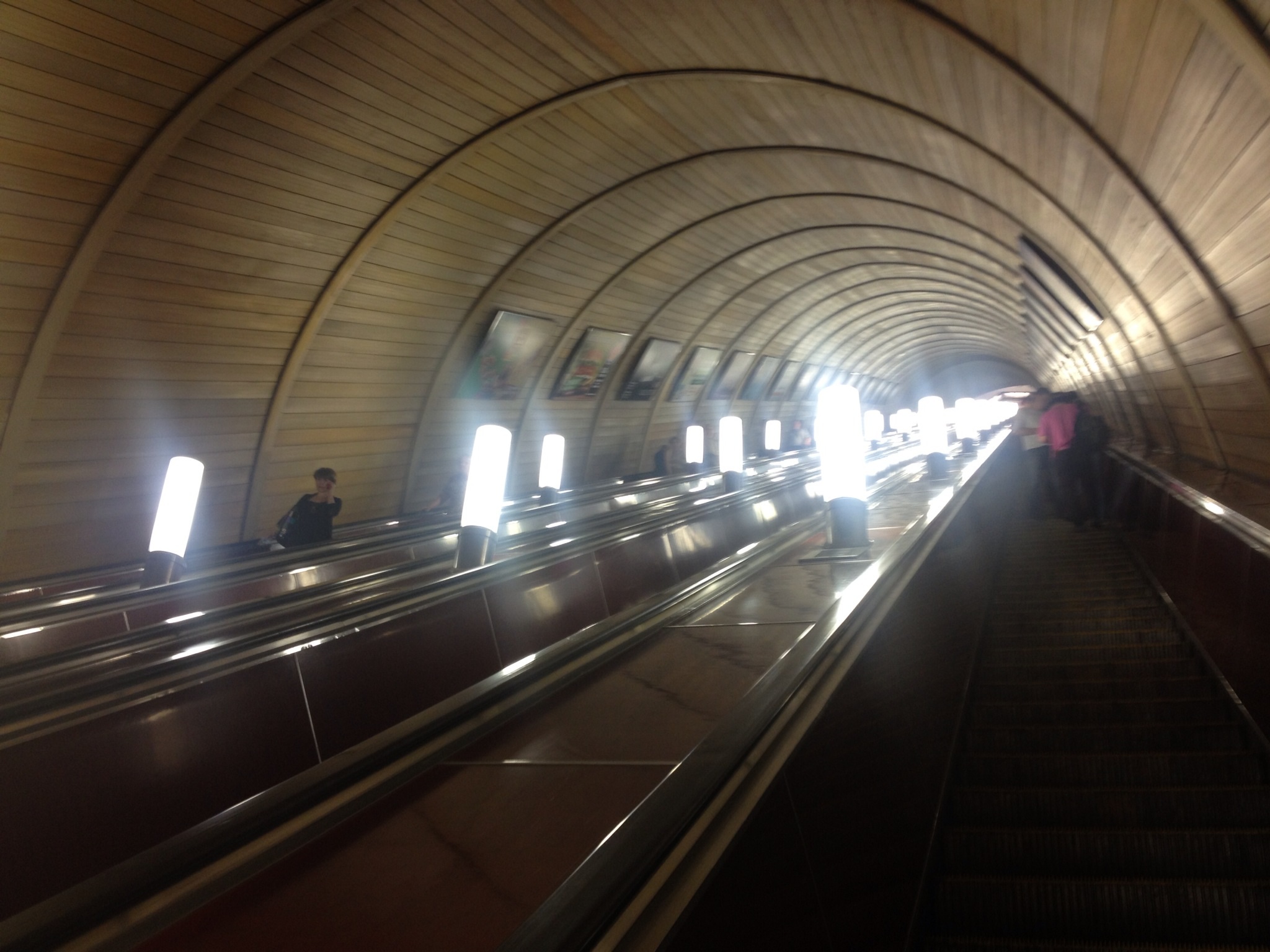
The long, cavernous escalator tunnel in one of the Moscow Metro stations.

The long, cavernous escalator tunnel in one of the Moscow Metro stations.

Maria had met us back at the hostel and taken us to the station, and made sure we’d all gotten on the train safely. “There’s two places empty?” she had asked us, and we reminded her that Marti and Rach had left us the day before, forfeiting their tickets for that section of the journey. “You should come with us to St Petersburg, Maria!” someone had said jokingly. At first she had just smiled and laughed, but five minutes later she stuck her head into our cabin, where Tim, Tracy, Jenna and I were preparing our beds for our final night in transit. “I think I am going to come to St Petersburg. I have a friend who I have been saying I will visit, but I have never been, and it’s been, oh, I have been saying I will go for four years or something.”

We were all a little stunned, but we couldn’t help but laugh. Maria had seemed like quite a lax and easy-going woman, and while it had been a little frustrating when she hadn’t known some things about Moscow that we might have expected from our guide, I couldn’t help but applaud her spontaneous nature that told her that getting a train to another city, with absolutely nothing except a phone, wallet and the clothes on her back, was a perfectly good idea. I guess I learnt something from Maria that night, because with my plans for the rest of my time in Europe being just as unplanned and flexible, I was going to have to learn to be just as swift and spontaneous when it came to making decisions about my travels.

A Nomads Life For Me

Luckily we were only staying in Ulaanbaatar for one night, because there didn’t appear to be a great deal of tourist attractions left to see in the city. The rest of our time in Mongolia would be spent at a ger camp about two hours away, far off in the Mongolian wilderness. A ger is a sort of semi-permanent tent that the nomadic people of Mongolia live in – while Ulaanbaatar does have a population of about 3 million, there is a remarkable amount of people who still live the nomadic life out in the wilderness and the Mongolian national parks, moving from place to place with the seasons and taking their home with them, as well as their herds of livestock.

***

We had one stop in the morning on our way to the ger camp. The Gandantegchenling Monastery was a beautiful structure, and Oko explained that Buddhism is one of the major religions of Mongolia. It’s quite interesting how the landlocked country has so many different cultural influences from the surrounding nations, yet it truly becomes a melting pot that breaks all of them down and recombines everything into their own culture that is quite unique. We walked through the temple, silently moving around the people who had come to light candles and incense and to pray, before stopping at the monastery to watch the monks begin their morning rituals and listen to their chanting. I hate to admit it, but ever since my bizarre incident with the shady Buddhist monk in Lop Buri, I’ve been unable to look at any monk the same way again, and even just seeing one creates a rising anxiety within me. It really is such a shame, because I used to hold such a fascination for ideals and spirituality behind the religion, and now those beliefs have been well and truly tainted. I listened to the chanting for only a few moments before stepping out of the low-hanging canopy of incense and into the fresh morning air.

The main building of the monastery complex.

The main building of the monastery complex.

Outside, in front of the main temple, there was a big pair of golden feet. Oko explained to us that the Mongols were attempting to build the worlds largest human structure, a Buddha even bigger than the Statue of Liberty. However, all of the money for the project comes from donations, so there is no scheduled finish date because no one really knows when they will be able to finish it. Oko had also mentioned yesterday that the weather in Mongolia only allows for construction to be done for two or three months every year, which is why there were so many construction sites and unfinished buildings in Ulaanbaatar, adding to the ugly, incomplete cityscape.

Golden feet - all there is of the statue so far.

Golden feet – all there is of the statue so far.

However, the most interesting, or at least entertaining, part of the monastery visit was the swarm of pigeons outside. As we first approached the monastery, we heard the low cooing noise steadily growing louder, and we soon found ourselves in front of a formidable sea of feathers. There were thousands of pigeons, and their call almost seemed to have an eerie echo as it rippled through the flock of birds in the courtyard. Some people were feeding them with seed they had bought from a little old lady wandering through the birds, while other children ran through the crowds to scatter the pigeons and sent them flying. They always came back though. Someone asked Oko about their significance. “The pigeons? No… They just live here, I don’t know why. But they are not special, not at all.”

The mass of pigeons outside the monastery.

The mass of pigeons outside the monastery.

***

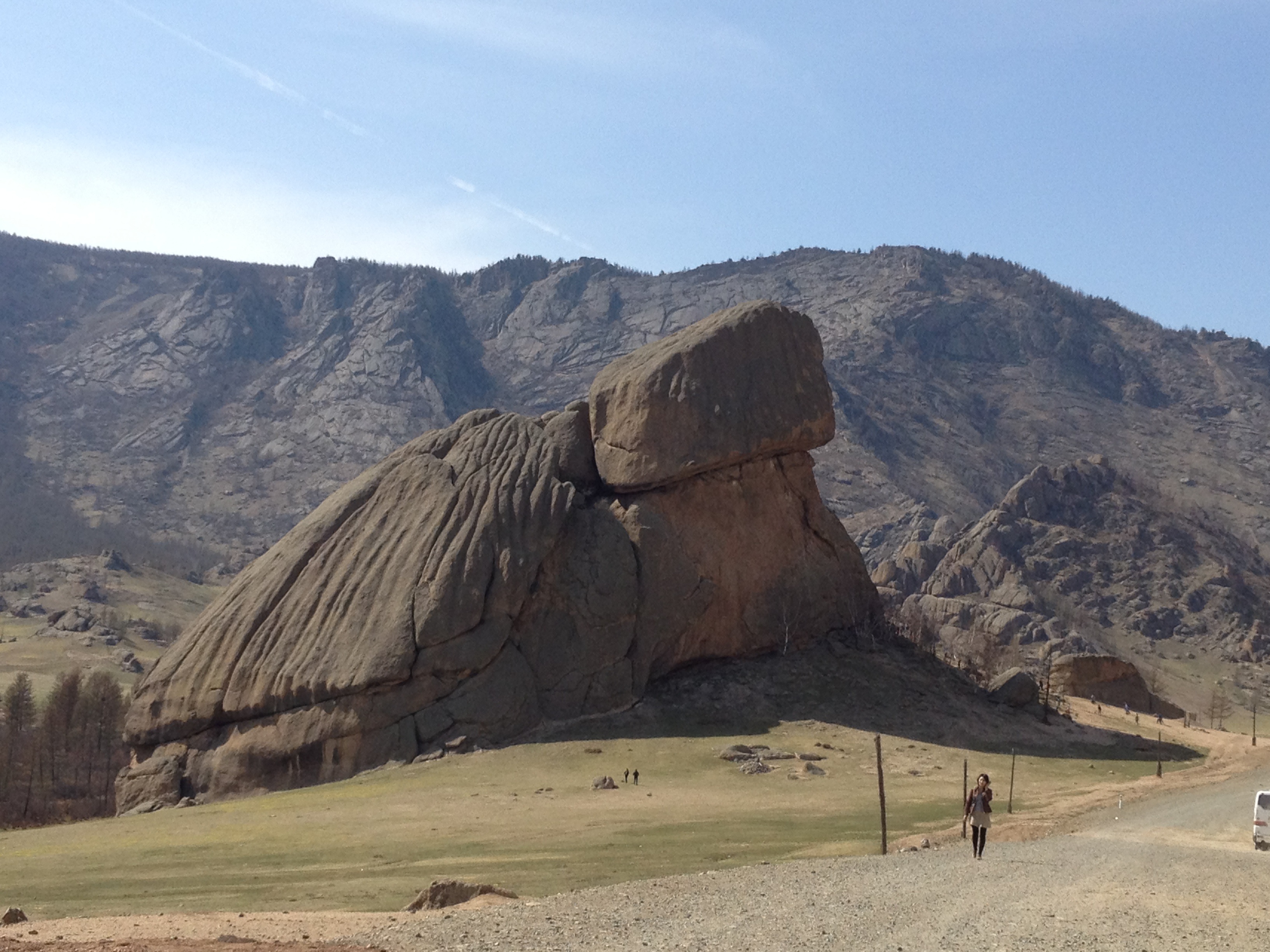
After the monastery it was onto the ger camp. The place we were staying at was in a region called Terelj National Park. It was more of a permanent set up that was obviously designed for tourists, but they were the same style of ger that the real nomads live in. Each circular tent was several metres wide in diameter, and had a wood-fire stove set up in the middle, which were traditionally used for cooking all the meals, but would serve only as a heater for us during our stay. I was sharing my ger with Tim and Don, the other Australian guy on our tour, and after we unloaded our bus and settled into the gers, we went for a short drive to a small landmark known as Turtle Rock.

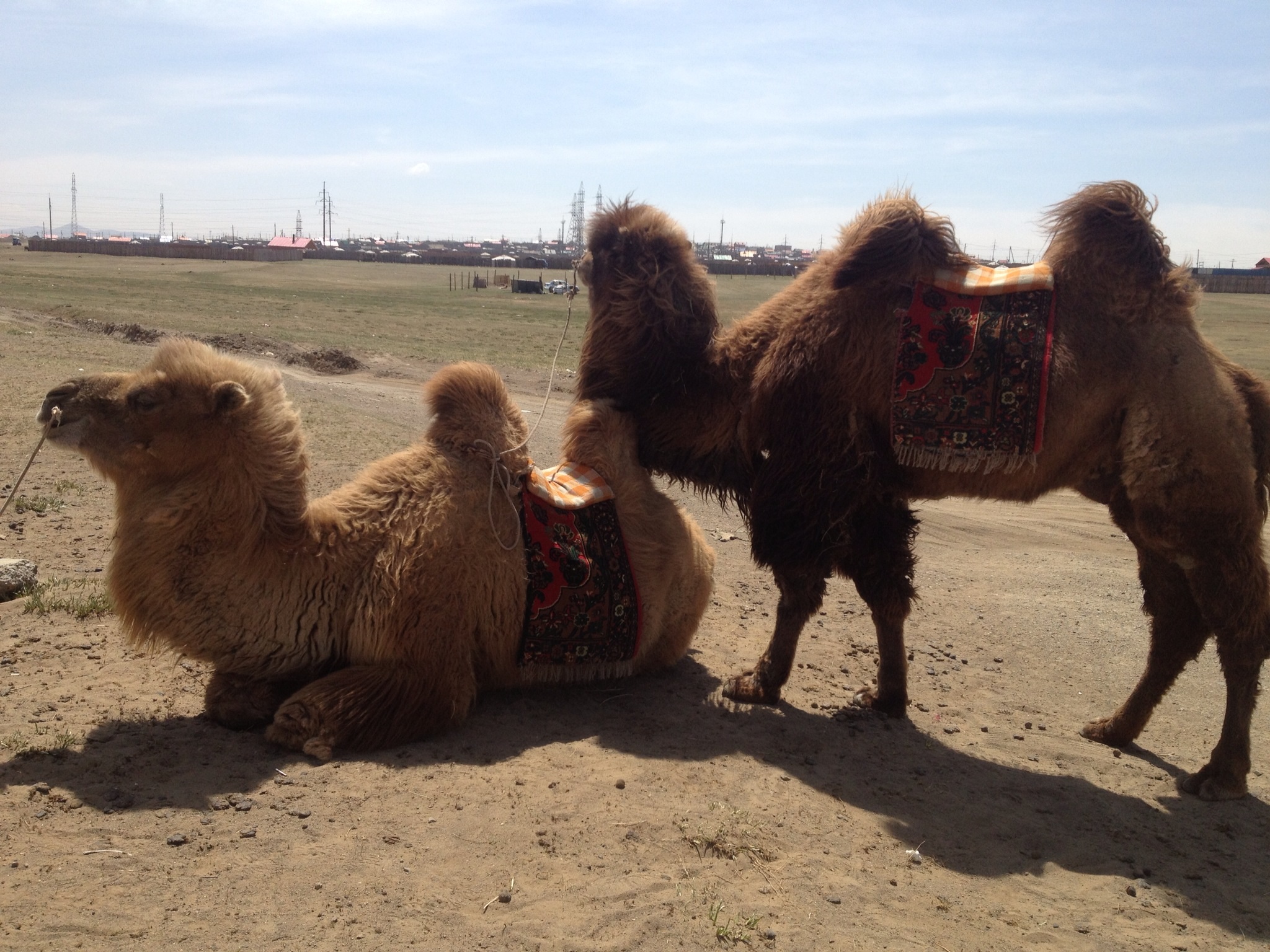
Some camels we passed on the way to the ger camp.

Some camels we passed on the way to the ger camp.

Turtle Rock.

Turtle Rock.

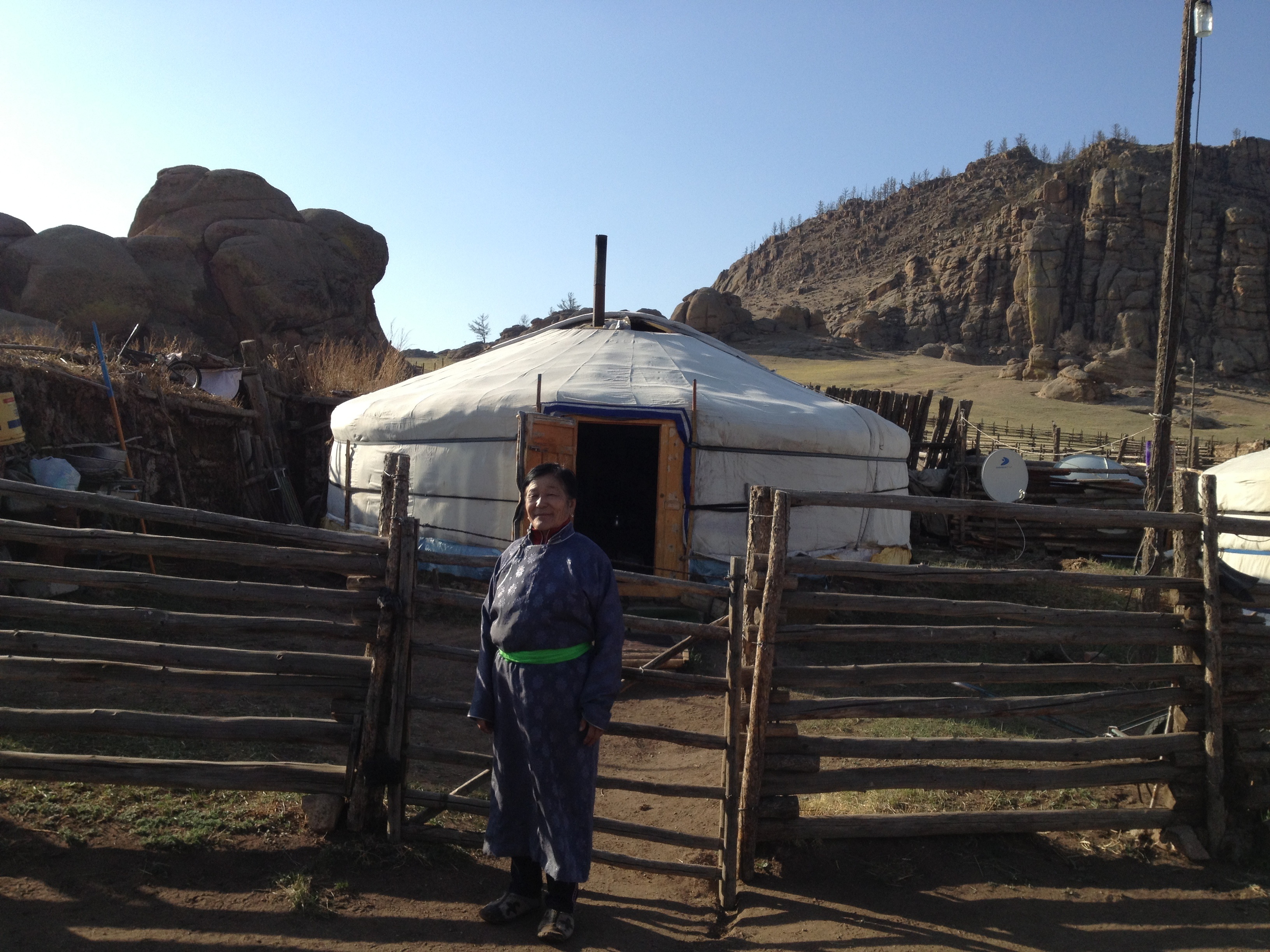
We climbed to the top of the rock to appreciate the view. The Mongolian countryside really is beautiful. I spent a lot of time with my family in the Snowy Mountains as a child, and it was a familiar feeling of watching the virtually untouched landscape stretch out for what seemed like forever. Such sights always remind me of my fathers words about cities being similar from country to country, and I was even more pleased that we’d escaped Ulaanbaatar to explore the rest of Mongolia. After Turtle Rock, we visited the ger of a real nomadic Mongol, and got to see what the inside of a truly inhabited ger looked like. The walls were lined with rugs to retain the warmth and heat, there was a TV and a fridge and a whole kitchen set up, and it felt like an actual home compared to our gers, which were essentially the hotel versions of the traditional Mongol dwelling. There was only one woman who lived in this ger, and she had prepared some food for us, so we asked her questions about Mongolian nomadic life, with Oko as translator, while we nibbled on homemade cheese and bread, dried yoghurt, and sipped on warm milk tea. I didn’t care much for the tea, and the dried yogurt was so hard I thought I was chewing bone, but after spending so long in South-East Asia it was quite a treat to have some hearty, homemade cheese.

The view from the top of Turtle Rock.

The view from the top of Turtle Rock.

The ger of the Mongolian woman who we paid a visit to.

The ger of the Mongolian woman who we paid a visit to.

It was definitely surprising how permanent the set up looked – apparently when they move, the nomads travel anywhere from a few kilometres down the road to hundreds of kilometres to a new region, usually for reasons of weather and climate or the availability of grass for their herds of cows, horses, goats, sheep or camels. It only takes 8 hours to completely dismantle the ger, which was deemed an impressive feat by our group. “It took me 8 hours just to pack for this trip!” Alyson exclaimed. We all had a bit of a laugh, but I suppose it was a reminder to all of us just how content people can be with so little in their lives. It feels like I have one of those epiphanies every time I visit a non-Western country, but I do think its important to retain that perspective throughout life, so I never end up taking for granted all the things I do have in life.

***

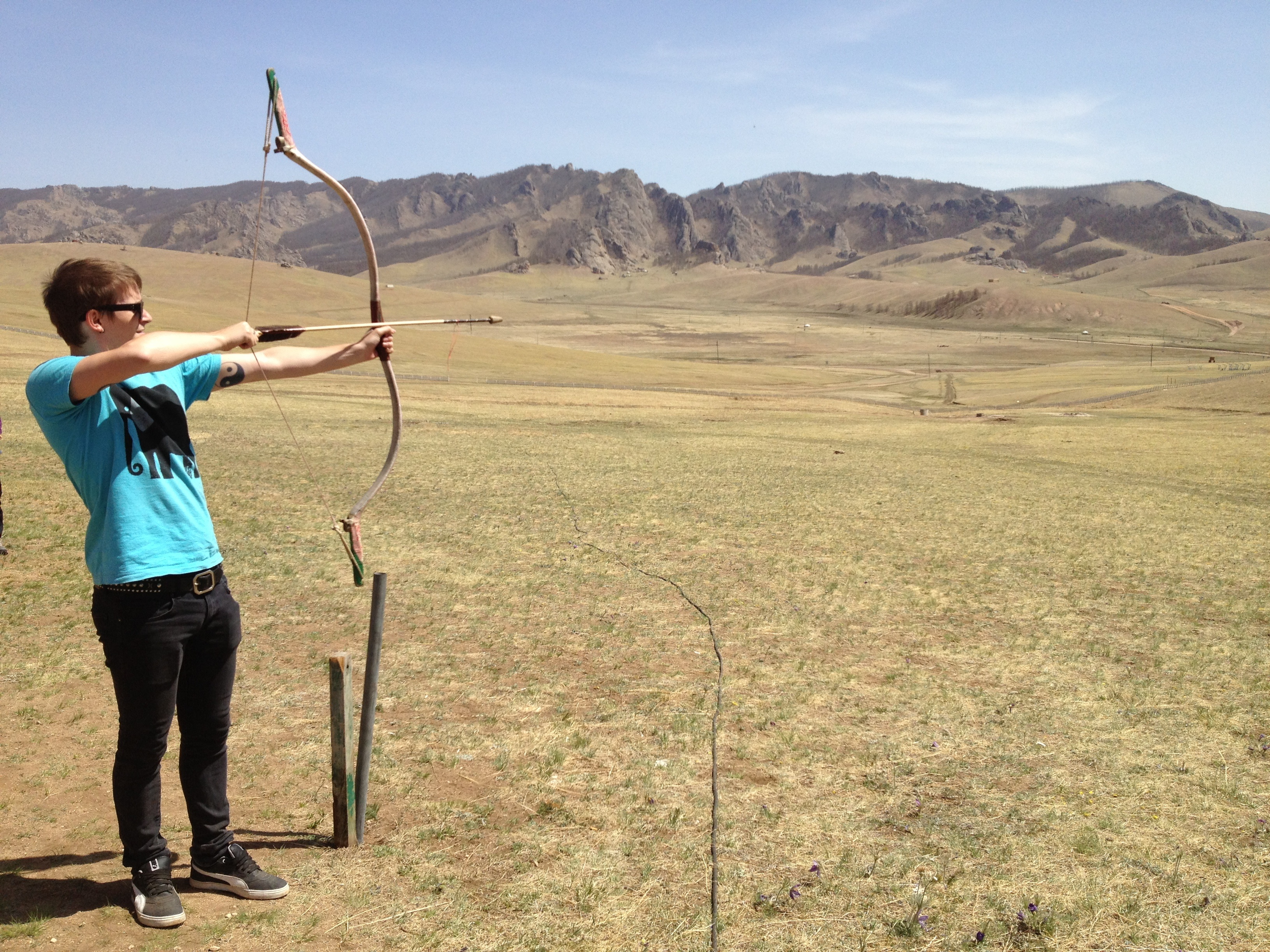
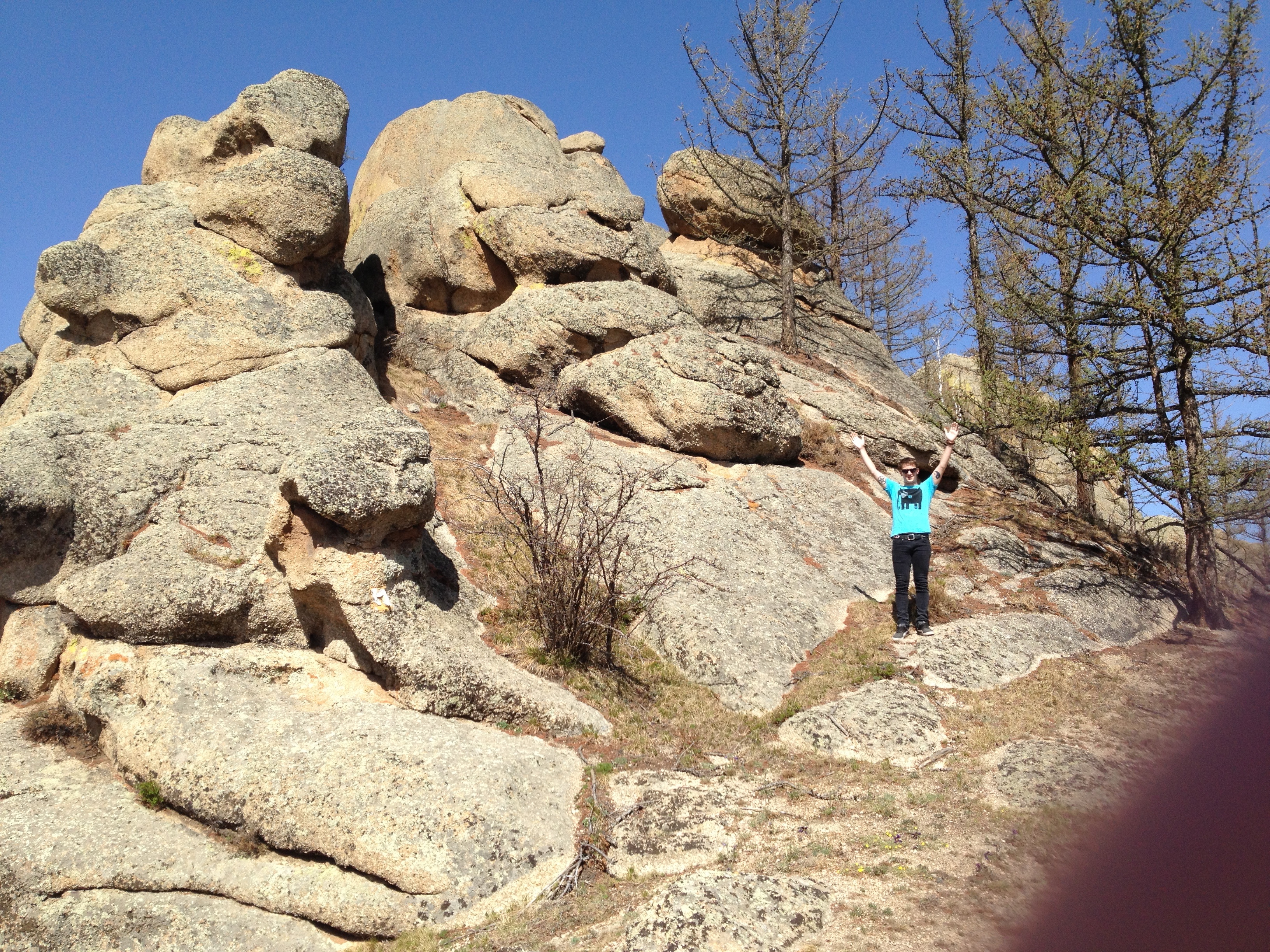
Our days at the ger camp were mostly spent outside, doing things like horse riding and archery. The warriors of the fearsome Mongolian Empire did both of those things are the same time, though horseback archery isn’t an easy skill to master in a few days, so we kept our attempts separate. We also made several small hikes up the hills and rocks that created the valley that our ger camp was in, and admired the awesome views. The hills rolled on in every direction, and in the neighbouring valleys we could see more clusters of gers, demonstrating just how common this nomadic way of life really is in Mongolia. The food in the ger camp was also amazing. Traditional Mongolian soups, salads and meat dishes, broths full of mutton and meat that melted in your mouth right off the bone, and hearty fillets of steak served with rice and potato. I wasn’t sure if there were any Mongolian restaurants around where I live, but I made a mental note to find out when I go back home – the cuisine is absolutely delicious, and I didn’t go to bed hungry once.

Oko tending to my horse just after I dismounted.

Oko tending to my horse just after I dismounted.

Trying out my archery skills - there's a reason there's no photos of the target...

Trying out my archery skills – there’s a reason there’s no photos of the target…

However, on one of the nights I did go to bed a little tipsy. As a group we’d decided we might get on the piss and have a little bit of a party in one of the gers. Some brought vodka, some brought beer or wine. I myself brought a semi-dry red that was made in Bulgaria, surprisingly delicious for the price that I paid for it. The conversation flowed freely, as is always the case when alcohol is involved, and I chatted a little more to some of the Australian girls who I hadn’t seen much of during the course of the trip. It was incredibly warm and toasty with the fire going inside the ger, and we frequently had to prop the door open for a little bit of relief, sometimes even stepping outside to cool off a little. The wine went to my head pretty quickly, but I remember standing outside with Dan and marvelling at the stars that were spread out across the dark blue night sky, thinking back to my night of stargazing on Koh Rong Samleon in Cambodia and still being a little bit excited that the constellations were all different in this hemisphere – and I don’t even think that was the wine talking.

***

While the Mongolian countryside is breathtakingly beautiful, there are a few things about it that are a little upsetting. When you’re gazing out from the peaks of a rocky outcrop the land looks untouched, but the reality is that the life of the nomadic people takes a toll on the land. Some people burn or bury their rubbish, but there is still an incredible amount of pollution. You’re just as likely to see a plastic bag take flight into the wind as you are a native bird, and at regular intervals there are huge mounds of trash that are most likely the remnants of a ger camp that has since packed up and moved on. I remember as a kid going out on Clean Up Australia Day and picking up all the trash in my local area – I think realistically this country would need a Clean Up Mongolia Year. I absolutely loved my time in Mongolia and out in the ger camp, but it was always a little bit disheartening to walk past what appeared to be a small forest of plastic bag trees, the skeleton of what was once lively greenery smothered with black and blue and translucent plastic.

The ger camp where we slept and lived for two days.

The ger camp where we slept and lived for two days.

On top of some rocks after one of our many short hikes through the hills.

On top of some rocks after one of our many short hikes through the hills.

***

When we finally returned to Ulaanbaatar, we had an afternoon to kill before jumping on a train to Siberia that evening. We had lunch at a buffet style Mongolian barbecue, which was amazing – I ate so much I felt sick – and then spent some time at the National Museum. The more I learnt about the native Mongolian people and the mighty empire of warriors they had once been, the more I suspect that they as a people were the inspiration for the Dothraki tribes in Game of Thrones. Fierce warriors with highly revered leaders and a lifestyle that revolves largely around their horses, they were nomads that travelled across their vast country and were constantly at war to expand their territory. Modern Mongolia is a different story though, but I still got a little kick out of my geeky comparison. I also saw some exhibits about musical instruments – the name of the Mongolian instruments I’d seen in the show last time we were in Ulaanbaatar was morin khuur, a name that translates to ‘fiddle with a horses head’. The end of each instrument is finished of with a carved wooden horse head, and the morin khuur is considered something of a national treasure for Mongolia.

As I wandered through the museum, I realised that most of the signs and information boards were in Mongolian, with no English translation. I hate being one of those tourists who just expects everyone to be able to speak English, and get angry when they can’t – I frequently struggle silently through awkward language barriers rather than go on a “Can anyone speak English?” spree – but I have to admit I was taken aback. Almost everywhere in South-East Asia had had signs in English, which I suppose I completely took for granted while I was there. English is a common and widespread language, but it’s by no means global or universal, and I think it took being in an official building like a museum, yet there still being very little English, for that fact to truly sink in.

***

Overall, my time in Mongolia was incredibly interesting and unique. Combined with the fact that I wasn’t scammed, tricked, injured or molested, I think I can safely say its been my favourite place on my journey so far, and my only regret is that I couldn’t stay for longer. But the tour schedule was pretty set when it came to transport, and we were due to catch our next train into the heart of Siberia.

Getting to Know You: Miss Saigon

My first impression of Ho Chi Minh City was that it seemed like a baby version of Bangkok. It has the backpacker district with the flashing lights and street hawkers, it has the numerous food carts selling a variety of local cuisines, and it has a lot of busy traffic. However, it’s almost as if the vehicles are in baby form, with the motorcycles being to cars what tadpoles are to frogs, and the motorcycles are everywhere. I know I’ve said it before, but literally everywhere – they put the gangs of Central Coast NSW to shame. So the city may feel a little smaller than Bangkok, but in no way does that make it feel any less busy, at least in District 1 in the central part of the city.

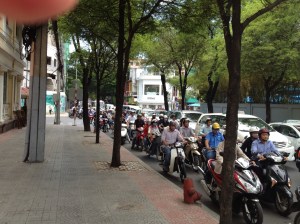
So. Many. Motorbikes.

So. Many. Motorbikes.

Vietnamese flag out the front of the Ho Chi Minh City Museum.

Vietnamese flag out the front of the Ho Chi Minh City Museum.

There is also a confusing aspect in that this city has two names – something that puzzled me to no end in the early stages of planning my side-step detour to Vietnam. Pretty much all the native locals call it Saigon, even a lot of the travel agencies do too. Ho Chi Minh City, taken from the name of the Vietnamese leader during the wartime period, is the name used by the government and officials and anyone else of relative importance. As a traveller, I don’t really have a preference, and will use both interchangeably throughout this blog, just to keep y’all on your toes.

***

My first few full days in Saigon were spent doing some sight seeing. I decided to tackle the city on foot – after letting my guard down and being scammed into paying an exorbitant amount of money for a brief ride in a cyclo, which is basically a bike with an oversized basket for passengers, I became a little mistrusting of all the locals who approached me, offering rides on their various street vehicles. I also found myself slightly terrified of the traffic, although I quickly learnt that in Saigon, being a pedestrian is just as hazardous as being behind the wheel of a car or on a motorbike. Which is not necessarily saying that it’s risky – you simply need to really keep your wits about you at all times… although, it is risky. I’ve had a number of extremely close encounters where my attention lapsed for just a moment, and I came this close to being far too acquainted with the front end of a motorbike. Look both ways, amnd look all four ways at intersections. Sometimes it’s easier to just slowly wander out onto the road and let the bikes move around you. This is particularly terrifying though and by no means safe – sometimes I just got impatient waiting for a legitimate gap in traffic.

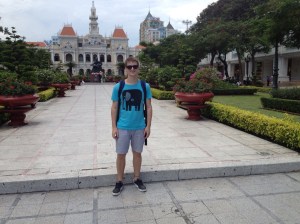
Outside the Ho Chi Minh City People's Council People's Committee Building .

Outside the Ho Chi Minh City People’s Council People’s Committee Building .

French-designed Cathedral in the city centre.

French-designed Cathedral in the city centre.

Reunification Palace.

Reunification Palace.

Another thing Ho Chi Minh City seems to have a lot of is museums. As well as the War Remnants Museum, I visited the Fine Arts Museum and the Museum of Ho Chi Minh City. I took some refuge from the bustling city outside to observe some of the paintings and sculptures in the Fine Arts Museum, almost all of which are created by Vietnamese artists. I’m no art critic, and I don’t know the first thing about techniques or designs or any of the fine details when it comes to the fine arts, but the museum did have a huge variety of works on display, much of which represented lots of aspects of Vietnamese culture. As I wandered through the halls, I noticed that many of the paintings depicted soldiers and other wartime themes. Despite being beautiful works, that saddened me a little bit, and I was beginning to understand just how much the war has affected the mindset of so many local people here, and had branded their cultural history with a very distinct and conspicuous mark. It was a mark of remembrance and mourning, but also hope for the future.

Then I came across a piece called ‘Agent Orange’, where the oil painting had been textured so that it recreated the horrific deformities of the victims of the harsh poison, to a point where the art was almost three dimensional, and the suffering reached out from within canvas to force you to feel the emotions it depicted. I both loved and hated the painting, because it was so confronting, and because it filled me with the similar feelings I felt at the War Remnants Museum. I took a few photos, which I think I probably was not supposed to do, so I won’t upload them. I also feel like these works are best experienced in their true medium, and not from within a computer screen.

The other museum was also interesting, learning about the history of the the city. I don’t really care to regurgitate everything I read though, so make sure you check it out if you’re ever in Saigon. The building did, however, have a nice view.

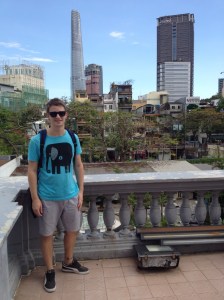
View of city from the Ho Chi Minh City Museum.

View of city from the Ho Chi Minh City Museum.

***

My first evening in the hostel was when I began to experience the tourist nightlife. As people began slowly arriving home from their days activities and trawling into the dorm room, one of the guys made an open invitation to anyone who was interested in joining him and a few other guys in getting some dinner. Having no plans and nothing to lose, I tagged along and found myself with four guys, respectively originating from Germany, Wales, America and New Zealand, and a Hungarian girl. Our small international party set out looking for cheap street food. I’d always been a bit of a fan on Vietnamese food back home, so it was kind of a novel thrill to sit on a tiny plastic chair on the side of the road, like all the local people did in District 1, and eat my pho noodle soup. After that we were joined by two Argentinians and headed to a bar to drink some beer. I say “bar”, but in reality it was a little hole-in-the-wall joint with tiny plastic chairs (and slightly bigger plastic chairs that were used as tables) littering the footpath out front, sprawling out onto the road when it got busy enough. Later in the week, when I explained this scene to a New Zealander expat now residing in Ho Chi Minh City, he merely chuckled and said, “Yep, we call that a bar here.”

However, what the place lacked in bells and whistles, it made up with value for money. Draught beer was 7000 Vietnamese dong per glass. That converts into approximately 35 Australian cents. It seemed criminal to drink anything else when you could drink for so ridiculously cheap, and not for the first time on this trip I found myself succumbing to peer pressure and going in for a round of beers, only to be surprised that I actually quite enjoyed the taste of it. I didn’t love it, but for a few quiet drinks on a Tuesday night it doesn’t get much better than three beers for a buck.

The weekend was a different story though – I met a bunch of Australians who had been in Vietnam for the last month or so for work, and they took me out to some of the nearby nightclubs. The bars were a little more sophisticated then plastic stools on the pavement, and the drinks were more than 35c, but they were still exponentially cheaper than back home and the cocktails were lethal. Two Long Island Ice Teas later and I have to confess that I couldn’t tell you much about the difference between the clubs in Saigon and the clubs back home. Except that in one of them I ran into a Tasmanian couple casually smoking a hukka, and I’m pretty sure the flavour was “blue”. And security guards loved to pose for photos, something I have never seen in Australia.

In an e-mail to my father about my trip down to Krabi, I had mentioned how good it had been to get out of the city for a while and see the rest of the country. His response triggered something in me that I’d never really considered before: “Yes, cities tend to all feel the same after a while. It’s best to get out and see the real country”. While I could see comparable differences in each city I had visited, I promised myself that I would make my best effort to see a little more than just the major cities in each country went to, wherever I could.

Because at the end of the night, whether its beer or spirits, Sydney or Saigon, hangovers are generally all the same too.

Suburban Hikes on Motorbikes: My first 24 hours in Vietnam

The warm air of the night was countered by the wind that billowed against my t-shirt, as we sped down the highway on a motorbike. All around us were the chirps and toots from the traffic, horns and indicators blaring out into the night. There was the odd car or bus, but the majority of vehicles on the road were other motorcycles. In Ho Chi Minh City, or Saigon as its known to the locals, motorcycles rein supreme. They fill the streets, they clutter the sidewalks, and you can’t walk fifty metres without an old man waving his hands lividly in the air at you, screaming “Motorbike! Motorbike!” in an attempt to attract your patronage so they can drive you to your destination for a fee. It really was a strange moment for me, whose mother has such a vehement opposition to motorcycles that I’d probably get cut off from the family should I ever attempt purchase my own, to see hordes of them flooding the streets in a way that just seems so normal and commonplace.

“You want to ride the motorbike?” my driver had shouted to me over the roar of the wind in my ears. I let out a short, sarcastic “Ha!” at the very idea.
“Come on, it’s easy,” he tried persuading me again. Driving a motorbike was one thing, but the traffic in this city was just as reckless as the streets of Bangkok – in the “You have to know the city extremely well to avoid certain death” kind of way – and I don’t think even the most expensive insurance premium would cover the driving of someone like me in a place like this. So I just laughed again, a little more genuinely this time, and shook my head.

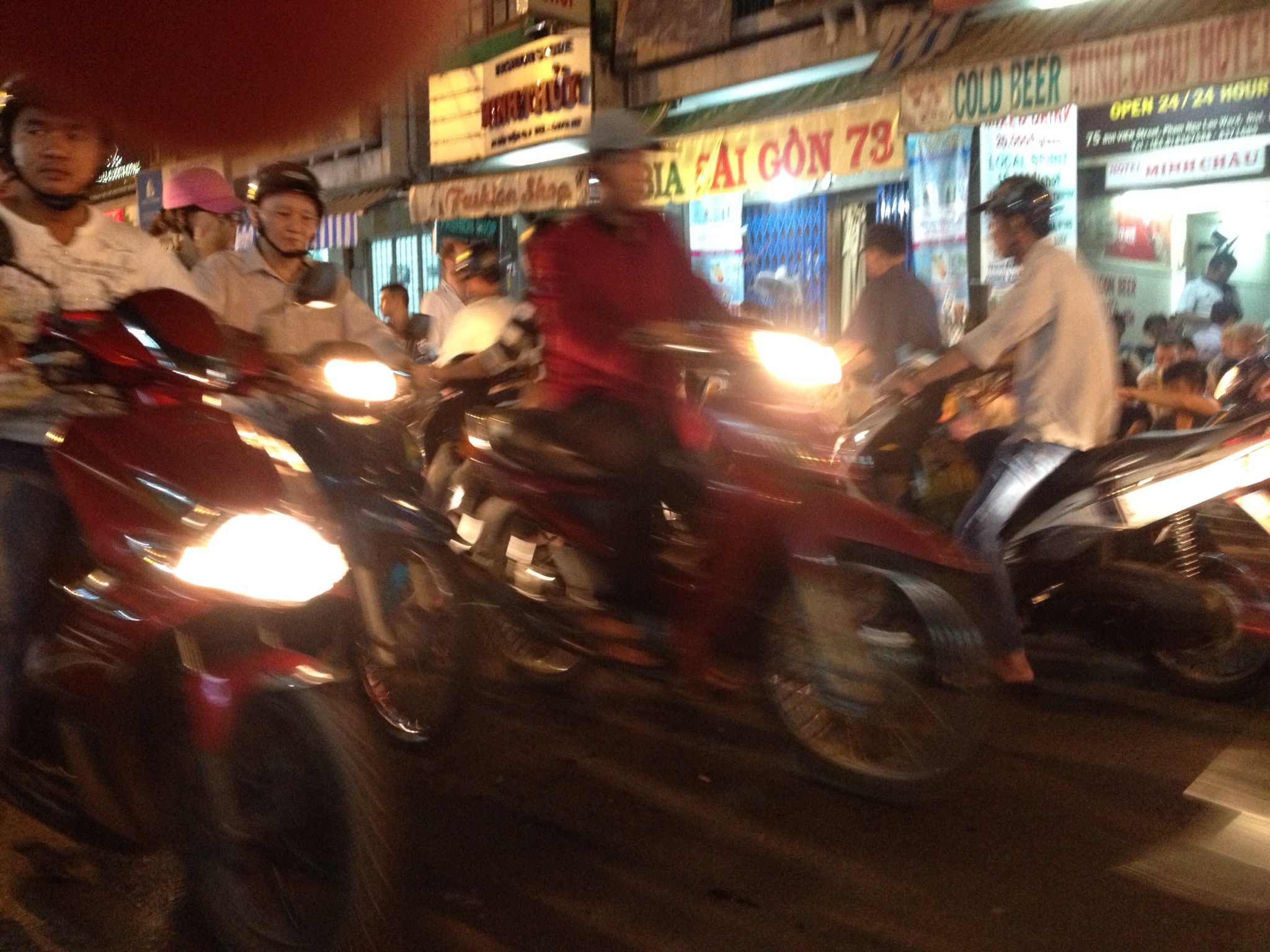
Motorbikes in close proximity.

Motorbikes in close proximity.

My first 24 hours in Vietnam would prove to be a ‘rinse and repeat’ in the culture shock process, but to explain it properly, I have to take it back to the beginning…

***

After landing in Ho Chi Minh City airport and dealing with the various visa and customs issues, I exited the airport into a heat that closely rivalled Thailand, and made my way to the bus terminal. My stay in Vietnam was to mark another of my many ‘firsts’ on this adventure – my first experience of being a Couchsurfer. For those not in the know, Couchsurfing is an online community that connects travellers from all over the world with people in cities all over the world that are able to host them, and provide a place for the travellers to stay while they’re in their city. The philosophy behind it is cheap accommodation when seeing the world, and at the same time creating global connections and friendships. Vietnam was to be the first country I was staying in where I didn’t have any contacts at all, let alone friends to stay with, so I figured it might be a good opportunity to take part in the Couchsurfing phenomenon that is taking on the travelling world. While I was in Bangkok I’d put a message into a subgroup created specifically for queer Couchsurfers – because sometimes it’s just nice to be around fellow friends of Dorothy – and after a few days I had a reply from a 22-year-old Vietnamese guy living in Ho Chi Minh City. We discussed the issue some, and he offered me a place on his couch.

However, he wasn’t able to meet me at the airport, and so gave me instructions on which bus to catch, and a time and place for us to meet. This involved me catching a public bus – something I was yet to do in South East Asia. As the bus rattled out of the airport and towards the city, I noticed a group of three girls sitting across the aisle of the bus from me, looking at me and whispering among themselves. Well… I assume they were talking, but I couldn’t see their mouths since they were covered by face masks. They’re the kind that doctors and medical professionals wear during operations, or that people in the street wear when they’re afraid of bird or swine flu – and suddenly I thought I may have missed some vital health information. I was later told there wasn’t too much to worry about, and that a lot of girls were just shy and wore them to hide their faces… Okay then.

I didn’t think much of it, until one of the girls reached out and passed me her phone. It was an iPhone opened to compose a new message, and in the typing section she had written ‘Where you from?, I smiled, passed the phone back and said I was from Australia. After a few moments she passed it back ‘What you do?’. I smiled again, amused by the exchange, and replied “I’m travelling.” The girl looked at me, perplexed, then back at her friends. Then back to me. Then back to her friends. Maybe I had overestimated their English? I took the phone from her and wrote ‘travelling’. She took the phone back, and I noticed the girls regrouping around another phone, perhaps for translation purposes. This exchange continued for the remainder of the trip, where they asked me where I was going, if I was alone, what I studied back home, and finally: ‘do you play facebook?’. I said I did, and gave them my Facebook name. ‘See you in facebook!’ was the last message I read. I hopped off the bus at the final stop, equal parts amused and confused.

Motorbikes take up every spare inch of the road.

Motorbikes take up every spare inch of the road.

***

The place where I was meeting my host was close by and I found it easily enough, and soon we were getting to know each other and chatting away. My host had previously spent time studying in Sydney – at the same university that I attended, as it would happen – and so we had a surprisingly large amount of common ground to cover. Then it came time to travel to my hosts house – knowing I had a large bag, he hadn’t brought his motorbike, so we caught another bus. Where I had stayed while I was in Bangkok was rather close to the major parts of the city, but after 45 minutes on this bus, watching the city scenery pass and eventually dwindle into the suburbs, I realised that my location in Ho Chi Minh City wouldn’t be quite so central. As we descended into the outer suburbs, out of the tourists areas and into the domain of the locals, it became clear I was going to get a very authentic Vietnamese experience.

I didn’t really have any definite expectations, but it was certainly a bit of a shock when we alighted from the bus. The city was well and truly gone, and all around us were either stretching roads full of buses and bikes, or narrow roads that forked off in twisting alleys and concrete walkways. We travelled through the dingy labyrinth until we got to my hosts house, where I made a few other unexpected discoveries: my host still lived with his parents, so I was staying with a family, and the ‘couch’ was actually a mattress, which I would be sharing with my host, in a room he told me he shared with his brother. The bedroom didn’t have a door, something that my host told me his parents did not allow. As we got chatting about it more, I learnt a whole heap of other things about Asian culture that were considered quite strange by my standards, but were completely normal for him. Though he had been to Australia before and understood the common practices and standards of living there, so I think he understood some of my confusion. They were quite middle-class living conditions for Vietnam, but that’s still very different from middle-class Sydney.

After I’d settled in, my host took me around the city on his motorbike, pointing out various attractions in the city centre, showing me his university where he studied, and took me to some truly local places to eat – the menus were entirely in Vietnamese, and had I come alone, I would not have had the faintest idea what anything on the menu was (besides ‘soda’, ‘Coke’ and ‘Sprite’). It was a great way to see the city from a locals point of view, and I am truly thankful for the experience and for the generosity of my host. However, the living arrangements weren’t exactly ideal. Sharing a bed is tough for me at the best of times, and the distance to and from the city meant it wouldn’t exactly be easy for me to get around without relying on someone else and their motorbike (I was not going to accept the offer to ride it by myself). So in the morning I headed off into the city, with a hand drawn map by my host, and found a hostel in the backpacker district to stay at for the remainder of my time in Saigon.

Motorbikes maintain the majority in the minor metropolis of Saigon.

Motorbikes maintain the majority in the minor metropolis of Saigon.

***

The rest of my afternoon was to be taken up by a highly recommended and fairly popular tourist attraction – the War Remnants Museum. My knowledge of the Vietnam War basically comprised of pop culture references and the part of the Australian History syllabus that addressed the topic and Australia’s involvement in it. I knew about the stigma attached to the soldiers and the war crimes they were accused of committing, but as a 15-year-old reading a slide from an overhead projector, the true meanings behind all of this never really sunk in.

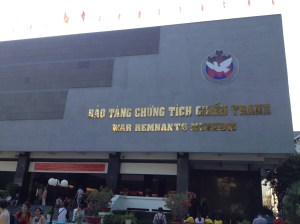
The War Remnants Museum

The War Remnants Museum

So I wasn’t expecting my trip to the museum to be so mentally and emotionally exhausting. The exhibit that particularly broke my heart was the galley titled ‘Victims of Agent Orange’. Agent Orange was a powerful dioxin that was used by the USA in biochemical warfare during the Vietnam War. It poisoned millions of Vietnamese people, but some of the most devastating impacts come from second-hand contamination – babies born with all sorts of horrific birth defects as a result of their parents being infected by Agent Orange. Seeing these images and reading their stories was such an intense experience – it took everything I had to blink back tears and not have a moment in the middle of the museum. The fact that many of these people do their best to live ordinary lives despite their crippling deformities just makes their stories even more amazing and inspiring. I thought about taking some photos of these powerful images, but I decided my poor photography would not do them justice to the incredible way that they affected me. But I urge anyone who visits Ho Chi Minh City to take the time to see this museum – it gave me a thorough schooling on what it’s like to feel compassion and empathy, and to be thankful for what you have. After viewing more galleries about war crimes, historical truths, and a photographic history of the Vietnam War, I left the museum feeling a little overwhelmed. I’ve long considered myself a pacifist, and seeing such shocking displays of the horrors of what seemed to be such a pointless war firmly re-cemented my position.

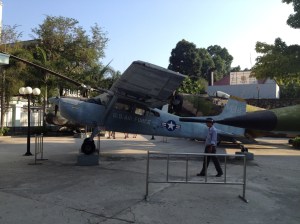
USA war plane outside the museum.

USA war plane outside the museum.

***

My first 24 hours really forced me to reevaluate some of the priorities in my life, both past and present – my future is just a big messy ball of ‘unknown’ that I’m not prepared to tackle right now. But I feel a little bad about the way I reacted to the Couchsurfing experience, simply because it hadn’t been what I had expected or of a standard I was used to. People make do with a lot less, and here I am complaining about not having my own room and/or bed. And to think that I ever felt that my life back in Australia was lacking or incomplete in any sort of way just seems completely laughable now. You really don’t realise that kind of thing until you step outside of your comfort zone and experience something that you would have otherwise never come into contact with. I know that no ones life is ever “perfect” or “complete”, and that you can always strive to do better, but this kind of experience really highlights how pointless and deconstructive complaining about it can be.

I don’t want to get all preachy or anything though, so I’ll just settle for saying that each and every day of this adventure is opening my eyes wider and wider to the incredible, immense, diverse and ever-changing world world around me.