Bird Flu and Beer – Chicken in China

While my days in China were spent doing typical tourist activities, at night Snow took us out to eat at some authentic Chinese restaurants. Most of the waiters at the places we went to had fairly limited English, so we had to rely on Snow to do all the ordering. We ended up getting a range of dishes and splitting between the group – it was amazing how much food you can order for a group of thirteen and still only end up paying approximately $7 each. Needless to say, nobody went hungry, and I feel I can safely say that some of the best Chinese food I’ve ever had, I had in China.

One thing that made me uneasy at first, however, was that Snow ordered a chicken dish. Alarm bells went off in my head immediately – all throughout my travels in South East Asia I had been following the news and tracking the progression of the new strain of bird flu. At the time I arrived in China, I knew there had been the most cases in the city of Shanghai, and even a few confirmed reports in Taiwan. Some people had suggested I not go to China – others, including my mother, had just strictly warned me to stay away from live poultry and to not eat any chicken. At this point in my trip, I can safely say that I am yet to handle any living poultry. As for eating chicken… well, to be honest, I completely forgot. The alarm bells didn’t go off until after we’d finished our meal, at which point I had eaten a substantial amount of chicken.

But so had everyone else in the group, and no one seemed to give the danger of bird flu the slightest thought, and if they had then they certainly hadn’t mentioned it. Snow hadn’t seemed too concerned, so I took that as a good sign – I figured the local people tend to know more about what’s going on in their areas then CNN, although with China you never really do know…

Tim, one of the Australian guys, had been travelling throughout China for the last three weeks on a different tour before joining our group. He was telling us a few stories about his travels and some of the places he had been, and at one point mentioned something about Shanghai. Alarm bells did instantly go off this time, and when he finished his stories, I leaned over to have a one on one conversation with him.

“Did you say you were in Shanghai?” I asked, trying to sound casual.
“Yeah, probably about a week or so ago.”
“For how long?” I continued to quiz him, with the nonchalant façade probably failing miserably.
“Just three nights,” Tim replied, quite matter-of-factly. I thought maybe the direction I was going might have been apparent, but he didn’t appear to have any idea where I was taking the interrogation. I leaned over further and spoke a little quieter, suddenly feeling a little silly about my paranoia.
“What about bird flu?” I asked in a low, hushed voice.
“Bird flu?” Tim repeated. “What about it?”
“Wasn’t it a problem? Like, weren’t you kinda scared going through Shanghai?”
He looked genuinely surprised, or at the very least confused. “Umm… No, not really. I mean, it might be around, but… no, I wasn’t worried. It’s mostly fine, really.” His tone carried the nonchalance I’d tried to attain in my original question, and I very much believed what he was saying.

So between Tim having survived a visit to Shanghai and our entire group eating chicken seemingly without a second thougth, I decided that perhaps bird flu wasn’t as much of a serious concern in Beijing as my loved ones would have me believe. I know most of them will be reading this either sighing, face palming, or rolling their eyes, but in my opinion it just really shows how a little bit of media hysteria can go a long way, and terrify the on-lookers more than the people actually living the experience.

***

The other part of Chinese night life I experienced was the Hou Hai Bar Street, where a bunch of different small bars lined a riverside street. I visited the street after dinner on our last night in Beijing with Tim and Alyson, the other American in our group. As we strolled down the street trying to decide on a place to have a drink, Tim made a comment on how unlike the rest of China this street was, or more precisely, how much American influence there was. Almost every bar had live music and karaoke, with many of them butchering Western music with their limited English vocabularies. Most bars had people outside trying to beckon you into their venue, but we kept walking until we found a place that lacked the hecklers. We ended up taking a seat at a Jamaican bar, sitting outside so that we could hear each other talking over the live music inside, and sampled some of the local draught beer. It was nice to get to know some more members of our travel group, though we didn’t end up staying out too late, as we had to get up early to get the train to Mongolia the next morning. But it was nice to catch a glimpse into the Chinese nightlife.
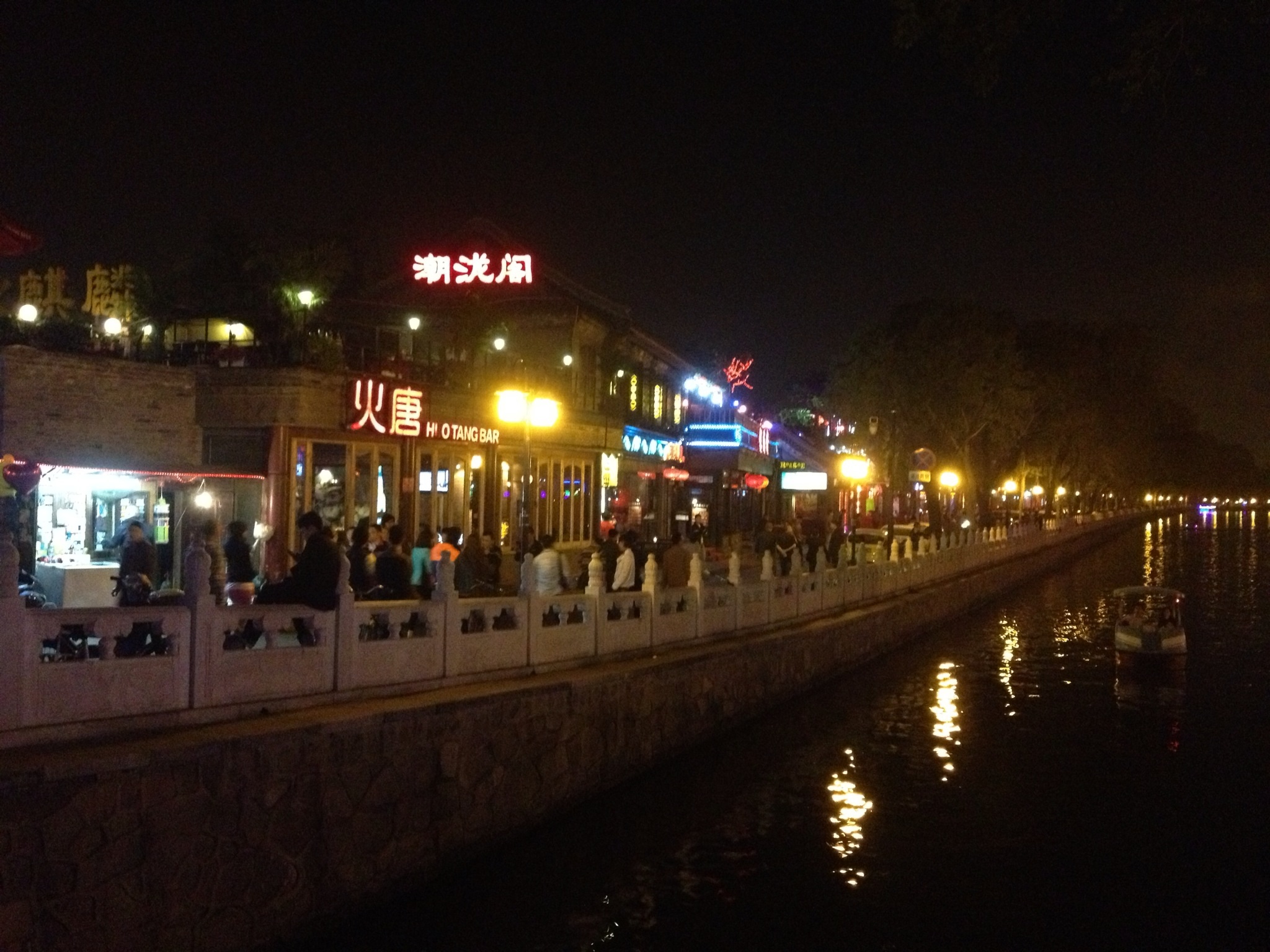
Beijing's riverside bar street.

Beijing’s riverside bar street.
Getting to Know You: Miss Saigon

My first impression of Ho Chi Minh City was that it seemed like a baby version of Bangkok. It has the backpacker district with the flashing lights and street hawkers, it has the numerous food carts selling a variety of local cuisines, and it has a lot of busy traffic. However, it’s almost as if the vehicles are in baby form, with the motorcycles being to cars what tadpoles are to frogs, and the motorcycles are everywhere. I know I’ve said it before, but literally everywhere – they put the gangs of Central Coast NSW to shame. So the city may feel a little smaller than Bangkok, but in no way does that make it feel any less busy, at least in District 1 in the central part of the city.

So. Many. Motorbikes.

So. Many. Motorbikes.

Vietnamese flag out the front of the Ho Chi Minh City Museum.

Vietnamese flag out the front of the Ho Chi Minh City Museum.

There is also a confusing aspect in that this city has two names – something that puzzled me to no end in the early stages of planning my side-step detour to Vietnam. Pretty much all the native locals call it Saigon, even a lot of the travel agencies do too. Ho Chi Minh City, taken from the name of the Vietnamese leader during the wartime period, is the name used by the government and officials and anyone else of relative importance. As a traveller, I don’t really have a preference, and will use both interchangeably throughout this blog, just to keep y’all on your toes.

***

My first few full days in Saigon were spent doing some sight seeing. I decided to tackle the city on foot – after letting my guard down and being scammed into paying an exorbitant amount of money for a brief ride in a cyclo, which is basically a bike with an oversized basket for passengers, I became a little mistrusting of all the locals who approached me, offering rides on their various street vehicles. I also found myself slightly terrified of the traffic, although I quickly learnt that in Saigon, being a pedestrian is just as hazardous as being behind the wheel of a car or on a motorbike. Which is not necessarily saying that it’s risky – you simply need to really keep your wits about you at all times… although, it is risky. I’ve had a number of extremely close encounters where my attention lapsed for just a moment, and I came this close to being far too acquainted with the front end of a motorbike. Look both ways, amnd look all four ways at intersections. Sometimes it’s easier to just slowly wander out onto the road and let the bikes move around you. This is particularly terrifying though and by no means safe – sometimes I just got impatient waiting for a legitimate gap in traffic.

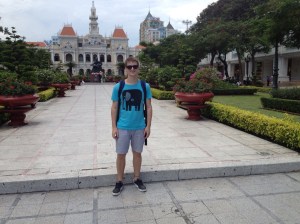
Outside the Ho Chi Minh City People's Council People's Committee Building .

Outside the Ho Chi Minh City People’s Council People’s Committee Building .

French-designed Cathedral in the city centre.

French-designed Cathedral in the city centre.

Reunification Palace.

Reunification Palace.

Another thing Ho Chi Minh City seems to have a lot of is museums. As well as the War Remnants Museum, I visited the Fine Arts Museum and the Museum of Ho Chi Minh City. I took some refuge from the bustling city outside to observe some of the paintings and sculptures in the Fine Arts Museum, almost all of which are created by Vietnamese artists. I’m no art critic, and I don’t know the first thing about techniques or designs or any of the fine details when it comes to the fine arts, but the museum did have a huge variety of works on display, much of which represented lots of aspects of Vietnamese culture. As I wandered through the halls, I noticed that many of the paintings depicted soldiers and other wartime themes. Despite being beautiful works, that saddened me a little bit, and I was beginning to understand just how much the war has affected the mindset of so many local people here, and had branded their cultural history with a very distinct and conspicuous mark. It was a mark of remembrance and mourning, but also hope for the future.

Then I came across a piece called ‘Agent Orange’, where the oil painting had been textured so that it recreated the horrific deformities of the victims of the harsh poison, to a point where the art was almost three dimensional, and the suffering reached out from within canvas to force you to feel the emotions it depicted. I both loved and hated the painting, because it was so confronting, and because it filled me with the similar feelings I felt at the War Remnants Museum. I took a few photos, which I think I probably was not supposed to do, so I won’t upload them. I also feel like these works are best experienced in their true medium, and not from within a computer screen.

The other museum was also interesting, learning about the history of the the city. I don’t really care to regurgitate everything I read though, so make sure you check it out if you’re ever in Saigon. The building did, however, have a nice view.

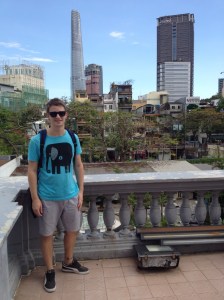
View of city from the Ho Chi Minh City Museum.

View of city from the Ho Chi Minh City Museum.

***

My first evening in the hostel was when I began to experience the tourist nightlife. As people began slowly arriving home from their days activities and trawling into the dorm room, one of the guys made an open invitation to anyone who was interested in joining him and a few other guys in getting some dinner. Having no plans and nothing to lose, I tagged along and found myself with four guys, respectively originating from Germany, Wales, America and New Zealand, and a Hungarian girl. Our small international party set out looking for cheap street food. I’d always been a bit of a fan on Vietnamese food back home, so it was kind of a novel thrill to sit on a tiny plastic chair on the side of the road, like all the local people did in District 1, and eat my pho noodle soup. After that we were joined by two Argentinians and headed to a bar to drink some beer. I say “bar”, but in reality it was a little hole-in-the-wall joint with tiny plastic chairs (and slightly bigger plastic chairs that were used as tables) littering the footpath out front, sprawling out onto the road when it got busy enough. Later in the week, when I explained this scene to a New Zealander expat now residing in Ho Chi Minh City, he merely chuckled and said, “Yep, we call that a bar here.”

However, what the place lacked in bells and whistles, it made up with value for money. Draught beer was 7000 Vietnamese dong per glass. That converts into approximately 35 Australian cents. It seemed criminal to drink anything else when you could drink for so ridiculously cheap, and not for the first time on this trip I found myself succumbing to peer pressure and going in for a round of beers, only to be surprised that I actually quite enjoyed the taste of it. I didn’t love it, but for a few quiet drinks on a Tuesday night it doesn’t get much better than three beers for a buck.

The weekend was a different story though – I met a bunch of Australians who had been in Vietnam for the last month or so for work, and they took me out to some of the nearby nightclubs. The bars were a little more sophisticated then plastic stools on the pavement, and the drinks were more than 35c, but they were still exponentially cheaper than back home and the cocktails were lethal. Two Long Island Ice Teas later and I have to confess that I couldn’t tell you much about the difference between the clubs in Saigon and the clubs back home. Except that in one of them I ran into a Tasmanian couple casually smoking a hukka, and I’m pretty sure the flavour was “blue”. And security guards loved to pose for photos, something I have never seen in Australia.

In an e-mail to my father about my trip down to Krabi, I had mentioned how good it had been to get out of the city for a while and see the rest of the country. His response triggered something in me that I’d never really considered before: “Yes, cities tend to all feel the same after a while. It’s best to get out and see the real country”. While I could see comparable differences in each city I had visited, I promised myself that I would make my best effort to see a little more than just the major cities in each country went to, wherever I could.

Because at the end of the night, whether its beer or spirits, Sydney or Saigon, hangovers are generally all the same too.