Leave It To The Locals

After traveling for over a month, I was beginning to feel pretty confident with my abilities in navigating new cities with a simple map and the unearthed Boy Scout skills from my childhood. The day before I had been driven from place to place in a motorbike tuk tuk, feeling relatively posh with my own little carriage to be chauffeured around in. During the evening of my second night in Phnom Penh, I had a brief encounter with another guy staying in my dorm, who had told me that he and a few other people had rented their own motorbikes and driven themselves around the city. Back in Ho Chi Minh City when my Couchsurfing host had offered me the controls of the vehicle, I had, rather sensibly, declined the offer. However, I’d seen quite a few people at my hostel in Saigon rent and even buy motorbikes, using it as a cheaper form of travel as well as a way to see more of the countryside. I had told them they were crazy, but one of the Americans had assured me that the traffic out there was nowhere near as crazy as in the city itself.

It never really crossed my mind again until it was mentioned to me in Phnom Penh. I’d seen the roads and the traffic, and it didn’t seem quite as busy as the hustle and bustle of Bangkok or Saigon. I told myself that I should be making the most of the unique experiences on offer here, and so far I’d been all about pushing my boundaries and challenging myself. With that in mind, I set off down the road to rent myself a motorbike, oblivious to the fact that my stay in Phnom Penh was about to get even more harrowing than a trip to the Killing Fields.

***

In retrospect, it was a terrible decision. As my mother reminded me when I emailed her after the fact, “You can barely ride a push bike, Bob!” Yet I was taken over by some kind of invincibility complex that most young adult males get after a six pack of beers (though it should be noted that I made this brilliant decision completely sober). The fact I’d never really ridden a motorbike didn’t occur to me as a potential problem – how hard could it be? It was only when they showed me the bike and demonstrated how to change the gears did the sheer unfamiliarity of this vehicle truly hit home. My blank, uncomprehending expression must have given me away, because one of the men suddenly shouted, “Ahh! Automatic! You need automatic?”. Honestly, I’d had no idea there were automatic and manual motorbikes until that very moment, but I figured I was going to have a hell of an easier time on an automatic one, so I agreed enthusiastically and waited for him to bring around another bike. After a brief overview of the controls, they handed me a helmet and the keys, and away I went.

I puttered along through the small streets, using the same cautious method that I employed for crossing the roads as a pedestrian, before turning onto a main road and zooming along with the rest of the traffic. It was a similar thrill to riding on the back of a motorcycle taxi, except this time there was a certain element of fear, given that I was the one who was actually driving. But I was doing pretty well so far. I was heading towards Phnom Wat, a large temple located in the north of the city, surrounded by lots of traffic. I managed to park the bike next to Phnom Wat, which was situated in the middle of a huge roundabout. I wandered over to the temple and had a brief look inside. It is still a very active place of worship, so I didn’t stay too long so as not to disturb the prayers inside. Besides, I was keen to get back on the motorbike and do some more exploring.

The temple of Phnom Wat, my first and only stop of the day.

The temple of Phnom Wat, my first and only stop of the day.

***

And shortly after that is when it all went wrong. My destination was to be the Russian Markets, which are supposed to be a unique and interesting corner of the city. I’d checked my map and memorised a rough route through the main roads, but I’d only been driving for a few minutes before I came up to the next roundabout. I needed to turn left, but as I followed the roads, I realised I was veering right, and there didn’t appear to be any way to change my course. Was I not as far as I thought I was? Was I taking a wrong turn? Could I still turn left from where the road was taking me? All these perplexing questions bombarded me at once, and the fact that they drive on the right side of the road rather than the left didn’t help my heightening confusion – although the very limited road rules at all hadn’t laid the best foundation for building confidence. In the end, I hesitated for just a moment, but that was all it took. I came tumbling off the motorbike and skidding across the road.

It all seemed so slow and surreal at first. I thought for sure that I was dead. I’d heard the horror stories, the idiot tourists who thought they knew what they were doing when they set out onto the roads and ended up becoming another statistic. I could hear my mothers “I told you so” screeching through the back of my mind. But as soon as I was down, I was jumping up again and scrambling off the road. The way I’d fell meant I’d skidded out of the roundabout towards the edge of the road, rather than deeper into the oncoming traffic. Anyone behind me just swerved around me and continued on their way, as though nothing had happened, or as though that kind of thing happened every day – though for all I knew, such accidents were a common occurrence.

A few of the motorbike taxi drivers on the edge of the road rushed over to my aid, pulling the bike up and helping me wheel it to the edge of the road. I checked my arms and legs to find myself, remarkably, almost unscathed. The only exception was a shallow, bloody graze on my right knee, though I was so full of adrenaline at the time that I barely noticed. I cleaned myself up as best I could, and the local men checked to make sure the bike wasn’t damaged. Thankfully, other than a few mild scratches on the paint, which could have very well been there before I took my little tumble, it was fine. I thanked the men for their help, though they didn’t understand English, so they simply watched me curiously, probably trying to figure out the exact same thing as me – what the hell was I going to do now?

There was nothing else I could do. In my shaken and unsettled state, I mounted the bike and took a few deep breaths. I assessed the roads and where I was going, and then revved the engine and took off again into the traffic. With my confidence shattered from the fall, it was one of the most terrifying decisions of my life, but I didn’t really have any other option. I could have called the rental company, but I didn’t want to risk having to pay for any damages if I confessed to crashing the bike. I couldn’t ask anyone for a lift, since I was the one who had the vehicle. Though it screamed of the illogical and was beyond all common sense, I managed to get back on my bike and continue driving around the city.

***

It was horrific. With the exception of the crash itself, I had never felt so scared as I did navigating the streets of Phnom Penh by motorbike. For some ridiculous reason that I still can’t explain, I decided to travel further from where I was staying, perhaps in the hopes I would regain confidence and learn from my mistake. I didn’t. Every turn, corner or crossing filled me with terror. I had several extremely close calls with both other motorbikes and cars. In the haze of my terror I think I actually even made it to the Russian Markets but by that point, shopping for whatever trinkets they sold there was the last thing in my mind. It was on the return trip that I became not only frightened, but lost. I remember stopping at a petrol station, staring out into the peak hour afternoon traffic, and wondering how the hell I was going to make it back to my hostel alive.
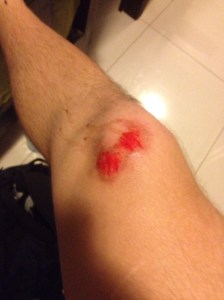
Thankfully, the gash on me knee was the only real injury I sustained during the ordeal.

Thankfully, the gash on me knee was the only real injury I sustained during the ordeal.

After a lot of slow puttering down busy streets and long waits at corners to make sure there was absolutely no chance of being caught by other traffic, I finally made it back to the hostel. I’d been following the setting sun to make sure I was going in the right direction, and using what little I did remember of the streets from my drive through the city yesterday. It had been another long and exhausting day, and as soon as I parked the bike I showered, tended to my wound, and put my leg up by the pool whilst nursing several scotch and Cokes to calm my nerves. Needless to say, I had learnt my lesson. The traffic might not seem dangerous when experienced locals weave their way in and out of cracks and crevices of the gridlock, but it’s still a death trap for anyone who doesn’t know what they’re doing.

I promised my mother I would stay away from motorbikes altogether, but that’s literally impossible in most parts of Cambodia, so from now on I’ll just leave the driving to the locals.

Getting to Know You: Miss Saigon

My first impression of Ho Chi Minh City was that it seemed like a baby version of Bangkok. It has the backpacker district with the flashing lights and street hawkers, it has the numerous food carts selling a variety of local cuisines, and it has a lot of busy traffic. However, it’s almost as if the vehicles are in baby form, with the motorcycles being to cars what tadpoles are to frogs, and the motorcycles are everywhere. I know I’ve said it before, but literally everywhere – they put the gangs of Central Coast NSW to shame. So the city may feel a little smaller than Bangkok, but in no way does that make it feel any less busy, at least in District 1 in the central part of the city.

So. Many. Motorbikes.

So. Many. Motorbikes.

Vietnamese flag out the front of the Ho Chi Minh City Museum.

Vietnamese flag out the front of the Ho Chi Minh City Museum.

There is also a confusing aspect in that this city has two names – something that puzzled me to no end in the early stages of planning my side-step detour to Vietnam. Pretty much all the native locals call it Saigon, even a lot of the travel agencies do too. Ho Chi Minh City, taken from the name of the Vietnamese leader during the wartime period, is the name used by the government and officials and anyone else of relative importance. As a traveller, I don’t really have a preference, and will use both interchangeably throughout this blog, just to keep y’all on your toes.

***

My first few full days in Saigon were spent doing some sight seeing. I decided to tackle the city on foot – after letting my guard down and being scammed into paying an exorbitant amount of money for a brief ride in a cyclo, which is basically a bike with an oversized basket for passengers, I became a little mistrusting of all the locals who approached me, offering rides on their various street vehicles. I also found myself slightly terrified of the traffic, although I quickly learnt that in Saigon, being a pedestrian is just as hazardous as being behind the wheel of a car or on a motorbike. Which is not necessarily saying that it’s risky – you simply need to really keep your wits about you at all times… although, it is risky. I’ve had a number of extremely close encounters where my attention lapsed for just a moment, and I came this close to being far too acquainted with the front end of a motorbike. Look both ways, amnd look all four ways at intersections. Sometimes it’s easier to just slowly wander out onto the road and let the bikes move around you. This is particularly terrifying though and by no means safe – sometimes I just got impatient waiting for a legitimate gap in traffic.

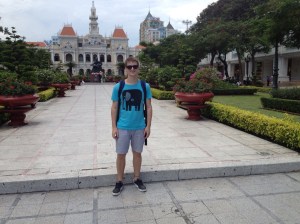
Outside the Ho Chi Minh City People's Council People's Committee Building .

Outside the Ho Chi Minh City People’s Council People’s Committee Building .

French-designed Cathedral in the city centre.

French-designed Cathedral in the city centre.

Reunification Palace.

Reunification Palace.

Another thing Ho Chi Minh City seems to have a lot of is museums. As well as the War Remnants Museum, I visited the Fine Arts Museum and the Museum of Ho Chi Minh City. I took some refuge from the bustling city outside to observe some of the paintings and sculptures in the Fine Arts Museum, almost all of which are created by Vietnamese artists. I’m no art critic, and I don’t know the first thing about techniques or designs or any of the fine details when it comes to the fine arts, but the museum did have a huge variety of works on display, much of which represented lots of aspects of Vietnamese culture. As I wandered through the halls, I noticed that many of the paintings depicted soldiers and other wartime themes. Despite being beautiful works, that saddened me a little bit, and I was beginning to understand just how much the war has affected the mindset of so many local people here, and had branded their cultural history with a very distinct and conspicuous mark. It was a mark of remembrance and mourning, but also hope for the future.

Then I came across a piece called ‘Agent Orange’, where the oil painting had been textured so that it recreated the horrific deformities of the victims of the harsh poison, to a point where the art was almost three dimensional, and the suffering reached out from within canvas to force you to feel the emotions it depicted. I both loved and hated the painting, because it was so confronting, and because it filled me with the similar feelings I felt at the War Remnants Museum. I took a few photos, which I think I probably was not supposed to do, so I won’t upload them. I also feel like these works are best experienced in their true medium, and not from within a computer screen.

The other museum was also interesting, learning about the history of the the city. I don’t really care to regurgitate everything I read though, so make sure you check it out if you’re ever in Saigon. The building did, however, have a nice view.

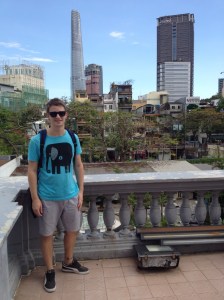
View of city from the Ho Chi Minh City Museum.

View of city from the Ho Chi Minh City Museum.

***

My first evening in the hostel was when I began to experience the tourist nightlife. As people began slowly arriving home from their days activities and trawling into the dorm room, one of the guys made an open invitation to anyone who was interested in joining him and a few other guys in getting some dinner. Having no plans and nothing to lose, I tagged along and found myself with four guys, respectively originating from Germany, Wales, America and New Zealand, and a Hungarian girl. Our small international party set out looking for cheap street food. I’d always been a bit of a fan on Vietnamese food back home, so it was kind of a novel thrill to sit on a tiny plastic chair on the side of the road, like all the local people did in District 1, and eat my pho noodle soup. After that we were joined by two Argentinians and headed to a bar to drink some beer. I say “bar”, but in reality it was a little hole-in-the-wall joint with tiny plastic chairs (and slightly bigger plastic chairs that were used as tables) littering the footpath out front, sprawling out onto the road when it got busy enough. Later in the week, when I explained this scene to a New Zealander expat now residing in Ho Chi Minh City, he merely chuckled and said, “Yep, we call that a bar here.”

However, what the place lacked in bells and whistles, it made up with value for money. Draught beer was 7000 Vietnamese dong per glass. That converts into approximately 35 Australian cents. It seemed criminal to drink anything else when you could drink for so ridiculously cheap, and not for the first time on this trip I found myself succumbing to peer pressure and going in for a round of beers, only to be surprised that I actually quite enjoyed the taste of it. I didn’t love it, but for a few quiet drinks on a Tuesday night it doesn’t get much better than three beers for a buck.

The weekend was a different story though – I met a bunch of Australians who had been in Vietnam for the last month or so for work, and they took me out to some of the nearby nightclubs. The bars were a little more sophisticated then plastic stools on the pavement, and the drinks were more than 35c, but they were still exponentially cheaper than back home and the cocktails were lethal. Two Long Island Ice Teas later and I have to confess that I couldn’t tell you much about the difference between the clubs in Saigon and the clubs back home. Except that in one of them I ran into a Tasmanian couple casually smoking a hukka, and I’m pretty sure the flavour was “blue”. And security guards loved to pose for photos, something I have never seen in Australia.

In an e-mail to my father about my trip down to Krabi, I had mentioned how good it had been to get out of the city for a while and see the rest of the country. His response triggered something in me that I’d never really considered before: “Yes, cities tend to all feel the same after a while. It’s best to get out and see the real country”. While I could see comparable differences in each city I had visited, I promised myself that I would make my best effort to see a little more than just the major cities in each country went to, wherever I could.

Because at the end of the night, whether its beer or spirits, Sydney or Saigon, hangovers are generally all the same too.

The Travel Bug

One of the big tourist destinations that you just have to see (or so I’d been told) when you are in Bangkok is the Grand Palace and the Royal Monastery of the Emerald Buddha. Even if temples aren’t really your thing, this one is so spectacular that its supposedly the one everyone has to see. But having studied mediation under the guidance of a Buddhist nun during my last few years of high school, I would definitely say I have an interest, or at least curiosity, in Eastern spirituality, and a certain sense of awe for their places of worship. So after seeing having seen some of the party destinations that are frequented by tourists, I decided I would begin this week by exploring some of the more traditional cultural attractions that Bangkok has to offer.

The Grand Palace is located towards the west of central Bangkok, on the eastern side of the Chao Phraya River. Since the palace is the official residence of the Thai royal family, the inside is not open to the public, but the monastery compound that houses various shrines, temples and monuments is usually considered the main attraction anyway. The temple that houses Emerald Buddha, while being a popular sight-seeing spot among tourists, is also still a frequently used place of worship for both the Thai royal family and local commoners. Therefore, respectful and modest clothing is required before tourists are allowed to enter the compound within which the temple is located. This means no exposed shoulders or knees, no singlets or shorts, so I made sure I packed my jeans into my backpack to change into once I got there. The midday sun was scorching and the heat and humidity had basically drenched my whole upper torso before I’d even made it inside the gates, so actually wearing long pants the whole day was definitely not a valid option.

Once inside, it was easy to see why this place was considered a “must see” destination – the intricacy of the beautiful and delicate designs is absolutely breath-taking.

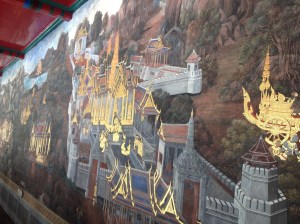
The beautiful hand painted murals that line the outer perimeter of the temple compound.

The beautiful hand painted murals that line the outer perimeter of the temple compound.

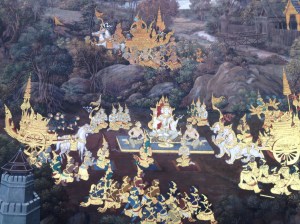
The murals depict the story from an epic poem in Thai mythology.

The murals depict the story from an epic poem in Thai mythology.

The cloisters that run along the inside perimeter of the compound are decorated with exquisite hand painted murals that depict the storyline in a famous epic poem from Thai mythology. Princes and princesses, armies of soldiers, monkeys, demons, giants, gods, temples, palaces – the detail is incredible and the work is flawless. Much of the subjects within the murals are laced with gold, and the walls glow and shine, beautiful and incredible works of art. Within the rest of the compound there are dozens of other structures the are wondrous to behold, with glass, jewels, gold leaf, mother of pearl, and a score of other materials decorating them in a way that lets them command the reverence they deserve, as such sacred and holy monuments. Some of my favourites were the golden statues of the mythical creatures that were half animal and half celestial beings, crafted with the finest, most precise detail, glowing magnificently in the sunlight.

One of the golden statues of a creature from Thai mythology.

One of the golden statues of a creature from Thai mythology.

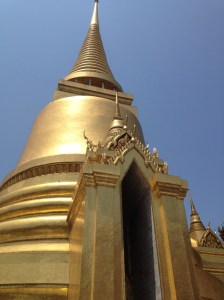
Phra Sri Ratana Chedi - one of the shrines covered in gold mosaic

Phra Sri Ratana Chedi – one of the shrines covered in gold mosaic

Myself standing in front of Prasat Phra Thep Bidon, the Royal Pantheon

Myself standing in front of Prasat Phra Thep Bidon, the Royal Pantheon

The highlight of the compound, however, is the Royal Chapel of the Emerald Buddha. Built on consecrated ground, all who enter the area are required to remove their shoes. I slipped off my sneakers, ascended the stairs onto the outer platform, and entered into the temple. The walls were vast and tall, decorated with beautiful murals similar to ones on the outer walls, depicting scenes from the life of Buddha, as well as other concepts of Thai mythology. Though it is the shrine in the centre of the room that truly captures your attention. Mounted high atop the shrine, on a golden throne made of gilded-carved wood, is the tiny Emerald Buddha, actually crafted from green jade. He is sitting in a stance of peaceful and relaxed mediation. The statue is hard to make out at first, such a small idol atop such an extravagant display, but the sight of the entire shrine is impressive, golden and glittering amongst the glow of they prayer candles, and for me it did feel like quite a spiritual experience. Perhaps it was because you cannot take photos inside the main temple, so being there really feels as though you are witnessing something truly special. I made my way past the standing tourists the where the prayer-goers were situated, and kneeled among them while I gazed up in awe at the shimmering golden shrine. It had been quite a while since I’d practiced mediation on a regular basis, so I sat there amongst the prayer and worship, absorbing the sacred presence within the temple and taking a moment to reflect on my own personal spirituality.

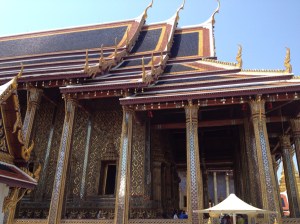
View from outside the temple of the Emerald Buddha.

View from outside the temple of the Emerald Buddha.

Myself  in front of the Grand Palace.

Myself in front of the Grand Palace.

The guards are apparently favourites for taking photos outside the palace.

The guards are apparently favourites for taking photos outside the palace.

Some marching guards that passed me on my way out of the palace grounds.

Some marching guards that passed me on my way out of the palace grounds.

After spending some time within the temple, I emerged to continue the rest of my tour around the grounds of the Grand Palace. However, after wandering around in the sun for a couple of hours, I’d become quite exhausted, and so decided to make my way home. After wandering the streets looking for a taxi, and now avoiding basically every tuk tuk I encountered, I finally found a taxi rank for motorbikes. They asked me where I was going and named a price – it wasn’t too dissimilar from what I’d paid in the taxi in the way over that morning, so I accepted. Motorbikes also had the advantage of being able to weave in and out of places that cars and tuk tuks are unable to, making them a convenient choice for peak hour traffic. Knowing that my mother would possibly have a field day when she heard eventually heard about this, I climbed onto the back of the motorbike and we took off into the street.

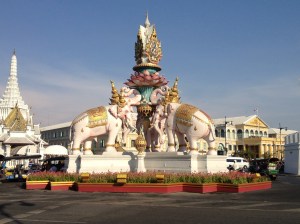
Monument that serves as a roundabout near the palace - taken before I was on the motorbike!

Monument that serves as a roundabout near the palace – taken before I was on the motorbike!

It was such an exhilarating rush. Sitting with my arms pressed heavily into the sides of my driver, we weaved in and out of traffic, between lanes, cutting in front of cars and tuk tuks, zooming through the streets among the pack of other motorcycles. The wind was flying through my hair, as the driver was the only one who had a helmet, and while I know that’s incredibly dangerous, I had a weird sense of absolute trust in this driver and his knowledge of the roads. I’d had some other locals say that driving in Bangkok isn’t scary or unsafe at all, and that only driving out in the more regional areas is something they hate or refuse to do, with city driving being considered relatively safe. I hadn’t believed them at first, but as I zoomed through the open air and soaked up the scenery as we weaved between vehicles, I think I finally understood what they meant. The city almost operates like a well-oiled machine – except in the traffic jams, where a little oil mightn’t go astray – or a living organism, where no matter how hectic or chaotic the environment may seem, everything is aware of and in sync with everything else. I’ve yet to see a single accident on the roads of Bangkok – plenty of what we would call “near misses” back home, but sometimes it feels as though the drivers of Bangkok know their roads so well that they can intentionally come so close with a much lower risk of accident. A tight-knit, well-oiled machine.

Towards the end of our trip, my driver even mounted the footpath and weaved between pedestrians to get me on the right side of the road and home as quickly as possible. When I paid the driver and slipped off the back of the motorbike, he smiled at me and placed a hand on my chest, and waited a moment before chuckling to himself. I must have had a rather puzzled look, because he proceeded to mimic the action on himself, then beat his chest a coupe of times with the palm of his hand. He repeated action on my chest, and then I realised what he was trying to communicate – my heartbeat. Placing my own hand on my chest, I felt it pulsing at a ridiculous speed that I hadn’t even noticed myself. Perhaps I was still a little high from the adrenaline of soaring down the tiny streets and open roads alike on the back of that motorbike, but it wasn’t until he drove off that I realised just how much of a thrill the simple trip home had been, and how much I had really enjoyed it.

It was a short walk home from where I’d alighted the motorbike, and I skipped off down the street with a new spring in my step. For perhaps the first time during this trip I finally felt like a traveler – not just a tourist, running around trying to see the cities greatest hits, but a real traveler just taking pleasure in the simple activities and cultural quirks that my new temporary home has to offer. I’d had a few difficulties getting used to being on the road and settling into my new, inconsistent lifestyle, but it was only a matter time before the travel bug finally kicked it, and I’m now more eager than ever to see not just the rest of this sprawling city, but to keep moving and behold the wonders that this country, this continent, and indeed this world, has to offer.